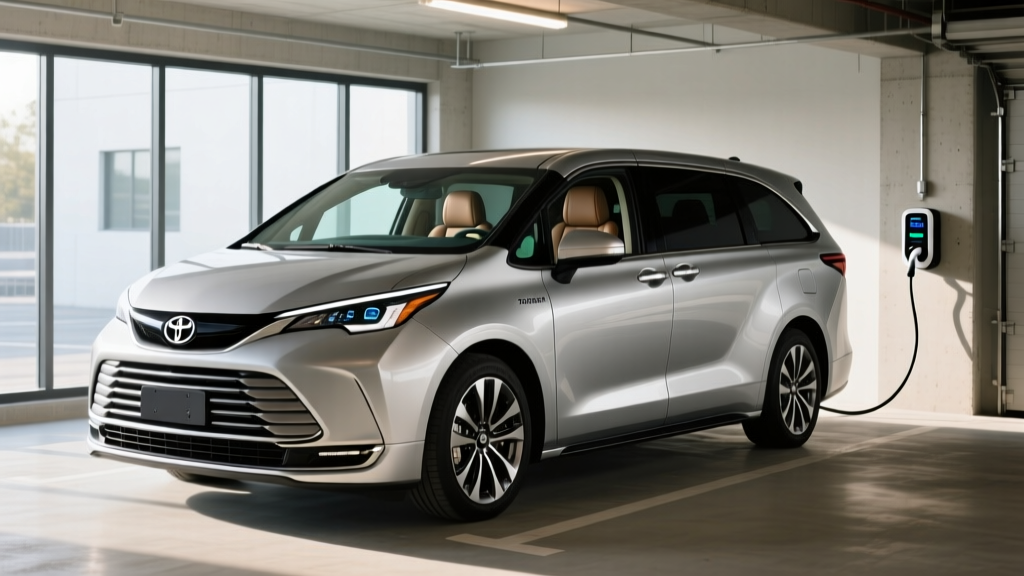
If you search for hybrid vans Toyota, you'll find one dominant answer: the Toyota Sienna. Since the 2021 model year, every Sienna has been a conventional hybrid (HEV) — no gas-only variant exists. For 2026, Toyota continues this hybrid-only strategy, making the Sienna the sole mainstream hybrid minivan on the US market. Chrysler's Pacifica Hybrid is a plug-in hybrid (PHEV), which is a fundamentally different setup with its own trade-offs.
This guide breaks down exactly what the 2026 Sienna delivers in fuel economy, powertrain performance, battery longevity, pricing, and whether any tax credits apply. If you're cross-shopping hybrid vans or weighing a Sienna against a full EV or PHEV alternative, the numbers below will clarify the decision.
HEV vs PHEV: What Toyota's Hybrid Van Actually Is
Conventional Hybrid (HEV) — Toyota Sienna: The gasoline engine and electric motors work together, with a small battery recharged by regenerative braking and the engine. You never plug it in. It operates like a regular gas car at the pump, but the hybrid system slashes fuel consumption — especially in city driving where electric motors handle low-speed propulsion.
Plug-in Hybrid (PHEV) — Chrysler Pacifica Hybrid (competitor): A larger battery (16 kWh) provides roughly 32 miles of electric-only driving before the gas engine engages. You plug it in overnight to replenish the battery. Once the electric range is depleted, it operates as a conventional hybrid.
The Sienna is strictly an HEV. Toyota has not announced a plug-in hybrid or fully electric Sienna variant for 2026. If you need electric-only commuting capability, the Pacifica Hybrid is the only minivan PHEV — but it sacrifices cargo space for the larger battery pack and carries a higher starting price.
2026 Toyota Sienna Fuel Economy: EPA and Real-World MPG
The Sienna's fourth-generation hybrid powertrain pairs a 2.5-liter inline-4 engine with two electric motors (three on AWD trims, adding a rear-mounted motor). The result is EPA-rated efficiency that beats nearly every three-row vehicle on the market.
| Drivetrain | City MPG | Highway MPG | Combined MPG |
|---|---|---|---|
| FWD | 36 | 36 | 36 |
| AWD (Electronic On-Demand) | 35 | 36 | 35 |
Source: fueleconomy.gov — EPA estimates for 2026 Toyota Sienna.
Real-World MPG: What Owners Actually See
Hybrids routinely outperform their EPA city estimates in stop-and-go traffic because regenerative braking recovers energy that a gas-only vehicle wastes as heat. Sienna owners on fueleconomy.gov's "My MPG" tracker report averages between 33 and 40 MPG combined, with city-heavy commuters often hitting 38-40 MPG.
Highway driving is where the Sienna's efficiency advantage narrows. At sustained 70-80 mph speeds, the 2.5L engine does most of the work, and real-world highway MPG drops to roughly 30-33 MPG — slightly below the EPA sticker. Cold weather (below 30°F) reduces fuel economy by 5-10% as the engine runs longer to heat the cabin and the battery operates less efficiently.
With a 17.9-gallon fuel tank, expect a real-world range of approximately 590-640 miles in mixed driving — enough for most family road trips without a fuel stop.
Powertrain Specs: Horsepower, Motors, and Drivetrain
| Specification | 2026 Toyota Sienna |
|---|---|
| Engine | 2.5L inline-4 (Atkinson cycle) |
| Engine Power | 189 hp / 176 lb-ft torque |
| Front Electric Motor | 134 hp / 199 lb-ft |
| Rear Motor (AWD only) | 54 hp / 89 lb-ft |
| Combined Net Horsepower | 245 hp |
| Transmission | eCVT (electronically controlled) |
| 0-60 mph | ~7.1 seconds (FWD) |
| Drivetrain | FWD or Electronic On-Demand AWD |
| Towing Capacity | 3,500 lbs (max, with tow prep) |
| Hybrid Battery | ~1.9 kWh (NiMH), sealed, not plug-in |
The 245 combined horsepower is adequate for merging and passing but not sporty. The eCVT eliminates fixed gear shifts, providing smooth acceleration without the hunting behavior of traditional automatics. The AWD system is not a mechanical driveshaft — the rear motor activates only when the front wheels slip, making it ideal for rain and light snow but not off-road use.
Battery Longevity, Warranty, and Replacement Cost
Hybrid Battery Warranty: Toyota covers the Sienna's hybrid battery for 10 years or 150,000 miles (whichever comes first) from date of first use. This applies to all 50 states. Earlier model years (pre-2020) had 8-year/100,000-mile coverage, but Toyota extended this starting with 2020 models.
Hybrid System Components Warranty: The inverter, converter, and associated hybrid control modules are also covered under the 10-year/150,000-mile hybrid system warranty.
How Long Do Sienna Hybrid Batteries Last?
The Sienna uses a nickel-metal hydride (NiMH) battery pack — a chemistry Toyota has refined over two decades since the original Prius. NiMH is less energy-dense than lithium-ion but extremely durable, with minimal degradation under the shallow charge/discharge cycles that hybrids use (the system typically keeps the battery between 40-80% state of charge).
Based on long-term data from Toyota's hybrid fleet, most Sienna hybrid batteries last well beyond 150,000 miles without significant capacity loss. Failures before 100,000 miles are rare and covered under warranty.
Battery Replacement Cost
If the hybrid battery fails outside of warranty, a new OEM replacement from a Toyota dealer runs approximately $3,000-$4,500 including parts and labor. Refurbished or aftermarket NiMH packs are available from third-party suppliers for $1,500-$2,500 installed. Individual cell replacement (only the degraded modules) can bring costs below $1,000 at a hybrid-specialist shop.
For context, a full EV battery replacement (e.g., a 75+ kWh pack) typically costs $10,000-$20,000+. The Sienna's small hybrid battery is far cheaper to replace because it stores less than 2 kWh.
Pricing, Trims, and Tax Credit Eligibility
The 2026 Toyota Sienna starts at approximately $38,000 MSRP for the LE FWD trim and climbs to roughly $53,000 for the Platinum AWD. Key trims include LE, XLE, XSE, Limited, and Platinum, with the Woodland Edition offering standard AWD and rugged styling.
| Trim | Drivetrain | Approx. MSRP |
|---|---|---|
| LE | FWD | $38,000 |
| LE | AWD | $39,600 |
| XLE | FWD | $43,000 |
| XSE | AWD | $46,500 |
| Limited | AWD | $49,500 |
| Platinum | AWD | $53,000 |
Does the Sienna Qualify for a Federal Tax Credit?
No. The Sienna is a conventional hybrid (HEV), not a plug-in vehicle. The federal §30D Clean Vehicle Credit applies only to battery electric vehicles (BEVs) and plug-in hybrids (PHEVs) with a minimum battery capacity of 7 kWh. The Sienna's ~1.9 kWh NiMH pack does not qualify.
There is no federal tax credit for conventional hybrids as of 2026. Some states may offer minor incentives (HOV lane access, reduced registration fees), but these vary by jurisdiction — check your state's DMV or energy office for current programs.
Sienna vs Pacifica Hybrid vs Full EV: Which Fits Your Family?
Choose the Toyota Sienna (HEV) if:
- You want maximum cargo and passenger space with no compromise (no battery intruding into the floor)
- You cannot charge at home or lack reliable public charging access
- You want the lowest total cost of ownership with no plug-in dependency
- You drive 12,000-15,000+ miles per year and want consistent 35-36 MPG without behavior changes
- You value Toyota's long-term reliability track record and dealer network
Look elsewhere if:
- You have a short commute and home charging — a PHEV (Pacifica Hybrid) or full EV could eliminate most gas use
- You want electric-only, zero-tailpipe-emission driving for school runs or neighborhood trips
- You need more than 245 hp for towing heavy loads (the Sienna's 3,500-lb limit is modest)
- You prefer a fully electric powertrain — consider the Kia EV9 (3-row BEV, ~300 mi range) though it starts higher and is smaller inside
Decision Framework
Sienna HEV → Best for families who drive a lot, can't charge at home, and want proven reliability with strong MPG. No lifestyle changes required.
Pacifica PHEV → Best for families with home charging and short daily commutes (<32 mi) who still need gas flexibility for road trips. Higher upfront cost but lower fuel spend if you charge daily.
Full EV (e.g., Kia EV9, Tesla Model X) → Best for families with reliable home charging, shorter total mileage needs, and willingness to plan road-trip charging. Lowest per-mile fuel cost but highest purchase price and range-planning overhead.
Reliability and Ownership Costs
Toyota's hybrid system is among the most proven in the automotive industry. The Sienna's powertrain shares architecture with the RAV4 Hybrid and Highlander Hybrid — vehicles with extensive long-term reliability data. IIHS has historically rated the Sienna as a Top Safety Pick when equipped with Toyota Safety Sense (standard on all trims).
Estimated 5-Year Fuel Cost
At 15,000 miles/year and $3.50/gallon regular unleaded, the Sienna (36 MPG combined) costs approximately $1,458/year in fuel — or about $7,290 over five years. A comparable gas-only minivan averaging 22 MPG combined would cost roughly $2,386/year ($11,930 over five years). That's a ~$4,640 fuel savings over five years, which partially offsets the Sienna's slightly higher MSRP versus discontinued gas-only competitors.
Maintenance costs are also lower: the hybrid system has no additional service intervals, regenerative braking extends brake pad life (often 80,000+ miles), and the Atkinson-cycle engine runs at lower stress than a conventional engine.
Frequently Asked Questions
How many MPG does the Toyota Sienna hybrid get?
The 2026 Sienna FWD is EPA-rated at 36 MPG city / 36 highway / 36 combined. AWD trims are rated at 35/36/35. In real-world city driving, many owners report 38-40 MPG thanks to regenerative braking. Highway driving at 75+ mph typically yields 30-33 MPG.
Is the Toyota Sienna a plug-in hybrid?
No. The Sienna is a conventional hybrid (HEV). It charges its own battery through regenerative braking and the gasoline engine. You never plug it in. If you want a plug-in hybrid minivan with electric-only range, the Chrysler Pacifica Hybrid is currently the only option.
Does the Toyota Sienna qualify for any tax credit?
No federal tax credit applies to the Sienna because it is not a plug-in vehicle. The IRS §30D credit requires plug-in capability and a minimum 7 kWh battery. Some states may offer minor hybrid incentives — check your local jurisdiction. Toyota does manufacture PHEVs and BEVs that may qualify (e.g., RAV4 Prime, bZ4X), but the Sienna is not among them.
How long will the Sienna hybrid battery last, and what does replacement cost?
Toyota warranties the hybrid battery for 10 years or 150,000 miles. Real-world data from Toyota's hybrid fleet suggests most NiMH packs last well beyond 150,000 miles. Out-of-warranty replacement costs $3,000-$4,500 for a new OEM battery, or $1,500-$2,500 for a refurbished unit. Individual cell repair can cost under $1,000.
Is the Sienna AWD system good for snow?
The Electronic On-Demand AWD uses a separate rear electric motor that engages automatically when front-wheel slip is detected. It handles rain, light snow, and icy intersections competently. It is not a heavy-duty mechanical AWD system and is not designed for deep snow or off-road use. For most suburban winter driving, it provides adequate confidence.
Can I tow with the Toyota Sienna hybrid?
Yes. With the available tow prep package, the Sienna is rated for up to 3,500 lbs — sufficient for a small boat trailer, lightweight camping trailer, or utility trailer. Towing will reduce fuel economy to approximately 20-25 MPG depending on load and terrain.
Hybrid vs PHEV vs EV — which minivan should I buy?
If you lack home charging or drive high annual miles, the Sienna HEV is the most practical choice — consistent efficiency with zero behavior change. If you have home charging and a short commute, the Pacifica PHEV lets you drive most weekdays on electricity while keeping gas flexibility. A full electric 3-row SUV (like the Kia EV9) offers the lowest running costs but requires charging infrastructure and range planning for long trips.