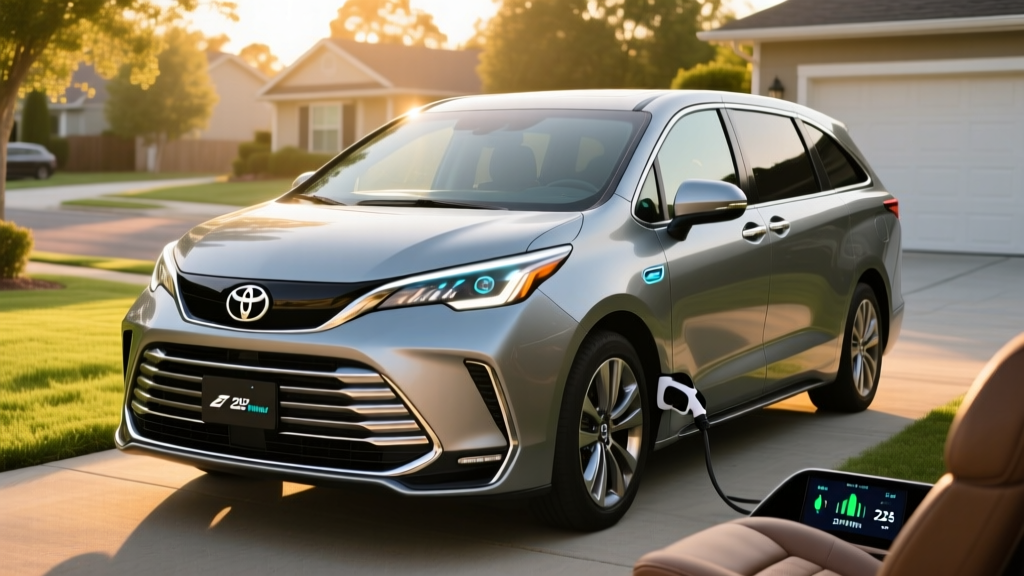
The Toyota Sienna has been exclusively hybrid since the 2021 model year, and the 2026 Sienna continues with a refined version of Toyota's fourth-generation hybrid system. Unlike many minivans that still offer thirsty V6 engines, the Sienna bets entirely on its 2.5-liter four-cylinder hybrid powertrain to deliver family-hauling capability with sedan-like fuel economy. Here's everything buyers need to know about how this system performs, what it costs, and whether it's the right choice versus a plug-in hybrid or full EV alternative.
How the Toyota Sienna Hybrid Powertrain Works
The 2026 Sienna uses Toyota's Hybrid Synergy Drive with a 2.5-liter inline-four Atkinson-cycle engine paired with two electric motor-generators (MG1 and MG2) routed through an electronically controlled continuously variable transmission (eCVT). This is a conventional hybrid (HEV), not a plug-in hybrid (PHEV). You never plug it in — the system recovers energy through regenerative braking and engine-driven generation to keep the 1.9 kWh nickel-metal hydride (NiMH) traction battery charged.
Total system output is rated at 245 horsepower. The gasoline engine produces 189 hp and 176 lb-ft of torque on its own, while the electric motors supplement that output across the RPM range. Front-wheel-drive models use a single rear-mounted motor for assist; all-wheel-drive (AWD) trims add a second independent rear electric motor rated at 54 hp that activates automatically for traction — no mechanical driveshaft connects the front and rear axles.
| Specification | Detail |
|---|---|
| Powertrain Type | Conventional Hybrid (HEV) — no plug |
| Engine | 2.5L inline-4 Atkinson-cycle |
| Engine Power | 189 hp @ 6,000 rpm / 176 lb-ft @ 4,400 rpm |
| Total System Horsepower | 245 hp |
| Transmission | eCVT (planetary gearset) |
| Traction Battery | 1.9 kWh NiMH (sealed) |
| Drivetrain | FWD standard; electronic AWD available |
| 0-60 mph (est.) | ~7.1 seconds (FWD) |
| Towing Capacity | 3,500 lbs (when properly equipped) |
EPA Fuel Economy: City, Highway, and Combined MPG
The Sienna's headline number is its EPA-estimated fuel economy, which remains among the best in the minivan segment. According to fueleconomy.gov, the 2026 Sienna FWD achieves:
| Drivetrain | City MPG | Highway MPG | Combined MPG |
|---|---|---|---|
| FWD | 36 | 36 | 36 |
| AWD | 35 | 35 | 35 |
That flat 36/36/36 split is unusual and reflects how hybrid systems excel in stop-and-go driving where regenerative braking recovers energy that a conventional vehicle would waste as heat. The AWD model drops only 1 MPG across the board because the rear electric motor only engages when needed and adds minimal parasitic loss.
Real-World MPG vs. EPA Sticker
In real-world driving, the Sienna's hybrid powertrain often exceeds its EPA estimates in city-heavy commutes. Owners running suburban school-drop-off and errand patterns with frequent stops commonly report 37-40 MPG on the trip computer. Highway-only driving at 75+ mph tends to drop economy to 30-33 MPG because the electric motor contributes less at sustained high speeds and the four-cylinder engine is working harder to push a 4,600-pound vehicle through the air.
Cold weather reduces fuel economy by roughly 5-10% due to increased engine idling for cabin heat, thicker fluids, and reduced battery efficiency. Expect 32-34 MPG combined in freezing temperatures. This is a smaller penalty than full EVs experience in cold weather (often 20-30% range loss), because the Sienna can use engine waste heat for the cabin rather than relying solely on electric resistance heating.
HEV vs. PHEV vs. EV: Which Minivan Fits Your Life?
The Sienna is a conventional hybrid. It has no plug, no electric-only driving range beyond a mile or two at very low speeds, and no EV mode button. If you're cross-shopping minivans, here's how the three electrification levels compare for family duty:
| Factor | HEV (Sienna) | PHEV (e.g., Chrysler Pacifica Hybrid) | Full EV (e.g., Kia EV9) |
|---|---|---|---|
| Plug Required? | No | Optional (better if you do) | Yes — mandatory |
| Electric-Only Range | ~1 mile (low speed) | ~32 miles | 240-310+ miles |
| Combined MPG / MPGe | 36 MPG | 30 MPG + 82 MPGe | 85-97 MPGe |
| Total Range | ~630 miles | ~490 miles | 240-310 miles |
| Home Charging Needed? | No | Recommended (Level 2) | Yes (Level 2 strongly recommended) |
| Federal Tax Credit | None | Up to $7,500 (if eligible) | Up to $7,500 (if eligible) |
| Base MSRP Range | $39,000-$54,000 | $51,000-$58,000 | $55,000-$74,000 |
Choose the Sienna HEV if you don't have access to home charging, drive more than 40 miles daily, take frequent long road trips, and want the lowest purchase price in a hybrid minivan. It asks nothing of you — just fill it with regular unleaded and drive.
Choose a PHEV minivan if you can install a Level 2 charger at home, your daily driving is under 30 miles round-trip (covering most school and errand runs on electricity), and you still want gas-engine range for weekend trips. The Chrysler Pacifica Hybrid offers 32 miles of electric-only range but costs roughly $12,000 more upfront.
Choose a full EV minivan/SUV if you have reliable home charging, your daily range needs are under 250 miles, you want the lowest per-mile fuel cost, and you're willing to plan around charging on road trips. Vehicles like the Kia EV9 offer three rows and 270+ miles of range but at a significant price premium.
Hybrid Battery Warranty, Lifespan, and Replacement Cost
Toyota Hybrid Battery Warranty: 10 years / 150,000 miles (whichever comes first) in all 50 states. This covers defects and capacity loss below a defined threshold. California-emissions states may have additional coverage provisions. Always confirm current terms with your dealer.
The Sienna's 1.9 kWh NiMH battery is a mature technology that Toyota has refined over two decades of hybrid production. Unlike the large lithium-ion packs in EVs and PHEVs, this small battery undergoes relatively shallow charge-discharge cycles — the hybrid system keeps it between roughly 40% and 80% state of charge to minimize stress. This shallow cycling is why Toyota's hybrid batteries routinely last 150,000-200,000+ miles without replacement.
According to Toyota's warranty documentation, the hybrid battery is covered for 10 years or 150,000 miles. If replacement is needed out of warranty, a new OEM hybrid battery for the Sienna typically costs between $2,500 and $4,000 including labor. Third-party reconditioned units can be sourced for $1,500-$2,500. This is dramatically less than EV traction battery replacements, which can exceed $10,000-$15,000.
Long-Term Reliability Track Record
Toyota's hybrid systems consistently rank at the top of long-term reliability studies. The eCVT transmission has no traditional clutch packs or bands to wear — it's a planetary gearset with no fixed gear ratios, meaning fewer mechanical failure points. The Sienna specifically has earned strong reliability scores from owner surveys, and the hybrid powertrain components (inverter, motor-generators, battery) have proven durable well past 200,000 miles in Toyota's broader hybrid fleet (Prius, Camry Hybrid, Highlander Hybrid).
One maintenance note: the hybrid system's inverter coolant and the engine coolant should be replaced at Toyota's specified intervals (typically 100,000 miles for the first change, then every 50,000 miles). This is low-cost preventive maintenance that protects expensive components.
2026 Sienna Pricing, Trims, and Tax Credit Eligibility
The 2026 Toyota Sienna starts at approximately $39,085 for the LE FWD trim (including destination charge) and climbs to roughly $53,805 for the Platinum AWD. Key trims include LE, XLE, XSE, Limited, and Platinum, with the Woodland Edition offering standard AWD and off-road-tuned suspension.
Does the Sienna Hybrid Qualify for a Federal Tax Credit?
No. The conventional Sienna HEV does not qualify for the federal §30D Clean Vehicle Credit. Under current IRS rules, only plug-in electric vehicles (BEVs) and plug-in hybrids (PHEVs) with a battery capacity of at least 7 kWh are eligible. The Sienna's 1.9 kWh NiMH battery does not meet this threshold, and it has no plug.
Some states may offer minor incentives for conventional hybrids, but these are increasingly rare as incentive programs shift toward plug-in vehicles. Check your state's energy office or department of environmental quality for current programs.
Who Should Buy the Sienna Hybrid — and Who Shouldn't
Pros
- 36 MPG combined — best-in-class minivan fuel economy
- No plug required — zero lifestyle change from a gas vehicle
- 10-year/150,000-mile hybrid battery warranty
- Standard Toyota Safety Sense 3.0 (ADAS suite)
- AWD available with electronic rear motor
- 3,500-lb towing capacity
- Proven long-term reliability with low maintenance costs
- Sliding doors, 8-passenger seating, and deep cargo well
Cons
- No electric-only driving range (not a PHEV)
- No federal tax credit eligibility
- Engine noise under hard acceleration (CVT drone)
- Modest 245 hp — adequate but not quick for a loaded van
- No DC fast charging (not applicable — no plug)
- Infotainment interface trails competitors in responsiveness
- Third-row seat doesn't fold flat into the floor (stow-and-go unavailable)
The Sienna hybrid powertrain is the right choice for families who want minivan practicality with dramatically lower fuel costs than a conventional V6 minivan (the non-hybrid Honda Odyssey gets roughly 22 MPG combined — that's a 39% improvement) without any charging infrastructure requirements. If you can charge at home and your daily trips are short, a PHEV minivan saves more fuel dollars. If you're ready for full electric, the emerging three-row EV options eliminate gasoline entirely but cost significantly more and require charging planning on road trips.
Frequently Asked Questions
How many MPG does the Toyota Sienna hybrid get?
The 2026 Sienna FWD achieves an EPA-estimated 36 MPG city, 36 MPG highway, and 36 MPG combined. AWD models are rated at 35/35/35 MPG. Real-world city driving often yields 37-40 MPG, while sustained highway driving at high speeds may drop to 30-33 MPG.
Is the Toyota Sienna a plug-in hybrid?
No. The Sienna is a conventional hybrid (HEV). It has no plug and no meaningful electric-only range. You never need to charge it — the system manages battery charge through regenerative braking and engine-driven generation automatically.
Is the Toyota Sienna hybrid reliable, and what does a battery replacement cost?
Toyota's hybrid systems have an excellent long-term reliability record spanning two decades. The hybrid battery is warrantied for 10 years / 150,000 miles. Out-of-warranty replacement costs approximately $2,500-$4,000 for an OEM unit, or $1,500-$2,500 for a reconditioned battery. Most hybrid batteries last 150,000-200,000+ miles before significant degradation.
Does the Toyota Sienna qualify for any tax credit?
The Sienna HEV does not qualify for the federal §30D Clean Vehicle Credit, which requires a plug-in vehicle with at least 7 kWh of battery capacity. The Sienna's 1.9 kWh battery and lack of a plug make it ineligible. State-level hybrid incentives vary by jurisdiction — check your state's official energy or environmental agency for current programs.
Can the Sienna hybrid run on electric power alone?
Only at very low speeds (under ~15 mph) for roughly a mile or less, such as creeping through a parking lot. During normal driving, the gasoline engine and electric motors work together continuously. This is fundamentally different from a PHEV, which can sustain electric-only driving at highway speeds for 20-40 miles.
How does the Sienna hybrid compare to the Honda Odyssey on fuel costs?
The 2026 Honda Odyssey (conventional V6) earns approximately 22 MPG combined. At 15,000 miles per year and $3.40/gallon, the Odyssey costs roughly $2,318 annually in fuel. The Sienna at 36 MPG costs approximately $1,417 — a savings of about $900 per year, or $4,500 over five years, according to fueleconomy.gov cost-to-own estimates.
Does the AWD system affect fuel economy significantly?
The Sienna's electronic AWD costs only 1 MPG across all driving cycles (35 vs. 36 combined). The rear motor disengages entirely during steady-state cruising, adding negligible drag. This is one of the smallest AWD penalties in the segment because there's no mechanical driveshaft or transfer case.