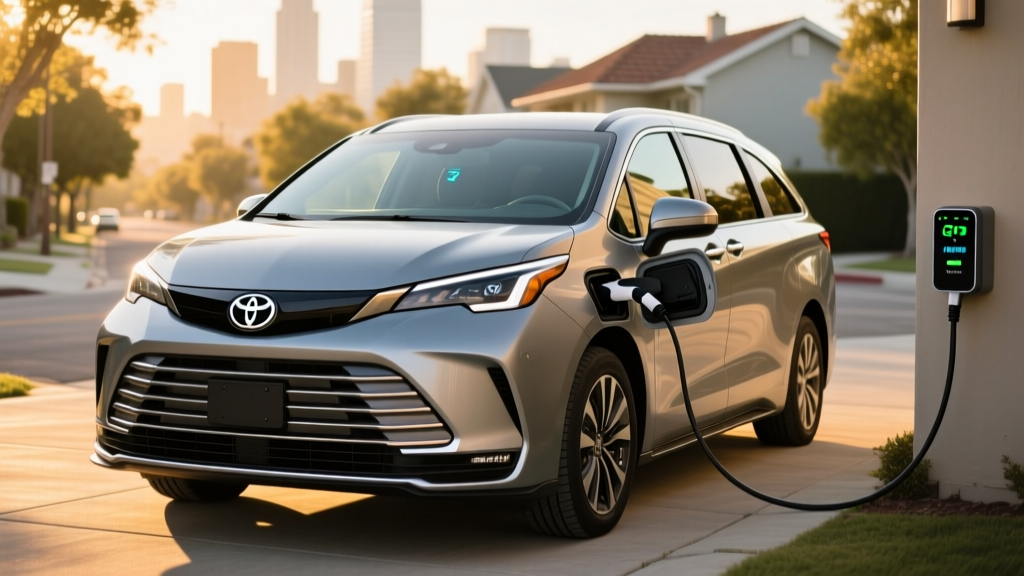
The Toyota Sienna has been a hybrid-only minivan since the 2021 redesign, and for 2026, it remains one of the most fuel-efficient three-row vehicles you can buy. The available electronic All-Wheel Drive (AWD) system adds rear-axle traction without sacrificing the efficiency that makes this minivan a standout. If you're searching for a Sienna Hybrid AWD and want hard numbers — not brochure fluff — this guide covers EPA MPG, real-world efficiency, powertrain specs, battery longevity, and whether this HEV makes sense versus a PHEV or full EV for your family.
2026 Sienna Hybrid AWD: Key Specs at a Glance
| Specification | 2026 Toyota Sienna Hybrid AWD |
|---|---|
| Powertrain Type | Conventional Hybrid (HEV) — no plug-in required |
| Engine | 2.5L 4-cylinder + 3 electric motors (front) / 1 rear motor (AWD) |
| Combined Horsepower | 245 hp (net system output) |
| Transmission | eCVT (planetary gearset, not a belt-driven CVT) |
| Drivetrain | Electronic AWD (independent rear electric motor) |
| EPA MPG (City / Hwy / Combined) | 35 / 36 / 35 MPG (AWD models) |
| Fuel Tank Capacity | 14.5 gallons |
| Total Driving Range | ~507 miles (EPA combined estimate) |
| Hybrid Battery | ~1.6 kWh nickel-metal hydride (NiMH), sealed |
| 0–60 mph | ~7.1 seconds (estimated, AWD) |
| Towing Capacity | 3,500 lbs (with towing prep package) |
| Base MSRP (LE AWD) | ~$39,500 (estimated 2026 pricing) |
| Federal Tax Credit | Not eligible (§30D applies to PHEVs/BEVs only) |
| Hybrid Battery Warranty | 10 years / 150,000 miles |
How Many MPG Does the Sienna Hybrid AWD Actually Get?
The EPA rates the 2026 Toyota Sienna AWD at 35 MPG city, 36 MPG highway, and 35 MPG combined. That's an unusual split — most vehicles rate higher in city driving or highway driving, but the Sienna's hybrid system is so efficient that the numbers nearly converge. Front-wheel-drive (FWD) Sienna models rate slightly higher at 36 MPG combined, making the AWD penalty just 1 MPG.
| Trim / Drivetrain | City | Highway | Combined |
|---|---|---|---|
| Sienna FWD (all trims) | 36 | 36 | 36 |
| Sienna AWD (all trims) | 35 | 36 | 35 |
Source: fueleconomy.gov — EPA estimates. Your mileage will vary.
Real-World MPG: What Owners Report
Toyota's hybrid system excels in stop-and-go traffic, where regenerative braking recaptures energy that would otherwise be lost. In real-world driving, many Sienna owners report exceeding the EPA city estimate, with 37–40 MPG achievable in urban conditions with moderate acceleration. Highway driving at sustained 75–80 mph tends to return 32–34 MPG, slightly below the EPA highway figure, because the aerodynamic profile of a minivan creates more drag at speed.
In cold weather (below 30°F), expect a 5–10% efficiency drop. The engine runs more frequently to provide cabin heat and maintain the hybrid battery's operating temperature, reducing the time spent in EV-only mode at low speeds. Owners in northern climates typically see winter averages around 31–33 MPG combined.
Understanding the Sienna's Hybrid Powertrain
The Sienna uses Toyota's fourth-generation hybrid system, which is fundamentally different from a plug-in hybrid or a full electric vehicle. Here's what's under the hood:
- 2.5-liter Dynamic Force 4-cylinder engine: Produces 189 hp and 176 lb-ft of torque on its own, running on the Atkinson cycle for maximum thermal efficiency.
- Front electric motors (2): One drives the front wheels and recaptures energy during braking; the second serves as a generator and engine starter.
- Rear electric motor (AWD models): A 54-hp independent motor powers the rear axle when additional traction is needed — there is no mechanical driveshaft connecting the front and rear.
- NiMH hybrid battery (~1.6 kWh): A compact, sealed nickel-metal hydride pack that buffers energy between the engine, motors, and regenerative braking system. It is not designed for plug-in charging or extended electric-only driving.
Total system output is 245 horsepower. The eCVT transmission uses a planetary gearset to seamlessly blend power from the engine and motors — it's mechanically simpler and more durable than a traditional belt-driven CVT, with no belts or pulleys to wear out.
How the Electronic AWD System Works
Unlike traditional AWD systems with a center differential and driveshaft, the Sienna's AWD is entirely electronic. The rear motor engages automatically when the front wheels slip — during rain, snow, or loose gravel — and can send up to 80% of available torque to the rear axle. Under normal dry-road conditions, the Sienna operates primarily as a front-wheel-drive vehicle to preserve fuel economy. The system adds approximately 165 lbs compared to FWD models, which accounts for the minimal 1 MPG combined penalty.
HEV vs. PHEV vs. EV: Which Powertrain Fits Your Family?
The Sienna is only available as a conventional hybrid (HEV). Toyota does not offer a plug-in hybrid Sienna, and there is no fully electric minivan competitor at this price point in 2026 (the Chrysler Pacifica PHEV was discontinued). Here's how the three electrified powertrain types compare for minivan buyers:
| Factor | Conventional Hybrid (HEV) | Plug-In Hybrid (PHEV) | Full EV (BEV) |
|---|---|---|---|
| Plug-in charging required? | No | Yes (for EV range benefit) | Yes |
| Electric-only range | ~1 mile at low speed | 20–45 miles typical | 250–400+ miles |
| Example vehicle | Toyota Sienna | No current minivan PHEV | Kia EV9 (3-row SUV) |
| Home charging needed? | No | Recommended | Essential |
| Federal tax credit (§30D) | Not eligible | Up to $7,500 (if eligible) | Up to $7,500 (if eligible) |
| Best for | Any household, no charging setup | Short commutes + road trips | Home charging + daily driving |
| Fuel cost (per mile) | ~$0.10–$0.12 | ~$0.04–$0.10 (varies) | ~$0.03–$0.06 |
Bottom line: If you need a true three-row minivan with sliding doors, low running costs, and zero lifestyle change from your last gas vehicle, the Sienna HEV is the most practical electrified option in 2026. If you want plug-in electric range for short school runs and errands, you'd need to look at three-row SUVs like the Kia EV9 or a used Chrysler Pacifica PHEV.
Sienna Hybrid AWD Trim Levels and Pricing
Toyota offers the 2026 Sienna AWD across multiple trims. Pricing below reflects estimated 2026 MSRP (destination charge included). AWD is available on every trim level.
| Trim | MSRP (AWD, est.) | Key Features |
|---|---|---|
| LE | $39,500 | 8-seat config, Toyota Safety Sense 3.0, 8" touchscreen |
| XLE | $44,000 | SofTex seats, power liftgate, 7-seat config, wireless CarPlay |
| XSE | $46,500 | Sport-tuned suspension, 20" wheels, sport appearance |
| Limited | $50,500 | Leather, 12.3" screen, JBL audio, heated/ventilated front seats |
| Platinum | $54,500 | Panoramic roof, 360° camera, rear entertainment, HUD |
Does the Sienna Hybrid Qualify for a Tax Credit?
No. The Toyota Sienna is a conventional hybrid (HEV), and the federal IRS §30D Clean Vehicle Credit only applies to plug-in electric vehicles (PHEVs and BEVs) with sufficient battery capacity. The Sienna's ~1.6 kWh NiMH battery is far below the §30D minimum threshold of 7 kWh for plug-in vehicles.
Some states and municipalities offer rebates for conventional hybrids, but these programs are limited and change frequently. Check your state's energy office or DOE's Alternative Fuels Data Center for current local incentives. For most buyers, the Sienna's value proposition is fuel savings, not tax credits.
Hybrid Battery Longevity, Warranty, and Replacement Cost
Toyota Hybrid Battery Warranty
- Coverage: 10 years or 150,000 miles (whichever comes first)
- Applies to: Hybrid battery pack, hybrid control module, inverter, and related components
- Transferable: Yes — warranty follows the vehicle, not the original owner
- What triggers a claim: Battery capacity loss causing a check-engine light or diagnostic failure, not a specific percentage threshold like EV warranties
Toyota's NiMH hybrid batteries have a strong track record. The Prius, which uses similar battery technology, has demonstrated 200,000+ mile lifespans routinely, with many original batteries still functioning at 15 years. The Sienna's hybrid battery is smaller and less stressed than an EV battery — it operates in a narrow state-of-charge window (roughly 40–80%) managed by the hybrid control system, which minimizes degradation.
Battery Replacement Cost
If the hybrid battery does fail outside of warranty, replacement costs typically range from $2,000 to $4,000 including parts and labor at a Toyota dealer. Independent hybrid specialists often offer refurbished or reconditioned battery packs for $1,500–$2,500. Individual battery modules can sometimes be replaced for even less, depending on the failure mode.
For context, this is dramatically cheaper than EV battery replacement, which can run $8,000–$20,000+. The Sienna's smaller, simpler NiMH pack is a cost advantage in long-term ownership.
Real-World Ownership: Fuel Cost Savings vs. a Gas Minivan
The Sienna's hybrid efficiency translates directly into fuel savings. Here's a five-year cost comparison against a conventional gas minivan, assuming 15,000 miles per year and $3.50/gallon regular unleaded:
| Metric | Toyota Sienna Hybrid AWD (35 MPG) | Gas Minivan Baseline (22 MPG) |
|---|---|---|
| Annual fuel consumption | 429 gallons | 682 gallons |
| Annual fuel cost | $1,501 | $2,387 |
| 5-year fuel cost | $7,505 | $11,935 |
| 5-year fuel savings | $4,430 | |
Those savings partially offset the Sienna's slightly higher starting price compared to some gas-only competitors. Factor in the hybrid system's reliability and minimal maintenance (no conventional transmission fluid changes, regenerative braking extends pad life), and the total cost of ownership becomes very competitive.
Pros, Cons, and Who Should Buy the Sienna Hybrid AWD
Pros
- 35 MPG combined with AWD — best-in-class for any AWD minivan
- No plug-in charging required; zero lifestyle adjustment from a gas vehicle
- Standard Toyota Safety Sense 3.0 across all trims
- 10-year / 150,000-mile hybrid battery warranty
- 3,500-lb towing capacity covers small trailers and boats
- Strong resale value — Toyota minivans hold value well
Cons
- No plug-in option — cannot drive on electric-only for school runs
- 245 hp is adequate but not quick for a loaded minivan on highway merges
- No federal tax credit eligibility
- AWD system is traction-based, not a true off-road system
- Infotainment system lags behind competitors in responsiveness
- Third-row space is tighter than the Honda Odyssey
Is the Sienna Hybrid AWD Right for You?
- Choose the Sienna Hybrid AWD if: You need a three-row minivan with low fuel costs, live in a climate with rain or snow, don't have (or want) home charging infrastructure, and prioritize long-term reliability and resale value.
- Look at a PHEV or EV instead if: You want electric-only driving for short trips, have home Level 2 charging, want to qualify for the §30D federal tax credit, or are open to a three-row SUV rather than a minivan.
- Consider a gas minivan only if: You drive very few miles per year (under 8,000), where the fuel savings won't offset the Sienna's price premium over remaining gas competitors.
Frequently Asked Questions
How many MPG does the 2026 Toyota Sienna Hybrid AWD get?
The EPA rates the Sienna AWD at 35 MPG city, 36 MPG highway, and 35 MPG combined. Real-world city driving often exceeds the EPA estimate, while sustained highway driving at 75+ mph typically returns 32–34 MPG.
Does the Sienna Hybrid need to be plugged in?
No. The Sienna is a conventional hybrid (HEV). The battery charges through regenerative braking and the gasoline engine. You never plug it in — you simply fill up at a gas station like any other vehicle.
How far can the Sienna go on electric power alone?
Less than 1 mile at very low speeds (under 25 mph). The hybrid system uses the electric motors for low-speed maneuvering and assist, but it is not designed for meaningful electric-only driving. If you want 30+ miles of EV range, you need a plug-in hybrid.
Is the Sienna Hybrid reliable? What about battery replacement?
Toyota's hybrid systems are among the most reliable powertrains in the industry. The hybrid battery is covered by a 10-year / 150,000-mile warranty. Out-of-pocket replacement, if needed, runs $2,000–$4,000, which is far less than an EV battery replacement.
Does the Sienna Hybrid AWD qualify for any federal tax credit?
No. The IRS §30D Clean Vehicle Credit requires a plug-in vehicle with at least 7 kWh of battery capacity. The Sienna's ~1.6 kWh NiMH battery does not qualify. Some state programs may offer small hybrid incentives — check your local energy office.
How does the AWD system affect fuel economy?
The electronic AWD system reduces combined MPG by just 1 MPG compared to the FWD Sienna (35 vs. 36 combined). The rear motor only engages when needed, so there's minimal efficiency penalty during normal driving.
Can I tow with the Sienna Hybrid AWD?
Yes. With the optional towing prep package, the Sienna Hybrid is rated to tow up to 3,500 lbs — sufficient for a small boat, utility trailer, or light camper. Expect fuel economy to drop to 22–26 MPG while towing, depending on load and terrain.