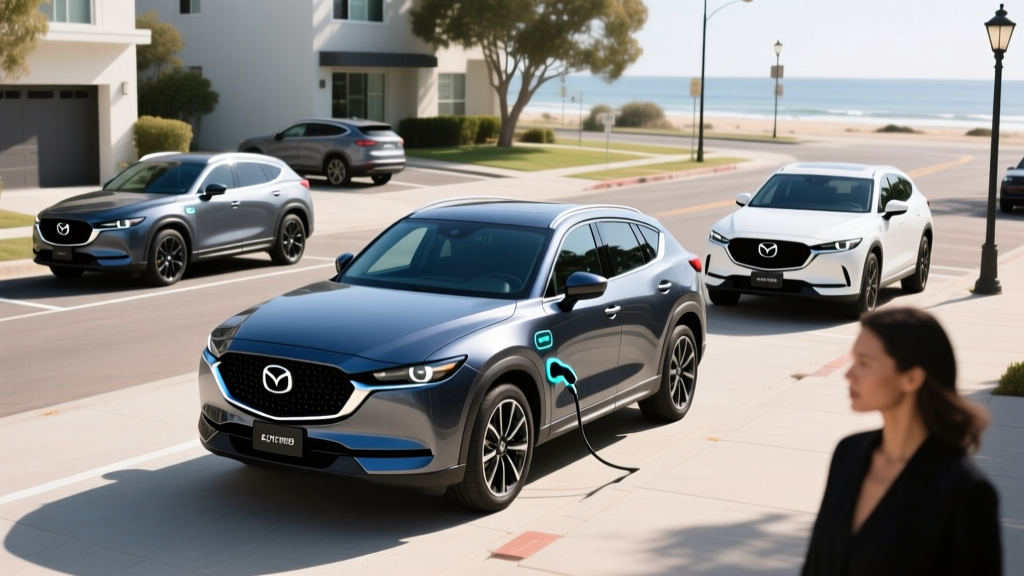
Mazda's electrification strategy has taken a distinctly pragmatic shape for 2026: rather than rushing to a fully electric lineup, the automaker offers a spread of hybrid and plug-in hybrid SUVs that slot between conventional gas models and full BEVs. If you've been searching for Mazda SUV hybrids, you've likely noticed the options have multiplied — and the naming conventions can get confusing fast. This guide breaks down every current Mazda hybrid SUV with exact EPA figures, real-world expectations, battery specs, pricing, and tax-credit eligibility so you can match the right powertrain to your driving routine.
Mazda's 2026 Hybrid SUV Lineup at a Glance
For 2026, Mazda sells three SUVs with electrified powertrains in the US market. Two are plug-in hybrids (PHEVs) with meaningful electric-only range; one is a conventional hybrid (HEV) that never needs plugging in. Here's how they stack up:
| Model | Type | EPA Combined MPG / MPGe | Electric-Only Range | Combined HP | Battery (kWh) | Starting MSRP |
|---|---|---|---|---|---|---|
| CX-50 Hybrid | HEV | 38 MPG combined | N/A (no plug) | 219 hp | ~1.6 kWh (self-charging) | ~$35,390 |
| CX-70 PHEV | PHEV | 25 MPG / 56 MPGe | 26 miles | 327 hp | 17.8 kWh usable | ~$55,895 |
| CX-90 PHEV | PHEV | 25 MPG / 56 MPGe | 26 miles | 327 hp | 17.8 kWh usable | ~$51,495 |
The CX-50 Hybrid uses Toyota's proven hybrid synergy drive system (a result of the Mazda-Toyota manufacturing partnership) adapted to Mazda's platform. The CX-70 and CX-90 PHEVs share an identical plug-in powertrain but differ in seating configuration — the CX-70 is a two-row, the CX-90 a three-row.
HEV vs PHEV: Which Mazda Hybrid Type Fits You?
Conventional Hybrid (HEV) — CX-50 Hybrid: The gasoline engine and electric motor work together seamlessly. The small battery recharges through regenerative braking and the engine — you never plug it in. You get better fuel economy with zero behavioral change.
Plug-In Hybrid (PHEV) — CX-70 / CX-90 PHEV: A larger 17.8 kWh battery provides 26 miles of electric-only driving for daily commutes. You plug in at home (Level 1 or Level 2) to recharge. Once the battery depletes, it operates as a conventional hybrid. Think of it as an EV for short trips and a hybrid for long ones.
The decision hinges on one question: Can you charge at home? If you have a garage or driveway with a 120V or 240V outlet, a PHEV lets you drive most weekday commutes on electricity alone — roughly 26 miles covers the average American's one-way commute (fueleconomy.gov). If you live in an apartment without charging access, the CX-50 HEV delivers fuel savings without infrastructure requirements.
CX-50 Hybrid: MPG, Powertrain, and Real-World Efficiency
The 2026 CX-50 Hybrid pairs a 2.5-liter four-cylinder engine with two electric motor-generators and an electronically controlled CVT. Total system output is 219 horsepower — adequate for merging and passing, though not sporty. The powertrain is mechanically similar to the Toyota RAV4 Hybrid's system, which is significant because it's one of the most proven hybrid architectures on the road.
| Driving Cycle | EPA Estimate | Real-World Expectation |
|---|---|---|
| City | 39 MPG | 38–42 MPG (hybrids excel in stop-and-go) |
| Highway | 37 MPG | 34–36 MPG (less regen benefit at steady speed) |
| Combined | 38 MPG | 36–39 MPG |
Hybrids consistently match or exceed EPA city estimates because regenerative braking recovers energy that gas cars waste as heat. Highway driving is where hybrids lose their advantage — at 75+ mph, the electric motor contributes less and aerodynamic drag dominates. In mixed real-world testing with moderate highway use, expect 36–39 MPG combined, which is right around the EPA sticker.
CX-70 and CX-90 PHEV: Electric Range, Charging, and Powertrain Specs
The CX-70 and CX-90 PHEVs use a 2.5-liter inline-four paired with a single electric motor integrated into an 8-speed automatic transmission. Combined output reaches 327 horsepower and 372 lb-ft of torque when running on premium fuel — making these the most powerful Mazda SUVs short of the turbocharged CX-90 non-PHEV.
| Spec | CX-70 PHEV / CX-90 PHEV |
|---|---|
| Battery capacity | 17.8 kWh (usable) |
| Electric-only range (EPA) | 26 miles |
| Total range (EV + hybrid) | ~430 miles |
| Combined HP (premium fuel) | 327 hp / 372 lb-ft |
| Level 1 charging (120V) | ~11 hours (full charge) |
| Level 2 charging (240V, 7.2 kW) | ~2.5 hours (full charge) |
| DC fast charging | Not supported |
| Charge port | J1772 (Level 2) |
| 0–60 mph | ~6.3 seconds |
A critical limitation: neither PHEV supports DC fast charging. The onboard charger maxes out at 7.2 kW on Level 2. For most PHEV owners, this is fine — you plug in overnight at home and wake up to a full 26-mile electric buffer. But if you were hoping to top up at a public fast charger during a road trip, that option doesn't exist here.
Real-world electric range varies with conditions. In mild weather (55–75°F) with city driving and regenerative braking, expect 24–28 miles on a charge. In winter or at sustained highway speeds, that drops to 18–22 miles. Cold weather reduces battery efficiency and cabin heating draws significant power — a universal PHEV limitation, not specific to Mazda.
Pricing, Trims, and Federal Tax Credit Eligibility
Mazda positions its hybrid SUVs at different price points depending on size and powertrain complexity:
- CX-50 Hybrid: Starts around $35,390 (Preferred trim). Fully loaded Hybrid Premium Plus lands near $42,000.
- CX-90 PHEV: Starts around $51,495 (Preferred Plus). Top Premium Plus trim approaches $58,000.
- CX-70 PHEV: Starts around $55,895 (Preferred). Premium Plus reaches approximately $61,000.
Federal Tax Credit (§30D) for Mazda PHEVs
The CX-90 PHEV and CX-70 PHEV may qualify for up to $3,750 under the IRS §30D Clean Vehicle Credit — not the full $7,500. The reduced amount reflects battery component and critical-mineral sourcing requirements that shift annually. Key eligibility rules for 2026:
- Vehicle MSRP must not exceed $80,000 for SUVs (both PHEVs clear this cap)
- Buyer adjusted gross income must not exceed $150,000 (single) / $300,000 (joint)
- Battery sourcing requirements determine whether the credit is $3,750 or $7,500
- Credit can be transferred to the dealer at point of sale as a purchase-price reduction
The CX-50 Hybrid (HEV) does not qualify for the §30D credit — federal incentives apply only to plug-in vehicles with at least 7 kWh of battery capacity. Always verify current eligibility on IRS.gov before purchasing, as sourcing rules change.
Battery Warranty, Lifespan, and Replacement Cost
Hybrid battery longevity remains a top concern for buyers switching from gas-only vehicles. Here's what Mazda covers:
| Coverage | CX-50 Hybrid (HEV) | CX-70 / CX-90 PHEV |
|---|---|---|
| Hybrid battery warranty | 8 years / 100,000 miles (10 yr/150k in CARB states) | 8 years / 100,000 miles (10 yr/150k in CARB states) |
| Powertrain warranty | 5 years / 60,000 miles | 5 years / 60,000 miles |
| Capacity retention guarantee | Not specified (HEV — small buffer) | Not specified (industry norm: ~70% at warranty end) |
The CX-50 Hybrid's battery is small (~1.6 kWh) and cycles shallowly — it never fully depletes or fully charges, which dramatically extends cell life. Toyota-sourced hybrid batteries have demonstrated 200,000+ mile longevity in real-world fleet use with minimal degradation.
The CX-70/CX-90 PHEV's 17.8 kWh pack faces deeper daily cycles (full charge to depletion on electric-only commutes), but Mazda's thermal management and conservative buffer strategy protect the cells. Out-of-warranty replacement for a PHEV battery of this size currently runs $6,000–$9,000 including labor — a figure that should decrease as the supply chain matures. For the HEV, replacement cost is lower, typically $3,000–$5,000, though the need is rare within the vehicle's useful life.
Real-World Ownership: Who Should Choose Which Mazda Hybrid?
CX-50 Hybrid Pros
- 38 MPG combined with no plug-in required
- Proven Toyota-derived hybrid system
- Lower starting price (~$35K)
- No range anxiety — fill up at any gas station
CX-50 Hybrid Cons
- No electric-only driving mode
- No federal tax credit eligibility
- 219 hp — adequate but not quick
- CVT drone under hard acceleration
CX-70 / CX-90 PHEV Pros
- 26-mile electric commute capability
- 327 hp — genuinely quick (6.3s 0–60)
- Potential $3,750 federal tax credit
- Premium interior, 8-speed auto (no CVT)
CX-70 / CX-90 PHEV Cons
- Requires home charging to realize value
- No DC fast charging support
- Higher starting price ($51K–$56K)
- Electric range drops to ~18 mi in winter
Which Mazda Hybrid SUV Is Right for You?
Choose the CX-50 Hybrid if: You want maximum fuel savings without changing your routine, you can't charge at home, or your budget is under $40K. It's the simplest path to 38 MPG in a compact SUV.
Choose the CX-90 PHEV if: You need three rows, have home charging, commute under 25 miles round-trip, and want the option of electric weekday driving with gas-engine flexibility for road trips.
Choose the CX-70 PHEV if: You want the same PHEV powertrain as the CX-90 but prefer a two-row layout with slightly more cargo space behind the second row and a sportier driving position.
Look at a full EV instead if: Your daily driving exceeds 30 miles and you have reliable home charging — a BEV like the Hyundai Ioniq 5 or Tesla Model Y eliminates gas entirely and costs less per mile to fuel.
Frequently Asked Questions
How many MPG does the Mazda CX-50 Hybrid get?
The 2026 CX-50 Hybrid is EPA-rated at 39 city / 37 highway / 38 combined MPG. In real-world city driving, owners often see 38–42 MPG thanks to regenerative braking. Highway-heavy driving drops this to 34–36 MPG.
How far can the CX-90 PHEV go on electric only?
The EPA rates the CX-90 PHEV at 26 miles of electric-only range. Expect 24–28 miles in mild conditions and 18–22 miles in cold weather or sustained highway driving. Once depleted, it operates as a conventional hybrid at 25 MPG combined.
Does the Mazda CX-50 Hybrid need to be plugged in?
No. The CX-50 Hybrid is a conventional HEV — its small battery charges through regenerative braking and the gasoline engine. You fuel it like any other car at a gas station.
Do the Mazda PHEVs qualify for a federal tax credit?
The CX-90 PHEV and CX-70 PHEV may qualify for up to $3,750 under the §30D Clean Vehicle Credit, depending on battery-sourcing requirements and buyer income limits. The CX-50 Hybrid does not qualify. Check current rules at IRS.gov before purchasing.
Are Mazda hybrid SUVs reliable?
The CX-50 Hybrid uses a Toyota-derived hybrid system with an extensive track record — Toyota hybrid batteries routinely exceed 200,000 miles. The CX-70/CX-90 PHEV powertrain is newer but backed by an 8-year/100,000-mile hybrid battery warranty (10 years/150,000 miles in CARB states including CA, NY, MA, and others).
What does it cost to replace a Mazda hybrid battery?
Out-of-warranty replacement runs approximately $3,000–$5,000 for the CX-50 HEV battery and $6,000–$9,000 for the CX-70/CX-90 PHEV battery, including labor. Most hybrid batteries last well beyond their warranty period, making replacement uncommon during typical ownership.
Can I DC fast charge the CX-90 PHEV?
No. Mazda's PHEVs support Level 1 (120V, ~11 hours) and Level 2 (240V at 7.2 kW, ~2.5 hours) charging only. There is no DC fast-charge port. This is typical for PHEVs — the battery is small enough that overnight Level 2 charging fully replenishes it.