Quick Verdict: The RAV4 Prime SE Still Sets the PHEV Benchmark
If you want electric-only commuting without the range anxiety of a full battery-electric vehicle, the 2026 Toyota RAV4 Plug-In Hybrid SE (commonly called the RAV4 Prime SE) remains one of the most compelling options on the market. With 42 miles of EPA-rated electric-only range, 302 combined horsepower, and standard all-wheel drive, it threads the needle between daily EV driving and long-distance gasoline flexibility. The SE trim serves as the entry point to the RAV4 Prime lineup, offering nearly identical powertrain and battery hardware as the pricier XSE trim at a lower MSRP.
But how does it stack up against the conventional RAV4 Hybrid, a full EV like the Tesla Model Y, or other PHEVs in 2026? This guide covers every spec that matters — from real-world MPG and charging speed to battery longevity and federal tax credit eligibility — so you can make a data-driven decision.
HEV vs. PHEV: What's the Actual Difference?
Toyota sells two electrified versions of the RAV4, and confusing them is the single most common mistake buyers make. Here's the breakdown:
| Attribute | RAV4 Hybrid (HEV) | RAV4 Plug-In Hybrid SE (PHEV) |
|---|---|---|
| Plug-in charging? | No — self-charging via engine + regen | Yes — plug in to access full battery |
| Battery capacity | 1.6 kWh (nickel-metal hydride) | 18.1 kWh usable (lithium-ion) |
| Electric-only range | ~0.5 miles at very low speed | 42 miles (EPA) |
| Combined horsepower | 219 hp | 302 hp |
| 0–60 mph | 7.4 sec | 5.7 sec |
| EPA combined MPG (hybrid mode) | 39 MPG | 38 MPG |
| MPGe (charge-sustaining + electric) | N/A | 94 MPGe |
| Starting MSRP (2026) | ~$33,500 | ~$44,500 |
| Federal tax credit (§30D) | Not eligible | Potentially up to $7,500* |
*Eligibility depends on income caps, MSRP caps, battery sourcing, and point-of-sale transfer rules. See tax credit section below.
The conventional HEV never plugs in. It uses a small battery charged by regenerative braking and the gasoline engine to assist acceleration and enable brief electric-only creeping. The PHEV carries a much larger battery that you charge from a wall outlet or public charger, enabling genuine electric-only driving for most commutes. Once the battery depletes, the PHEV operates exactly like a conventional hybrid.
Electric-Only Range and Total Range: What to Expect
The 2026 RAV4 Plug-In Hybrid SE carries an 18.1 kWh usable lithium-ion battery pack. The EPA rates it at 42 miles of electric-only range. For context, the average American one-way commute is approximately 16 miles, meaning most drivers can complete a full round-trip commute without the gasoline engine ever turning on — provided they charge at home overnight.
EPA electric-only: 42 miles. In warm-weather city driving with moderate climate control, expect 38–44 miles before the engine engages. In highway driving at 70+ mph, expect 30–35 miles. In cold weather (below 35°F), cabin heating and battery resistance can reduce electric range to 28–34 miles. The RAV4 Prime uses a heat pump on higher trims (XSE); the SE trim relies on resistive heating, which draws more from the battery in winter.
Once the battery is depleted, the RAV4 Prime SE operates as a conventional hybrid using its 2.5-liter four-cylinder engine and two electric motors. Combined with the 14.5-gallon fuel tank, total system range exceeds 600 miles — eliminating the range anxiety that still deters some buyers from full EVs.
Fuel Economy: EPA MPG and Real-World Numbers
| Mode | City | Highway | Combined |
|---|---|---|---|
| Electric-only (MPGe) | 94 MPGe | 93 MPGe | 94 MPGe |
| Hybrid mode (gasoline, battery depleted) | 40 MPG | 36 MPG | 38 MPG |
Source: EPA fueleconomy.gov
Real-world MPG note: Hybrid-mode fuel economy in the RAV4 Prime tends to track close to the EPA estimate on the highway (34–37 MPG at 75 mph) but can exceed it in city driving, where regenerative braking recaptures energy. Owners who charge nightly and commute within the 42-mile electric window may go weeks without visiting a gas station, effectively achieving infinite MPG for daily driving.
The energy consumption in electric mode is rated at approximately 36 kWh per 100 miles, which translates to roughly $0.04–$0.06 per mile depending on your local electricity rate (national average ~$0.16/kWh as of early 2026). Compare that to $0.12–$0.15 per mile for a 28-MPG gas SUV at $3.40/gallon.
Powertrain and Performance Specs
| Specification | 2026 RAV4 Plug-In Hybrid SE |
|---|---|
| Engine | 2.5L inline-4 Atkinson-cycle |
| Front electric motor | 134 kW (180 hp) |
| Rear electric motor | 40 kW (54 hp) — electronic AWD |
| Combined system output | 302 hp |
| 0–60 mph | 5.7 seconds |
| Drivetrain | Electronic AWD (eAWD) |
| Transmission | eCVT (planetary gearset) |
| Battery (usable) | 18.1 kWh lithium-ion |
| Towing capacity | 2,500 lbs |
| Cargo volume (behind rear seats) | 33.5 cu ft |
The 302-hp combined output makes the RAV4 Prime the quickest RAV4 Toyota sells — quicker than the gas-only RAV4 TRD Off-Road and substantially more powerful than the 219-hp conventional hybrid. The electronic AWD system uses the rear motor to power the rear axle without a mechanical driveshaft, providing confident traction in rain and light snow without the efficiency penalty of a traditional AWD system.
Charging: Speeds, Times, and What You Need at Home
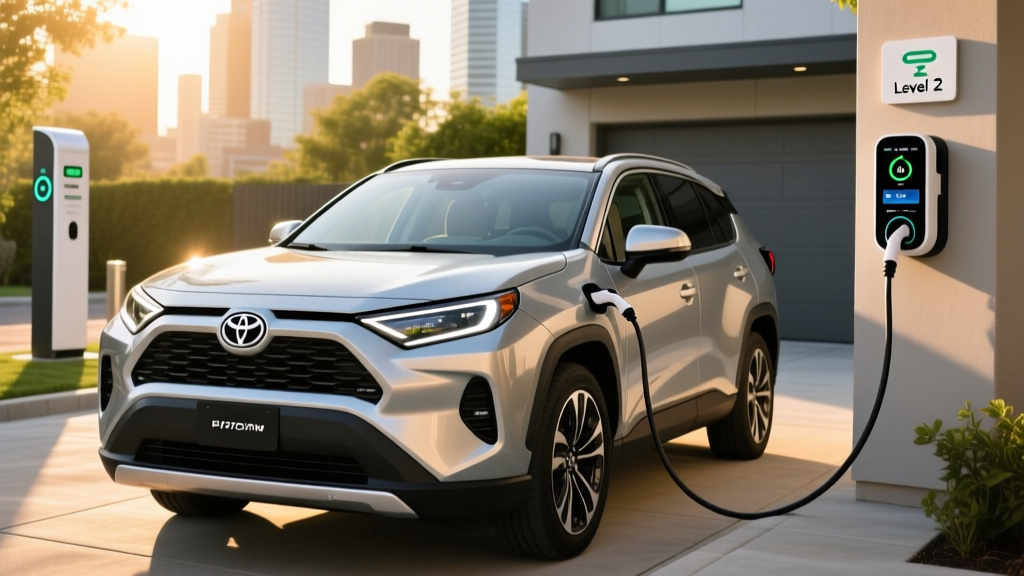
Charging the RAV4 Prime SE is straightforward, but it has one notable limitation: no DC fast charging capability. This is typical for PHEVs with smaller batteries, as the added cost and weight of a DC fast-charge port are harder to justify on an 18.1 kWh pack. Here's what to expect at each charging level:
| Level | Power (kW) | 0–100% Time | Notes |
|---|---|---|---|
| Level 1 (120V household outlet) | ~1.4 kW | ~12 hours | Included mobile cord; sufficient for overnight if you drive <30 mi/day |
| Level 2 (240V, 16A) | ~3.3 kW | ~5.5 hours | SE trim onboard charger limit; home wall charger recommended |
| Level 2 (240V, 32A — XSE only) | ~6.6 kW | ~2.5 hours | SE trim limited to 3.3 kW onboard charger |
| DC Fast Charge | N/A | N/A | Not available on RAV4 Prime |
Critical detail for SE buyers: The SE trim includes a 3.3 kW onboard charger, meaning even if you plug into a 48A Level 2 wall connector, the car will only accept 3.3 kW. The faster 6.6 kW charger is reserved for the XSE trim. For most owners who plug in overnight, 5.5 hours is more than sufficient — you'll arrive home, plug in, and wake up to a full battery. But if you need mid-day top-ups between errands, the 3.3 kW limit means adding only about 10–12 miles of range per hour of charging.
The RAV4 Prime uses a standard J1772 connector for Level 1 and Level 2 AC charging. If you have a Tesla Wall Connector at home (NACS), you'll need a J1772 adapter, which Tesla includes with the Wall Connector or can be purchased separately.
A dedicated 240V/20A circuit with a quality Level 2 charger (such as the ChargePoint Home Flex or Emporia Level 2) typically costs $500–$1,200 installed, depending on panel proximity and local permit fees. If your electrical panel needs an upgrade to 200A, add $1,500–$3,000. Always get a quote from a licensed electrician before purchasing equipment.
Pricing, Trims, and Federal Tax Credit Eligibility
The 2026 Toyota RAV4 Plug-In Hybrid SE starts at approximately $44,500 MSRP (including destination charge). The XSE trim adds roughly $3,000–$5,000 for features like the 6.6 kW onboard charger, heated steering wheel, and premium audio.
Federal tax credit (§30D) eligibility: The RAV4 Prime has historically qualified for the full $7,500 federal tax credit, but under the current IRS rules effective in 2026, eligibility depends on several conditions that change periodically:
- MSRP cap: SUVs must have an MSRP at or below $80,000 — the RAV4 Prime SE clears this easily.
- Buyer income cap: Modified adjusted gross income must not exceed $150,000 (single), $225,000 (head of household), or $300,000 (joint filers).
- Battery sourcing: A percentage of critical minerals and battery components must be sourced from the U.S. or free-trade-agreement countries. Toyota has worked to meet these thresholds, but specific eligibility can shift quarterly. Verify at fueleconomy.gov before purchasing.
- Point-of-sale transfer: As of 2024+, you can transfer the credit to the dealer at purchase, reducing your out-of-pocket cost immediately rather than waiting for tax filing.
Always verify current eligibility on IRS.gov and consult a tax professional. Credit rules and eligible vehicle lists are updated regularly.
Effective price after credit: If you qualify for the full $7,500, the RAV4 Prime SE's effective price drops to approximately $37,000 — narrowing the gap with the conventional RAV4 Hybrid and making the PHEV a significantly stronger value proposition.
Battery Warranty, Reliability, and Replacement Costs
- Duration: 10 years / 150,000 miles (whichever comes first)
- Coverage: Defects and capacity loss below a specified threshold
- Transferable: Yes — transfers to subsequent owners automatically
- Hybrid system components: Also covered under the 8-year/100,000-mile hybrid system warranty
Toyota's hybrid battery track record is among the strongest in the industry. The Prius, now in its sixth generation, has demonstrated that Toyota's hybrid battery management systems — which never fully charge or fully discharge the pack, keeping it in a narrow state-of-charge window — significantly extend cell life. RAV4 Prime owners report minimal degradation in the first 3–5 years of ownership.
Battery replacement cost: If the battery does need replacement out of warranty (rare before 150,000+ miles based on historical Toyota hybrid data), expect $4,000–$7,000 for the pack and labor at a dealership. Independent hybrid specialists can sometimes source refurbished packs for $2,500–$4,000. For context, most Toyota hybrid batteries in Prius and Camry Hybrid applications have lasted well beyond 200,000 miles in taxi and fleet use.
The RAV4 as a platform consistently earns top reliability scores from Consumer Reports and has been an IIHS Top Safety Pick in recent model years. The PHEV variant adds complexity (larger battery, more powerful motors) but shares its core architecture with the proven Toyota Hybrid System II.
Who Should Buy the RAV4 Prime SE — and Who Shouldn't?
- 42-mile EV range covers most daily commutes
- 302 hp — quickest RAV4 available
- Standard electronic AWD
- 600+ mile total range eliminates range anxiety
- Strong $7,500 tax credit potential
- Excellent reliability track record
- No home charger upgrade urgency (3.3 kW is adequate overnight)
- $11,000+ premium over conventional RAV4 Hybrid
- 3.3 kW onboard charger (SE) limits mid-day top-ups
- No DC fast charging
- Cargo space slightly reduced vs. gas RAV4 (battery under floor)
- Resistive cabin heating on SE (no heat pump)
- Tax credit eligibility not guaranteed for all buyers
- Choose the RAV4 Prime SE if: You can charge at home, your daily driving is under 45 miles, you want EV-commute savings with road-trip flexibility, and you qualify for the federal tax credit.
- Choose the conventional RAV4 Hybrid if: You can't charge at home (apartment, street parking), your budget is tighter, and you don't need the extra horsepower.
- Choose a full EV (e.g., Tesla Model Y, Hyundai Ioniq 5) if: You drive less than 300 miles between charges, you want zero gasoline maintenance, you have reliable home charging, and you want DC fast charging for road trips.
Frequently Asked Questions
How many MPG does the RAV4 Plug-In Hybrid SE get?
In hybrid mode (battery depleted), the EPA rates it at 40 city / 36 highway / 38 combined MPG. In electric mode, it achieves 94 MPGe combined. Real-world highway driving in hybrid mode typically yields 34–37 MPG.
How far can the RAV4 Prime SE go on electric only?
The EPA rates it at 42 miles electric-only. Real-world results range from about 28 miles in cold highway driving to 44 miles in warm city conditions. Most commuters will find 35–40 miles achievable in moderate weather.
Does the RAV4 Prime qualify for a tax credit?
The RAV4 Prime has qualified for up to $7,500 under the IRS §30D clean vehicle credit, subject to buyer income caps, MSRP limits, and battery-sourcing requirements that can change quarterly. Verify current eligibility at fueleconomy.gov and IRS.gov before purchasing. The point-of-sale transfer option lets you apply the credit directly at the dealer.
Is the RAV4 Prime reliable, and what does a battery replacement cost?
Toyota's hybrid system has a decades-long reliability track record. The hybrid battery is warranted for 10 years/150,000 miles. Out-of-warranty replacement typically costs $4,000–$7,000 at a dealer, though most Toyota hybrid batteries last well beyond 200,000 miles in practice.
Can I charge the RAV4 Prime at a DC fast charger?
No. The RAV4 Prime does not support DC fast charging. It charges via AC only — Level 1 (120V) or Level 2 (240V) using a J1772 connector. The SE trim's 3.3 kW onboard charger fills the battery in about 5.5 hours on Level 2.
Should I get the SE or XSE trim?
The SE offers the same powertrain and battery at a lower price. The XSE adds the faster 6.6 kW onboard charger (2.5-hour Level 2 fill), a heat pump for better cold-weather EV range, and premium interior features. If you plan to charge mid-day between errands or live in a cold climate, the XSE's upgrades are worth considering.
Hybrid vs. PHEV vs. EV — which fits me?
A conventional hybrid (HEV) is best if you can't plug in at home. A PHEV like the RAV4 Prime is ideal if you can charge at home and want EV savings on daily commutes plus gas-engine flexibility for long trips. A full EV is best if you want the lowest per-mile cost, zero tailpipe emissions, and don't mind planning around charging on road trips.