Quick Verdict: The RAV4 Prime Still Sets the PHEV Benchmark
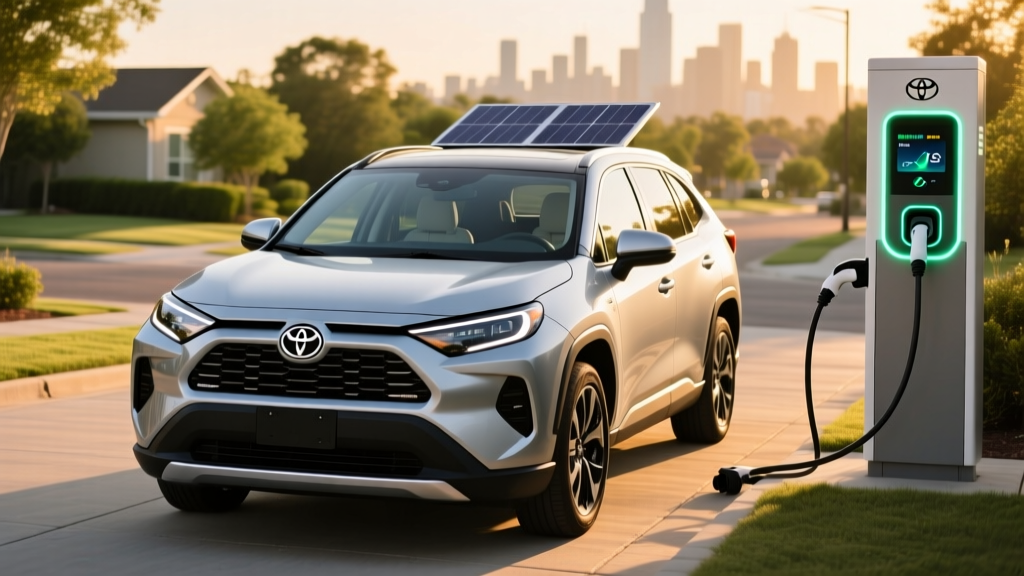
The Toyota RAV4 Plug-In Hybrid (badged as the RAV4 Prime) occupies a rare sweet spot in the electrified-vehicle market: it offers genuine daily electric-only driving for most commutes, all-wheel drive with 302 horsepower, and the cargo versatility of a compact SUV — all without range anxiety on road trips. For 2026, the RAV4 Prime continues with the powertrain that made it one of the most sought-after PHEVs in America, though availability at dealers remains competitive.
If you can charge at home and your daily driving stays under ~40 miles, the RAV4 Prime functions as an EV on weekdays and a hybrid on weekends. That dual personality is precisely what makes plug-in hybrids compelling for buyers not yet ready to commit to a battery-electric vehicle.
HEV vs PHEV: What Separates the RAV4 Prime From the Standard Hybrid
| Attribute | RAV4 Hybrid (HEV) | RAV4 Prime (PHEV) |
|---|---|---|
| Powertrain | 2.5L 4-cyl + 2 electric motors | 2.5L 4-cyl + 2 electric motors (higher output) |
| Combined Horsepower | 219 hp | 302 hp |
| Battery Capacity | ~1.6 kWh (self-charging) | 18.1 kWh (plug-in capable) |
| Electric-Only Range | None (EV assist only) | 42 miles (EPA) |
| Plug-In Charging | No — never needs plugging in | Yes — Level 1 & Level 2 |
| EPA Combined MPG (hybrid mode) | 39 MPG combined | 38 MPG combined (after battery depleted) |
| MPGe (electric + hybrid) | N/A | 94 MPGe |
| 0–60 mph | 7.4 seconds | 5.7 seconds |
| DC Fast Charging | N/A | No — AC only |
| Starting MSRP | ~$33,500 | ~$44,500 |
The conventional RAV4 Hybrid (HEV) charges its small battery entirely through regenerative braking and the gasoline engine — you never plug it in. The RAV4 Prime (PHEV) adds a much larger 18.1 kWh lithium-ion battery and more powerful electric motors, enabling 42 miles of pure electric driving before the gas engine engages. Once the battery is depleted, the Prime operates exactly like a conventional hybrid.
Electric Range, MPGe, and Real-World Fuel Economy
The EPA rates the 2026 RAV4 Prime at 42 miles of electric-only range and 94 MPGe when operating in combined EV/hybrid mode. After the battery is depleted, it returns an EPA-estimated 38 MPG combined (40 city / 36 highway) as a conventional hybrid.
| Mode | City | Highway | Combined |
|---|---|---|---|
| Electric-Only (MPGe) | 94 MPGe | 94 MPGe | 94 MPGe |
| Hybrid Mode (MPG) | 40 MPG | 36 MPG | 38 MPG |
Total combined range (electric + gasoline) exceeds 600 miles, thanks to the 14.5-gallon fuel tank and efficient hybrid operation. For comparison, a fully electric SUV like the Tesla Model Y Long Range offers ~310 miles of total range before needing a charge stop.
How Many MPG Does the RAV4 Prime Actually Get?
If you charge nightly and drive under 42 miles daily, you may use almost no gasoline during the workweek. Real-world owners who charge regularly report effective fuel economy well above the EPA sticker — some achieving the equivalent of 100+ MPGe over mixed commutes. However, if you rarely plug in and drive primarily on the highway, expect fuel economy closer to 35–37 MPG, slightly below the EPA hybrid-mode estimate due to the added weight of the larger battery (the Prime is roughly 350 lbs heavier than the standard RAV4 Hybrid).
Charging: Level 1, Level 2, and What You Need at Home
The RAV4 Prime's 18.1 kWh battery charges exclusively via AC power — there is no DC fast-charging capability. This is typical for PHEVs, whose smaller batteries don't justify the cost and weight of DC fast-charge hardware.
| Charging Level | Power (kW) | 0–100% Time | Requirements |
|---|---|---|---|
| Level 1 (120V household) | ~1.4 kW | ~12 hours | Standard outlet; included cord |
| Level 2 (240V, 16A) | ~3.3 kW | ~5.5 hours | 240V outlet or hardwired station |
| Level 2 (240V, 32A)* | ~6.6 kW | ~2.5 hours | Requires upgraded onboard charger (SE/XSE trim-dependent) |
*The 6.6 kW onboard charger availability varies by trim and model year. Verify your specific trim's onboard charger rating — some trims include the 3.3 kW charger as standard, while higher trims offer the 6.6 kW option.
For most owners, a Level 2 home charger is ideal: plug in after work, and the battery is full by morning. A dedicated 240V circuit (typically 20A or 30A) installed by a licensed electrician runs $500–$1,500 depending on your electrical panel's capacity and the distance from the panel to the charging location. If your panel is at capacity, a panel upgrade can add $1,500–$3,000.
Important: The RAV4 Prime uses a J1772 connector for AC charging — the universal standard for non-Tesla EVs in North America. No adapter is needed for Level 1 or Level 2 charging at home or at public AC stations.
Powertrain and Performance: 302 HP With AWD
| Specification | Detail |
|---|---|
| Engine | 2.5L Dynamic Force 4-cylinder (177 hp / 165 lb-ft) |
| Front Electric Motor | 134 kW (180 hp) |
| Rear Electric Motor | 40 kW (54 hp) |
| Combined System Output | 302 hp |
| Drivetrain | Electronic AWD (eAWD) — no mechanical driveshaft |
| Transmission | eCVT (planetary gearset, no traditional gears) |
| 0–60 mph | 5.7 seconds |
| Battery | 18.1 kWh lithium-ion (NMC chemistry) |
| Towing Capacity | 2,500 lbs |
| Cargo Volume | 33.5 cu ft (rear seats up) / 63.2 cu ft (folded) |
The RAV4 Prime's 5.7-second 0–60 mph time makes it one of the quickest vehicles in Toyota's lineup — quicker than the Camry V6 of a generation ago. The eAWD system uses the rear electric motor to provide instant torque to the rear axle without a traditional mechanical connection, improving traction in rain and snow. In EV mode, the Prime operates silently and delivers smooth, linear acceleration that makes it feel more refined than its EPA numbers suggest.
Pricing, Trims, and Federal Tax Credit Eligibility
The 2026 RAV4 Prime starts at approximately $44,500 MSRP (SE trim) and climbs to around $48,500 (XSE trim with premium packages). Destination charges add approximately $1,350.
Does the RAV4 Prime Qualify for the Federal Tax Credit?
Under current IRS §30D rules, the RAV4 Prime's eligibility for the federal plug-in vehicle tax credit (up to $7,500) depends on several factors that change frequently:
- MSRP Cap: SUVs must have an MSRP at or below $80,000 — the RAV4 Prime clears this easily.
- Buyer Income Cap: Modified adjusted gross income must not exceed $150,000 (single) / $300,000 (joint). Check IRS §30D guidelines for current-year thresholds.
- Battery Sourcing: Critical minerals and battery components must meet phased-in domestic-content requirements. Toyota's supply chain for the RAV4 Prime has faced scrutiny on this point — eligibility can shift based on model year and production batch.
- Point-of-Sale Transfer: If eligible, you can transfer the credit to the dealer at purchase for an immediate price reduction rather than waiting to claim it on your tax return.
Critical caveat: PHEV tax credit eligibility is highly sensitive to battery-sourcing rules that tighten annually. Some RAV4 Prime model years have qualified for the full $7,500, partial credit, or no credit depending on when they were placed in service. Always verify current eligibility on the IRS Clean Vehicle Credit page or consult a tax professional before relying on the credit in your purchase decision.
Battery Warranty, Reliability, and Replacement Cost
Is the RAV4 Prime Reliable?
Toyota's hybrid powertrains have an extensive reliability track record spanning over two decades since the original Prius. The RAV4 Hybrid and Prime share the proven Dynamic Force engine and eCVT architecture. The RAV4 Prime's larger battery pack operates within conservative charge/discharge windows (Toyota uses significant top and bottom buffers to prevent degradation), which is favorable for long-term battery health.
Based on data from earlier model-year RAV4 Primes (introduced for 2021), battery degradation has been minimal — most owners report retaining 90%+ of original electric range after 50,000+ miles. Toyota's 10-year/150,000-mile hybrid battery warranty is among the longest in the industry.
What Does a Battery Replacement Cost?
If the high-voltage battery fails outside warranty, replacement costs for the RAV4 Prime's 18.1 kWh pack are estimated at $6,000–$9,000 including labor at a Toyota dealership. However, out-of-warranty failures remain rare based on Toyota's hybrid track record. Individual battery modules can sometimes be replaced rather than the entire pack, reducing cost. For context, the standard RAV4 Hybrid's much smaller battery replacement runs $3,000–$4,000.
Who Should Choose the RAV4 Prime vs. a Full EV or Gas Car?
Choose the RAV4 Prime (PHEV) If:
- You can charge at home (garage, driveway, or dedicated outlet)
- Your daily commute is under ~40 miles round-trip
- You take road trips where charging infrastructure may be sparse
- You want EV-like daily driving without range anxiety
- You need AWD and cargo space for family life
Choose the RAV4 Hybrid (HEV) If:
- You cannot charge at home (apartment, street parking)
- You want the lowest purchase price and simplest ownership
- Your daily driving is mostly highway (hybrids and PHEVs are similar at highway speeds)
Choose a Full EV (e.g., Tesla Model Y, Hyundai Ioniq 5) If:
- You want zero gasoline use and minimal maintenance
- You have reliable home charging and access to DC fast chargers for road trips
- Your daily driving exceeds 42 miles but stays under ~280 miles
- You want to maximize federal tax credit value (full EVs have broader eligibility)
Pros
- 42 miles EV range covers most daily commutes
- 302 hp and 5.7s 0–60 — genuinely quick
- 600+ mile total range for road trips
- Proven Toyota reliability and 10-year battery warranty
- AWD standard with no mechanical driveshaft
- Strong resale value
Cons
- High demand = limited dealer inventory, possible markups
- No DC fast charging (AC only, 2.5–12 hours)
- $11,000+ premium over the standard RAV4 Hybrid
- Federal tax credit eligibility uncertain due to battery-sourcing rules
- Cargo floor slightly higher due to battery placement
- EV range drops significantly in cold weather
Frequently Asked Questions
How far can the RAV4 Prime go on electric only?
The EPA rates the RAV4 Prime at 42 miles of electric-only range. Real-world results typically range from 30 miles (cold weather, highway speeds) to 44 miles (moderate temperatures, city driving). For most commuters with home charging, this covers the entire daily round-trip without burning gasoline.
Do I have to plug in the RAV4 Prime?
No — if you never plug it in, the RAV4 Prime operates as a conventional hybrid and still returns a respectable 38 MPG combined. However, you'd miss the entire point of the larger battery and EV mode. The financial and efficiency case for the Prime depends on regular charging. If you can't charge at home or work, the standard RAV4 Hybrid is a better value.
How does the RAV4 Prime compare to a full EV like the Tesla Model Y?
The Model Y Long Range offers ~310 miles of total range, DC fast charging (10–80% in ~20 minutes), and zero gasoline use — but requires reliable charging access and planning for long trips. The RAV4 Prime offers only 42 electric miles but eliminates range anxiety entirely with its 600+ mile total range and 5-minute gas fill-ups. Choose the Prime if charging access is uncertain; choose the Model Y if you want full electrification and have home charging.
Is the hybrid battery expensive to replace?
Out-of-warranty replacement for the RAV4 Prime's 18.1 kWh battery is estimated at $6,000–$9,000. However, Toyota's hybrid batteries have proven exceptionally durable — widespread out-of-warranty failures are uncommon. The 10-year/150,000-mile warranty covers most ownership periods. See Toyota's warranty details for specifics.
Can the RAV4 Prime tow?
Yes — the RAV4 Prime is rated to tow up to 2,500 lbs when properly equipped, matching the standard RAV4 Hybrid. This is sufficient for a small utility trailer, bike rack, or lightweight boat trailer but not for heavier loads.
Does the RAV4 Prime qualify for HOV lane access?
HOV lane access for PHEVs varies by state. California, for example, has issued Clean Air Vehicle decals for qualifying PHEVs, but the program has specific income and vehicle requirements that change annually. Check your state's DMV for current eligibility.