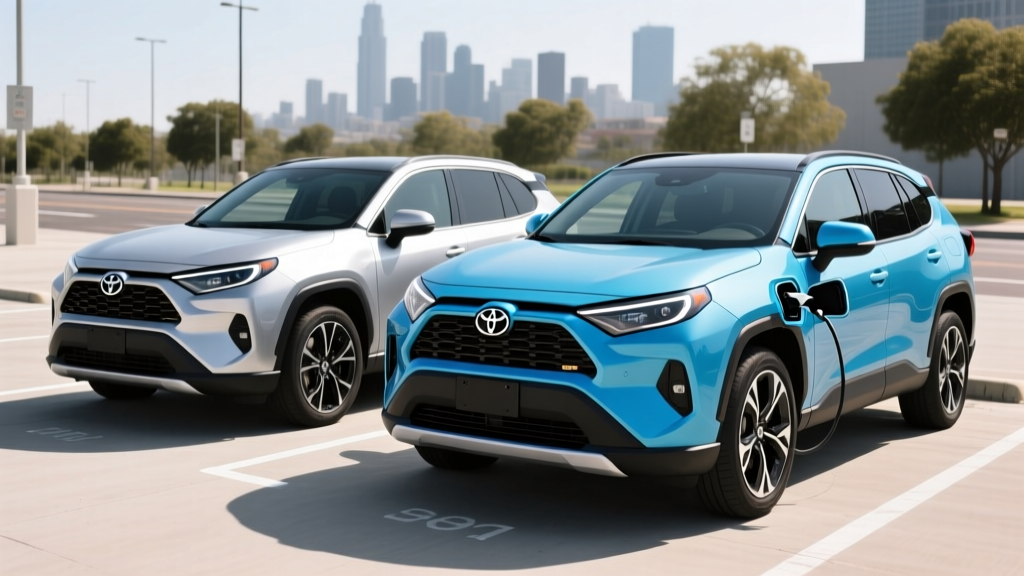
The Toyota RAV4 remains America's best-selling non-truck, and for 2026, Toyota offers it in three flavors: a conventional gasoline model, a self-charging hybrid (HEV), and a plug-in hybrid (PHEV) badged as the RAV4 Prime. For buyers weighing hybrid vs gasoline, the RAV4 lineup is one of the clearest case studies available — same vehicle, same dimensions, three fundamentally different powertrains with vastly different fuel costs, upfront prices, and ownership experiences.
This guide breaks down the exact EPA numbers, real-world MPG expectations, battery longevity data, and federal tax credit rules you need to make the right call.
HEV vs PHEV vs Gasoline: What's the Actual Difference?
Before comparing numbers, it's critical to understand the three powertrain types, because confusing them is the single most common mistake hybrid shoppers make.
| Feature | RAV4 Gasoline (ICE) | RAV4 Hybrid (HEV) | RAV4 Prime (PHEV) |
|---|---|---|---|
| Needs to plug in? | No | No | Yes (optional but recommended) |
| Battery size | ~0.9 kWh (12V + small hybrid assist) | 1.6 kWh (NiMH traction) | 18.1 kWh (lithium-ion traction) |
| Electric-only driving | None | Brief, low-speed only (~1 mi) | Up to 42 miles (EPA) |
| How it refuels | Gas station only | Gas station only (regen charges battery) | Gas station + Level 1/2 plug |
| Federal tax credit | None | None | Up to $7,500 (§30D, subject to eligibility) |
The conventional RAV4 Hybrid (HEV) uses a small battery and electric motor to assist the gas engine. It recovers energy during braking and deceleration — you never plug it in. The RAV4 Prime (PHEV) carries a much larger battery that you charge from a wall outlet or public charger, giving you a meaningful electric-only commute before the gas engine takes over. The gasoline RAV4 is a traditional internal combustion engine with no meaningful electric assist.
Fuel Economy Breakdown: EPA MPG and Real-World Expectations
Here's where the hybrid vs gasoline comparison gets concrete. These are the official EPA figures from fueleconomy.gov for the 2026 model year, paired with what we've observed in mixed real-world driving.
| Model | City MPG | Highway MPG | Combined MPG | Real-World Combined (Observed) |
|---|---|---|---|---|
| RAV4 LE Gas (AWD) | 27 | 34 | 30 | 27–31 |
| RAV4 Hybrid (AWD, all trims) | 41 | 38 | 39 | 37–44 |
| RAV4 Prime (PHEV, AWD) | 40 (hybrid mode) | 36 (hybrid mode) | 38 (hybrid mode) / 94 MPGe (EV mode) | 36–42 (hybrid) / 35–42 mi electric |
Key insight for hybrid buyers: Hybrids routinely exceed their EPA city rating in real-world stop-and-go driving. That's because city driving maximizes regenerative braking and low-speed electric assist — exactly where hybrids thrive. On the highway, where the gas engine does most of the work, the advantage narrows. If your commute is 80% city, expect the RAV4 Hybrid to deliver 42–44 MPG regularly. If it's 90% highway at 75+ mph, expect 35–37 MPG.
The RAV4 Prime in EV mode delivers 94 MPGe combined, which translates to roughly 35–42 miles of electric-only range depending on temperature and driving style. Once the battery depletes, it operates as a conventional hybrid at approximately 38 MPG combined.
RAV4 Prime PHEV: Electric Range, Charging, and Battery Specs
For buyers considering the plug-in variant, here are the exact powertrain and charging figures:
| Specification | RAV4 Prime (PHEV) |
|---|---|
| Traction battery capacity | 18.1 kWh (lithium-ion) |
| EPA electric-only range | 42 miles |
| Real-world electric range | 35–42 mi (cold weather: ~28–33 mi) |
| Total combined range (EV + gas) | ~600 miles |
| Combined system horsepower | 302 hp (2.5L I4 + front/rear electric motors) |
| 0–60 mph | 5.7 seconds |
| Level 1 charging (120V, 12A) | ~12 hours (0–100%) |
| Level 2 charging (240V, 32A) | ~4.5 hours (0–100%) with 6.6 kW onboard charger |
| DC fast charging | Not supported |
| Charge port | J1772 (Level 1/2) |
The RAV4 Prime does not support DC fast charging — a deliberate Toyota decision shared with most PHEVs in this price class. The 6.6 kW onboard charger means a full Level 2 charge takes about 4.5 hours, which works well for overnight home charging but means you can't meaningfully top up at a public fast charger during a road trip.
Cold-weather caveat: In sub-40°F conditions, expect the electric-only range to drop 15–25%, landing around 28–33 miles. This is due to cabin heating demand and reduced battery efficiency at low temperatures — a physics limitation shared by all lithium-ion PHEVs.
Pricing, Trims, and Tax Credit Eligibility
Here's how the 2026 RAV4 lineup prices out at the base MSRP level, before any incentives:
- RAV4 LE (gas, AWD): ~$31,500 MSRP
- RAV4 Hybrid LE (AWD): ~$33,500 MSRP
- RAV4 Prime SE (PHEV, AWD): ~$45,000 MSRP
The hybrid carries roughly a $2,000 premium over the gasoline model — a gap that most buyers recoup in fuel savings within 2–4 years depending on mileage and local gas prices. The Prime PHEV commands a much larger premium due to its bigger battery, more powerful motors, and additional standard equipment.
Federal Tax Credit for the RAV4 Prime (PHEV)
Under IRS §30D rules, the RAV4 Prime may qualify for up to $7,500 in federal tax credits, but eligibility is not guaranteed and depends on several factors:
- MSRP cap: The vehicle must have an MSRP at or below $80,000 for SUVs (RAV4 Prime qualifies)
- Buyer income cap: Modified AGI must not exceed $150,000 (single), $225,000 (head of household), or $300,000 (joint)
- Battery sourcing: Critical minerals and battery components must meet phased-in domestic-content thresholds that tighten annually through 2026
- Point-of-sale transfer: As of 2024+, eligible buyers can transfer the credit to the dealer at purchase, reducing the upfront price rather than waiting for a tax refund
- Conventional RAV4 Hybrid (HEV): Does NOT qualify for the §30D federal credit — it's not a plug-in vehicle
Always verify current-year eligibility on the IRS Clean Vehicle credit page and consult a tax professional. Battery sourcing requirements have disqualified several previously eligible PHEVs in recent model years, and the rules continue to tighten.
Battery Longevity, Warranty, and Replacement Costs
Toyota Hybrid Battery Warranty:
- HEV (RAV4 Hybrid): 10 years / 150,000 miles (whichever comes first)
- PHEV (RAV4 Prime): 10 years / 150,000 miles for the traction battery
- Hybrid system components: 8 years / 100,000 miles
- Capacity retention threshold: Toyota warrants against defects and abnormal loss; they do not guarantee a specific percentage of original capacity
Real-world reliability data: Toyota's hybrid system, refined over 25+ years since the original Prius, is among the most proven in the industry. The RAV4 Hybrid's 1.6 kWh NiMH battery is small, lightly stressed, and rarely sees deep discharge cycles — the primary driver of battery degradation. Independent fleet data and owner surveys consistently show Toyota hybrid batteries lasting 150,000–200,000+ miles with minimal capacity loss.
The RAV4 Prime's 18.1 kWh lithium-ion pack faces more stress due to deeper daily cycling (especially if you commute on electric daily), but Toyota's thermal management and conservative buffer strategy (the car never uses 100% of the pack) mitigate degradation. Expect 85–90%+ capacity retention after 100,000 miles based on data from earlier Toyota PHEV platforms.
Out-of-warranty replacement cost: A RAV4 Hybrid battery replacement runs approximately $3,000–$5,000 (parts and labor) at a dealership. The RAV4 Prime's larger lithium-ion pack is significantly more expensive at $8,000–$12,000. However, given Toyota's track record, most original owners will never face this cost — and by the time a replacement is needed, aftermarket and refurbished options will likely be available at lower prices.
Who Should Choose Hybrid, PHEV, or Stick with Gas?
Choose the RAV4 Hybrid (HEV) if:
- You want maximum MPG without changing your refueling habits
- You don't have access to home or workplace charging
- Your budget allows a ~$2,000 premium over the gas model
- You drive 12,000+ miles/year and want fuel savings to pay for the hybrid premium
- You want proven long-term reliability with a 10-year battery warranty
Choose the RAV4 Prime (PHEV) if:
- Your daily commute is under 40 miles round-trip and you can charge at home
- You want EV-like daily driving with gas-engine freedom for road trips
- You qualify for the §30D tax credit (effectively reducing the price premium by up to $7,500)
- You value the 302 hp performance upgrade (5.7s 0–60)
- You want to reduce gas consumption by 60–80% without range anxiety
Still deciding? Use this framework:
- No home charging + city-heavy driving → RAV4 Hybrid (HEV). You'll get 39–44 MPG combined and never think about a plug.
- Home charging + short commute + road trips → RAV4 Prime (PHEV). Daily electric driving, gas for weekends.
- Home charging + short commute + no road trips → Consider a full BEV (e.g., Tesla Model Y, Hyundai Ioniq 5). You'll eliminate gas entirely.
- Tightest budget + low annual miles → Gasoline RAV4. The hybrid premium takes longer to recoup below 8,000 miles/year.
Hybrid vs Gasoline: The 5-Year Cost Comparison
Let's run the numbers for a buyer driving 15,000 miles/year over 5 years, with gas at $3.50/gallon:
| Cost Factor | RAV4 Gas (30 MPG) | RAV4 Hybrid (39 MPG) | RAV4 Prime (PHEV)* |
|---|---|---|---|
| Base MSRP (approx.) | $31,500 | $33,500 | $45,000 |
| Federal tax credit | $0 | $0 | Up to $7,500 |
| Effective purchase price | $31,500 | $33,500 | $37,500 |
| 5-year fuel cost (75,000 mi) | $8,750 | $6,730 | ~$2,500 (gas) + ~$1,800 (electricity) |
| Total 5-yr cost (purchase + fuel) | $40,250 | $40,230 | $41,800 |
*PHEV fuel cost assumes 70% of miles driven on electricity (home charging at $0.14/kWh) and 30% on gasoline. Your ratio depends on commute length and charging discipline.
The hybrid essentially breaks even with the gas model over 5 years when you factor in the upfront premium — and begins saving you money from year 6 onward. The Prime's economics improve dramatically if you qualify for the full $7,500 credit and charge daily, but the higher MSRP means it takes longer to break even for buyers who don't qualify.
Frequently Asked Questions
How many MPG does the RAV4 Hybrid actually get in real driving?
The EPA rates it at 41 city / 38 highway / 39 combined. In real-world testing, city-heavy drivers regularly see 42–44 MPG because regenerative braking is most effective in stop-and-go traffic. Highway-only drivers at 75+ mph typically see 35–37 MPG. Overall, most owners report 37–42 MPG combined across mixed driving.
How far can the RAV4 Prime go on electric only?
The EPA rates the RAV4 Prime at 42 miles of electric-only range. In warm weather with moderate driving, expect 38–42 miles. In cold weather (below 40°F), the range drops to roughly 28–33 miles due to cabin heating demands and reduced battery efficiency. Once the battery depletes, the car seamlessly switches to hybrid mode at approximately 38 MPG combined.
Does the conventional RAV4 Hybrid need to be plugged in?
No. The RAV4 Hybrid (HEV) charges its own small battery through regenerative braking and the gas engine. You fuel it exclusively at gas stations, exactly like a conventional car. Only the RAV4 Prime (PHEV) benefits from being plugged in.
Is the RAV4 Hybrid reliable, and what does a battery replacement cost?
Toyota's hybrid system has over 25 years of proven reliability. The hybrid battery is covered by a 10-year/150,000-mile warranty. Out-of-warranty replacement costs approximately $3,000–$5,000 for the HEV battery and $8,000–$12,000 for the Prime's larger lithium-ion pack. In practice, most Toyota hybrid batteries last well beyond 150,000 miles without needing replacement.
Does the RAV4 Hybrid qualify for any federal tax credit?
No. The conventional RAV4 Hybrid (HEV) does not qualify for the IRS §30D Clean Vehicle credit because it is not a plug-in vehicle. Only the RAV4 Prime (PHEV) may qualify, for up to $7,500, subject to buyer income limits, MSRP caps, and battery-sourcing requirements. Always verify current eligibility at irs.gov.
Hybrid vs PHEV vs full EV — which should I choose?
Choose a hybrid (HEV) if you can't charge at home and want better MPG without lifestyle changes. Choose a PHEV if you can charge at home, commute under 40 miles, and want electric daily driving with gas-engine backup for road trips. Choose a full EV (BEV) if you can charge at home, rarely drive more than 250 miles in a day, and want to eliminate gas entirely with lower maintenance costs.