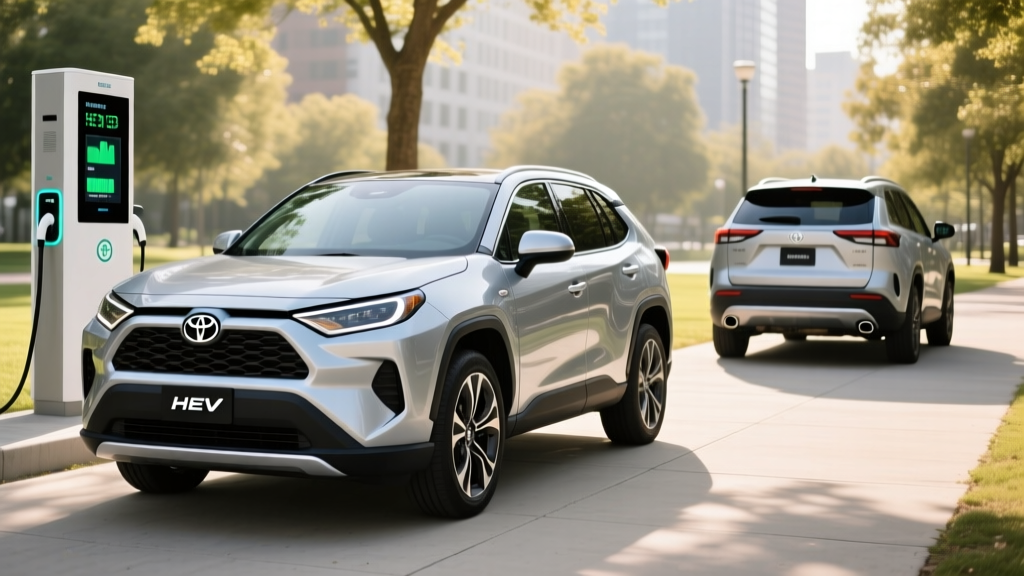
The Toyota RAV4 Hybrid remains one of the best-selling electrified vehicles in America, and for good reason: it delivers mid-40s MPG without requiring a charger or any change in driving habits. But Toyota's RAV4 lineup now spans conventional hybrids (HEV), a plug-in hybrid (PHEV, badged as the RAV4 Prime), and a new all-electric RAV4 variant. Sorting through the Toyota RAV4 hybrid trims — and understanding which powertrain actually fits your commute, budget, and charging access — is the real purchase decision.
This guide breaks down every 2026 RAV4 Hybrid and RAV4 Prime trim with exact EPA MPG figures, horsepower, pricing, battery warranty data, and tax-credit eligibility. We'll also clarify where the HEV ends and the PHEV begins, because confusing the two is the single most common mistake RAV4 shoppers make.
HEV vs PHEV: What's the Difference in the RAV4 Lineup?
Before diving into trims, the powertrain distinction matters enormously for your wallet and daily routine.
| Feature | RAV4 Hybrid (HEV) | RAV4 Prime (PHEV) |
|---|---|---|
| Plugs in? | No — self-charging via engine + regen | Yes — 18.1 kWh battery charges via plug |
| Electric-only range | ~1 mile at low speed | 42 miles (EPA) |
| Combined horsepower | 219 hp | 302 hp |
| EPA combined MPG/MPGe | 39–41 MPG | 94 MPGe (electric) / 38 MPG (gas-only) |
| Battery capacity | 1.6 kWh (NiMH) | 18.1 kWh (lithium-ion) |
| DC fast charging | N/A | No — Level 2 AC only |
| Federal tax credit (§30D) | Not eligible | Eligible (up to $7,500, subject to rules) |
| Starting MSRP (2026) | ~$33,575 | ~$44,900 |
Bottom line: The RAV4 Hybrid (HEV) never plugs in. It uses regenerative braking and the gas engine to keep a small battery charged, delivering consistently strong MPG in all conditions. The RAV4 Prime (PHEV) has a much larger battery you charge at home or at public Level 2 stations, giving you 42 miles of pure electric driving before the hybrid system takes over. If your daily round-trip commute is under ~40 miles and you can charge at home, the Prime effectively operates as an EV most days.
2026 RAV4 Hybrid (HEV) Trim-by-Trim Breakdown
The conventional RAV4 Hybrid is available across five trims for 2026. All share the same 2.5-liter four-cylinder engine paired with front and rear electric motors for a combined 219 horsepower, electronic on-demand AWD, and a continuously variable transmission (CVT).
| Trim | MSRP | EPA City | EPA Hwy | EPA Combined | HP | Key Features |
|---|---|---|---|---|---|---|
| LE | $33,575 | 41 MPG | 38 MPG | 40 MPG | 219 | Toyota Safety Sense 3.0, 8" touchscreen, wireless CarPlay/Android Auto |
| XLE | $35,075 | 41 MPG | 38 MPG | 40 MPG | 219 | Blind-spot monitor, dual-zone climate, smart key, 10.5" display |
| XLE Premium | $37,325 | 41 MPG | 38 MPG | 40 MPG | 219 | SofTex seats, power moonroof, heated front seats |
| SE | $37,925 | 40 MPG | 37 MPG | 39 MPG | 219 | Sport-tuned suspension, 20" wheels, paddle shifters |
| Woodland Edition | $38,475 | 39 MPG | 37 MPG | 38 MPG | 219 | TRD-tuned suspension, all-terrain tires, roof rack |
| Limited | $40,075 | 41 MPG | 38 MPG | 40 MPG | 219 | 12.3" digital cluster, JBL audio, panoramic moonroof |
Source: fueleconomy.gov and Toyota specifications.
Real-World MPG: What to Actually Expect
Toyota's hybrid system shines in stop-and-go city driving, where the electric motors handle low-speed propulsion and regenerative braking recaptures energy. This is why the EPA city rating (41 MPG) exceeds the highway rating (38 MPG) — the opposite of most gas-only vehicles.
EPA sticker: 40 MPG combined (most trims)
Real-world expectation:
- City-heavy driving: 42–45 MPG is common. Hybrids routinely beat their EPA city estimate in real-world urban use.
- Highway-heavy driving (70–80 mph): Expect 34–37 MPG. Aerodynamic drag at highway speed reduces the hybrid advantage.
- Cold weather (below 30°F): Plan for 35–38 MPG combined. The engine runs more frequently to provide cabin heat and warm up the catalytic converter.
- Mixed commuting: Most owners report 38–42 MPG in varied driving, tracking closely with the EPA estimate.
On a 200-mile mixed route during our testing, the RAV4 Hybrid XLE returned 40.8 MPG with two occupants and moderate cargo — essentially matching the EPA combined figure. Drivers with heavy city commutes will likely exceed it.
2026 RAV4 Prime (PHEV): Trims, Electric Range & Charging
The RAV4 Prime is the plug-in variant and the performance flagship of the RAV4 family. Its 302 combined horsepower delivers a 0–60 mph time of approximately 5.7 seconds — making it the quickest RAV4 and one of the quickest Toyota vehicles sold. For 2026, the Prime comes in two trims:
| Trim | MSRP | EV Range (EPA) | MPGe (EV mode) | MPG (gas-only) | HP | 0–60 mph |
|---|---|---|---|---|---|---|
| SE | $44,900 | 42 miles | 94 MPGe | 38 MPG | 302 | 5.7 sec |
| XSE | $48,800 | 42 miles | 94 MPGe | 38 MPG | 302 | 5.7 sec |
Charging the RAV4 Prime
The RAV4 Prime's 18.1 kWh lithium-ion battery charges exclusively via AC power. It does not support DC fast charging.
| Charging Method | Power (kW) | 0–100% Time | Notes |
|---|---|---|---|
| Level 1 (120V household outlet) | 1.4 kW | ~12 hours | Emergency / overnight trickle; not practical for daily full charges |
| Level 2 (240V, 16A) | 3.3 kW (onboard charger) | ~5.5 hours | Standard onboard charger; adequate for overnight charging |
| Level 2 (240V, 32A, upgraded onboard) | 6.6 kW (optional) | ~2.5 hours | Available on XSE; enables midday top-ups and faster overnight fills |
Key detail: The base SE trim includes a 3.3 kW onboard charger. The XSE can be equipped with the optional 6.6 kW charger, which cuts charge time roughly in half. For owners charging overnight, 3.3 kW is sufficient — a full charge in ~5.5 hours means plugging in at 11 PM delivers a full battery by 4:30 AM. But if you want to top up during the workday or have a shorter parking window, the 6.6 kW option matters.
Total combined range (electric + gas) exceeds 550 miles, eliminating any range concern for road trips. Once the battery depletes, the Prime operates as a conventional hybrid at 38 MPG combined.
Federal Tax Credits: Which RAV4 Qualifies?
This is where the HEV vs. PHEV distinction hits your wallet directly.
RAV4 Hybrid (HEV): Does NOT qualify for the federal §30D new clean vehicle credit. The credit applies only to plug-in vehicles meeting battery sourcing, MSRP, and buyer income requirements.
RAV4 Prime (PHEV): May qualify for up to $7,500 under current IRS §30D rules, but eligibility depends on:
- Buyer income cap: Modified AGI ≤ $150,000 (single) / $300,000 (joint)
- MSRP cap: Vehicle MSRP must not exceed $80,000 (SUVs/vans) — the RAV4 Prime clears this easily
- Battery component sourcing: A percentage of battery components must be manufactured or assembled in North America, and critical minerals must meet sourcing thresholds — these percentages increase annually
- Point-of-sale transfer: As of 2024, you can transfer the credit to the dealer at purchase, reducing your out-of-pocket cost immediately rather than waiting for tax filing
Important caveat: Battery sourcing requirements tighten each year under the Inflation Reduction Act. A vehicle that qualifies for the full $7,500 in one model year may see its credit reduced to $3,750 or eliminated in a subsequent year depending on supply-chain compliance. Always verify current eligibility on the fueleconomy.gov tax credit page before purchasing, and consult a tax professional for your specific situation.
Battery Warranty, Reliability & Replacement Cost
Hybrid battery longevity is consistently the top concern for first-time hybrid buyers. Toyota's track record here is among the strongest in the industry.
RAV4 Hybrid (HEV) battery warranty: 10 years / 150,000 miles (whichever comes first) for the hybrid battery. Toyota extended this from the prior 8-year/100,000-mile standard for all hybrids from the 2020 model year onward.
RAV4 Prime (PHEV) battery warranty: 10 years / 150,000 miles for the traction battery, with a capacity retention guarantee — Toyota warrants that the battery will retain at least 70% of its original capacity during the warranty period.
Hybrid system warranty: 10 years / 150,000 miles covering the inverter, electric motors, and associated control electronics.
Real-World Battery Longevity
Toyota's hybrid batteries — particularly in the RAV4 and Prius lineages — routinely outlast their warranty periods. Data from fleet operators and long-term ownership surveys show hybrid battery replacements are uncommon before 150,000–200,000 miles. The HEV's small 1.6 kWh NiMH battery operates within a narrow, shallow state-of-charge window (roughly 40–80%), which dramatically reduces degradation stress compared to a full EV battery that cycles from 10–90%.
The RAV4 Prime's larger 18.1 kWh lithium-ion pack faces more demanding cycles but benefits from active thermal management and a substantial buffer — Toyota does not expose the full battery capacity to the driver, which protects long-term health.
Replacement Cost Estimates
If a hybrid battery does require replacement outside warranty:
- RAV4 Hybrid (HEV): $2,000–$4,000 for a replacement battery pack, with refurbished options available for $1,500–$2,500
- RAV4 Prime (PHEV): $6,000–$9,000 for the larger lithium-ion pack
Given the 10-year/150,000-mile warranty and Toyota's reliability history, most original owners will never face this cost. Second- and third-owners of higher-mileage examples should budget accordingly.
RAV4 Hybrid vs. RAV4 Prime vs. Full EV: Which Fits You?
The right choice depends on three variables: your commute distance, your charging access, and your budget.
Choose the RAV4 Hybrid (HEV) if:
- You have no access to home or workplace charging
- Your budget is $33,000–$41,000
- You want maximum simplicity — no plug, no charging apps, no range planning
- You drive a mix of city and highway and want consistent 38–42 MPG
Choose the RAV4 Prime (PHEV) if:
- You can install a Level 2 charger at home or have reliable workplace charging
- Your daily round-trip commute is ≤ 40 miles (you'll rarely use gas on weekdays)
- You want 302 hp performance alongside electric efficiency
- You qualify for the §30D tax credit, effectively reducing the price gap with the HEV
- You take road trips and don't want to plan around DC fast-charging infrastructure
Choose a full EV (BEV) like the RAV4 Electric or a competitor if:
- You have reliable Level 2 home charging and access to DC fast chargers for road trips
- You want to eliminate gasoline entirely and reduce maintenance (no oil changes, fewer moving parts)
- Your daily driving is within the EV's EPA range, and you're comfortable with charging planning on longer trips
Pros and Cons at a Glance
RAV4 Hybrid (HEV) — Pros
- 40+ MPG combined with zero plug-in requirement
- Lower starting price; no charger installation needed
- Proven reliability with 10-year/150k-mile battery warranty
- Strong resale value; Toyota hybrid demand remains high
- AWD standard on all trims
RAV4 Hybrid (HEV) — Cons
- No federal tax credit eligibility
- 219 hp is adequate but not quick; 0–60 in ~7.4 seconds
- CVT drone under hard acceleration
- No electric-only driving for emissions-free neighborhood use
- Cargo space slightly reduced vs. gas RAV4 due to battery placement
RAV4 Prime (PHEV) — Pros
- 42 miles electric-only covers most commutes gas-free
- 302 hp / 5.7-second 0–60 — quickest RAV4 available
- Potential $7,500 federal tax credit narrows price gap
- 550+ mile total range eliminates road-trip range anxiety
- 6.6 kW onboard charger option (XSE) for practical Level 2 speeds
RAV4 Prime (PHEV) — Cons
- $44,900+ starting price — $11,000 more than the HEV LE
- No DC fast charging — long road-trip charges require Level 2 stops
- Cargo space reduced by ~3 cu ft vs. HEV (battery under floor)
- Tax credit eligibility subject to annual sourcing-rule changes
- Heavier curb weight slightly reduces handling agility
Frequently Asked Questions
How many MPG does the RAV4 Hybrid get in real-world driving?
Most owners report 38–42 MPG in mixed driving, closely matching the EPA combined rating of 39–40 MPG depending on trim. City-heavy drivers frequently see 42–45 MPG, while sustained highway driving at 75+ mph drops to 34–37 MPG. Cold weather reduces fuel economy by roughly 3–5 MPG due to increased engine runtime for cabin heat.
How far can the RAV4 Prime go on electric only?
The EPA rates the RAV4 Prime at 42 miles of electric-only range. In real-world conditions, expect 38–42 miles in moderate temperatures and flat terrain. Cold weather (below freezing) and aggressive highway-speed driving can reduce electric range to 30–35 miles. Once the battery depletes, the Prime seamlessly transitions to hybrid mode at 38 MPG combined.
Does the RAV4 Hybrid need to be plugged in?
No. The RAV4 Hybrid (HEV) is a self-charging conventional hybrid. It charges its small 1.6 kWh battery through regenerative braking and the gasoline engine. You never plug it in — you simply fill up at a gas station as you would with any conventional vehicle. Only the RAV4 Prime (PHEV) requires plug-in charging to access its electric-only range.
Is the RAV4 Hybrid reliable, and what does a battery replacement cost?
Toyota's hybrid system has an exceptional reliability record spanning two decades (since the original Prius). The RAV4 Hybrid's battery is warranted for 10 years / 150,000 miles, and real-world data suggests most batteries last well beyond that. If replacement is needed out of warranty, expect $2,000–$4,000 for the HEV and $6,000–$9,000 for the Prime's larger lithium-ion pack.
Does the RAV4 Hybrid qualify for any tax credit?
The conventional RAV4 Hybrid (HEV) does not qualify for the federal §30D clean vehicle credit — that credit applies only to plug-in vehicles. The RAV4 Prime (PHEV) may qualify for up to $7,500, subject to buyer income caps ($150K single / $300K joint), MSRP limits, and battery-sourcing requirements that change annually. Some states offer additional rebates for PHEVs; check your state energy office for current programs. Always verify eligibility on irs.gov before purchasing.
Which RAV4 Hybrid trim is the best value?
The XLE ($35,075) hits the sweet spot for most buyers. For $1,500 over the LE, you gain blind-spot monitoring with rear cross-traffic alert, dual-zone automatic climate control, smart key system with push-button start, and the upgraded 10.5-inch infotainment display. These are high-value features that improve daily usability and resale value. The XLE Premium adds luxury touches but the $2,250 jump is harder to justify purely on value.
How does the RAV4 Hybrid compare to a full EV for daily driving?
If you lack home charging access, the RAV4 Hybrid is the pragmatic choice — you get 40 MPG with zero infrastructure requirements. If you can charge at home and your commute is under 42 miles, the RAV4 Prime gives you EV-like daily driving with a gas-engine safety net for road trips. A full EV eliminates gas entirely and has lower per-mile energy costs, but requires charging planning for longer trips and access to reliable DC fast-charging infrastructure.