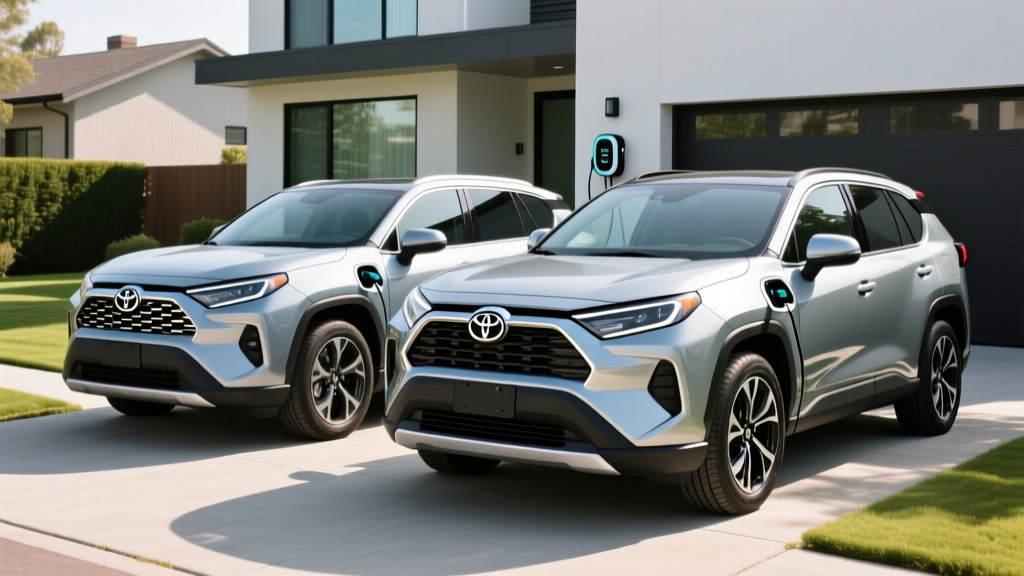
The Toyota RAV4 has been America's best-selling non-truck for years, and its electrified variants—the conventional RAV4 Hybrid and the plug-in RAV4 Prime—account for a growing share of those sales. For 2026, Toyota continues both powertrains with meaningful differences in fuel economy, electric-only range, pricing, and tax-credit eligibility. This guide breaks down every number you need to choose between them.
RAV4 Hybrid (HEV) vs. RAV4 Prime (PHEV): What's the Difference?
Before diving into specs, the distinction matters because it shapes your daily ownership experience:
| Feature | RAV4 Hybrid (HEV) | RAV4 Prime (PHEV) |
|---|---|---|
| Plugs in? | No — self-charging via regenerative braking and engine | Yes — plug in to charge the larger battery |
| Battery size | 1.6 kWh (NiMH) | 18.1 kWh (lithium-ion) |
| Electric-only driving | Very short, low-speed EV mode (~1 mi) | 42 miles EPA at full charge |
| Combined horsepower | 219 hp | 302 hp |
| 0-60 mph | 7.4 seconds | 5.5 seconds |
| Federal tax credit | None | Up to $7,500 (see eligibility below) |
| Starting MSRP (2026) | $33,850 (LE AWD) | $44,410 (SE AWD) |
The HEV is the simpler, more affordable choice that requires zero change in habit—you fuel it like any gas car, and it simply uses less gas. The Prime is for drivers who can charge at home and want to eliminate most daily fuel consumption while keeping a gas engine for longer trips.
Fuel Economy and Real-World MPG
RAV4 Hybrid (HEV)
The 2026 RAV4 Hybrid comes standard with all-wheel drive (AWD-i) across all trims. EPA ratings from fueleconomy.gov:
| Trim | City | Highway | Combined |
|---|---|---|---|
| LE / XLE / Woodland Edition | 41 MPG | 38 MPG | 39 MPG |
| XLE Premium / Limited | 41 MPG | 38 MPG | 39 MPG |
Real-world note: Toyota's hybrid system excels in city driving where regenerative braking and electric-only low-speed operation maximize efficiency. Many owners report 42–45 MPG in mixed city commuting. Highway-only driving at 75+ mph typically drops to 34–36 MPG. In cold weather (below 30°F), expect a 5–10% reduction as the engine runs more frequently for cabin heat.
RAV4 Prime (PHEV)
The Prime's efficiency story is two-part: electric-only operation for short trips, and hybrid mode once the battery depletes.
| Mode | Rating |
|---|---|
| Electric-only (EV mode) | 94 MPGe combined |
| Hybrid mode (battery depleted) | 38 MPG combined (36 city / 39 hwy) |
| Electric-only range | 42 miles EPA |
| Total combined range (EV + gas) | ~600 miles |
Real-world note: The 42-mile EV range is achievable in moderate temperatures at speeds under 60 mph. In summer heat or winter cold, expect 35–38 miles. Highway driving at 70+ mph in EV mode may yield 30–33 miles before the engine engages. Once the battery depletes, the Prime operates as a slightly less efficient hybrid than the standard RAV4 Hybrid due to its greater weight (302 hp powertrain and larger battery add ~280 lbs).
Powertrain and Performance
Both models use Toyota's 2.5-liter inline-4 Atkinson-cycle engine paired with electric motors, but the output differs substantially:
| Specification | RAV4 Hybrid | RAV4 Prime |
|---|---|---|
| Engine | 2.5L I4 Atkinson | 2.5L I4 Atkinson |
| Engine horsepower | 176 hp | 177 hp |
| Front electric motor | 118 hp | 180 hp |
| Rear electric motor (AWD-i) | 54 hp | 54 hp |
| Net combined output | 219 hp | 302 hp |
| 0-60 mph | 7.4 sec | 5.5 sec |
| Drivetrain | AWD (standard) | AWD (standard) |
| Towing capacity | 1,750 lbs | 2,500 lbs |
The Prime's 302 hp makes it one of the quickest compact SUVs in its class, rivaling performance SUVs at a fraction of their price. The standard Hybrid's 219 hp is adequate for daily driving and highway merging, though it feels less urgent under hard acceleration.
RAV4 Prime Charging and Battery Details
The Prime's 18.1 kWh lithium-ion battery pack can be recharged two ways:
| Charging Method | Power | Time (0-100%) |
|---|---|---|
| 120V household outlet (Level 1) | 1.4 kW | ~12 hours |
| 240V Level 2 (standard trim) | 3.3 kW (onboard charger) | ~5.5 hours |
| 240V Level 2 (Premium trim) | 6.6 kW (upgraded onboard charger) | ~2.5 hours |
| DC fast charging | Not supported | |
Critical detail: The RAV4 Prime does not support DC fast charging. It uses a J1772 connector for Level 1 and Level 2 AC charging only. This is typical for PHEVs—the battery is small enough that overnight Level 2 charging is sufficient for most owners. If you choose a Premium trim, the 6.6 kW onboard charger cuts charge time roughly in half, making mid-day top-ups practical.
The standard RAV4 Hybrid requires no plug-in charging whatsoever. Its 1.6 kWh nickel-metal-hydride battery charges automatically through regenerative braking and the gasoline engine.
Pricing, Trims, and Tax Credit Eligibility
2026 RAV4 Hybrid Pricing
| Trim | MSRP (incl. destination) |
|---|---|
| LE | $33,850 |
| XLE | $35,350 |
| XLE Premium | $38,275 |
| Woodland Edition | $37,400 |
| Limited | $41,075 |
The RAV4 Hybrid does not qualify for the federal §30D clean vehicle tax credit, as it is a conventional hybrid without plug-in capability. Some states offer rebates for hybrids—check your state's energy office or IRS clean vehicle credit page for current rules.
2026 RAV4 Prime Pricing
| Trim | MSRP (incl. destination) |
|---|---|
| SE | $44,410 |
| XSE | $48,090 |
Federal §30D tax credit for the RAV4 Prime: Up to $7,500, but eligibility depends on multiple IRS requirements:
- Buyer income cap: AGI must not exceed $150,000 (single), $225,000 (head of household), or $300,000 (joint filers)
- MSRP cap: SUVs must be under $80,000 — the RAV4 Prime clears this easily
- Battery sourcing: A percentage of critical minerals and battery components must be sourced from the US or free-trade-agreement countries — this requirement tightens annually and may reduce the credit to $3,750 or $0 depending on the specific build date and supply chain
- Point-of-sale transfer: You can transfer the credit to the dealer at purchase for an immediate price reduction, or claim it on your tax return
Always verify current eligibility at irs.gov and consult a tax professional before relying on the credit in your purchase decision. Sourcing rules change frequently.
Battery Warranty, Reliability, and Replacement Costs
Hybrid battery longevity is the single most common concern among first-time hybrid buyers. Toyota's track record here is among the best in the industry.
| Coverage | RAV4 Hybrid | RAV4 Prime |
|---|---|---|
| Hybrid battery warranty | 10 years / 150,000 miles | 10 years / 150,000 miles |
| Hybrid system components | 10 years / 150,000 miles | 10 years / 150,000 miles |
| Bumper-to-bumper | 3 years / 36,000 miles | 3 years / 36,000 miles |
| Powertrain | 5 years / 60,000 miles | 5 years / 60,000 miles |
Replacement cost if out of warranty:
- RAV4 Hybrid (NiMH pack): $3,000–$4,000 for the battery module, plus ~$500–$800 labor
- RAV4 Prime (lithium-ion pack): $6,000–$9,000 for the battery, plus labor — significantly more expensive due to the larger lithium-ion pack
Reliability context: Toyota's hybrid system, refined over 25+ years since the original Prius, is widely regarded as one of the most dependable powertrains on the road. The RAV4 Hybrid consistently earns top marks from IIHS for crashworthiness. The e-CVT transmission has no traditional gears or clutch packs to wear out, and the Atkinson-cycle engine operates under less stress than conventional engines. Many Toyota hybrids reach 200,000+ miles on the original battery pack.
Who Should Choose the Hybrid, the Prime, or a Full EV?
Choose the RAV4 Hybrid (HEV) if:
- You cannot charge at home (apartment, street parking, no garage)
- Your budget is under $40,000 and you want maximum value
- You want zero behavior change — just fill up with gas less often
- You drive mostly in the city, where the hybrid system shines (41 MPG city)
- You want Toyota's proven reliability with the lowest upfront cost
Choose the RAV4 Prime (PHEV) if:
- You can install a Level 2 charger at home (garage or driveway with 240V access)
- Your daily round-trip commute is under 40 miles — you may go weeks without buying gas
- You qualify for the federal tax credit (up to $7,500), which narrows the price gap with the Hybrid significantly
- You want strong acceleration (5.5 sec 0-60) and 2,500-lb towing capacity
- You take occasional long road trips and don't want to rely on public charging infrastructure
Choose a full EV (like a Tesla Model Y or Hyundai Ioniq 5) if:
- You can charge at home AND your typical trips stay within 250–300 miles
- You want to eliminate gasoline entirely and minimize maintenance (no oil changes, no engine)
- You have access to reliable DC fast charging for road trips
- You want the lowest per-mile fuel cost (electricity is typically 3–5¢ per mile vs. 12–15¢ for the Hybrid)
RAV4 Hybrid Pros
- 39 MPG combined with zero plug-in hassle
- Strong resale value and proven reliability
- Lower starting price ($33,850)
- Standard AWD across all trims
- Excellent city MPG (41)
RAV4 Hybrid Cons
- No federal tax credit
- Slower acceleration (7.4 sec 0-60)
- No electric-only driving for commutes
- Still requires all gas-engine maintenance
RAV4 Prime Pros
- 42 miles EV range covers most commutes
- 302 hp — genuinely quick for a compact SUV
- Up to $7,500 federal tax credit (if eligible)
- 600-mile total range eliminates range anxiety
- 2,500-lb towing capacity
RAV4 Prime Cons
- Higher starting price ($44,410)
- No DC fast charging
- Heavier — slightly worse MPG in hybrid mode (38 vs 39)
- Limited trim selection (SE and XSE only)
- Lithium-ion replacement cost is steep out of warranty
Frequently Asked Questions
How many MPG does the Toyota RAV4 Hybrid get?
The 2026 RAV4 Hybrid is EPA-rated at 41 city / 38 highway / 39 combined MPG across all trims. In real-world city driving, many owners consistently achieve 42–45 MPG thanks to the hybrid system's regenerative braking and electric-only low-speed operation. Highway-only driving at sustained high speeds typically yields 34–36 MPG.
How far can the RAV4 Prime go on electric only?
The EPA rates the RAV4 Prime at 42 miles of electric-only range. In real-world conditions, expect 35–38 miles in extreme temperatures or at highway speeds, and up to 44 miles in mild weather around town. Once the battery depletes, the Prime seamlessly switches to hybrid mode with 38 MPG combined.
Does the RAV4 Hybrid or Prime qualify for a tax credit?
The standard RAV4 Hybrid does not qualify for the federal §30D clean vehicle credit because it is not a plug-in vehicle. The RAV4 Prime may qualify for up to $7,500, but eligibility depends on your income (AGI caps apply), the vehicle's battery sourcing compliance, and current IRS rules. Check irs.gov and consult a tax professional before purchasing.
Is the RAV4 Hybrid reliable and what does battery replacement cost?
Toyota's hybrid system has over 25 years of proven reliability, and the hybrid battery is covered for 10 years or 150,000 miles. Out-of-warranty replacement for the RAV4 Hybrid's NiMH battery runs $3,000–$4,800 including labor. The Prime's lithium-ion pack is more expensive at $6,000–$9,000+. In practice, most Toyota hybrid batteries last well beyond the warranty period — many reach 200,000+ miles without replacement.
Do I need to plug in the RAV4 Hybrid?
No. The standard RAV4 Hybrid is a self-charging hybrid (HEV). Its small battery charges through regenerative braking and the gas engine. You never plug it in. Only the RAV4 Prime (PHEV) requires plug-in charging to take advantage of its 42-mile electric-only range.
Is the RAV4 Prime worth the extra cost over the Hybrid?
The price gap is roughly $10,500 at base trim. If you qualify for the full $7,500 federal credit, that gap shrinks to ~$3,000 — at which point the Prime's 42-mile EV range, 302 hp, and higher towing capacity make it a strong value. If you don't qualify for the credit or can't charge at home, the standard Hybrid offers excellent fuel economy at a significantly lower price.