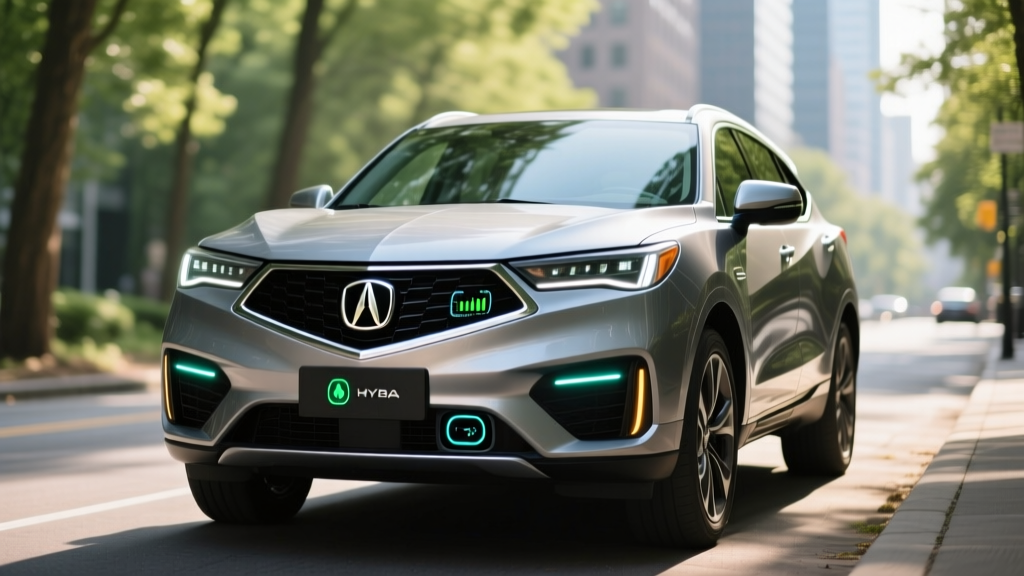
For nearly two decades, the Acura RDX has been a staple of the compact luxury crossover segment — a turbocharged, tech-forward alternative to German rivals. But as Acura phases out RDX production and pivots toward electrification, buyers are left with a critical question: what replaces it, and will it be a conventional hybrid, a plug-in hybrid, or a full battery-electric vehicle?
Based on Honda/Acura's published electrification roadmap and industry reporting through early 2026, Acura is preparing a next-generation compact luxury crossover with hybrid and plug-in hybrid variants built on the company's evolving architecture. Here's a data-driven breakdown of what we know, what's still preliminary, and how to plan your next purchase.
Why Acura Is Retiring the RDX
The outgoing RDX, powered by a 2.0-liter turbocharged four-cylinder producing 272 horsepower, has been a sales mainstay. But it faces two headwinds: tightening CAFE (Corporate Average Fuel Economy) standards and shifting buyer demand toward electrified powertrains. Honda's broader strategy — announced in 2021 and updated through 2024 — targets 100% zero-emission sales by 2040, with hybrid and PHEV models serving as the bridge technology through the late 2020s and 2030s.
The RDX's platform dates back to the 2019 model year. Rather than invest in another refresh of an aging architecture, Acura is consolidating its compact crossover lineup around a new, electrification-ready platform that can support HEV (conventional hybrid), PHEV (plug-in hybrid), and potentially BEV (battery-electric) configurations.
HEV vs PHEV: Understanding the Hybrid Options
Before speculating on specs, it's essential to distinguish between the two hybrid types Acura is likely to offer. This is the single most common source of buyer confusion in the hybrid market.
| Feature | HEV (Conventional Hybrid) | PHEV (Plug-In Hybrid) |
|---|---|---|
| Plug-in charging required? | No — charges via engine + regen | Yes — plugs into Level 1 or Level 2 |
| Battery size | ~1.0–1.5 kWh | ~15–20 kWh (estimated) |
| Electric-only driving | Minimal (~1 mi at low speed) | 30–40 miles (estimated) |
| Fueling | Gasoline only | Gasoline + electricity |
| Federal tax credit | No | Up to $7,500 (subject to §30D rules) |
| Best for | No home charging access | Home charging + short commutes |
If you can install a Level 2 home charger, the PHEV variant offers the most flexibility: electric-only commuting during the week, gasoline range for weekend road trips. If you live in an apartment or lack reliable charging access, the HEV delivers meaningful fuel savings with zero behavior change.
Projected Powertrain & Performance Specs
Honda's current hybrid systems — seen in the CR-V Hybrid and Accord Hybrid — use a two-motor architecture pairing an Atkinson-cycle gasoline engine with electric motors. For a luxury compact crossover in the RDX's weight class (~4,000 lbs), Acura will likely scale this system upward.
| Specification | HEV (Estimated) | PHEV (Estimated) |
|---|---|---|
| Engine | 2.0L turbo 4-cyl + 2 motors | 2.0L turbo 4-cyl + 2 motors |
| Combined horsepower | ~290–310 hp | ~300–330 hp |
| Battery capacity | ~1.3 kWh (NiMH or Li-ion) | ~17–20 kWh (Li-ion) |
| Electric-only range | N/A | ~30–40 miles |
| Total combined range | ~480–520 miles | ~420–460 miles (gas + electric) |
| 0–60 mph | ~6.5–7.0 sec | ~6.0–6.5 sec |
| Drivetrain | AWD (SH-AWD expected) | AWD (SH-AWD expected) |
| DC fast charging | N/A | Unlikely (most PHEVs are Level 2 only) |
| Level 2 charge time (0–100%) | N/A | ~2.5–3.5 hours at 7.2 kW |
Note: These figures are preliminary estimates based on Honda's current hybrid architecture and segment norms. Acura has not published official specs as of this writing. We'll update this article when final numbers are confirmed.
Fuel Economy: What MPG Can You Expect?
The outgoing gas-only RDX returns an EPA-estimated 21 city / 27 highway / 23 combined MPG. A hybrid powertrain should deliver substantial gains, particularly in city driving where regenerative braking and electric motor assist shine.
| Configuration | City MPG | Highway MPG | Combined MPG |
|---|---|---|---|
| Outgoing RDX (2.0T gas) | 21 | 27 | 23 |
| RDX HEV replacement (est.) | 34–38 | 30–33 | 32–35 |
| RDX PHEV replacement (est. charge-sustaining) | 30–34 | 28–31 | 29–32 |
| RDX PHEV (electric mode MPGe est.) | ~85–95 MPGe combined | ||
Real-world MPG vs. EPA: Honda's two-motor hybrid systems consistently meet or slightly exceed EPA city estimates in real-world driving because city stop-and-go traffic maximizes regenerative braking. Highway MPG tends to track closely with EPA numbers or fall 1–2 MPG short at sustained 75+ mph speeds. For the PHEV, your effective fuel economy depends entirely on charging habits — if you charge nightly and commute under 35 miles, you may use gasoline only a handful of times per month.
For reference, the similarly sized Honda CR-V Hybrid AWD achieves an EPA-estimated 40 city / 34 highway / 37 combined MPG, though it's a non-luxury vehicle with less weight and power.
Pricing, Tax Credits & Purchase Considerations
The outgoing 2025 Acura RDX started at approximately $44,350 (base) and climbed to ~$54,000 (fully loaded Advance trim). Expect the hybrid replacement to carry a modest price premium over equivalent gas trims, consistent with Honda's pricing strategy for the CR-V Hybrid (~$1,500–$2,000 premium over gas models).
Estimated pricing:
- HEV base: ~$46,000–$48,000 MSRP
- HEV loaded (Advance/A-Spec): ~$54,000–$57,000 MSRP
- PHEV base: ~$52,000–$55,000 MSRP
- PHEV loaded: ~$60,000–$63,000 MSRP
Federal Tax Credit Eligibility (§30D)
The conventional HEV does not qualify for the federal EV tax credit. The PHEV variant may qualify for up to $7,500 under IRS §30D, but eligibility depends on several factors that change frequently:
- MSRP cap: SUVs/crossovers must be priced at or below $80,000
- Buyer income cap: AGI ≤ $150,000 (single) / $300,000 (joint)
- Battery sourcing: Critical minerals and battery components must meet phased-in domestic/free-trade-agreement sourcing thresholds
- Point-of-sale transfer: As of 2024+, eligible buyers can transfer the credit to the dealer for an upfront price reduction
Given Honda's historical reliance on Asian battery supply chains, PHEV credit eligibility is not guaranteed. Verify current sourcing compliance on fueleconomy.gov before purchasing, and consult a tax professional for your specific situation.
Battery Longevity, Warranty & Replacement Costs
Hybrid battery anxiety remains a top buyer concern, but two decades of real-world data from Toyota, Honda, and Hyundai demonstrate that modern hybrid batteries are remarkably durable.
Expected warranty coverage:
- Hybrid battery: 8 years / 100,000 miles (federal minimum; some states like California mandate 10 years / 150,000 miles)
- Powertrain: 6 years / 70,000 miles (Acura's current coverage)
Real-world degradation: Honda's hybrid batteries in the Accord and CR-V Hybrid have shown minimal capacity loss (typically under 10%) over 100,000+ miles. The battery management system maintains a state-of-charge buffer — never allowing full 0% or 100% — which significantly extends cycle life.
Replacement cost: If a hybrid battery fails outside warranty, replacement currently runs $2,000–$4,000 for conventional HEV batteries and $5,000–$9,000 for larger PHEV packs, based on current Honda/Acura hybrid models. However, out-of-warranty failures before 150,000 miles are statistically rare.
IIHS and NHTSA safety ratings for the replacement vehicle have not yet been published. We'll update when crash-test results are available.
Hybrid vs PHEV vs Full EV: Which Fits Your Lifestyle?
Choose the HEV (conventional hybrid) if:
- You lack access to home or workplace charging
- You want better fuel economy with zero behavior change
- You frequently take long road trips and don't want to plan around charging stops
- Your budget is under $50,000
Choose the PHEV if:
- You can install a Level 2 charger at home (240V, ~$500–$1,500 installed)
- Your daily commute is under 35 miles round-trip (covering most days on electricity alone)
- You want EV-like daily driving but gasoline flexibility for road trips
- You can confirm §30D tax credit eligibility, effectively reducing the PHEV premium
Choose a full BEV (e.g., Acura ZDX, Tesla Model Y, Genesis GV60) if:
- You have reliable home charging
- Your daily driving is under 250 miles and you're comfortable with DC fast charging on road trips
- You want the lowest per-mile fuel cost and minimal maintenance
- You want to eliminate gasoline entirely
Competitive Landscape: What Else Should You Cross-Shop?
While waiting for the RDX hybrid replacement, several compelling alternatives already exist in the compact luxury hybrid/PHEV crossover segment:
- BMW X3 xDrive30e (PHEV): ~35 miles electric range, ~28 MPG gas-only, starting ~$53,000. Eligible for partial §30D credit depending on sourcing year.
- Volvo XC60 Recharge (PHEV): ~35 miles electric range, 455 hp combined, starting ~$58,000. One of the most powerful PHEVs in the segment.
- Genesis GV70 Electrified (BEV): 236-mile EPA range, 10.9-minute 10–80% DC fast charge, starting ~$67,000. Full electric, no gas backup.
- Lexus NX 450h+ (PHEV): 37 miles electric range, 36 MPG combined (gas mode), starting ~$59,000. Strong reliability reputation.
Each of these is available now with confirmed specs. The Acura hybrid replacement will need to compete on price, technology, and the brand's traditional value proposition of premium features at a lower entry cost than German rivals.
Timeline: When Will It Arrive?
Honda/Acura has not announced an exact launch date for the RDX's hybrid successor. Based on typical product-cycle timelines and industry reporting:
- Late 2026 – early 2027: Most likely reveal window for the next-generation compact luxury crossover
- 2027 model year: Expected first model year on sale, likely as a 2027 model arriving in showrooms mid-to-late 2026
- HEV first, PHEV following: Acura may launch the conventional hybrid first, with the PHEV arriving 6–12 months later (consistent with Honda's CR-V Hybrid / CR-V e:PHEV rollout in other markets)
If you're currently shopping and can't wait, the outgoing RDX remains a capable vehicle, and the competitors listed above offer strong hybrid/PHEV alternatives today.
Pros (Projected)
- Significant MPG improvement over outgoing gas RDX (32–35 combined vs 23)
- SH-AWD hybrid system for confident all-weather performance
- Acura's value pricing vs. German luxury rivals
- PHEV option for EV-like commuting with gas flexibility
- Strong hybrid reliability track record from Honda
Cons (Projected)
- Not yet available — buyers must wait or cross-shop competitors
- PHEV federal tax credit eligibility uncertain (battery sourcing)
- Price premium over outgoing gas-only RDX
- DC fast charging unlikely on PHEV variant
- Specs remain preliminary until official reveal
Frequently Asked Questions
How many MPG will the Acura RDX hybrid replacement get?
Based on Honda's current hybrid systems and segment benchmarks, we estimate 32–35 MPG combined for the HEV variant and 29–32 MPG combined (charge-sustaining, gas-only mode) for the PHEV. The PHEV also delivers an estimated 85–95 MPGe when operating in electric mode. These are preliminary estimates; official EPA figures will be published closer to launch.
How far can the PHEV version go on electric only?
We project 30–40 miles of electric-only range, based on a ~17–20 kWh battery pack and the efficiency of Honda's two-motor system. This covers the average American's daily commute (approximately 33 miles round-trip according to FHWA data). Actual range will vary with temperature, terrain, and driving style — expect 20–25% less in cold weather below freezing.
Does the hybrid replacement qualify for any tax credit?
The conventional HEV does not qualify for the federal §30D clean vehicle credit. The PHEV variant may qualify for up to $7,500, but eligibility depends on MSRP (must be ≤$80,000 for SUVs), buyer income (≤$300,000 joint AGI), and battery component/critical mineral sourcing requirements. Check fueleconomy.gov and consult a tax professional before relying on credit eligibility in your purchase decision.
Is the hybrid system reliable, and what does battery replacement cost?
Honda's hybrid systems have demonstrated strong reliability over 20+ years of production (Insight, Accord Hybrid, CR-V Hybrid). The hybrid battery is warrantied for 8 years/100,000 miles (10 years/150,000 miles in CARB states). Out-of-warranty replacement costs are estimated at $2,000–$4,000 for HEV and $5,000–$9,000 for PHEV, though failures before 150,000 miles are uncommon.
Should I wait for the RDX replacement or buy something now?
If your current vehicle is functional and you're set on an Acura compact crossover, waiting 12–18 months for the hybrid replacement is reasonable — you'll gain significantly better fuel economy and modern hybrid tech. If you need a vehicle now, the Lexus NX 450h+, BMW X3 xDrive30e, and Volvo XC60 Recharge are all strong PHEV alternatives available today with confirmed specs and pricing.
Will the RDX replacement offer a full electric (BEV) version?
Acura has not confirmed a BEV variant of the RDX replacement. The brand currently offers the ZDX as its electric crossover (built on GM's Ultium platform). It's possible but unconfirmed that the next-gen compact crossover architecture could support a BEV configuration in the future. Honda's newly developed "e:Architecture" is expected to underpin future Acura EVs, but product plans remain unannounced.