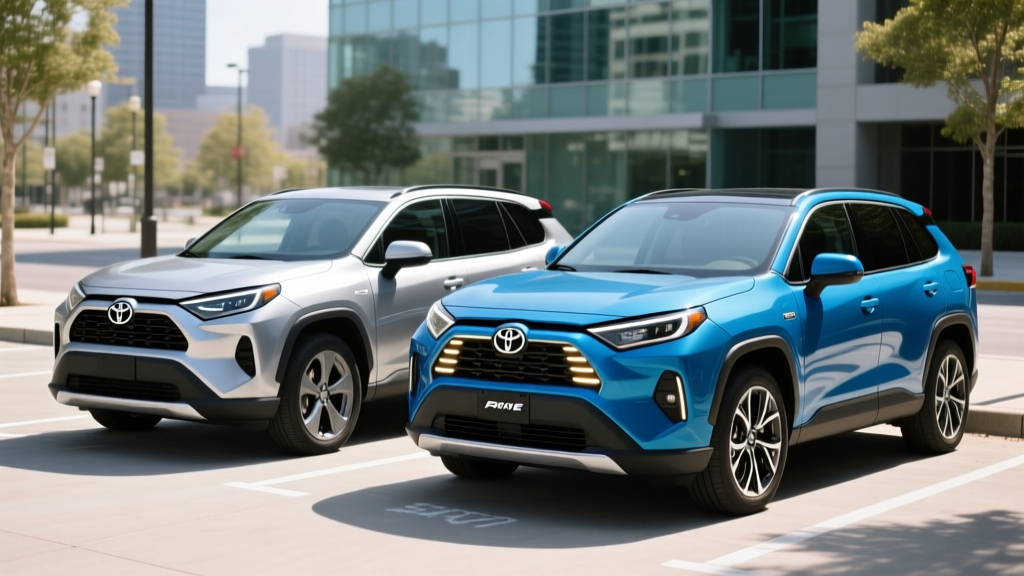
If you've been researching compact SUVs with electrified powertrains, the Toyota RAV4 Hybrid and Prime lineup sits at the top of nearly every shortlist — and for good reason. Toyota sells more RAV4s than almost any other vehicle in America, and the electrified variants now represent a significant share of those sales. But with two distinct flavors — the conventional hybrid (HEV) and the plug-in hybrid Prime (PHEV) — buyers face a real decision that goes beyond just the badge.
This guide breaks down the 2026 Toyota RAV4 Hybrid and RAV4 Prime with exact EPA figures, real-world efficiency data, charging logistics, powertrain specs, pricing, and tax-credit eligibility. Whether you're cross-shopping against a full EV like the Tesla Model Y or a gas-only compact SUV, here's everything you need to decide which RAV4 — if either — fits your driving life.
HEV vs PHEV: Understanding the Two RAV4 Electrified Options
Before comparing numbers, it's critical to understand that the RAV4 Hybrid and RAV4 Prime are fundamentally different vehicles under the skin.
RAV4 Hybrid (HEV)
A conventional hybrid that never needs to be plugged in. It uses a small battery (approximately 1.6 kWh) charged entirely through regenerative braking and the gasoline engine. The electric motor assists the gas engine to reduce fuel consumption, but the vehicle cannot drive on electricity alone for meaningful distances. Think of it as a more efficient gas car.
RAV4 Prime (PHEV)
A plug-in hybrid with a much larger battery (18.1 kWh) that you charge by plugging in. It can drive 42 miles on electricity alone before the gas engine kicks in, functioning as a full EV for most daily commutes. Once the battery is depleted, it operates as a conventional hybrid. Think of it as an EV and a hybrid in one vehicle.
The distinction matters enormously for your daily routine, your fuel budget, and your charging setup. If you have access to home or workplace charging, the Prime unlocks dramatically lower operating costs. If you don't, the standard Hybrid delivers strong efficiency without any lifestyle change.
Fuel Economy and Electric Range: The Numbers That Matter
EPA figures tell a clear story: both variants are highly efficient, but the Prime's ability to run on electricity changes the math for drivers with short commutes.
| Metric | RAV4 Hybrid (HEV) | RAV4 Prime (PHEV) |
|---|---|---|
| EPA City MPG | 41 MPG | 40 MPG (hybrid mode) |
| EPA Highway MPG | 38 MPG | 36 MPG (hybrid mode) |
| EPA Combined MPG | 39 MPG | 38 MPG (hybrid mode) |
| MPGe (electric mode) | N/A | 94 MPGe |
| Electric-Only Range | N/A | 42 miles |
| Total Combined Range | ~580 miles | ~600 miles |
| Fuel Tank Capacity | 14.5 gallons | 14.5 gallons |
Source: fueleconomy.gov
Real-World MPG: What to Actually Expect
Toyota hybrids are famous for exceeding EPA city estimates in stop-and-go driving because regenerative braking recovers energy that gas cars waste as heat. In real-world city testing, many RAV4 Hybrid owners report 42-44 MPG. Highway driving is a different story — at sustained 75-80 mph speeds, expect 33-35 MPG, as the gasoline engine does more of the work without regen assistance.
For the RAV4 Prime in hybrid mode (battery depleted), real-world figures track closely with EPA numbers. In EV mode, the 42-mile electric range holds up well in moderate temperatures but can drop to 32-35 miles in freezing weather due to cabin heating demands and reduced battery efficiency.
Powertrain and Performance Specs
Both RAV4 electrified models use Toyota's proven hybrid synergy drive system built around a 2.5-liter four-cylinder engine, but the Prime's larger battery and more powerful electric motors give it a significant performance advantage.
| Specification | RAV4 Hybrid | RAV4 Prime |
|---|---|---|
| Engine | 2.5L 4-cyl + 2 electric motors | 2.5L 4-cyl + 2 electric motors |
| Combined Horsepower | 219 hp | 302 hp |
| 0-60 mph | 7.4 seconds | 5.7 seconds |
| Drivetrain | AWD (electronic rear motor) | AWD (electronic rear motor) |
| Battery Capacity | ~1.6 kWh (NiMH) | 18.1 kWh (lithium-ion) |
| Towing Capacity | 1,750 lbs | 2,500 lbs |
| Cargo Volume (rear seats up) | 37.5 cu ft | 33.5 cu ft |
The Prime's 302 horsepower makes it one of the quickest compact SUVs in its class — quicker than many turbocharged gas rivals and significantly quicker than the standard Hybrid. The trade-off is cargo space: the Prime's larger battery sits under the floor, reducing rear cargo volume by about 4 cubic feet.
Charging the RAV4 Prime: Times, Levels, and Home Setup
If you're considering the Prime, understanding the charging logistics is essential. The standard RAV4 Hybrid requires no charging whatsoever — it's fueled exclusively by gasoline.
| Charging Level | Power (kW) | Time (0-100%) | Miles of EV Range per Hour |
|---|---|---|---|
| Level 1 (120V household outlet) | ~1.4 kW | ~12 hours | ~3-4 miles/hr |
| Level 2 (240V, standard home charger) | 3.3 kW (standard) | ~5.5 hours | ~7-8 miles/hr |
| Level 2 (240V, optional 6.6 kW onboard charger) | 6.6 kW | ~2.5 hours | ~16-17 miles/hr |
| DC Fast Charging | Not supported | N/A | N/A |
Critical note: The RAV4 Prime cannot DC fast charge. It is limited to Level 1 and Level 2 AC charging only. This is typical for PHEVs — the battery is small enough that overnight Level 2 charging fully replenishes it, and DC fast-charging hardware would add cost and weight. However, it also means you cannot top up at highway rest stops the way a full EV owner might.
The optional 6.6 kW onboard charger (available on XSE and higher trims) is a significant upgrade over the base 3.3 kW unit. It cuts charging time roughly in half, making midday top-ups at workplace chargers practical.
Home Level 2 Charging Setup Cost (Estimated)
| Component | Cost Range |
|---|---|
| Level 2 charger (240V, 32A) | $300 – $700 |
| Electrician labor (240V outlet or hardwire) | $500 – $1,500 |
| Electrical panel upgrade (if needed, 200A) | $1,500 – $3,000 |
| Permits and inspection | $50 – $200 |
| Total (typical, no panel upgrade) | $850 – $2,400 |
Always consult a licensed electrician for a site-specific quote. Panel upgrades are not always necessary but can be required in older homes.
Pricing, Trims, and Tax Credit Eligibility
The RAV4 Hybrid and Prime occupy different price brackets, and the gap has meaningful implications for your total cost of ownership.
| Model & Trim | 2026 MSRP (est.) |
|---|---|
| RAV4 Hybrid LE | $33,425 |
| RAV4 Hybrid XLE | $35,075 |
| RAV4 Hybrid Woodland Edition | $36,425 |
| RAV4 Hybrid Limited | $39,575 |
| RAV4 Prime SE | $44,990 |
| RAV4 Prime XSE | $47,860 |
| RAV4 Prime XSE Premium | $51,310 |
Prices include destination charge. Actual dealer pricing may vary.
Federal Tax Credit Status
The RAV4 Prime no longer qualifies for the federal §30D new clean vehicle tax credit. Under current IRS rules effective for 2026, the credit requires that battery components and critical minerals meet specific domestic-sourcing thresholds. The RAV4 Prime is manufactured in Japan, and its battery supply chain does not meet these requirements.
Key §30D eligibility rules for reference:
- Vehicle MSRP cap: $80,000 for SUVs (RAV4 Prime qualifies)
- Buyer income cap: $150,000 single / $300,000 joint (varies by filer)
- Battery critical minerals: must meet annual percentage thresholds sourced from US or FTA partners
- Battery components: must meet annual percentage thresholds manufactured in North America
- Point-of-sale transfer option available for qualifying vehicles
Source: IRS.gov §30D. Tax rules change frequently — consult a tax professional before purchasing.
The standard RAV4 Hybrid does not qualify for any federal EV tax credit, as it is not a plug-in vehicle. Some states and local utilities offer rebates for hybrids and PHEVs — check your state energy office or utility provider for current programs.
Battery Warranty, Reliability, and Replacement Cost
Toyota's hybrid system is among the most proven in the industry, with over 25 years of real-world data since the original Prius. Battery longevity is consistently the top concern for hybrid buyers, so let's address it directly.
Toyota Hybrid Battery Warranty
- Hybrid battery: 10 years / 150,000 miles (whichever comes first)
- Hybrid system components: 8 years / 100,000 miles
- Basic vehicle warranty: 3 years / 36,000 miles
- Powertrain warranty: 5 years / 60,000 miles
Toyota's 10-year/150,000-mile hybrid battery warranty is one of the strongest in the industry and applies in all 50 states. The battery must retain sufficient capacity to function properly; if it degrades below a usable threshold within the warranty period, Toyota covers replacement.
Real-World Battery Longevity
Toyota hybrid batteries routinely last well beyond the warranty period. Third-party fleet data and owner surveys show many Toyota hybrids reaching 200,000+ miles on the original hybrid battery. The RAV4 Hybrid's nickel-metal hydride (NiMH) battery is a mature, conservative chemistry known for exceptional cycle life. The Prime's lithium-ion battery operates with a larger usable buffer and active thermal management, which helps preserve long-term health.
Replacement Cost if Out of Warranty
If your hybrid battery fails outside the warranty window, here's what to budget:
- RAV4 Hybrid (NiMH): $2,000 – $3,500 (remanufactured or new from Toyota)
- RAV4 Prime (lithium-ion, 18.1 kWh): $4,000 – $6,500 (estimated, based on comparable Toyota PHEV batteries)
Independent hybrid repair shops can often replace individual battery modules for significantly less than a full pack replacement — typically $500–$1,500 depending on how many cells have degraded.
Who Should Choose the RAV4 Hybrid, the Prime, or a Full EV?
The right choice depends on your driving patterns, charging access, and budget. Here's a practical decision framework:
Choose the RAV4 Hybrid (HEV) If:
- You don't have access to home or workplace charging
- You want maximum simplicity — no plugs, no charging apps, no electrical work
- Your budget is under $40,000
- You drive a mix of city and highway and want consistent 38-42 MPG
- You want a proven, low-risk ownership experience
Choose the RAV4 Prime (PHEV) If:
- You can charge at home (even a standard 120V outlet works overnight for 42 miles)
- Your daily round-trip commute is under 40 miles
- You want EV-like running costs on weekdays and gas-engine flexibility for road trips
- You value the 302 hp performance upgrade
- You're not ready to commit to a full EV but want to reduce gas consumption significantly
Choose a Full EV (e.g., Tesla Model Y, Hyundai Ioniq 5) If:
- You have reliable home Level 2 charging
- Your daily driving rarely exceeds 250 miles, or you're comfortable with DC fast charging on road trips
- You want to eliminate gasoline entirely and minimize maintenance
- You qualify for the $7,500 federal EV tax credit (which the Prime does not)
- You prioritize the lowest per-mile fuel cost
Pros and Cons at a Glance
RAV4 Hybrid — Pros
- Excellent real-world city MPG (42+ achievable)
- No charging infrastructure required
- Lower starting price than the Prime
- Strong reliability track record
- Standard AWD across all trims
RAV4 Hybrid — Cons
- No electric-only driving capability
- Modest 219 hp — adequate but not quick
- No federal tax credit eligibility
- Highway MPG drops at sustained high speeds
RAV4 Prime — Pros
- 42 miles of electric-only range covers most commutes
- 302 hp makes it genuinely quick (5.7s 0-60)
- 94 MPGe in EV mode dramatically cuts fuel costs
- 600+ miles total range eliminates range anxiety
- Higher towing capacity (2,500 lbs)
RAV4 Prime — Cons
- $11,000+ price premium over base Hybrid
- No DC fast charging capability
- Reduced cargo space (33.5 vs 37.5 cu ft)
- No federal tax credit (as of 2026)
- Long wait times at some dealers due to high demand
Frequently Asked Questions
How many MPG does the Toyota RAV4 Hybrid get?
The EPA rates the 2026 RAV4 Hybrid at 41 city / 38 highway / 39 combined MPG. In real-world city driving with frequent stops, many owners report 42-44 MPG thanks to aggressive regenerative braking. Highway driving at 75+ mph typically yields 33-35 MPG.
How far can the RAV4 Prime go on electric only?
The EPA rates the RAV4 Prime at 42 miles of electric-only range. In moderate temperatures at city speeds, you may see 44-45 miles. In freezing weather or at highway speeds, expect 32-37 miles before the gas engine engages.
Does the RAV4 Prime qualify for a federal tax credit?
No. As of 2026, the RAV4 Prime does not qualify for the IRS §30D new clean vehicle credit due to battery-sourcing requirements. The vehicle is manufactured in Japan, and its battery components and critical minerals do not meet the domestic-content thresholds. Some state and utility incentives may still apply — check your local programs.
Is the RAV4 Hybrid reliable? What about battery replacement cost?
Toyota's hybrid system has an exceptional reliability record spanning 25+ years. The hybrid battery is covered by a 10-year/150,000-mile warranty. Out-of-warranty replacement costs approximately $2,000–$3,500 for the Hybrid and $4,000–$6,500 for the Prime. Many Toyota hybrid batteries last 200,000+ miles without issue.
Do I need to plug in the RAV4 Hybrid?
No. The standard RAV4 Hybrid (HEV) charges its battery entirely through regenerative braking and the gasoline engine. You never plug it in. Only the RAV4 Prime (PHEV) requires plugging in to access its electric-only range — if you never plug in the Prime, it simply operates as a conventional hybrid.
Can the RAV4 Prime DC fast charge?
No. The RAV4 Prime supports Level 1 (120V) and Level 2 (240V) AC charging only. With the optional 6.6 kW onboard charger, a full charge takes approximately 2.5 hours on a Level 2 home charger. DC fast charging is not available on any current Toyota PHEV.
Hybrid vs PHEV vs EV — which is right for me?
If you lack home charging and want simplicity, choose the Hybrid (HEV). If you have home charging and a sub-40-mile commute but want road-trip flexibility, choose the Prime (PHEV). If you have home charging, want zero gas costs, and qualify for the $7,500 federal EV credit, consider a full EV like the Model Y or Ioniq 5.