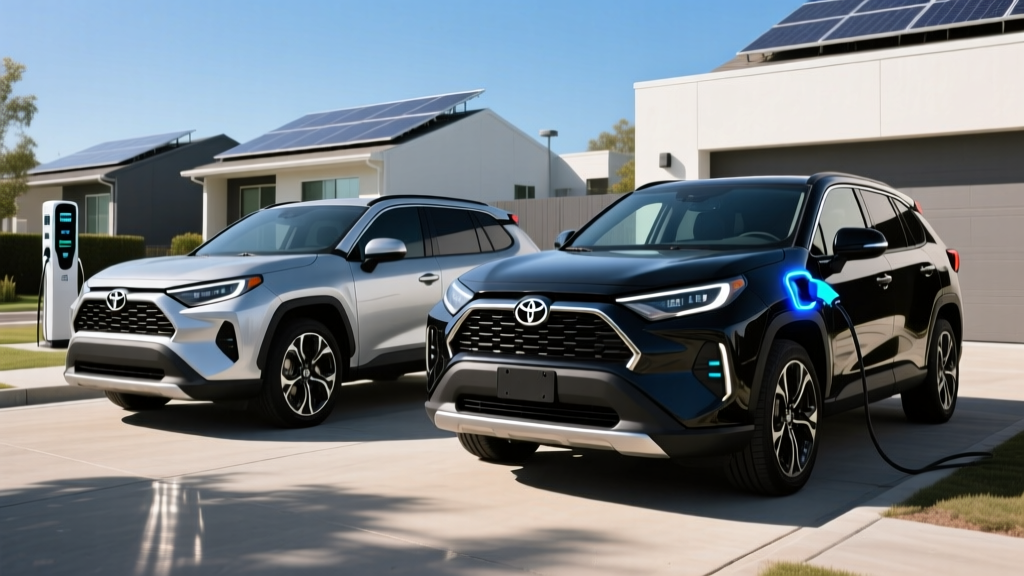
The Toyota RAV4 remains the best-selling non-truck in America, and its electrified variants — the conventional RAV4 Hybrid (HEV) and the plug-in RAV4 Prime (PHEV) — account for a growing share of those sales. For buyers navigating the hybrid automotive landscape in 2026, the RAV4 lineup offers a case study in how self-charging hybrids and plug-in hybrids serve fundamentally different use cases, despite sharing a nameplate.
This guide breaks down the 2026 RAV4 Hybrid and RAV4 Prime with exact EPA figures, real-world efficiency observations, powertrain specs, battery warranty details, and current federal tax credit eligibility. Whether you're cross-shopping against a full EV like the Tesla Model Y or a gas-only compact SUV, the numbers below will clarify which version fits your driving pattern.
HEV vs PHEV: How the Two RAV4 Electrified Models Differ
Before diving into specs, the structural difference between these two vehicles matters for daily ownership:
RAV4 Hybrid (HEV)
- How it charges: Regenerative braking and the gasoline engine — never plugs in
- Battery: 1.6 kWh nickel-metal hydride (NiMH), small buffer
- Electric-only driving: Brief low-speed EV mode only (under ~1 mile)
- Best for: Drivers without home charging access who want better MPG with zero behavior change
RAV4 Prime (PHEV)
- How it charges: Plug in to a wall outlet, Level 2 charger, or rely on the engine
- Battery: 18.1 kWh lithium-ion (usable ~14.5 kWh)
- Electric-only driving: EPA-rated 42 miles before the gas engine engages
- Best for: Drivers with home Level 2 charging and commutes under 40 miles who want EV-like daily driving with gas-engine backup
The critical mistake buyers make is assuming the RAV4 Hybrid can plug in. It cannot. If you want electric-only commuting, you need the Prime. If you want a fuel-efficient SUV that works exactly like a gas car at the pump, the HEV is the simpler, less expensive choice.
Fuel Economy: EPA MPG and Real-World Observations
Fuel economy is where the RAV4 Hybrid earns its reputation. The 2026 model carries over the fifth-generation hybrid powertrain with minor efficiency refinements.
| Model | City MPG | Highway MPG | Combined MPG | MPGe (PHEV EV mode) |
|---|---|---|---|---|
| RAV4 Hybrid AWD | 41 | 38 | 39 | N/A |
| RAV4 Prime AWD (charge-sustaining) | 40 | 36 | 38 | 94 MPGe |
Source: fueleconomy.gov, EPA estimates for 2026 model year.
Real-World MPG: Hybrids Often Beat the Sticker in the City
Unlike gas-only vehicles, Toyota's hybrid system thrives in stop-and-go traffic where regenerative braking continuously recharges the small battery. In real-world city driving, owners consistently report 42-45 MPG in the RAV4 Hybrid — exceeding the EPA city estimate. Highway driving tells the opposite story: at sustained 70-80 mph speeds, expect 34-36 MPG, as the electric motor provides less assistance and aerodynamic drag dominates.
For the RAV4 Prime, once the battery depletes after 42 electric miles, the vehicle operates as a conventional hybrid at roughly 36-38 MPG combined. If your daily driving stays within the electric range and you charge nightly, your effective gasoline consumption can drop to near zero for weeks at a time.
Real-world range expectation: The RAV4 Hybrid's 14.5-gallon tank yields approximately 520-565 real-world miles per tank depending on your city/highway mix. The RAV4 Prime adds 42 electric miles on top of roughly 480 gas-powered miles for a total range exceeding 520 miles when fully charged and fueled.
Powertrain Specs: Horsepower, Engines, and Motors
| Specification | RAV4 Hybrid | RAV4 Prime |
|---|---|---|
| Engine | 2.5L 4-cylinder Atkinson cycle | 2.5L 4-cylinder Atkinson cycle |
| Engine horsepower | 176 hp | 177 hp |
| Front electric motor | 118 hp | 174 hp |
| Rear electric motor | 54 hp | 67 hp |
| Net combined system HP | 219 hp | 302 hp |
| 0-60 mph | 7.4 seconds | 5.5 seconds |
| Drivetrain | AWD (e-AWD, electronic rear axle) | AWD (e-AWD, electronic rear axle) |
| Transmission | eCVT (planetary gearset) | eCVT (planetary gearset) |
| Towing capacity | 1,750 lbs | 2,500 lbs |
The Prime's 302 combined horsepower makes it the quickest RAV4 Toyota has ever produced — quicker than many turbocharged gas crossovers in this segment. That performance comes from the larger, more powerful electric motors paired with the bigger battery that can deliver higher current. The standard Hybrid's 219 hp is adequate for merging and passing, but not exhilarating.
RAV4 Prime: Battery, Electric Range, and Charging Details
For buyers considering the PHEV, the battery and charging characteristics determine whether the Prime's premium pays off in daily life.
| Specification | RAV4 Prime |
|---|---|
| Battery chemistry | Lithium-ion |
| Total battery capacity | 18.1 kWh |
| Usable capacity | ~14.5 kWh |
| EPA electric-only range | 42 miles |
| Level 1 charging (120V, 12A) | ~12 hours (full charge) |
| Level 2 charging (240V, 32A) | ~2.5 hours (full charge) |
| DC fast charging | Not available |
| Charge port | J1772 (Level 1 and Level 2) |
The absence of DC fast charging is a deliberate Toyota engineering choice: the 18.1 kWh battery is small enough that Level 2 charging fully replenishes it in roughly 2.5 hours, making public fast-charging infrastructure largely irrelevant for daily PHEV use. The Prime is designed to charge at home overnight or at a workplace Level 2 station, then run on electricity for the commute.
Electric-Only Range in Real Conditions
The EPA's 42-mile electric range assumes moderate temperatures and mixed driving. In practice, expect 35-38 miles in warm weather on suburban roads. In winter (below 35°F), cabin heating draws significant energy from the battery, reducing electric-only range to roughly 28-32 miles. Highway-speed electric driving at 70+ mph will also deplete the battery faster, yielding perhaps 30-33 miles before the engine engages.
Pricing, Trims, and Federal Tax Credit Eligibility
| Model / Trim | 2026 MSRP (est.) |
|---|---|
| RAV4 Hybrid LE | $34,500 |
| RAV4 Hybrid XLE | $36,800 |
| RAV4 Hybrid Woodland Edition | $38,200 |
| RAV4 Hybrid Limited | $41,500 |
| RAV4 Prime SE | $47,500 |
| RAV4 Prime XSE | $51,000 |
Federal Tax Credit for the RAV4 Prime (PHEV)
The RAV4 Prime qualifies for a partial federal tax credit under IRS Section 30D. However, eligibility depends on several factors that change based on battery sourcing requirements:
- Credit amount: Up to $3,750 for the RAV4 Prime (partial credit — the full $7,500 requires meeting both critical minerals AND battery component sourcing thresholds, which varies by model year production batch)
- MSRP cap: SUVs must be under $80,000 — the Prime clears this easily
- Buyer income cap: Modified AGI must not exceed $150,000 (single), $225,000 (head of household), or $300,000 (joint filing)
- Point-of-sale transfer: As of 2024, the credit can be transferred to the dealer at purchase, reducing your out-of-pocket cost directly — confirm with your dealer
- Conventional RAV4 Hybrid (HEV): Does NOT qualify for the §30D credit — it lacks sufficient battery capacity and plug-in capability
Tax credit rules are subject to change. Consult a tax professional and verify current eligibility on irs.gov before purchasing.
State Incentives
Several states offer additional rebates or HOV lane access for PHEVs. California's CVRP program, Colorado's state tax credit, and various utility company rebates may apply. Check your state energy office and local utility for current programs — these vary widely by jurisdiction and funding availability.
Battery Warranty, Reliability, and Replacement Cost
Hybrid Battery Warranty: Toyota covers the hybrid battery in both the RAV4 Hybrid and RAV4 Prime for 10 years / 150,000 miles (whichever comes first) in all 50 states. This has been Toyota's standard since the 2020 model year, up from the previous 8-year/100,000-mile coverage.
General powertrain warranty: 5 years / 60,000 miles.
How Long Do Toyota Hybrid Batteries Actually Last?
Toyota's hybrid battery track record is among the best in the industry. The Prius, which shares similar hybrid architecture, has documented cases of original batteries lasting 200,000+ miles. The RAV4 Hybrid's NiMH battery is relatively small and operates in a narrow state-of-charge window (roughly 40-80%), which dramatically reduces stress and degradation compared to a full EV battery that cycles from 10-100%.
The RAV4 Prime's larger lithium-ion battery faces more demanding cycles but still benefits from Toyota's conservative buffer management — the usable 14.5 kWh is substantially less than the 18.1 kWh total capacity, leaving top and bottom buffers that protect long-term health.
Battery Replacement Cost
If a hybrid battery does fail outside warranty:
- RAV4 Hybrid (NiMH): $2,500-$4,000 for a replacement battery pack (refurbished options available for less)
- RAV4 Prime (lithium-ion): $5,000-$8,000 estimated — higher due to larger capacity and lithium-ion chemistry
For context, out-of-warranty hybrid battery failures in Toyota products remain statistically uncommon based on long-term owner data and Consumer Reports reliability surveys, where Toyota consistently ranks near the top for hybrid powertrain durability.
RAV4 Hybrid vs Prime vs Full EV: Decision Framework
Choose the RAV4 Hybrid (HEV) if:
- You cannot install a home charger (apartment, street parking, no garage)
- Your budget is under $40,000
- You want maximum simplicity — no plugs, no charging apps, no behavior change
- You drive mostly city miles where the hybrid system excels (40+ MPG real-world)
- You don't need the performance or electric-only driving the Prime offers
Choose the RAV4 Prime (PHEV) if:
- You have access to Level 2 charging at home or work
- Your daily round-trip commute is under 42 miles (most US commutes are)
- You want EV-like daily driving without range anxiety on road trips
- You value the 302 hp performance upgrade and 2,500-lb towing capacity
- You qualify for the partial federal tax credit, narrowing the price gap with the HEV
Choose a full EV (e.g., Tesla Model Y, Hyundai Ioniq 5) if:
- You want zero gasoline purchases and minimal maintenance (no oil changes, no engine)
- You have reliable home charging and access to DC fast charging for road trips
- You want the full $7,500 federal tax credit (subject to eligibility)
- Your household has a second gas vehicle for long trips, or you're comfortable planning charging stops
Pros and Cons at a Glance
RAV4 Hybrid — Pros
- 39 MPG combined, often 42+ in real city driving
- No plug-in required — zero lifestyle change
- 10-year/150,000-mile battery warranty
- Lower starting price ($34,500)
- Proven reliability track record
RAV4 Hybrid — Cons
- No electric-only commuting capability
- No federal tax credit eligibility
- 219 hp is adequate but not quick
- 1,750-lb towing limit
RAV4 Prime — Pros
- 42 miles electric-only covers most commutes
- 302 hp — quickest RAV4 ever
- Partial federal tax credit (~$3,750)
- 94 MPGe in electric mode
- 520+ mile total range (electric + gas)
RAV4 Prime — Cons
- $13,000 premium over Hybrid LE base
- No DC fast charging
- Requires home/work charging to realize value
- Electric range drops to ~28-32 miles in winter
- Higher battery replacement cost if out of warranty
Frequently Asked Questions
How many MPG does the 2026 RAV4 Hybrid get?
The EPA rates the RAV4 Hybrid AWD at 41 city / 38 highway / 39 combined MPG. In real-world city driving, many owners report 42-45 MPG thanks to regenerative braking. Highway driving at 75+ mph typically yields 34-36 MPG.
How far can the RAV4 Prime go on electric only?
The EPA rates the RAV4 Prime at 42 miles of electric-only range. Real-world results vary: expect 35-38 miles in warm weather and 28-32 miles in freezing temperatures due to cabin heating demands. Once the battery depletes, the Prime operates as a conventional hybrid at approximately 36-38 MPG.
Does the RAV4 Hybrid need to be plugged in?
No. The conventional RAV4 Hybrid (HEV) charges its small battery entirely through regenerative braking and the gasoline engine. You fuel it at a gas station like any other vehicle. Only the RAV4 Prime (PHEV) requires plugging in to access its 42-mile electric range.
Does the RAV4 Hybrid or Prime qualify for a tax credit?
The conventional RAV4 Hybrid does not qualify for the federal §30D clean vehicle credit. The RAV4 Prime may qualify for up to $3,750 depending on battery sourcing compliance, buyer income limits ($150K single / $300K joint), and the SUV's MSRP being under $80,000. The credit can be transferred to the dealer at point of sale. Always verify current rules on irs.gov and consult a tax professional.
Is the RAV4 Hybrid reliable, and what does battery replacement cost?
Toyota's hybrid systems have a 25+ year track record dating to the original Prius. The hybrid battery is warrantied for 10 years / 150,000 miles. Out-of-warranty replacement costs approximately $2,500-$4,000 for the HEV's NiMH battery and $5,000-$8,000 for the Prime's lithium-ion pack. Premature failures are statistically rare based on long-term owner data and Consumer Reports reliability ratings.
Can the RAV4 Prime DC fast charge?
No. The RAV4 Prime supports Level 1 (120V) and Level 2 (240V) AC charging only. A full Level 2 charge takes approximately 2.5 hours. Given the 18.1 kWh battery size, Toyota determined that DC fast charging infrastructure was unnecessary — the Prime is designed for home and workplace charging, not public fast-charger stops.
Hybrid vs PHEV vs EV — which should I choose?
Choose the HEV if you lack charging access and want maximum simplicity. Choose the PHEV (Prime) if you can charge at home and want electric commuting with gas-engine backup for road trips. Choose a full EV if you want zero gasoline costs, have reliable charging access, and are comfortable planning DC fast-charge stops on longer trips. The right answer depends on your charging access, daily mileage, and willingness to adapt your fueling routine.