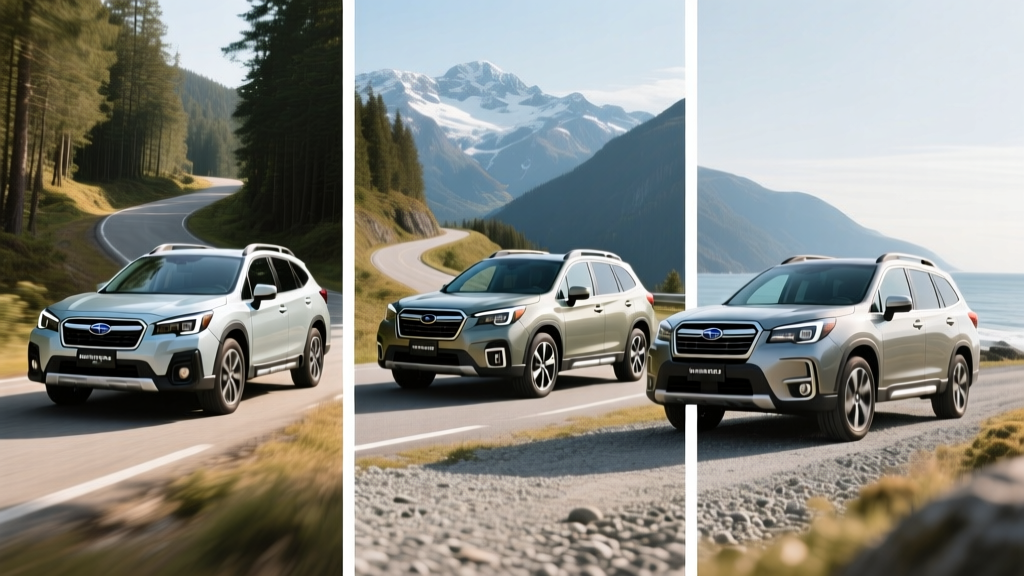
Subaru's hybrid lineup has quietly expanded into one of the most practical AWD-focused offerings in the segment. For 2025, the brand fields three conventional hybrid (HEV) models—the Crosstrek Hybrid, Forester Hybrid, and the newly introduced Outback Hybrid—all built around Subaru's revised e-Boxer powertrain. Unlike plug-in hybrids, none of these require a charger or change in daily routine. They simply use a small battery and electric motor to assist the boxer engine, cutting fuel consumption while retaining Subaru's hallmark symmetrical all-wheel drive.
This guide breaks down each 2025 Subaru hybrid with exact EPA figures, real-world expectations, pricing, and whether any qualify for federal tax incentives. If you're weighing a Subaru hybrid against a full EV or a conventional gas model, the data below will clarify which path makes sense.
2025 Subaru Hybrid Lineup at a Glance
All three 2025 Subaru hybrids share the same fundamental architecture: a 2.5-liter naturally aspirated flat-four engine paired with an electric motor integrated into the Lineartronic CVT. This is a conventional hybrid (HEV)—the battery recharges through regenerative braking and engine power. You never plug it in.
| Spec | Crosstrek Hybrid | Forester Hybrid | Outback Hybrid |
|---|---|---|---|
| Powertrain | 2.5L Flat-4 + e-motor | 2.5L Flat-4 + e-motor | 2.5L Flat-4 + e-motor |
| Combined HP | 194 hp | 194 hp | 194 hp |
| Drivetrain | Symmetrical AWD | Symmetrical AWD | Symmetrical AWD |
| Transmission | Lineartronic CVT | Lineartronic CVT | Lineartronic CVT |
| EPA City MPG | 36 | 35 | 34 |
| EPA Highway MPG | 34 | 33 | 32 |
| EPA Combined MPG | 35 | 34 | 33 |
| Battery Type | Lithium-ion (~1.1 kWh) | Lithium-ion (~1.1 kWh) | Lithium-ion (~1.1 kWh) |
| Plug-In Required? | No (HEV) | No (HEV) | No (HEV) |
| Base MSRP | $30,995 | $33,995 | $37,995 |
| Federal Tax Credit | Not eligible | Not eligible | Not eligible |
HEV vs. PHEV vs. EV: Which Subaru Buyer Are You?
Subaru currently offers only conventional hybrids (HEVs) in the US market. The previous Crosstrek PHEV was discontinued after the 2023 model year. Here's how the three electrification levels compare for a Subaru shopper:
Conventional Hybrid (HEV) — All 2025 Subaru Hybrids
- No plug, no charging infrastructure needed
- Self-charging via regen braking and engine
- 33–35 MPG combined (real-world often higher in city driving)
- No federal tax credit under IRS §30D (requires plug-in capability)
- Best for: Drivers without home charging access, rural/suburban commuters, those who want simplicity
Plug-In Hybrid (PHEV) — Not Available from Subaru in 2025
- Requires Level 2 home charging for full benefit
- Typically 20–40 miles electric-only range
- May qualify for up to $7,500 federal credit (subject to §30D sourcing, MSRP, and income caps)
- Best for: Households with home charging and short commutes who want occasional gas-free driving
Battery Electric Vehicle (BEV) — e.g., Subaru Solterra
- Full electric, 222–227 miles EPA range (Solterra)
- Requires reliable home or workplace charging
- Eligible for $7,500 federal credit (if §30D requirements met; point-of-sale transfer available)
- Best for: Two-car households, urban/suburban drivers with charging access, those targeting lowest fuel cost
Choose a 2025 Subaru HEV if: You want AWD efficiency with zero lifestyle change, you lack home charging, or you frequently drive in cold/rural conditions where charging infrastructure is sparse.
Consider a PHEV from another brand if: You have a Level 2 charger at home and a commute under 35 miles round-trip. Toyota RAV4 Prime and Hyundai Tucson PHEV are strong AWD alternatives.
Go full BEV (Solterra or competitor) if: You have reliable home charging, want the lowest per-mile energy cost, and your daily driving stays within ~180 miles.
Fuel Economy: EPA vs. Real-World MPG
The EPA rates the 2025 Crosstrek Hybrid at 35 MPG combined, the Forester Hybrid at 34, and the Outback Hybrid at 33. These figures come from fueleconomy.gov and represent standardized testing.
| Model | EPA Combined | Real-World City | Real-World Highway | Cold-Weather (Below 30°F) |
|---|---|---|---|---|
| Crosstrek Hybrid | 35 MPG | 36–39 MPG | 31–34 MPG | 29–32 MPG |
| Forester Hybrid | 34 MPG | 35–38 MPG | 30–33 MPG | 28–31 MPG |
| Outback Hybrid | 33 MPG | 34–37 MPG | 29–32 MPG | 27–30 MPG |
Why real-world city MPG often exceeds the EPA sticker: Conventional hybrids recapture energy during stop-and-go braking, which is where the electric motor contributes most. On the highway, the gasoline engine does nearly all the work, and the hybrid advantage narrows. Expect your actual combined MPG to closely track—or slightly beat—the EPA number if most of your driving is urban or suburban. Sustained highway trips at 75+ MPH will pull numbers below the sticker.
Cold-weather impact: Hybrid efficiency drops 8–15% in freezing temperatures. The engine runs more frequently to provide cabin heat (Subarus lack a heat pump in the hybrid system), and battery chemistry becomes less efficient. This is less severe than the 20–30% range loss seen in full EVs, but it's still measurable.
Powertrain Deep Dive: The e-Boxer System
Subaru's e-Boxer hybrid system pairs the FB25 2.5-liter horizontally opposed four-cylinder with a permanent-magnet electric motor sandwiched into the CVT housing. Combined output is 194 horsepower—roughly 12 hp more than the non-hybrid 2.5L models.
The lithium-ion traction battery stores approximately 1.1 kWh of energy. This is a small pack by design: it's enough to assist during acceleration, enable brief low-speed electric-only movement (typically under 1 mile at parking-lot speeds), and smooth out CVT operation. It does not provide meaningful electric-only range like a PHEV would.
Regenerative braking is tuned progressively—Subaru avoids the aggressive one-pedal feel of some competitors. The transition from regen to friction braking is well-calibrated, which matters for daily comfort. There is no selectable regen mode or paddles to adjust braking intensity.
All three models retain Subaru's X-MODE for off-road and low-traction situations. The hybrid system does not compromise ground clearance: the Crosstrek Hybrid maintains 8.7 inches, the Forester Hybrid 8.7 inches, and the Outback Hybrid 8.7 inches.
Pricing and Tax Credit Reality
The 2025 Subaru hybrid lineup starts at $30,995 for the Crosstrek Hybrid (Premium trim) and climbs to $37,995 for the Outback Hybrid. These prices represent a $2,000–$3,500 premium over equivalent non-hybrid trims.
| Model / Trim | MSRP | Hybrid Premium vs. Gas | Fuel Savings (5 yr, 15K mi/yr) |
|---|---|---|---|
| Crosstrek Hybrid Premium | $30,995 | +$2,500 | ~$1,800–$2,400 |
| Forester Hybrid Premium | $33,995 | +$2,500 | ~$1,700–$2,300 |
| Outback Hybrid Limited | $37,995 | +$3,000 | ~$1,600–$2,200 |
Federal Tax Credit: Not Eligible
None of the 2025 Subaru hybrids qualify for the IRS §30D Clean Vehicle Credit. That credit requires a vehicle with a battery capacity of at least 7 kWh and plug-in charging capability—criteria that only PHEVs and BEVs meet. The e-Boxer system's ~1.1 kWh battery and lack of a charge port place it outside IRS §30D eligibility.
Some states offer their own hybrid incentives (Colorado, for example, has had hybrid-specific rebates). Check your state's energy office or department of revenue for current programs. These vary by jurisdiction and change frequently.
Break-even math: At $3.40/gallon regular and 15,000 miles/year, the Crosstrek Hybrid (35 MPG) saves roughly $370–$480 annually over the non-hybrid Crosstrek (29 MPG combined). The $2,500 hybrid premium pays back in about 5–7 years. If gas prices rise above $4.00/gallon, payback shortens to 4–5 years. The hybrid also holds resale value well—Subaru hybrids historically depreciate slower than their gas counterparts.
Reliability and Battery Warranty
Subaru's hybrid battery warranty covers 8 years/100,000 miles (whichever comes first) in most states, and 10 years/150,000 miles in California-emissions states (CA, CT, MA, ME, NJ, NY, OR, RI, VT, WA, and others adopting CARB standards). This warranty guarantees the battery will retain sufficient capacity to support the hybrid system's function—it's not a capacity-percentage guarantee like you'd see on a BEV.
Hybrid Battery Replacement Cost
If a Subaru e-Boxer hybrid battery fails outside warranty, replacement costs typically range from $2,000 to $3,500 including labor at a dealership. The small ~1.1 kWh pack is less expensive to replace than a full EV battery. Third-party hybrid battery refurbishers can sometimes source replacements for $1,200–$2,000.
Longevity data: Subaru's hybrid system is relatively new in its current e-Boxer form (introduced globally in 2019, US market 2020+). However, the FB25 engine is well-proven, and the electric motor integration is mechanically simple. Toyota's longer-running hybrid systems show 150,000–200,000+ mile battery lifespans as typical; Subaru's smaller battery and lighter electrical load suggest similar or better longevity, though long-term US data is still accumulating.
The hybrid system adds minimal maintenance burden. There are no additional fluids to change, no belts driven by the e-motor, and regenerative braking extends brake pad life. Subaru's standard 5-year/60,000-mile powertrain warranty and 3-year/36,000-mile basic warranty apply to all non-hybrid-specific components. IIHS has rated recent Subaru models highly for safety, and the hybrid variants share the same structure and crash-test performance.
Pros and Cons: The Honest Assessment
Pros
- AWD standard on every hybrid—no FWD compromise
- Real-world city MPG often beats EPA sticker (36–39 MPG)
- No charging infrastructure required
- Ground clearance and X-MODE retained for light off-road use
- Smooth, progressive regen braking—no learning curve
- Strong resale value; Subaru hybrid demand outpaces supply at many dealers
- Battery warranty up to 10 yr/150K mi in CARB states
Cons
- No federal tax credit—hybrid premium is out-of-pocket
- Small battery means negligible electric-only driving (<1 mi at low speed)
- Highway MPG advantage over gas models is modest (3–5 MPG)
- No PHEV option for those wanting meaningful EV-only commuting
- CVT can drone under hard acceleration (common to Subaru)
- Hybrid trims limited to mid/upper levels—no base-trim hybrid
- ~1.1 kWh battery too small to meaningfully reduce cold-weather engine run time
Frequently Asked Questions
How many MPG does the 2025 Subaru Crosstrek Hybrid get?
The EPA rates the 2025 Crosstrek Hybrid at 36 city / 34 highway / 35 combined MPG. In real-world city driving, owners commonly report 36–39 MPG thanks to regenerative braking. Highway-only trips at 75+ MPH typically return 31–34 MPG.
Can I plug in a 2025 Subaru hybrid to charge it?
No. All 2025 Subaru hybrids are conventional hybrids (HEVs), not plug-in hybrids (PHEVs). The battery charges itself through regenerative braking and the gasoline engine. There is no charge port. Subaru discontinued the Crosstrek PHEV after 2023 and does not currently sell a PHEV in the US market.
How far can a 2025 Subaru hybrid drive on electric only?
Effectively zero meaningful distance. The ~1.1 kWh battery can propel the car at very low speeds (under 20 MPH) for roughly a quarter to half a mile—useful for creeping through a parking lot or a drive-through. This is not a vehicle that offers electric-only commuting. For that capability, you need a PHEV like the Toyota RAV4 Prime (42 miles EV range) or a full BEV.
Do 2025 Subaru hybrids qualify for any tax credit?
They do not qualify for the federal IRS §30D Clean Vehicle Credit, which requires plug-in capability and a minimum 7 kWh battery. Some states offer separate hybrid incentives—check your state's energy office. There is no federal used-vehicle credit applicable to new hybrid purchases either.
Is the Subaru hybrid battery reliable? What does replacement cost?
Subaru's hybrid battery is covered for 8 years/100,000 miles (10 years/150,000 miles in CARB states). Out-of-warranty replacement runs $2,000–$3,500 at a dealer, or $1,200–$2,000 through third-party hybrid specialists. The small battery size and light electrical load suggest good longevity, though long-term US data is still building. The FB25 engine itself has a strong reliability record.
Is a Subaru hybrid worth it over the gas model?
Financially, the $2,500–$3,000 hybrid premium pays back in 5–7 years at current gas prices (~$3.40/gallon). If you plan to keep the vehicle 7+ years, the hybrid is a sound investment—especially given Subaru hybrids' strong resale value. If you trade vehicles every 3–4 years, the premium may not fully recoup. Beyond economics, the hybrid offers smoother low-speed operation and marginally better passing power (194 hp vs. 182 hp on gas models).
How does Subaru's hybrid compare to Toyota's?
Toyota's hybrid system (used in the RAV4 Hybrid, Camry Hybrid, etc.) is more mature and typically delivers 3–5 MPG higher combined than Subaru's e-Boxer. The RAV4 Hybrid, for instance, achieves 39–41 MPG combined vs. the Forester Hybrid's 34 MPG. However, Subaru offers standard AWD across all trims (Toyota's AWD hybrid is an option or specific trim), more ground clearance, and stronger off-road capability via X-MODE. The tradeoff is efficiency vs. all-weather capability.