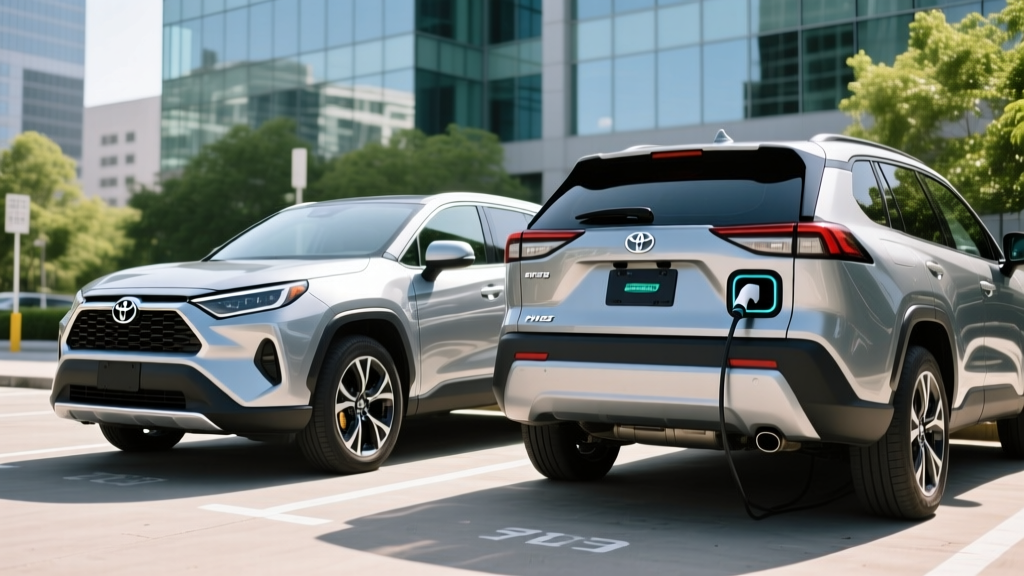
If you're searching for a Toyota hybrid crossover, the 2026 RAV4 lineup gives you two distinct paths: the conventional RAV4 Hybrid (HEV) that never needs a plug, and the RAV4 Prime plug-in hybrid (PHEV) that covers most daily commutes on electricity alone. Both share the same practical compact-crossover footprint, but their powertrains, efficiency profiles, and ownership economics diverge sharply. This guide breaks down every number you need to choose between them.
HEV vs PHEV: How Toyota's Two Hybrid Crossovers Differ
Before comparing trims, it's essential to understand the mechanical split. A conventional hybrid (HEV) like the RAV4 Hybrid uses a small battery (roughly 1.6 kWh) that charges itself through regenerative braking and the gas engine. You never plug it in — you just fuel up and drive, and the hybrid system squeezes more miles out of every gallon.
A plug-in hybrid (PHEV) like the RAV4 Prime carries a much larger battery pack (18.1 kWh usable) and a more powerful electric motor. You plug it in overnight to unlock 42 miles of pure electric driving. Once that electric range is depleted, it operates exactly like a conventional hybrid — no range anxiety, no lifestyle change required on road trips.
HEV vs PHEV at a Glance
| Feature | RAV4 Hybrid (HEV) | RAV4 Prime (PHEV) |
|---|---|---|
| Plug in required? | No — self-charging | Yes — for electric range |
| Battery capacity | ~1.6 kWh (NiMH) | 18.1 kWh usable (Li-ion) |
| Electric-only range | ~1 mile (low-speed only) | 42 miles (EPA) |
| Combined horsepower | 219 hp | 302 hp |
| EPA combined MPG/MPGe | 39 MPG | 94 MPGe (elec) / 38 MPG (gas) |
| 0–60 mph | 7.4 sec | 5.7 sec |
| Starting MSRP (2026) | $33,875 | $44,940 |
Fuel Economy: Real-World MPG for the RAV4 Hybrid
The 2026 RAV4 Hybrid carries an EPA-estimated 41 city / 38 highway / 39 combined MPG for the most efficient LE AWD trim. Those numbers are strong for a 3,800-lb all-wheel-drive crossover, but the real story is how Toyota's hybrid system behaves in practice.
| Trim / Drivetrain | City | Highway | Combined |
|---|---|---|---|
| LE AWD | 41 | 38 | 39 |
| XLE / XLE Premium AWD | 41 | 38 | 39 |
| Woodland Edition AWD | 38 | 35 | 37 |
| Limited AWD | 41 | 38 | 39 |
RAV4 Prime PHEV: 42 Miles Electric, Then Hybrid Efficiency
The 2026 RAV4 Prime's 18.1 kWh lithium-ion battery delivers an EPA-rated 42 miles of electric-only range and 94 MPGe when running on electricity. That's enough to cover the average American's 37-mile daily round-trip commute without burning a drop of gasoline — provided you plug in nightly.
Once the battery depletes, the Prime seamlessly transitions to hybrid mode, returning an EPA-estimated 38 MPG combined (40 city / 36 highway). Total combined range — electric plus a full 14.5-gallon tank — exceeds 600 miles.
| RAV4 Prime Spec | Value |
|---|---|
| Electric-only range (EPA) | 42 miles |
| MPGe (electric mode) | 94 MPGe |
| MPG (hybrid mode, combined) | 38 MPG |
| Battery capacity (usable) | 18.1 kWh (Li-ion) |
| Level 2 charge time (240V, 16A) | ~4.5 hours (3.3 kW onboard) |
| Level 2 charge time (optional 6.6 kW charger) | ~2.5 hours |
| DC fast charging | Not available |
| Total combined range | ~600+ miles |
Charging reality check: The RAV4 Prime does not support DC fast charging — a common limitation among PHEVs due to their smaller battery packs. The standard onboard charger is 3.3 kW, meaning a full charge from a 240V Level 2 outlet takes about 4.5 hours. The available 6.6 kW onboard charger upgrade (standard on XSE trim, optional on SE) cuts that to roughly 2.5 hours. For overnight home charging, either rate is sufficient — you'll wake up to a full battery every morning.
Powertrain and Performance: 219 HP vs 302 HP
Both RAV4 hybrids pair a 2.5-liter Atkinson-cycle four-cylinder engine with electric motors, but the output gap is substantial.
| Powertrain Spec | RAV4 Hybrid | RAV4 Prime |
|---|---|---|
| Engine | 2.5L I4 Atkinson | 2.5L I4 Atkinson |
| Engine HP | 176 hp | 177 hp |
| Front electric motor | 118 hp | 180 hp |
| Rear electric motor (AWD-i) | 54 hp | 54 hp |
| Combined system HP | 219 hp | 302 hp |
| 0–60 mph | 7.4 sec | 5.7 sec |
| Drivetrain | AWD-i (eAWD) | AWD-i (eAWD) |
| Towing capacity | 1,750 lbs | 2,500 lbs |
The Prime's 302 combined horsepower makes it the quickest RAV4 Toyota has ever built — quicker, in fact, than many turbocharged compact crossovers from European rivals. The extra power comes from a larger front electric motor drawing from the bigger battery. If performance matters alongside efficiency, the Prime is the clear pick.
Pricing, Trims, and Tax Credit Eligibility
The 2026 RAV4 Hybrid starts at $33,875 for the LE trim (including destination), climbing to roughly $42,000 for a fully loaded Limited. The RAV4 Prime begins at $44,940 for the SE and reaches approximately $50,000 for the XSE with premium packages.
Federal Tax Credit: What Applies in 2026?
The RAV4 Hybrid (HEV) does not qualify for the federal §30D Clean Vehicle Credit — that credit applies only to plug-in vehicles with batteries above 7 kWh.
The RAV4 Prime (PHEV) may qualify for up to $7,500 under IRS §30D rules, but eligibility depends on several factors that shift frequently:
- MSRP cap: SUVs/crossovers must be under $80,000 — the Prime clears this easily.
- Buyer income cap: Modified AGI must not exceed $150K (single) / $300K (joint).
- Battery sourcing: Critical minerals and battery component requirements phase in annually. Check fueleconomy.gov for the current sourcing compliance status of the RAV4 Prime — this is the variable most likely to reduce or eliminate the credit.
- Point-of-sale transfer: As of 2024+, you can transfer the credit to the dealer at purchase for an immediate price reduction, rather than waiting to claim it on your tax return.
Consult a tax professional before relying on credit eligibility — rules change and individual circumstances vary.
Battery Warranty, Reliability, and Replacement Costs
Toyota's hybrid battery warranty is one of the strongest in the industry: 10 years or 150,000 miles (whichever comes first) on the hybrid battery pack for both the RAV4 Hybrid and RAV4 Prime. This covers capacity loss below a defined threshold and defects.
Toyota's hybrid synergy drive system has accumulated over two decades of real-world data. The Prius fleet — using fundamentally similar components — has demonstrated hybrid battery packs lasting 150,000–200,000+ miles with gradual, manageable degradation rather than sudden failure. The RAV4 Hybrid's smaller NiMH pack is under less stress than a full EV battery, contributing to its longevity.
For the broader powertrain, Toyota covers the hybrid system components (inverter, electric motors, control modules) under the same 10-year/150,000-mile warranty. The conventional powertrain warranty is 5 years / 60,000 miles.
Hybrid vs PHEV vs Full EV: Which Fits Your Life?
Decision Framework
Choose the RAV4 Hybrid (HEV) if:
- You can't charge at home (apartment, street parking, no garage)
- You want maximum simplicity — no plugs, no new habits
- Your budget caps around $35K–$40K
- You drive 12,000–15,000 miles/year and want 39 MPG without thinking about it
Choose the RAV4 Prime (PHEV) if:
- You have home charging (even a standard 120V outlet works overnight for ~4 miles/hr)
- Your daily driving is under 40 miles round-trip (you'll rarely use gas)
- You want 302 hp and 5.7-second 0–60 performance alongside efficiency
- You take road trips and don't want to plan around DC fast chargers
- You may qualify for the §30D tax credit, narrowing the price gap with the HEV
Choose a full EV (like the Toyota bZ4X or Tesla Model Y) if:
- You have reliable home Level 2 charging
- Your daily driving is under 250 miles and you road-trip infrequently
- You want zero tailpipe emissions and minimal maintenance (no oil changes, no engine)
- You want the lowest per-mile fuel cost — electricity at $0.14/kWh costs roughly $0.04/mile vs $0.12/mile for a 39 MPG hybrid on $3.50/gal gas
Pros and Cons: The Honest Summary
✓ Pros
- Class-leading reliability track record — Toyota's hybrid system is battle-tested
- RAV4 Hybrid exceeds EPA city MPG in real-world stop-and-go driving
- RAV4 Prime's 302 hp makes it genuinely quick while returning 94 MPGe
- AWD standard on all trims — no FWD compromise
- 10-year / 150,000-mile hybrid battery warranty
- Prime's 42-mile EV range covers most commutes gas-free
- Strong resale value — RAV4 hybrids hold value better than most competitors
✗ Cons
- Prime requires Level 2 home charging to maximize value — 120V is painfully slow
- No DC fast charging on the Prime (common for PHEVs, but limits road-trip electric top-ups)
- Prime's $44,940 starting price is $11K+ above the Hybrid — tax credit may not close the gap
- Highway MPG drops at sustained 75+ mph speeds (both models)
- Infotainment system is functional but lags behind Hyundai/Kia in responsiveness
- Woodland Edition trades 2 MPG for off-road aesthetics
Frequently Asked Questions
How many MPG does the Toyota RAV4 Hybrid get?
The 2026 RAV4 Hybrid achieves an EPA-estimated 41 city / 38 highway / 39 combined MPG on most trims (LE, XLE, Limited). The Woodland Edition drops slightly to 38/35/37 due to all-terrain tires. In real-world city driving, many owners report 42–44 MPG thanks to Toyota's regenerative braking and engine-stop system.
How far can the RAV4 Prime go on electric only?
The EPA rates the 2026 RAV4 Prime at 42 miles of electric-only range. In moderate weather at city speeds, some drivers squeeze out 45–48 miles. In cold weather (below freezing) or at sustained highway speeds, expect 34–38 miles. Once depleted, the Prime operates as a conventional hybrid at 38 MPG combined — total range exceeds 600 miles.
Does the Toyota RAV4 Hybrid qualify for a tax credit?
The conventional RAV4 Hybrid (HEV) does not qualify for the federal §30D Clean Vehicle Credit — it has no plug and its battery is below the 7 kWh threshold. The RAV4 Prime (PHEV) may qualify for up to $7,500 depending on your income, the vehicle's battery sourcing compliance, and current IRS rules. Check fueleconomy.gov for the latest eligibility status and consult a tax professional.
Is the RAV4 Hybrid reliable and what does battery replacement cost?
Toyota's hybrid system has an exceptional reliability record spanning 25+ years since the original Prius. The hybrid battery is warrantied for 10 years / 150,000 miles. Real-world data shows these packs routinely lasting 150,000–200,000+ miles. Out-of-warranty replacement runs $3,000–$5,000 for the HEV and $8,000–$12,000 for the Prime, with refurbished options available for less.
Do I need to plug in the RAV4 Hybrid?
No. The RAV4 Hybrid (HEV) is a self-charging hybrid — its battery recharges through regenerative braking and the gasoline engine. You never plug it in. Only the RAV4 Prime (PHEV) requires plugging in to access its 42-mile electric range, and even the Prime drives normally as a hybrid if you forget to charge.
How long does it take to charge the RAV4 Prime at home?
With the standard 3.3 kW onboard charger and a 240V Level 2 outlet, a full charge takes approximately 4.5 hours. The available 6.6 kW onboard charger cuts that to about 2.5 hours. On a standard 120V household outlet (Level 1), expect 10–12 hours for a full charge — feasible overnight but tight if you need a full battery daily.