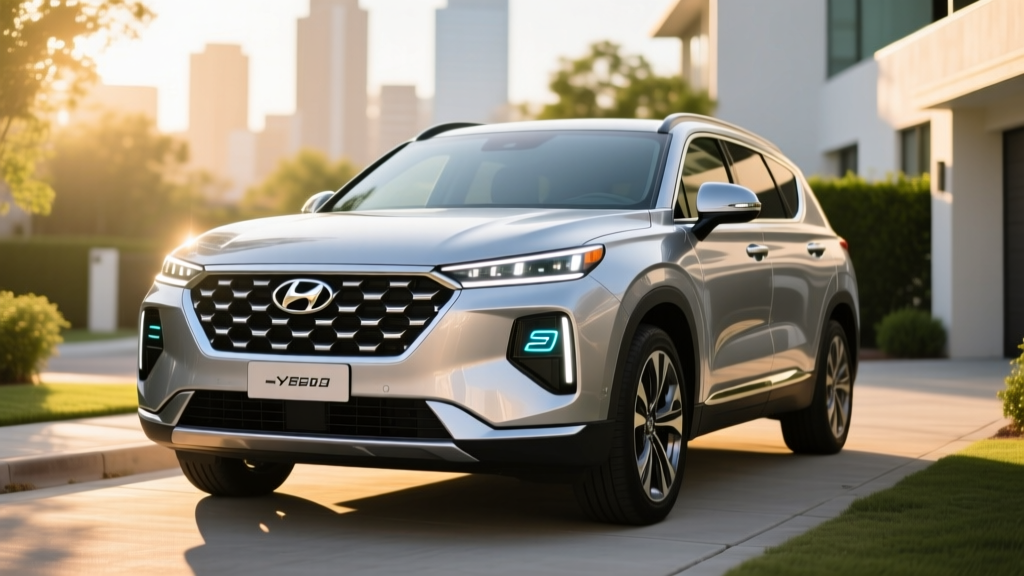
The midsize hybrid SUV segment is crowded, but the 2025 Hyundai Santa Fe SEL Hybrid carves out a distinct position with its boxy design language, standard third row, and a turbocharged hybrid powertrain that prioritizes real-world drivability over spec-sheet one-upmanship. If you're researching the 2025 Hyundai Santa Fe SEL Hybrid as a potential purchase, this guide covers the exact numbers — fuel economy, powertrain output, pricing, battery longevity, and tax credit eligibility — that matter for your decision.
Before we get into specifics, an important clarification: the Santa Fe Hybrid is a conventional hybrid electric vehicle (HEV). It does not plug in. Hyundai also offers a Santa Fe Plug-in Hybrid (PHEV) variant, which is a fundamentally different vehicle with different capabilities, pricing, and incentive eligibility. We'll cover both where relevant, but this review focuses primarily on the SEL Hybrid trim that most buyers cross-shop against the Toyota Highlander Hybrid and Kia Sorento Hybrid.
HEV vs PHEV: Which Santa Fe Hybrid Is Which?
Hyundai sells two electrified Santa Fe variants, and confusing them is one of the most common mistakes we see in buyer research. Here's the distinction:
| Attribute | Santa Fe Hybrid (HEV) | Santa Fe Plug-in Hybrid (PHEV) |
|---|---|---|
| Plugs in to charge? | No — self-charging via engine and regen | Yes — 12.6 kWh battery, Level 2 chargeable |
| Electric-only driving | Very short distances at low speed | EPA-estimated 30 miles electric-only |
| Combined horsepower | 232 hp | 261 hp |
| EPA combined MPG / MPGe | 36 MPG combined (SEL AWD) | 79 MPGe (charge-depleting), 35 MPG (gas-only) |
| Federal tax credit (§30D) | Not eligible | Potentially up to $7,500 (see eligibility below) |
| Starting MSRP (2025) | ~$39,360 (SEL trim) | ~$46,650 (SEL Premium trim) |
If you can charge at home and your daily commute is under 30 miles, the PHEV lets you drive most weekdays on electricity while retaining the gas engine for road trips. If you live in an apartment without charging access or simply want a no-plug-required ownership experience, the conventional HEV is the more practical path — and it costs significantly less upfront.
Fuel Economy: EPA Ratings and Real-World MPG
The headline number for the 2025 Hyundai Santa Fe SEL Hybrid is its EPA-estimated fuel economy. According to fueleconomy.gov, the AWD SEL Hybrid achieves:
| Cycle | EPA Estimate |
|---|---|
| City | 35 MPG |
| Highway | 37 MPG |
| Combined | 36 MPG |
The FWD variant bumps those numbers slightly to 36 city / 35 highway / 36 combined. The small city-highway spread is typical of modern turbo-hybrid systems: the electric motor assists heavily in stop-and-go driving, while the turbocharged 1.6-liter engine runs efficiently at highway cruise.
Real-World MPG: What to Actually Expect
Hyundai's hybrid system tends to perform close to or slightly above its EPA city estimate in real-world urban driving — a characteristic we've seen across the Tucson Hybrid and Sonata Hybrid as well. Expect 34–38 MPG in mixed suburban driving and 32–35 MPG on sustained highway trips at 75+ mph. Hybrids generally lose their city advantage on long highway runs where the electric motor contributes less and aerodynamic drag dominates.
In cold weather (below 30°F), expect a 5–10% fuel economy reduction due to longer engine warm-up cycles and increased accessory load from cabin heating. This is smaller than the 20–30% range loss a full EV experiences in the same conditions, since the hybrid's waste engine heat is repurposed for cabin warming.
Powertrain: 232 Horsepower From a Turbo-Hybrid System
The Santa Fe Hybrid pairs a 1.6-liter turbocharged four-cylinder engine (178 hp, 195 lb-ft) with a 47.7 kW electric motor (64 hp, 195 lb-ft) integrated into a 6-speed automatic transmission. Combined system output is 232 horsepower and 271 lb-ft of torque.
This is a meaningful advantage over some competitors that use naturally aspirated engines in their hybrid systems. The turbo gives the Santa Fe Hybrid strong mid-range pull for highway merging and mountain grades, and the electric motor fills in the low-end torque gap that turbocharged engines sometimes exhibit. The 6-speed automatic, rather than a CVT, delivers more natural shift feel — a preference point for drivers who dislike the drone of continuously variable transmissions.
| Spec | Value |
|---|---|
| Engine | 1.6L turbocharged I-4 |
| Engine output | 178 hp / 195 lb-ft |
| Electric motor output | 47.7 kW (64 hp) / 195 lb-ft |
| Combined system output | 232 hp / 271 lb-ft |
| Transmission | 6-speed automatic |
| Drivetrain (SEL) | AWD standard (HTRAC) |
| Towing capacity | 2,000 lbs |
| 0–60 mph (est.) | ~7.8 seconds |
The HTRAC all-wheel-drive system on the SEL Hybrid is standard — not an upgrade — which simplifies the buying decision and provides year-round traction confidence without a fuel-economy penalty compared to the FWD base model.
Pricing, Trims, and Tax Credit Eligibility
The 2025 Hyundai Santa Fe SEL Hybrid starts at an MSRP of approximately $39,360, including destination. This positions it between the Toyota Highlander Hybrid LE (~$40,970) and the Kia Sorento Hybrid EX (~$39,990).
Federal Tax Credit: What You Need to Know
The conventional Santa Fe Hybrid (HEV) does not qualify for the federal §30D clean vehicle tax credit. That credit applies only to plug-in electric vehicles — battery-electric vehicles (BEVs) and plug-in hybrids (PHEVs) — that meet battery sourcing, critical mineral, MSRP, and buyer income requirements under current IRS rules.
If you're considering the Santa Fe Plug-in Hybrid instead, the §30D credit could apply, but eligibility depends on several factors that change periodically:
- MSRP cap: SUVs must have an MSRP at or below $80,000
- Buyer income cap: AGI must not exceed $150,000 (single) / $300,000 (joint)
- Battery sourcing: Critical minerals and battery components must meet phased-in domestic/free-trade-partner sourcing thresholds — check the latest IRS eligible vehicle list before purchasing
- Point-of-sale transfer: As of 2024, eligible buyers can transfer the credit to the dealer for an immediate price reduction rather than waiting for a tax refund
Because sourcing requirements tighten annually, a PHEV that qualifies in January may not qualify by July. Always verify current eligibility on IRS.gov or consult a tax professional before counting the credit into your budget.
Battery Warranty, Reliability, and Replacement Costs
This is one of the strongest hybrid battery warranties in the segment and directly addresses the top concern we hear from hybrid-curious buyers: what happens when the battery degrades?
How Long Will the Hybrid Battery Last?
Hyundai's lithium-ion hybrid battery packs in the Santa Fe are relatively small (approximately 1.5 kWh usable) compared to EV battery packs, and they operate within a narrow state-of-charge window — typically between 20% and 80% SoC. This shallow cycling dramatically reduces stress on the cells. Based on long-term data from Hyundai/Kia hybrid platforms, most hybrid battery packs retain well over 90% of their original capacity after 150,000 miles. Catastrophic failure within the warranty period is uncommon.
Battery Replacement Cost
If replacement is needed outside of warranty, a Santa Fe Hybrid battery pack typically costs between $2,500 and $4,000 for the part, plus $500–$800 in labor. This is far less than EV battery replacement (often $10,000–$20,000) because the hybrid pack is small and operates at lower voltages. Some third-party refurbishers offer reconditioned packs for $1,500–$2,500, though availability varies by market.
The conventional hybrid system also eliminates several maintenance items found in gas-only vehicles: there's no traditional starter motor to fail, regenerative braking extends brake pad life significantly (often to 80,000+ miles), and the engine runs less frequently, reducing wear on belts and accessories.
Hybrid vs PHEV vs Full EV: Which Fits Your Life?
The Santa Fe lineup forces a three-way decision. Here's a practical framework:
Choose the Santa Fe Hybrid (HEV) if: You don't have reliable home or workplace charging access, you want the lowest upfront cost in the electrified Santa Fe lineup, your annual mileage is moderate (10,000–15,000 miles), and you want a no-behavior-change ownership experience. You'll save roughly $600–$900/year in fuel vs. the gas-only Santa Fe at current prices.
Choose the Santa Fe Plug-in Hybrid (PHEV) if: You can install a Level 2 home charger, your daily commute is under 30 miles round-trip, you want to drive mostly electric on weekdays but need gas flexibility for weekend road trips, and you qualify for the §30D federal tax credit (which can offset the PHEV's ~$7,300 price premium over the HEV).
Choose a full EV (e.g., Hyundai Ioniq 5, Kia EV9) if: You have home charging, your daily driving is under 250 miles, you want to eliminate gasoline entirely, and you're comfortable with DC fast charging for road trips. Full EVs have lower per-mile "fuel" costs (typically $0.04–$0.06/mile vs. $0.11–$0.14/mile for the hybrid) but higher upfront cost and require charging infrastructure.
Pros and Cons at a Glance
- 36 MPG combined with standard AWD — excellent for a 3-row SUV
- Turbo-hybrid powertrain feels responsive, not sluggish
- 10-year/100,000-mile hybrid battery warranty
- Boxy design with genuine third-row usability
- 6-speed automatic avoids CVT drone
- No plug-in charging required — zero behavior change
- No federal tax credit for the HEV variant
- 2,000-lb towing capacity trails V6 competitors
- Third row is tight for adults on long trips
- Hybrid premium over gas Santa Fe takes ~4 years to recoup at 12k mi/yr
- Highway MPG drops noticeably above 80 mph
- No DC fast charging (not applicable — this is an HEV)
Frequently Asked Questions
How many MPG does the 2025 Hyundai Santa Fe SEL Hybrid get?
The EPA rates the AWD Santa Fe SEL Hybrid at 35 city / 37 highway / 36 combined MPG. In real-world mixed driving, owners typically report 34–38 MPG. Highway-only trips at speeds above 75 mph tend to return 32–35 MPG.
Does the Santa Fe Hybrid need to be plugged in?
No. The Santa Fe Hybrid is a conventional HEV — it charges its small battery pack through regenerative braking and the gasoline engine. You fuel it like any other car. Only the Santa Fe Plug-in Hybrid (a separate, more expensive variant) requires or benefits from plugging in.
How far can the Santa Fe Plug-in Hybrid go on electric only?
The 2025 Santa Fe PHEV has an EPA-estimated 30 miles of electric-only range on its 12.6 kWh battery pack. This is sufficient for most daily commutes. Once the battery is depleted, it operates as a conventional hybrid with an EPA rating of approximately 35 MPG combined. Total combined range (electric + gas) exceeds 400 miles. The PHEV charges via a J1772 Level 2 connection in approximately 3.5 hours at 7.2 kW; it does not support DC fast charging.
Is the Santa Fe Hybrid reliable?
Hyundai's turbo-hybrid powertrain has been in production since the Tucson Hybrid's 2022 launch, and early reliability data is positive. The hybrid system adds complexity (electric motor, inverter, high-voltage battery) but eliminates other failure-prone components (starter, alternator, traditional brake wear). Hyundai's 10-year/100,000-mile hybrid warranty provides substantial financial protection. Long-term reliability beyond 5 years will depend on the turbo engine's durability — Hyundai's 1.6T has a solid track record in non-hybrid applications.
Does the Santa Fe Hybrid qualify for any tax credit?
The conventional Santa Fe Hybrid (HEV) does not qualify for the federal §30D clean vehicle tax credit — that credit is reserved for plug-in vehicles (BEVs and PHEVs). Some states and local utilities offer rebates for conventional hybrids, but these vary widely by jurisdiction. Check your state energy office and utility provider for current programs. The Santa Fe PHEV variant may qualify for up to $7,500 under §30D, subject to income caps, MSRP limits, and battery sourcing requirements — verify on IRS.gov before purchasing.
What's the hybrid battery replacement cost?
Out-of-warranty replacement for the Santa Fe Hybrid battery pack typically runs $2,500–$4,000 for parts plus $500–$800 in labor. Given the 10-year/100,000-mile warranty and the low-stress shallow-cycling design of hybrid batteries, most owners will never face this expense. For comparison, a set of four tires for the Santa Fe costs $800–$1,200 and needs replacement every 40,000–60,000 miles.
How does the Santa Fe Hybrid compare to the Toyota Highlander Hybrid?
The Highlander Hybrid achieves an EPA-estimated 35 MPG combined (AWD) — nearly identical to the Santa Fe Hybrid — but starts about $1,600 higher and uses a CVT that some drivers find less engaging. The Santa Fe offers a more distinctive design and a longer hybrid warranty (10 years vs. Toyota's 10 years/150,000 miles for the battery, but only 5 years/60,000 miles for hybrid components beyond the battery). Cargo space and third-row dimensions are comparable. If you prioritize resale value, the Highlander historically holds an edge; if you prioritize warranty coverage and driving feel, the Santa Fe Hybrid is the stronger pick.