The Toyota RAV4 Hybrid remains one of the best-selling electrified vehicles in the United States, and for good reason: it delivers substantial fuel savings over its gas-only counterpart without requiring a plug, a lifestyle change, or a steep learning curve. If you've been searching for the Toyota RAV4 Hybrid gas mileage figures and whether the real-world numbers match the EPA sticker, this guide breaks down every relevant specification for the current-generation RAV4 Hybrid and its plug-in sibling, the RAV4 Prime.
Below, we cover EPA and real-world fuel economy, the powertrain behind those numbers, battery longevity and warranty coverage, pricing, and how the RAV4 Hybrid stacks up against both the RAV4 Prime PHEV and a full battery-electric vehicle (BEV) for different types of drivers.
Toyota RAV4 Hybrid MPG: EPA Ratings and Real-World Results
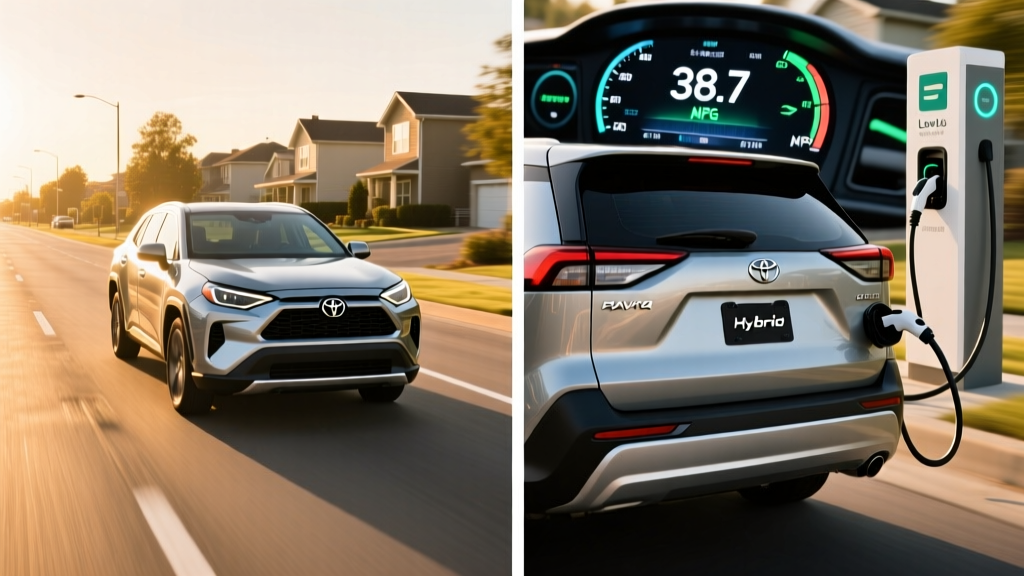
The EPA rates the current Toyota RAV4 Hybrid (AWD, which is now standard across all trims) at 41 MPG city / 38 MPG highway / 39 MPG combined. These figures apply to the LE, XLE, XLE Premium, SE, Woodland Edition, and Limited trims, as all share the same hybrid powertrain and all-wheel-drive configuration.
| Trim | City MPG | Highway MPG | Combined MPG | Drivetrain |
|---|---|---|---|---|
| LE | 41 | 38 | 39 | AWD (eAWD) |
| XLE | 41 | 38 | 39 | AWD (eAWD) |
| XLE Premium | 41 | 38 | 39 | AWD (eAWD) |
| SE | 41 | 38 | 39 | AWD (eAWD) |
| Woodland Edition | 41 | 38 | 39 | AWD (eAWD) |
| Limited | 41 | 38 | 39 | AWD (eAWD) |
Source: EPA Fuel Economy (fueleconomy.gov). Figures reflect the most recent model year available at time of publication.
Toyota's hybrid system excels in stop-and-go city driving, where the electric motor handles low-speed propulsion and regenerative braking recaptures energy. In our experience and consistent owner reports, the RAV4 Hybrid often exceeds its EPA city rating, with drivers seeing 42–45 MPG on urban commutes. Highway driving tells a different story: at sustained 70–80 MPH speeds, expect 34–37 MPG, below the 38 MPG highway sticker. Cold weather (below 35°F) can reduce fuel economy by 5–10% due to increased engine idling for cabin heat and reduced battery efficiency. A combined real-world average of 37–41 MPG is typical for mixed driving.
RAV4 Hybrid vs. RAV4 Prime: HEV and PHEV Compared
Toyota offers the RAV4 in two electrified flavors, and it's critical to understand the difference before shopping:
- RAV4 Hybrid (HEV): A conventional self-charging hybrid. You never plug it in. A small battery (approximately 1.6 kWh) is charged by the gasoline engine and regenerative braking. The electric motor assists the engine to reduce fuel consumption.
- RAV4 Prime (PHEV): A plug-in hybrid with a much larger battery (18.1 kWh). You can plug it in to charge, and it can drive on electric power alone for a meaningful distance before the gas engine kicks in.
| Specification | RAV4 Hybrid (HEV) | RAV4 Prime (PHEV) |
|---|---|---|
| Powertrain Type | Conventional Hybrid | Plug-in Hybrid |
| Combined Horsepower | 219 hp | 302 hp |
| Battery Capacity | ~1.6 kWh (NiMH) | 18.1 kWh (Lithium-ion) |
| Plug-In Charging | No — self-charging | Yes — Level 1 & Level 2 |
| DC Fast Charging | N/A | No DC fast charge |
| Electric-Only Range | N/A (EV assist only) | 42 miles (EPA) |
| Total Combined Range | ~580 miles | ~600 miles (EV + gas) |
| MPG (gas mode) | 39 combined | 38 combined (gas only) |
| MPGe (electric + gas) | N/A | 94 MPGe |
| 0–60 MPH | 7.4 seconds | 5.7 seconds |
| Charge Time (Level 2, 240V) | N/A | ~2.5 hours (6.6 kW) |
| Charge Time (Level 1, 120V) | N/A | ~10 hours |
| Starting MSRP | ~$33,500 | ~$44,500 |
The RAV4 Prime's 42-mile electric-only range is enough to cover most daily commutes without using a drop of gasoline, provided you can charge at home. Once the battery depletes, it operates as a conventional hybrid at 38 MPG combined — only slightly less than the standard Hybrid due to the added weight of the larger battery pack.
Powertrain Breakdown: How 219 Horsepower Gets 39 MPG
The RAV4 Hybrid uses Toyota's fourth-generation hybrid system, pairing a 2.5-liter four-cylinder Atkinson-cycle gasoline engine with two electric motors (one front, one rear) that together produce a net 219 combined horsepower.
The front electric motor is integrated into the transaxle and handles the bulk of electric assist and regenerative braking. The rear motor provides on-demand all-wheel drive — what Toyota calls eAWD — by powering the rear axle independently when traction is needed. There is no mechanical driveshaft connecting the front and rear axles, which reduces weight and drivetrain losses compared to a conventional AWD system.
The Atkinson-cycle engine sacrifices some peak power for thermal efficiency, running a higher expansion ratio than compression ratio. Combined with Toyota's continuously variable transmission (eCVT), the system seamlessly blends electric and gas power. The result is a vehicle that feels adequately quick in daily driving (7.4 seconds to 60 MPH) while sipping fuel at a rate that would have seemed impossible for an AWD SUV a decade ago.
Battery Warranty, Lifespan, and Replacement Cost
Toyota covers the RAV4 Hybrid's battery pack under its Hybrid System Warranty for 10 years or 150,000 miles, whichever comes first. This applies to the original owner and is transferable to subsequent owners. In California-emission states (California, New York, Massachusetts, and others adopting CARB standards), hybrid battery coverage extends to 10 years / 150,000 miles under emissions warranty provisions. The broader hybrid system components (inverter, control module, electric motors) share this same coverage period.
Battery degradation in Toyota's conventional hybrids is remarkably low. Because the system uses a relatively small NiMH pack and never fully charges or discharges it (operating roughly between 40% and 80% state of charge), the battery experiences gentle cycling that extends its life. Data from fleet operators and long-term owners shows most RAV4 Hybrid batteries retain well over 80% of their original capacity at 150,000 miles. Failure before 200,000 miles is uncommon.
If replacement is needed out of warranty, a new OEM hybrid battery for the RAV4 Hybrid typically costs between $2,500 and $4,000 including labor. Refurbished or reconditioned packs are available for $1,500–$2,500. For the RAV4 Prime's larger lithium-ion pack, replacement costs are higher — approximately $8,000–$12,000 — though its more robust thermal management system and larger buffer zone similarly support a long service life.
Pricing, Trims, and Tax Credit Eligibility
The Toyota RAV4 Hybrid starts at approximately $33,500 for the LE trim and climbs to around $42,000 for the Limited. The RAV4 Prime starts near $44,500 (SE trim) and reaches approximately $49,000 (XSE Premium).
| Model / Trim | Approx. MSRP | Federal Tax Credit (§30D) |
|---|---|---|
| RAV4 Hybrid LE | $33,500 | Not eligible (HEV) |
| RAV4 Hybrid XLE | $35,000 | Not eligible (HEV) |
| RAV4 Hybrid Limited | $42,000 | Not eligible (HEV) |
| RAV4 Prime SE | $44,500 | Check current §30D eligibility* |
| RAV4 Prime XSE | $47,500 | Check current §30D eligibility* |
*Federal tax credit note for the RAV4 Prime: Under IRS §30D, the RAV4 Prime has historically qualified for a partial or full up-to-$7,500 federal tax credit, but eligibility depends on current-year battery sourcing and critical mineral requirements, which have tightened significantly. The RAV4 Prime's MSRP falls under the $80,000 SUV cap, but buyer income limits ($150,000 single / $300,000 joint) and North American assembly requirements also apply. Additionally, the point-of-sale transfer option allows eligible buyers to apply the credit directly at the dealership as a down payment reduction. Always verify current eligibility on the IRS Clean Vehicle Credits page before purchasing, as sourcing rules change periodically.
The conventional RAV4 Hybrid (HEV) does not qualify for the federal §30D new clean vehicle credit, as that credit applies only to plug-in vehicles (BEVs and PHEVs) with a minimum battery capacity. Some states and utilities offer separate rebates for conventional hybrids — check your local programs.
Who Should Choose the RAV4 Hybrid, Prime, or a Full EV?
- You cannot charge at home (no garage, apartment living, no outlet access)
- You want maximum simplicity — no plugs, no charging apps, no planning
- Your budget is under $40,000
- You drive a mix of city and highway and want 39 MPG combined without thinking about it
- You plan to keep the vehicle 10+ years and value Toyota's long-term reliability record
- You can install a Level 2 charger at home
- Your daily round-trip commute is under 40 miles (covers most errands on electric)
- You want EV-like daily driving but need gas-engine range for road trips
- You want 302 hp and a 5.7-second 0–60 time
- You can take advantage of the potential federal tax credit to offset the higher MSRP
- You have reliable home Level 2 charging and access to DC fast-charging networks
- You want zero tailpipe emissions and the lowest per-mile fuel cost
- Your typical trips are under 250 miles, or you're willing to plan charging stops on road trips
- You want the full federal tax credit (up to $7,500 on eligible models) and lower maintenance costs
Ownership Costs: RAV4 Hybrid vs. Gas RAV4 vs. RAV4 Prime
The financial case for the RAV4 Hybrid over the gas-only RAV4 (rated at roughly 30 MPG combined) comes down to fuel savings over time. At 15,000 miles per year and $3.40/gallon gasoline:
| Model | Combined MPG | Gallons/Year | Annual Fuel Cost | 5-Year Fuel Cost |
|---|---|---|---|---|
| RAV4 Gas (AWD) | 30 | 500 | $1,700 | $8,500 |
| RAV4 Hybrid (AWD) | 39 | 385 | $1,308 | $6,540 |
| RAV4 Prime (gas mode) | 38 | 395 | $1,342 | $6,710 |
The RAV4 Hybrid saves approximately $1,960 in fuel over five years compared to the gas model. With a typical MSRP premium of $1,500–$2,000 for the hybrid powertrain over the equivalent gas trim, the hybrid pays for itself in fuel savings alone within roughly five years — and that's before factoring in the hybrid's typically stronger resale value.
The RAV4 Prime's economics depend heavily on how often you drive on electricity. If your daily commute falls within the 42-mile electric range and you charge nightly, your effective gasoline consumption drops dramatically. Electricity cost for a full charge (roughly 15–16 kWh from the wall accounting for charging losses) runs about $2.00–$2.50 at the national average residential rate of $0.16/kWh — the equivalent of less than a gallon of gas for 42 miles of driving.
Frequently Asked Questions
How many MPG does the Toyota RAV4 Hybrid actually get?
The EPA rates it at 41 city / 38 highway / 39 combined MPG. In real-world driving, most owners report 37–41 MPG combined. City driving often exceeds the EPA rating (42–45 MPG), while sustained highway driving at higher speeds typically falls to 34–37 MPG. Cold weather and aggressive acceleration further reduce efficiency.
How far can the RAV4 Prime go on electric power alone?
The EPA rates the RAV4 Prime at 42 miles of electric-only range on a full charge. Real-world electric range varies from about 35 miles (highway driving in cold weather) to 48 miles (gentle city driving in mild temperatures). Once the battery depletes, the Prime seamlessly transitions to hybrid mode at 38 MPG combined.
Does the RAV4 Hybrid need to be plugged in?
No. The conventional RAV4 Hybrid (HEV) is a self-charging system. The battery is charged by the gasoline engine and through regenerative braking during deceleration. You simply fill up with gas as you would with any other vehicle. Only the RAV4 Prime (PHEV) benefits from being plugged in.
Is the RAV4 Hybrid reliable, and what does a battery replacement cost?
Toyota's hybrid powertrains have an exceptional reliability track record spanning over two decades (since the original Prius). The RAV4 Hybrid's battery is warranted for 10 years / 150,000 miles, and real-world data shows most packs last well beyond 200,000 miles. Out-of-warranty replacement runs approximately $2,500–$4,000 for the HEV pack. The vehicle consistently earns top reliability scores from Consumer Reports and holds strong resale values.
Does the RAV4 Hybrid or Prime qualify for a federal tax credit?
The conventional RAV4 Hybrid (HEV) does not qualify for the federal §30D clean vehicle credit, which is limited to plug-in vehicles. The RAV4 Prime (PHEV) may qualify for up to $7,500 depending on current-year battery sourcing rules, buyer income limits ($150K single / $300K joint), and MSRP caps. The credit can be transferred to the dealer at point of sale. Always check the IRS website for the latest eligibility requirements before purchasing.
RAV4 Hybrid vs. a full EV — which is better for me?
If you have home charging and mostly drive under 250 miles per trip, a full EV (like the Tesla Model Y or Hyundai Ioniq 5) offers lower per-mile energy costs, less maintenance, and zero tailpipe emissions. If you lack home charging, frequently drive long distances through areas with sparse charging infrastructure, or simply want the lowest-hassle ownership experience with strong fuel economy, the RAV4 Hybrid is the pragmatic choice. The RAV4 Prime splits the difference — EV-like daily driving with gas-engine freedom for road trips.