Quick Verdict: Two Hybrids, Two Very Different Use Cases
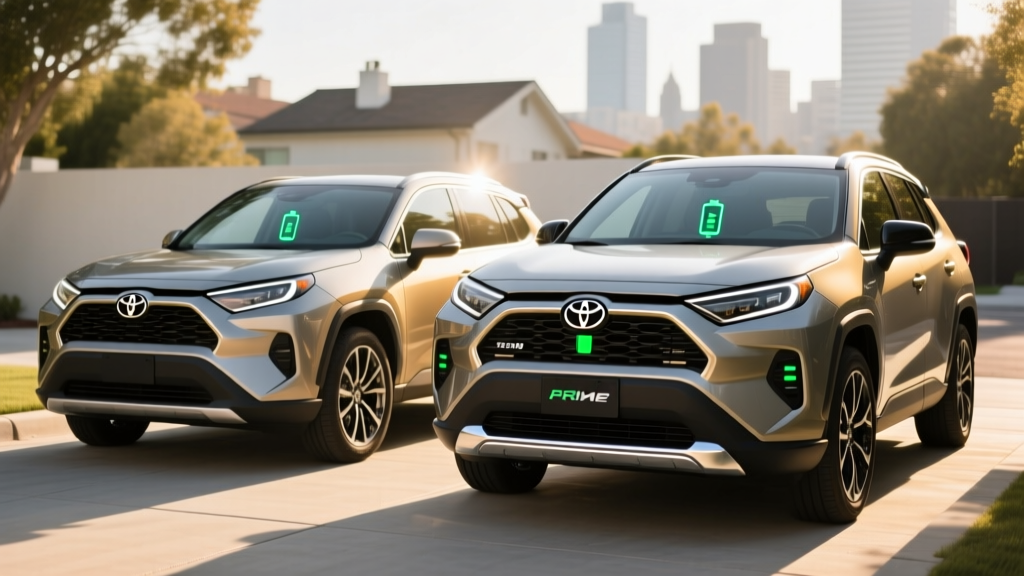
The 2021 Toyota RAV4 Hybrid lineup splits into two distinct vehicles sharing a platform. The conventional RAV4 Hybrid (HEV) is a self-charging hybrid delivering 40 MPG combined with zero lifestyle change — no plugs, no charging apps, no range planning. The RAV4 Prime (PHEV) is a plug-in hybrid offering 42 miles of electric-only driving, 94 MPGe when charged, and a combined 302 horsepower that makes it the quickest RAV4 Toyota has ever built.
Both remain strong picks on the used market in 2026, but they serve fundamentally different buyers. Here's exactly what each delivers, with the numbers to back it up.
HEV vs. PHEV: Understanding the RAV4's Two Hybrid Systems
Before diving into specs, the distinction between these two powertrains is critical because it affects daily routine, fuel cost, and tax-credit eligibility.
| Feature | RAV4 Hybrid (HEV) | RAV4 Prime (PHEV) |
|---|---|---|
| Plugs in? | No — self-charging via regen and engine | Yes — 18.1 kWh battery, Level 1 or Level 2 |
| Electric-only driving | Very short distances at low speed (under 1 mile) | 42 miles EPA at full charge |
| Combined horsepower | 219 hp | 302 hp |
| Federal tax credit (new) | None — §30D requires plug-in capability | Was eligible for up to $7,500 (now expired for new purchases) |
| Best for | Drivers without home charging; high-mileage commuters | Home chargers with short daily commutes; weekend road-trippers |
The HEV uses a small 1.6 kWh nickel-metal hydride (NiMH) traction battery that charges exclusively through regenerative braking and the gasoline engine. You never plug it in. The Prime carries a much larger 18.1 kWh lithium-ion (Li-ion) battery pack that you charge from a wall outlet or public Level 2 station, giving it genuine EV capability for most daily commutes.
Fuel Economy: EPA Numbers and Real-World MPG
RAV4 Hybrid (HEV)
| Trim / Drivetrain | City MPG | Highway MPG | Combined MPG |
|---|---|---|---|
| LE (AWD) | 41 | 38 | 40 |
| XLE / XLE Premium / SE / XSE / Limited (AWD) | 41 | 38 | 40 |
Source: fueleconomy.gov
All 2021 RAV4 Hybrid trims come standard with electronic AWD (a separate rear motor), so there's no FWD-only variant that changes the numbers. The 40 MPG combined figure is the official EPA rating.
RAV4 Prime (PHEV)
| Mode | City | Highway | Combined |
|---|---|---|---|
| Charge-depleting (EV mode) | 94 MPGe combined (40 kWh/100mi) | ||
| Charge-sustaining (hybrid mode, battery depleted) | 40 | 36 | 38 |
Source: fueleconomy.gov
When the Prime's battery is depleted, it operates as a conventional hybrid at 38 MPG combined — only slightly less than the standard Hybrid, despite carrying roughly 300 lbs of additional battery mass. That's a testament to Toyota's hybrid system efficiency.
RAV4 Prime: Electric-Only Range, Charging, and Battery Specs
The Prime's 18.1 kWh lithium-ion battery delivers 42 miles of EPA-rated electric-only range. In real-world conditions:
- Mild weather, city/suburban driving: 40-45 miles achievable with gentle acceleration and regen use
- Highway at 70 mph: Expect 32-36 electric miles before the engine engages
- Cold weather (below freezing): 28-34 miles, as battery efficiency drops and cabin heating draws power
| Charging Method | Power | 0-100% Time | Notes |
|---|---|---|---|
| Level 1 (120V household outlet) | ~1.4 kW | ~12 hours | Included cord; adequate for overnight if you start partially depleted |
| Level 2 (240V, 16A) | ~3.3 kW | ~5.5 hours | Using included cable with 240V adapter or aftermarket EVSE |
| Level 2 (240V, 32A+) | ~6.6 kW | ~2.5 hours | Requires upgraded onboard charger (standard on some trims); aftermarket EVSE needed |
| DC Fast Charging | N/A | N/A | No DC fast-charge capability — CHAdeMO/CCS not supported |
The Prime's onboard charger tops out at either 3.3 kW or 6.6 kW depending on trim and equipment. There is no DC fast-charging capability — this is common for PHEVs, whose smaller batteries make Level 2 sufficient for overnight replenishment. You'll charge at home or at workplace Level 2 stations; public DC fast chargers are irrelevant for this vehicle.
Powertrain Specs: What's Under the Hood
| Specification | RAV4 Hybrid (HEV) | RAV4 Prime (PHEV) |
|---|---|---|
| Engine | 2.5L 4-cyl Atkinson-cycle | 2.5L 4-cyl Atkinson-cycle |
| Engine output | 176 hp / 163 lb-ft | 177 hp / 165 lb-ft |
| Front electric motor | 118 hp / 149 lb-ft | 174 hp / 199 lb-ft |
| Rear electric motor (AWD) | 54 hp / 89 lb-ft | 54 hp / 89 lb-ft |
| Combined system output | 219 hp | 302 hp |
| 0-60 mph | ~7.5 seconds | ~5.7 seconds |
| Transmission | eCVT (planetary gearset) | eCVT (planetary gearset) |
| Drivetrain | Electronic AWD (eAWD) | Electronic AWD (eAWD) |
| Towing capacity | 1,750 lbs | 2,500 lbs |
The Prime's larger front motor and more powerful battery output give it 83 additional horsepower, making it genuinely quick. The eCVT isn't a traditional belt-and-cone CVT — it's Toyota's planetary gearset that seamlessly blends engine and motor power with no fixed gear ratios. It's proven, smooth, and nearly maintenance-free.
Pricing and Tax Credit Eligibility
Because the 2021 RAV4 Hybrid and Prime are now pre-owned vehicles, the original MSRP matters mainly as a depreciation baseline and for used-EV credit purposes.
Original 2021 MSRP (new)
- RAV4 Hybrid LE: $29,470 (including destination)
- RAV4 Hybrid XLE: $30,765
- RAV4 Hybrid Limited: $35,875
- RAV4 Prime SE: $39,220
- RAV4 Prime XSE: $42,545
Tax credit situation in 2026
- RAV4 Hybrid (HEV): Never qualified for the federal §30D plug-in vehicle credit. No federal incentive applies.
- RAV4 Prime (PHEV) — new purchase: Originally eligible for up to $7,500, but the IRS §30D credit for this model ended when Toyota hit the manufacturer cap under prior rules, and subsequent Inflation Reduction Act sourcing requirements further restricted eligibility. No new 2021 units are available anyway.
- RAV4 Prime (PHEV) — used purchase: The §25E used clean vehicle credit offers up to $4,000 (30% of sale price, capped at $4,000) for qualified used PHEVs purchased from a dealer. Requirements include: sale price under $25,000, buyer income under $75,000 (single) / $150,000 (joint), and purchasing from a licensed dealer (private-party sales excluded). Given typical 2021 Prime used prices in 2026 ($28,000-$35,000), hitting the $25,000 price cap is challenging but possible on higher-mileage SE examples.
Battery Longevity, Reliability, and Replacement Costs
Toyota's hybrid battery track record is among the best in the industry. The Prius, now in its 25+ year history, demonstrates that NiMH and Li-ion traction batteries routinely exceed 150,000-200,000 miles before significant degradation.
What degradation looks like
- RAV4 Hybrid (NiMH, 1.6 kWh): NiMH chemistry is extremely tolerant of shallow charge cycles. Capacity loss of 10-15% over 10 years is typical and barely noticeable since the battery buffer is managed by the vehicle computer.
- RAV4 Prime (Li-ion, 18.1 kWh): Li-ion degrades faster than NiMH but starts with far more capacity. Expect 85-90% state of health (SoH) after 5 years. Electric-only range might drop from 42 to 36-38 miles over a decade.
Replacement cost if out of warranty
- RAV4 Hybrid NiMH pack: $2,500-$4,000 (refurbished or new from Toyota)
- RAV4 Prime Li-ion pack: $6,000-$9,000 (estimated; few out-of-warranty replacements have been needed as of 2026)
Independent hybrid-battery refurbishers can sometimes replace individual modules for $500-$1,500 on the NiMH pack, extending life at a fraction of full replacement cost.
Who Should Choose Which RAV4 — Hybrid, Prime, or Full EV?
- You can't charge at home (apartment, street parking, no garage)
- You drive 300+ miles per week and want zero refueling behavior change
- You want the lowest purchase price and simplest ownership
- Most of your driving is city/suburban (where you'll beat EPA ratings)
- You have home Level 2 charging and a commute under 40 miles round-trip
- You want EV daily driving but need gasoline flexibility for road trips
- You value the 302-hp performance upgrade
- You want to run on electricity ~70% of the time while keeping a 600+ mile total range
- You have reliable home charging and rarely drive over 250 miles in a day
- You want zero oil changes, zero engine maintenance, and the lowest per-mile fuel cost
- You're eligible for the full $7,500 §30D credit on a new EV (which the Prime no longer qualifies for)
RAV4 Hybrid (HEV) — Pros
- 40 MPG combined, often exceeded in city driving
- No charging infrastructure needed
- 10-year/150,000-mile hybrid battery warranty
- Strong resale value and Toyota reliability
- Standard AWD on every trim
RAV4 Hybrid (HEV) — Cons
- No electric-only driving to speak of
- No federal tax credit eligibility
- eCVT drone under hard acceleration
- 219 hp is adequate, not exciting
RAV4 Prime (PHEV) — Pros
- 42 miles EV range covers most commutes gas-free
- 302 hp / 5.7-second 0-60 — quickest RAV4 ever
- 38 MPG even with a depleted battery
- 600+ mile total range (EV + gas)
- 2,500-lb towing capacity
RAV4 Prime (PHEV) — Cons
- Higher purchase price ($10K+ over HEV on the used market)
- No DC fast charging
- Heavier — slightly worse MPG when battery is empty
- Used §25E credit hard to qualify for due to $25K price cap
- Cargo space slightly reduced vs. HEV due to larger battery
Frequently Asked Questions
How many MPG does the 2021 RAV4 Hybrid actually get?
The EPA rates all 2021 RAV4 Hybrid trims at 41 city / 38 highway / 40 combined MPG. In real-world city-heavy driving, many owners consistently achieve 42-45 MPG. Highway-only trips at sustained speeds above 70 mph typically yield 35-37 MPG. Cold weather reduces these figures by roughly 5-10%.
How far can the RAV4 Prime go on electric power alone?
The EPA rates the 2021 RAV4 Prime at 42 miles of electric-only range. Real-world results range from about 28 miles in freezing weather at highway speeds to 45 miles in mild conditions around town. Once the battery depletes, the gasoline engine engages seamlessly and the vehicle operates as a conventional hybrid at 38 MPG combined.
Does the 2021 RAV4 Hybrid or Prime qualify for a federal tax credit?
The conventional RAV4 Hybrid (HEV) has never qualified for the §30D federal plug-in vehicle credit because it cannot be plugged in. The RAV4 Prime originally qualified for up to $7,500 when purchased new, but that credit is no longer available for new purchases of this model year. For used Prime purchases from a dealer, the §25E used clean vehicle credit offers up to $4,000, but only if the sale price is $25,000 or less and buyer income falls under the IRS thresholds. Consult a tax professional and check current IRS §25E rules before relying on this credit.
Is the RAV4 Hybrid battery reliable, and what does replacement cost?
Toyota's hybrid batteries are among the most proven in the industry. The 2021 model carries a 10-year/150,000-mile hybrid battery warranty. NiMH packs in the HEV commonly last 200,000+ miles with minimal degradation. Li-ion packs in the Prime show similar longevity given the conservative charge management Toyota employs. Out-of-warranty replacement runs $2,500-$4,000 for the HEV and an estimated $6,000-$9,000 for the Prime, though very few replacements have been needed at this vehicle age.
Should I get the RAV4 Hybrid or a full electric vehicle?
If you lack reliable home charging, frequently drive over 250 miles in a day, or live in an area with sparse public charging infrastructure, the RAV4 Hybrid is the lower-risk choice. If you have home Level 2 charging, a predictable commute, and want the lowest possible operating cost with zero engine maintenance, a full EV like the Hyundai Ioniq 5 or Tesla Model Y will save more over five years. The RAV4 Prime splits the difference — EV commuting with gas-engine road-trip insurance — at a higher purchase price.
Can the RAV4 Prime DC fast charge?
No. The 2021 RAV4 Prime supports Level 1 (120V) and Level 2 (240V) AC charging only, at a maximum rate of 3.3 kW or 6.6 kW depending on equipment. There is no DC fast-charge port. This is standard for plug-in hybrids — the 18.1 kWh battery is small enough that overnight Level 2 charging fully replenishes it in 2.5-5.5 hours.