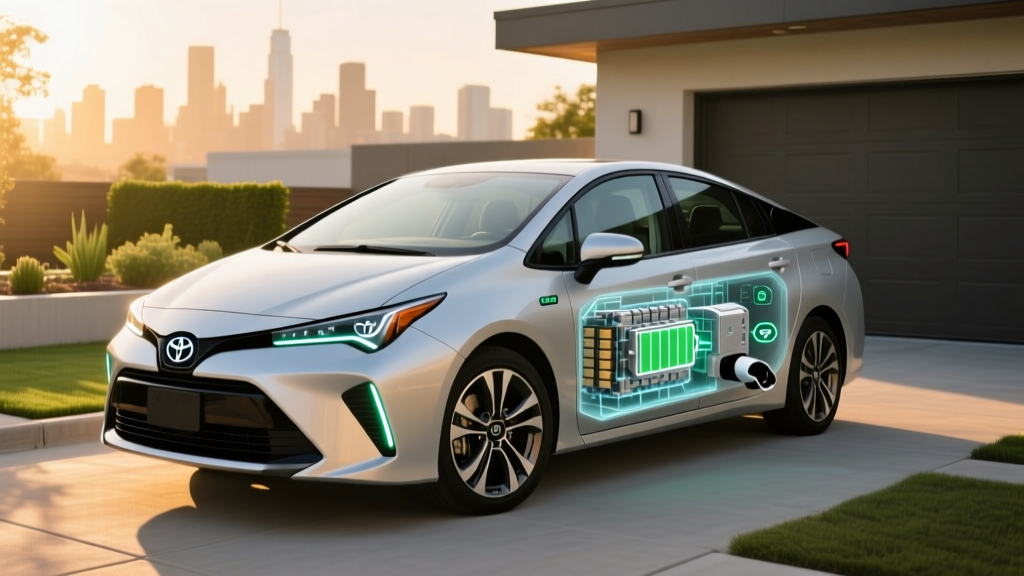
The Toyota Prius Prime hybrid occupies a specific niche in the electrified-vehicle landscape: it delivers meaningful electric-only commuting range without the charging dependency of a full battery-electric vehicle. For 2026, the Prius Prime continues with the redesign introduced for the 2023 model year, pairing a 2.0-liter four-cylinder engine with a plug-in hybrid powertrain that produces 220 combined horsepower. The result is a vehicle that can handle most daily commutes on electricity alone while retaining the flexibility of a 400-plus-mile total range for road trips.
This guide breaks down the Prius Prime's EPA-rated efficiency, real-world MPG behavior, charging logistics, battery longevity, and tax credit eligibility so you can determine whether this PHEV fits your driving pattern better than a conventional hybrid or a full EV.
HEV vs PHEV: Where the Prius Prime Fits
Toyota sells two versions of the Prius, and the distinction matters for both your fuel budget and your charging setup.
| Attribute | Prius (HEV) | Prius Prime (PHEV) |
|---|---|---|
| Powertrain | Hybrid (no plug) | Plug-in hybrid |
| EPA Combined MPG | 57 MPG | 52 MPG (hybrid mode) |
| Electric-Only Range | None | 44 miles (EPA) |
| Battery Capacity | ~1.0 kWh (small buffer) | 13.6 kWh usable |
| Combined Horsepower | 194 hp | 220 hp |
| Requires Plugging In? | No | No, but you lose EV range benefits |
| DC Fast Charging | N/A | No — Level 2 AC only |
| Starting MSRP (2026) | ~$28,550 | ~$33,450 |
The conventional Prius HEV generates all its electricity onboard through regenerative braking and the gasoline engine. You never plug it in. The Prius Prime PHEV carries a substantially larger battery that you can charge from a wall outlet or Level 2 station, giving it a 44-mile electric-only envelope. When that battery depletes, the Prime seamlessly transitions to hybrid mode and operates much like the standard Prius, just at slightly lower MPG due to the extra battery weight.
Fuel Economy and Electric Range: The Numbers
The EPA publishes separate ratings for the Prius Prime's electric mode and its hybrid mode. Both matter depending on how you drive.
| Mode | City | Highway | Combined |
|---|---|---|---|
| EV Mode (MPGe) | 127 MPGe | 108 MPGe | 119 MPGe |
| Hybrid Mode (MPG) | 50 MPG | 47 MPG | 52 MPG |
Electric-only range: The EPA rates the 2026 Prius Prime at 44 miles on a full charge. Total combined range — electric plus a full tank of gasoline — exceeds 420 miles.
Real-world MPG vs. EPA: Toyota's hybrid system excels in stop-and-go city driving, where regenerative braking recaptures energy and the engine shuts off frequently. In real-world city testing, owners regularly report 53–58 MPG in hybrid mode, exceeding the EPA city estimate. Highway driving at sustained 75+ mph speeds typically yields 43–46 MPG, slightly below the EPA highway figure. If your commute is mostly suburban and city driving under 50 mph, expect to beat the EPA combined number. If you do mostly interstate driving, plan for a few MPG less.
Real-World Range Expectations:
EPA electric range: 44 miles. Expect 38–42 miles in mixed driving with climate control active. In freezing temperatures (below 32°F), cabin heating draws from the battery and can reduce EV range to 30–35 miles. The gasoline engine may also engage sooner in cold weather to provide heat.
Powertrain, Battery, and Charging Specs
The 2026 Prius Prime pairs a 2.0-liter Atkinson-cycle four-cylinder engine with two motor-generators and a lithium-ion battery pack mounted under the rear seat. Combined system output is 220 horsepower, a meaningful jump from the 121 hp of the pre-2023 Prius Prime. The 0–60 mph time drops to approximately 6.6 seconds, making this the quickest Prius Toyota has ever built.
| Specification | 2026 Toyota Prius Prime |
|---|---|
| Engine | 2.0L 4-cyl Atkinson cycle |
| Combined System HP | 220 hp |
| 0–60 mph | ~6.6 seconds |
| Battery Chemistry | Lithium-ion (NMC) |
| Battery Capacity (Usable) | 13.6 kWh |
| EV Range (EPA) | 44 miles |
| Level 1 Charge (120V, 12A) | ~1.4 kW — approx. 12.5 hours |
| Level 2 Charge (240V, 32A) | ~3.3 kW onboard — approx. 4 hours |
| DC Fast Charging | Not available |
| Charge Port | J1772 (Level 2 AC) |
| Fuel Tank | 11.4 gallons |
| Total Combined Range | ~420+ miles |
Charging reality check: The Prius Prime's onboard charger maxes out at 3.3 kW on Level 2 AC power. That means a full 0–100% charge takes about 4 hours on a 240V Level 2 home station. On a standard 120V household outlet (Level 1), expect roughly 12.5 hours for a full charge — which still works for overnight replenishment if your daily EV commute is under 44 miles. The Prius Prime does not support DC fast charging, so public fast-charging stations (Electrify America, EVgo, etc.) are not usable for this vehicle.
For most Prius Prime owners, a basic Level 2 home charger installed in the garage is the ideal setup. Plug in when you get home, wake up to a full 44-mile EV range, and rarely visit a gas station for daily driving. The EPA's fueleconomy.gov listing for the Prius Prime confirms these ratings and provides trim-level detail.
Pricing, Trims, and Tax Credit Eligibility
The 2026 Toyota Prius Prime is offered in three trims. Pricing below includes destination charge.
| Trim | MSRP (approx.) |
|---|---|
| SE | $33,450 |
| XSE | $36,650 |
| XSE Premium | $40,050 |
Federal Tax Credit: Does the Prius Prime Qualify?
Under IRS §30D, the Prius Prime is eligible for a federal tax credit, but the amount and your personal qualification depend on several factors that shift periodically. As of 2026, the credit can reach up to $3,750 for qualifying buyers, contingent on:
- MSRP cap: The vehicle must have an MSRP at or below $55,000 for sedans — all Prius Prime trims qualify.
- Buyer income limits: Modified adjusted gross income must not exceed $150,000 (single), $225,000 (head of household), or $300,000 (married filing jointly).
- Battery sourcing requirements: The credit is split into two halves ($3,750 for critical minerals + $3,750 for battery components). Sourcing rules tighten annually, and the Prius Prime's battery supply chain may only satisfy one of the two requirements, yielding $3,750 rather than the full $7,500. Check the IRS qualified vehicles list for the current determination.
- Point-of-sale transfer: You can elect to transfer the credit to the dealer at purchase, reducing your out-of-pocket cost immediately rather than waiting for tax filing.
Tax credit rules are subject to change. Consult a tax professional and verify current eligibility on IRS.gov before relying on a specific credit amount in your purchase decision.
Battery Warranty, Reliability, and Replacement Cost
Hybrid and PHEV battery longevity remains a top concern for buyers transitioning from conventional vehicles. Toyota addresses this with robust warranty coverage.
Toyota Hybrid Battery Warranty:
10 years / 150,000 miles (whichever comes first) for the hybrid battery pack.
This covers defects and capacity loss below a specified threshold. Toyota's hybrid system warranty also covers the inverter, motor-generators, and related control electronics for the same duration.
Real-world reliability data: Toyota's hybrid powertrains have accumulated over two decades of field data, starting with the original 1997 Prius. Third-generation and newer Prius models have demonstrated hybrid battery lifespans routinely exceeding 150,000–200,000 miles before any degradation-related service is needed. The lithium-ion pack in the current Prius Prime benefits from active thermal management and conservative state-of-charge buffering (the vehicle never uses 100% or drops to 0% of the physical cell capacity), which significantly extends cycle life.
Battery replacement cost: If a replacement is needed outside warranty, a Toyota Prius Prime hybrid battery currently costs approximately $3,500–$5,500 including labor at a dealership. Independent hybrid specialists may offer refurbished packs for $2,000–$3,500. Given the 10-year/150,000-mile warranty and Toyota's track record, out-of-pocket battery replacement is statistically uncommon during typical ownership periods.
According to IIHS safety ratings, the Prius Prime continues to earn strong crash-test scores, complementing its mechanical reliability profile.
Who Should Choose the Prius Prime vs. a Full EV or Gas Car?
The Prius Prime solves a specific problem: you want electric driving for your commute but lack reliable access to charging for longer trips, or you live in an apartment without a dedicated charging outlet.
Choose the Prius Prime (PHEV) if:
- Your daily round-trip commute is under 40 miles and you can charge at home overnight.
- You take road trips of 200+ miles several times a year and don't want to plan around DC fast-charging infrastructure.
- You live in a region with extreme cold that significantly reduces EV range.
- You want to reduce fuel consumption without committing to full EV logistics.
Choose a full EV (e.g., Tesla Model 3, Hyundai Ioniq 6) if:
- You have reliable Level 2 home charging and your daily driving is under 250 miles.
- You want zero tailpipe emissions and minimal maintenance (no oil changes, no engine).
- You're eligible for the full $7,500 federal credit on a qualifying BEV, improving the value equation.
Choose the conventional Prius HEV if:
- You cannot charge at home or work (no garage, no outlet access).
- You want the lowest purchase price and simplest ownership — no cables, no charging apps.
- Your driving pattern is high-mileage highway commuting where the Prime's EV range provides little benefit.
Pros
- 44-mile EV range covers most commutes gas-free
- 52 MPG hybrid mode exceeds most competitors
- 220 hp — genuinely quick for a Prius
- No range anxiety — 420+ mile total range
- 10-year/150,000-mile hybrid battery warranty
- Eligible for partial federal tax credit (up to $3,750)
Cons
- No DC fast charging — Level 2 AC only
- 3.3 kW onboard charger is slow for public Level 2 stations
- EV range drops to ~30 miles in freezing weather
- Higher MSRP than conventional Prius HEV
- Rear cargo space slightly reduced vs. HEV due to larger battery
Frequently Asked Questions
How many MPG does the Toyota Prius Prime hybrid get?
The EPA rates the 2026 Prius Prime at 52 MPG combined in hybrid mode (50 city / 47 highway). In real-world city driving, many owners report 53–58 MPG thanks to regenerative braking. Highway driving at 75+ mph typically yields 43–46 MPG.
How far can the Prius Prime go on electric only?
The EPA rates the Prius Prime at 44 miles of electric-only range. In moderate temperatures with light climate use, expect 40–44 miles. In freezing weather with cabin heat, plan for 30–35 miles before the gasoline engine engages.
Does the Prius Prime qualify for a federal tax credit?
The Prius Prime may qualify for up to $3,750 under IRS §30D, depending on current battery-sourcing rules and your income level. The full $7,500 credit is unlikely due to partial sourcing compliance. Verify eligibility on the IRS qualified clean vehicles list before purchasing.
How long does the Prius Prime hybrid battery last?
Toyota warranties the hybrid battery for 10 years or 150,000 miles. Real-world data from Toyota's hybrid lineup suggests these batteries routinely last 150,000–200,000+ miles. The conservative charge buffer and thermal management system help extend cell life well beyond the warranty period.
What does it cost to replace the Prius Prime battery?
Out-of-warranty replacement runs approximately $3,500–$5,500 at a dealership, or $2,000–$3,500 through independent hybrid specialists using refurbished packs. Given the warranty coverage and Toyota's reliability record, most owners never face this expense.
Can I charge the Prius Prime at a public DC fast charger?
No. The Prius Prime only accepts AC charging via its J1772 port — Level 1 (120V) or Level 2 (240V). DC fast chargers (CCS, CHAdeMO, NACS) are not compatible. For rapid charging away from home, you would need a full battery-electric vehicle.
Is the Prius Prime better than a full EV for my commute?
If your commute is under 40 miles round-trip and you can charge at home, the Prius Prime lets you drive electric daily while keeping a gas engine for longer trips. If you have reliable home charging and rarely exceed 200 miles in a day, a full EV offers lower running costs, zero tailpipe emissions, and less maintenance. The Prius Prime is the pragmatic bridge for drivers who aren't ready to commit to EV-only logistics.