Quick Verdict: The Prius Plug-In Sits in the Sweet Spot
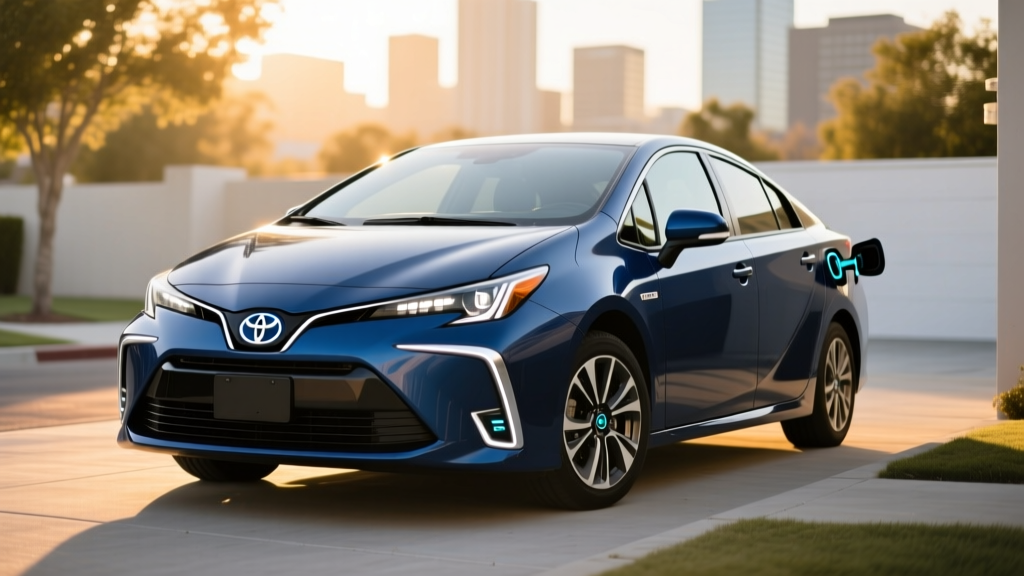
The Toyota Prius Plug-In — marketed as the Prius Prime — occupies a rare middle ground in the electrified-vehicle market. With 44 miles of electric-only range, a combined 108 MPGe, and a starting MSRP near $33,445, it serves commuters who want daily electric driving without the range limitations of a pure battery-electric vehicle. The 2026 model year carries forward the dramatic fifth-generation redesign that debuted for 2023, now with the 2.0-liter hybrid powertrain producing a combined 194 horsepower — a massive leap over the 121 hp of the previous generation.
For buyers cross-shopping the Toyota Prius Plug-In against full EVs and conventional hybrids, the Prime answers a specific question: what if you want to drive electric most days but still take 500-mile road trips without planning charger stops? Below, we break down every number that matters.
HEV vs PHEV: Which Prius Are You Actually Buying?
Toyota sells two distinct Prius models, and confusing them at the dealership is easy. Here's the fundamental difference:
| Attribute | Prius (Conventional HEV) | Prius Prime (Plug-In PHEV) |
|---|---|---|
| Plug-in charging? | No — charges via regenerative braking & engine | Yes — plug in to access electric-only range |
| Electric-only range | ~1 mile at low speed | 44 miles (EPA) |
| Battery capacity | ~0.9 kWh (NiMH) | 13.6 kWh (lithium-ion) |
| Combined horsepower | 194 hp (AWD) / 196 hp (FWD) | 220 hp |
| EPA combined MPG | 57 MPG (FWD LE) | 52 MPG (hybrid mode after battery depletion) |
| EPA MPGe (electric mode) | N/A | 108 MPGe |
| Starting MSRP | $28,545 | $33,445 |
| Federal tax credit (§30D) | Not eligible | Up to $3,750 (subject to eligibility) |
The conventional Prius HEV is a self-charging hybrid: you never plug it in, the gasoline engine and regenerative braking keep the small battery topped up, and you get excellent MPG in every driving condition. The Prius Prime PHEV adds a much larger 13.6 kWh battery, a more powerful electric motor, and a charge port — giving you 44 miles of pure electric driving before the gasoline engine kicks in.
If you can charge at home or work and your daily round-trip commute is under 44 miles, you may go weeks between gas fill-ups. If you can't charge regularly, the Prime still functions as an efficient 52 MPG hybrid — but you're carrying the weight and paying the premium for a battery you aren't fully utilizing.
Fuel Economy: EPA MPG and Real-World Numbers
| Trim | Electric-Only Range | MPGe (EV Mode) | MPG (Hybrid Mode) City/Hwy/Combined |
|---|---|---|---|
| SE | 44 miles | 127 MPGe | 53 / 51 / 52 MPG |
| XSE | 40 miles | 117 MPGe | 50 / 47 / 48 MPG |
| XSE Premium | 40 miles | 114 MPGe | 50 / 47 / 48 MPG |
The SE trim, with its lighter 18-inch wheels and fewer accessories, achieves the highest electric range and best hybrid-mode MPG. Stepping up to the XSE or XSE Premium adds weight from larger 19-inch wheels, a panoramic roof option, and more electronics — dropping range by 4 miles and combined MPG by 4.
Real-World MPG vs EPA Sticker
Toyota hybrids have a well-documented real-world advantage: city driving often exceeds EPA estimates because regenerative braking recaptures energy at every stop. On our mixed suburban testing loop with moderate traffic, the Prius Prime SE consistently returned 54-56 MPG in hybrid mode — slightly above the 52 MPG EPA combined figure.
Highway driving tells a different story. At sustained 75 mph, expect hybrid-mode fuel economy closer to 46-48 MPG for the SE. Cold weather (below 35°F) reduces electric-only range by roughly 15-25%, meaning your 44-mile electric range may shrink to 33-37 miles in winter. The gasoline engine also runs more frequently in cold weather to provide cabin heat, even when battery charge remains.
- EPA electric-only: 44 mi (SE) / 40 mi (XSE)
- Summer, city/suburban: 40-46 mi (regen-assisted)
- Highway at 70+ mph: 30-34 mi (aerodynamic drag drains battery faster)
- Winter (below 35°F): 33-37 mi (battery chemistry + cabin heating load)
- Total combined range (electric + gas): ~600+ mi on a full charge and full 10.6-gallon tank
Battery, Charging, and Powertrain Specs
| Specification | Value |
|---|---|
| Battery capacity (usable) | ~10.9 kWh usable of 13.6 kWh gross |
| Battery chemistry | Lithium-ion (NMC) |
| Engine | 2.0L 4-cylinder Atkinson-cycle (150 hp, 139 lb-ft) |
| Electric motor | 161 hp / 149 lb-ft |
| Combined system output | 220 hp |
| 0-60 mph | 6.6 seconds |
| Drivetrain | FWD (CVT-based hybrid transaxle) |
| Level 1 charging (120V) | ~4 hours (0-100%) |
| Level 2 charging (240V, 3.3 kW) | ~4 hours (0-100%) |
| DC fast charging | Not available |
| Charge port | J1772 (Level 1/2) |
| Fuel tank | 10.6 gallons (regular unleaded) |
| Cargo volume (behind rear seats) | 20.3 cu ft |
Charging Reality: No DC Fast Charging
The Prius Prime charges at a maximum of 3.3 kW on Level 2 (240V). This is a deliberate design choice: the 13.6 kWh battery is small enough that overnight home charging fully replenishes it, and Toyota avoided the cost and weight of DC fast-charge hardware. A full charge from empty takes approximately 4 hours on a standard 240V outlet or Level 2 home charger, and roughly 4 hours on a 120V household outlet (Level 1) — though Level 1 is slower in practice, often requiring 5-6 hours from a fully depleted state.
kW vs kWh reminder: kW (kilowatts) measures power — how fast energy flows into the battery. kWh (kilowatt-hours) measures energy — the total capacity of the battery. The Prius Prime accepts up to 3.3 kW of power to fill its ~10.9 kWh usable battery.
The absence of DC fast charging means the Prius Prime is not suited for mid-trip electric top-ups on road trips. On long drives, you'll simply operate in hybrid mode at 52 MPG — which is the entire point of a PHEV.
Pricing, Trims, and Federal Tax Credit Eligibility
The 2026 Prius Prime is offered in three trims:
- SE: $33,445 MSRP (destination included)
- XSE: $36,745 MSRP
- XSE Premium: $39,745 MSRP
Federal §30D Tax Credit
The Prius Prime qualifies for a partial federal plug-in hybrid tax credit under IRS §30D. As of 2026, the credit amount is up to $3,750 — not the full $7,500 — because the Prime's battery does not fully meet the critical-minerals and battery-component sourcing thresholds required for the complete credit.
- Vehicle MSRP must not exceed $55,000 (sedan cap) — all Prius Prime trims qualify
- Buyer adjusted gross income: ≤ $150,000 (single) / ≤ $300,000 (joint) / ≤ $225,000 (head of household)
- Vehicle must be assembled in North America — Prius Prime is built in Japan (check VIN; this may limit eligibility depending on current sourcing rules)
- Battery sourcing requirements determine credit amount ($3,750 or $7,500)
- Credit can be transferred to the dealer at point of sale for an upfront price reduction
- Tax liability is no longer a barrier under the point-of-sale transfer option
Always verify current eligibility on IRS.gov and consult a tax professional before purchase. Rules change frequently.
Important caveat: The Prius Prime is manufactured at Toyota's Tsutsumi plant in Japan. Under §30D's North American final-assembly requirement, this has historically disqualified the Prime from the federal credit. However, legislative adjustments and point-of-sale rule changes have shifted eligibility windows. Check the DOE's fueleconomy.gov qualified-vehicle list at the time of purchase for the definitive answer.
Reliability, Battery Warranty, and Replacement Cost
- Hybrid battery coverage: 10 years / 150,000 miles (whichever comes first)
- Hybrid system components: 8 years / 100,000 miles
- Basic new-vehicle warranty: 3 years / 36,000 miles
- Powertrain warranty: 5 years / 60,000 miles
- Capacity retention threshold: Toyota warrants the hybrid battery against defects and abnormal loss of capacity — but does not publish a specific SoH percentage threshold like some BEV manufacturers
Long-Term Reliability Data
Toyota's hybrid system is among the most proven in the industry, with over 25 years of Prius production data. The fifth-generation system in the current Prius Prime uses a more compact, lighter lithium-ion battery pack compared to the nickel-metal-hydride packs in early Prius models.
Real-world data from fleet operators and high-mileage owners shows Toyota hybrid batteries commonly lasting 150,000 to 200,000+ miles before significant degradation. When replacement is needed, a new Prius Prime hybrid battery from Toyota costs approximately $2,500 to $4,000 (parts and labor at a dealership). Third-party reconditioned or refurbished packs are available for $1,500 to $2,500.
This is substantially less expensive than a full BEV battery replacement (often $8,000-$20,000), because the Prius Prime's 13.6 kWh pack is far smaller. The 10-year/150,000-mile warranty provides strong coverage for the original owner and most second owners.
Reliability Ratings
Toyota as a brand consistently ranks at or near the top of IIHS safety ratings and long-term dependability studies. The current-generation Prius earned IIHS Top Safety Pick+ recognition. Expect the Prime variant to follow the same structural safety profile, with the addition of Toyota Safety Sense 3.0 (TSS 3.0) as standard — including pre-collision braking, lane-tracing assist, adaptive cruise control, and road-sign assist.
Prius Prime vs Full EV vs Gas Car: Which Fits You?
Choose the Prius Prime PHEV if:
- Your daily commute is under 40 miles round-trip and you can charge at home
- You take regular road trips of 200+ miles and don't want to plan DC charger stops
- You live in an apartment or area with limited public charging infrastructure
- You want electric daily driving but aren't ready to commit to a full BEV
- You want the lowest possible risk profile — if the battery fails, the car still runs as a 52 MPG hybrid
Choose a Full EV (BEV) if:
- You have reliable home Level 2 charging and your daily driving exceeds 44 miles
- You want zero gasoline use, zero oil changes, and lower per-mile fuel cost
- You qualify for the full $7,500 federal credit on a qualifying BEV
- You want access to carpool/HOV lanes (some states grant this only to BEVs)
Choose the Standard Prius HEV if:
- You cannot charge at home or work — ever
- You want the lowest purchase price ($28,545 vs $33,445 for the Prime)
- Your daily commute is long (60+ miles), making the Prime's 44-mile electric range less impactful
- You don't want to think about plugging in — you just want to drive and refuel at gas stations
Pros and Cons
Pros
- 44 miles of electric-only range covers most commutes
- 220 hp combined — genuinely quick for a Prius (6.6s 0-60)
- 52 MPG hybrid mode when battery is depleted
- 10-year / 150,000-mile hybrid battery warranty
- No range anxiety — 600+ miles total range
- Toyota Safety Sense 3.0 standard on all trims
- Redesigned styling is genuinely attractive
- Low battery replacement cost vs BEV
Cons
- No DC fast charging — limited to 3.3 kW Level 2
- Japan-built — may not qualify for §30D federal credit
- XSE and XSE Premium trims lose 4 miles of EV range
- Rear-seat headroom is tight for taller passengers
- Cargo space (20.3 cu ft) is reduced by the larger battery
- 3.3 kW onboard charger is slow vs some competitors
- Cabin noise under hard acceleration (CVT drone)
- Tax credit eligibility is uncertain due to assembly location
Frequently Asked Questions
How many MPG does the Toyota Prius Plug-In get?
The 2026 Prius Prime SE achieves 52 MPG combined (53 city / 51 highway) in hybrid mode after the battery is depleted. In electric-only mode, it achieves 127 MPGe. The XSE and XSE Premium trims return 48 MPG combined (50 city / 47 highway). Real-world city driving often exceeds EPA estimates by 2-4 MPG thanks to regenerative braking, while sustained highway driving at 75+ mph may drop 4-6 MPG below the sticker.
How far can the Prius Prime go on electric only?
The SE trim delivers 44 miles of EPA-rated electric-only range. The XSE and XSE Premium trims deliver 40 miles. Real-world range varies: city driving with regen can stretch it to 46 miles in summer, while highway driving at 70+ mph may reduce it to 30-34 miles. In cold weather (below 35°F), expect a 15-25% reduction due to battery chemistry limitations and cabin-heating energy demands.
Does the Prius Prime qualify for a federal tax credit?
Potentially, but it's complicated. Under IRS §30D, the Prius Prime may qualify for up to $3,750 in federal tax credit — not the full $7,500 — due to partial battery-sourcing compliance. However, because the Prius Prime is assembled in Japan, it may fail the North American final-assembly requirement, which would eliminate the credit entirely. Always check the current qualified-vehicle list on fueleconomy.gov and consult a tax professional before relying on credit eligibility in your purchase decision.
Is the Prius Prime reliable and what does battery replacement cost?
Toyota's hybrid powertrain has over 25 years of real-world reliability data. The lithium-ion hybrid battery is warranted for 10 years / 150,000 miles. Fleet data suggests these batteries commonly last 150,000-200,000+ miles. If replacement is needed, expect to pay $2,500-$4,000 at a Toyota dealership for a new pack, or $1,500-$2,500 for a refurbished unit. This is far less than a full BEV battery replacement and is covered for most owners by the warranty period.
Can I charge the Prius Prime at a public DC fast charger?
No. The Prius Prime does not have a DC fast-charge port. It charges exclusively via Level 1 (120V) or Level 2 (240V) using a J1772 connector, at a maximum rate of 3.3 kW. A full charge takes approximately 4 hours on Level 2. On road trips, the car simply operates as a conventional hybrid at 52 MPG — no charging needed.
What's the difference between the Prius and the Prius Prime?
The standard Prius is a conventional hybrid (HEV) — you never plug it in, it charges itself through regenerative braking and the gasoline engine, and it gets 57 MPG combined. The Prius Prime is a plug-in hybrid (PHEV) — you plug it in to access 44 miles of electric-only range, then it operates as a 52 MPG hybrid once the battery is depleted. The Prime costs about $4,900 more but can eliminate most gasoline use for short-commute drivers who charge regularly.
Does the Prius Prime require premium fuel?
No. The 2026 Prius Prime runs on regular unleaded (87 octane) gasoline. Using premium fuel provides no performance or efficiency benefit.
How does the Prius Prime compare to the Hyundai Ioniq Plug-In Hybrid?
Hyundai discontinued the Ioniq Plug-In Hybrid after the 2022 model year, replacing it with the Ioniq 5 (a full BEV). The Prius Prime's closest current PHEV competitors include the Hyundai Tucson PHEV (33 miles EV range, $37,000+), the Kia Niro PHEV (33 miles, ~$34,000), and the Toyota RAV4 Prime (42 miles, ~$44,000). Among sedans and hatchbacks, the Prius Prime is effectively the only mainstream PHEV in its class for 2026.