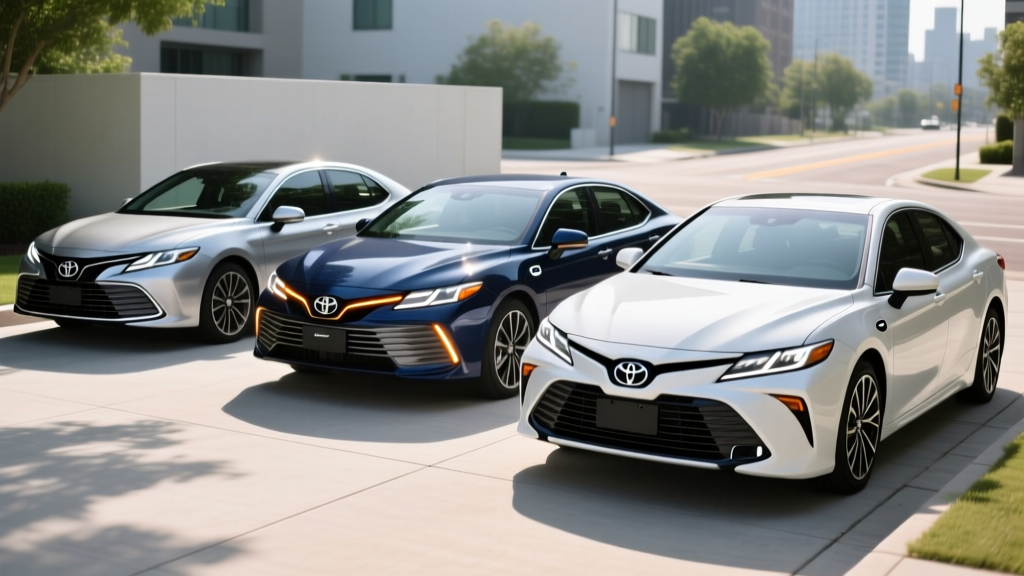
If you want sedan efficiency without range anxiety or charging infrastructure dependence, Toyota's hybrid lineup remains the segment benchmark. For 2026, Toyota offers four distinct hybrid sedans spanning conventional hybrids (HEVs) and one plug-in hybrid (PHEV): the Camry Hybrid, the Prius, the Prius Prime (PHEV), and the premium Crown. Each targets a different buyer — from the cost-conscious commuter to the tech-forward driver who wants some electric-only capability without committing to a full BEV.
This guide breaks down every 2026 Toyota hybrid sedan with exact EPA figures, real-world expectations, powertrain specs, pricing, and tax-credit eligibility so you can match the right model to your driving pattern.
HEV vs PHEV: Understanding Toyota's Two Hybrid Approaches
Before comparing models, it's critical to understand the fundamental difference between Toyota's conventional hybrids and its plug-in hybrid — because the ownership experience, fueling routine, and cost structure differ substantially.
| Feature | Conventional Hybrid (HEV) | Plug-In Hybrid (PHEV) |
|---|---|---|
| Needs to plug in? | No — charges via regenerative braking and the gas engine | Yes — plug in to access electric-only range |
| Electric-only driving | Very limited (under 1 mile at low speeds) | Full electric mode for 25–44+ miles |
| Battery size | ~1.0–1.6 kWh (small, assists engine) | 13.6 kWh usable (Prius Prime) |
| Home charging needed? | No | Yes, for full PHEV benefit (Level 1 or 2) |
| Federal tax credit | None (no §30D eligibility) | Up to $7,500 if sourcing/income rules met |
| Best for | Drivers without home charging access | Drivers with home charging and short commutes |
The 2026 Camry Hybrid, Prius, and Crown are all conventional HEVs — you never plug them in. The Prius Prime is Toyota's only PHEV sedan, offering meaningful electric-only range for daily commuting before the gas engine engages.
2026 Toyota Hybrid Sedan Lineup: Full Spec Comparison
| Spec | Camry Hybrid | Prius | Prius Prime (PHEV) | Crown |
|---|---|---|---|---|
| Powertrain | 2.5L 4-cyl + 2 motors (FWD) or 3 motors (AWD) | 2.0L 4-cyl + 2 motors | 2.0L 4-cyl + 2 motors + larger battery | 2.5L 4-cyl + 3 motors (AWD) or Hybrid MAX turbo |
| Combined HP | 225 hp (FWD) / 232 hp (AWD) | 196 hp | 220 hp | 236 hp (AWD) / 340 hp (MAX) |
| EPA Combined MPG | 51 mpg (FWD LE) | 57 mpg (LE) | 52 mpg (gas mode) / 127 MPGe (combined) | 41 mpg (XLE AWD) |
| EPA City / Hwy | 53 city / 50 hwy (FWD LE) | 57 city / 56 hwy (LE) | 53 city / 51 hwy (gas) | 127 MPGe | 42 city / 41 hwy (XLE) |
| Electric-Only Range | N/A (HEV) | N/A (HEV) | 44 mi (SE/XSE) / 40 mi (other trims) | N/A (HEV) |
| Battery (kWh) | ~1.6 kWh (NiMH/Li-ion) | ~1.0 kWh (Li-ion) | 13.6 kWh usable (Li-ion) | ~1.6 kWh (Li-ion) |
| Charging (PHEV) | N/A | N/A | Level 1: ~11 hrs / Level 2: ~4 hrs / No DCFC | N/A |
| 0-60 mph | ~7.0 sec | ~7.0 sec | ~6.6 sec | ~7.6 sec (AWD) / ~5.1 sec (MAX) |
| Starting MSRP | $29,790 (LE) | $28,345 (LE) | $33,445 (SE) | $41,440 (XLE) |
| Federal Tax Credit | None | None | Up to $7,500 (§30D, rules apply) | None |
Sources: fueleconomy.gov, Toyota Motor Corporation. Specs reflect 2025–2026 model-year data. MSRP excludes destination charges.
Fuel Economy Deep Dive: EPA Stickers vs Real-World MPG
Toyota hybrids consistently deliver — and often exceed — their EPA ratings in city driving, where regenerative braking and electric motor assist do the heavy lifting. Highway driving is a different story: at sustained 70+ mph speeds, the gas engine carries most of the load, and real-world MPG tends to dip below the EPA sticker.
| Model | EPA Combined | Real-World City (Observed) | Real-World Highway (Observed) | Cold-Weather Impact |
|---|---|---|---|---|
| Camry Hybrid LE (FWD) | 51 mpg | 52–56 mpg | 44–48 mpg | −3 to −5 mpg in winter |
| Prius LE | 57 mpg | 58–62 mpg | 48–52 mpg | −4 to −6 mpg in winter |
| Prius Prime (gas mode) | 52 mpg | 53–56 mpg | 46–50 mpg | −3 to −5 mpg in winter |
| Crown XLE (AWD) | 41 mpg | 40–43 mpg | 36–39 mpg | −2 to −4 mpg in winter |
Key observations from owner data and long-term testing:
- City drivers benefit most. If 70%+ of your miles are stop-and-go urban, the Prius LE can average 60+ mpg — beating its EPA rating.
- Highway-heavy commuters see less advantage. At 75 mph on flat interstate, expect the Camry Hybrid to deliver 44–47 mpg, not the 50 mpg highway sticker.
- Cold weather reduces MPG modestly. Unlike full EVs that can lose 20–30% of range in freezing temps, hybrids lose roughly 5–10% of fuel economy — the engine waste heat helps warm the cabin, mitigating the penalty.
- The Prius Prime's electric mode changes the calculus entirely. If your round-trip commute is under 44 miles and you charge nightly, you may use almost zero gasoline for months.
Prius Prime PHEV: Electric-Only Range and Charging Details
The 2026 Prius Prime is the only Toyota sedan that plugs in, and its 44-mile electric-only range (on SE and XSE trims) covers the daily commute of roughly 75% of American drivers, according to Federal Highway Administration data.
EPA-rated: 44 miles (SE/XSE) | 40 miles (base trim with larger wheels). Real-world: Expect 36–42 miles in mixed driving, 30–35 miles in freezing weather or at sustained highway speeds above 65 mph. The heat pump on higher trims helps mitigate winter losses.
Charging the Prius Prime:
- Level 1 (120V household outlet): ~11 hours from empty to full. Sufficient if you plug in overnight and drive under 44 miles daily.
- Level 2 (240V home charger): ~4 hours from empty to full using a 3.3 kW onboard charger. This is a modest charge rate — the Prius Prime does not accept faster Level 2 speeds.
- DC Fast Charging: Not available. The Prius Prime has no DCFC port. This is standard for PHEVs in this class — the battery is too small to justify the hardware cost and weight.
Total combined range (electric + gas tank): approximately 510–540 miles depending on trim, making the Prius Prime one of the longest-range vehicles in Toyota's lineup when you factor in both energy sources.
Powertrain and Performance: What Drives Each Model
Toyota's fifth-generation hybrid system (used in the Prius and Prius Prime) and its proven 2.5L hybrid architecture (Camry, Crown) prioritize efficiency over outright performance — but the latest generation has closed the gap considerably.
Camry Hybrid: The 2.5-liter Dynamic Force four-cylinder paired with two front motors (FWD) or three motors (AWD e-FWD) produces 225–232 combined horsepower. The AWD system uses a dedicated rear motor that engages on-demand for traction — there's no mechanical driveshaft to the rear wheels. The 0–60 mph time of approximately 7.0 seconds is competitive with turbocharged midsize sedans.
Prius: The redesigned Prius uses a 2.0-liter engine with two motors for 196 hp — a substantial improvement over the previous generation's 121 hp. It feels genuinely quick in city driving and adequate on highway merges.
Prius Prime: With 220 combined horsepower and a larger battery that can deliver full torque in EV mode, the Prime is the quickest Prius variant at approximately 6.6 seconds to 60 mph. In EV mode, acceleration is instant and silent.
Crown: Available in two flavors. The standard AWD hybrid pairs a 2.5L with three motors for 236 hp and a comfort-oriented ride. The Hybrid MAX variant uses a 2.4-liter turbo with hybrid assist for 340 hp and a 5.1-second 0–60 — aimed at buyers who want near-luxury performance with hybrid efficiency.
Pricing, Trims, and Tax Credit Eligibility
Here's where the math gets interesting — especially for the Prius Prime.
| Model | Base Trim MSRP | Mid Trim MSRP | Top Trim MSRP | Federal §30D Credit |
|---|---|---|---|---|
| Camry Hybrid | $29,790 (LE) | $32,290 (SE) | $36,490 (XLE) | Not eligible |
| Prius | $28,345 (LE) | $31,345 (XLE) | $35,345 (Limited) | Not eligible |
| Prius Prime | $33,445 (SE) | $36,445 (XSE) | $39,445 (XSE Premium) | Up to $7,500* |
| Crown | $41,440 (XLE) | $45,440 (Limited) | $53,440 (Platinum) | Not eligible |
*Prices exclude destination charges (~$1,095–$1,350 depending on model).
- Vehicle must have MSRP under $55,000 (sedan cap) — all Prius Prime trims qualify ✓
- Buyer AGI must not exceed: $150,000 (single), $225,000 (head of household), $300,000 (joint) ✓
- Battery components must meet North American assembly thresholds (phased in annually through 2029)
- Critical minerals must meet sourcing requirements from US or FTA-partner countries
- Credit is now available as a point-of-sale transfer — you can apply it as a down payment reduction at the dealer rather than waiting for a tax refund
- Full details and current-year sourcing requirements at IRS.gov §30D
Important caveat: The actual credit amount ($3,750 or $7,500) depends on whether the vehicle meets both the battery-component and critical-minerals requirements for the specific model year. Toyota has been actively reshoring battery supply chains, but the exact credit amount for the 2026 Prius Prime should be verified with your dealer and a tax professional at the time of purchase, as these rules tighten annually.
Conventional hybrids (Camry, Prius, Crown) do not qualify for the §30D new clean vehicle credit because they are not plug-in vehicles. Some states offer modest rebates for HEVs — check your state energy office or the Alternative Fuels Data Center for local incentives.
Battery Longevity, Warranty, and Replacement Costs
Hybrid battery anxiety is the number-one concern we hear from prospective buyers — and it's largely overblown based on two decades of Toyota data.
Coverage: 10 years / 150,000 miles (whichever comes first) on the hybrid battery and all hybrid system components, including the inverter and electric motors.
What's covered: Battery capacity loss below a defined threshold, cell failures, and hybrid system defects.
Transferable: Yes — the warranty transfers to subsequent owners, which supports resale value.
Real-world longevity data: Toyota's hybrid batteries, particularly in the Prius and Camry, routinely last 150,000–200,000+ miles before significant degradation. The smaller batteries in HEVs (~1–1.6 kWh) experience shallow charge cycles — they never fully deplete or fully charge, which dramatically extends cell life compared to a full EV battery that cycles through deeper states of charge.
Replacement costs if out of warranty:
- Camry Hybrid / Crown HEV battery: $2,500–$4,000 (parts + labor at a Toyota dealer)
- Prius HEV battery: $2,000–$3,500
- Prius Prime PHEV battery: $5,000–$8,000 (larger 13.6 kWh pack)
- Independent hybrid shops often offer refurbished battery replacements for 40–60% less than dealer pricing
For context, a hybrid battery replacement is comparable in cost to a transmission rebuild on a conventional gas car — and it's far less likely to be needed within the first 10–15 years of ownership. Toyota's hybrid system reliability consistently tops Consumer Reports and J.D. Power dependability rankings.
Who Should Buy Which Toyota Hybrid Sedan?
- You need a spacious midsize sedan with room for family and cargo
- You want AWD availability without a plug-in requirement
- Your budget is $30K–$37K and you want the highest MPG in the midsize class
- You don't have access to home or workplace charging
- Maximum fuel economy is your top priority (57 mpg combined)
- You want the lowest starting price in Toyota's hybrid lineup
- You drive mostly in the city where hybrids shine brightest
- You prefer a hatchback's cargo versatility in a sedan-like footprint
- You have home charging (even a standard 120V outlet works overnight)
- Your daily round-trip commute is under 40 miles
- You want to drive mostly on electricity but need gas flexibility for road trips
- You may qualify for the $7,500 federal tax credit, bringing effective price close to the standard Prius
- You want a premium, elevated-riding sedan with near-luxury appointments
- Performance matters (Hybrid MAX delivers 340 hp and 5.1s 0–60)
- You're cross-shopping entry-level luxury sedans but want hybrid efficiency
- Budget is $42K–$55K and you value standard AWD and a quiet cabin
- Choose a Toyota HEV (Camry/Prius/Crown) if you lack reliable home charging, drive long or unpredictable distances, or want the lowest-complexity path to 40–57 mpg without changing your fueling habits at all.
- Choose the Prius Prime PHEV if you can charge at home, your daily driving is under ~40 miles, and you want EV-like daily operation with a gas engine safety net for road trips. The potential $7,500 credit makes this the value play.
- Choose a full EV (like a Tesla Model 3, Hyundai Ioniq 6, or Toyota bZ4X) if you have reliable home Level 2 charging, want zero gasoline costs, and your typical trips fit within 250–300 miles between charges — or you're comfortable planning DC fast-charging stops on road trips.
Frequently Asked Questions
How many MPG does the Toyota Camry Hybrid actually get?
The 2026 Camry Hybrid LE (FWD) is EPA-rated at 51 mpg combined (53 city / 50 highway). In real-world city driving, owners frequently report 52–56 mpg thanks to regenerative braking. Highway driving at 70+ mph typically yields 44–48 mpg. Cold weather reduces these figures by roughly 3–5 mpg. The AWD trims drop to approximately 44–49 mpg combined due to the added weight and drag of the rear motor.
How far can the Prius Prime go on electric only?
The 2026 Prius Prime SE and XSE are EPA-rated for 44 miles of electric-only range. The base trim with larger wheels is rated for 40 miles. In real-world mixed driving, expect 36–42 miles; in freezing temperatures or sustained highway speeds, expect 30–35 miles. Once the battery depletes, the car seamlessly switches to hybrid mode and delivers 52 mpg combined on gasoline.
Do Toyota hybrid batteries need to be replaced? What does it cost?
Toyota hybrid batteries are warranted for 10 years / 150,000 miles and routinely last 150,000–200,000+ miles based on fleet and owner data. The shallow charge cycles of HEV batteries (never fully empty, never fully full) dramatically extend cell life. If replacement is needed out of warranty, expect $2,000–$4,000 for a Camry or Prius HEV battery, or $5,000–$8,000 for the Prius Prime's larger pack. Independent hybrid specialists often offer refurbished units at significant savings.
Does the Camry Hybrid or Prius qualify for a federal tax credit?
No. Conventional hybrids (HEVs) do not qualify for the federal §30D clean vehicle tax credit because they are not plug-in vehicles. Only the Prius Prime PHEV is potentially eligible for up to $7,500, subject to buyer income limits (AGI under $150K single / $300K joint), MSRP caps ($55K for sedans), and battery sourcing requirements that tighten annually. Verify current eligibility at IRS.gov before purchasing.
Can I charge the Camry Hybrid or standard Prius at home?
No — and you don't need to. The Camry Hybrid, standard Prius, and Crown are conventional hybrids that charge their small batteries entirely through regenerative braking and the gasoline engine. There is no plug and no electric-only driving mode of meaningful distance. You fuel them exclusively with gasoline and drive them exactly like a conventional car.
Is the Toyota Crown Hybrid worth the premium over the Camry Hybrid?
The Crown starts approximately $12,000 above the Camry Hybrid and delivers a more premium interior, standard AWD, a quieter cabin, and an elevated ride height that many buyers prefer. Fuel economy drops to 41 mpg combined (vs. the Camry's 51). If you value the luxury-adjacent experience and don't need maximum MPG, the Crown is a compelling alternative to entry-level luxury sedans from BMW, Lexus, and Genesis. If pure efficiency and value drive your decision, the Camry Hybrid is the stronger choice.
How does Toyota's hybrid reliability compare to full EVs?
Toyota's hybrid powertrains are among the most reliable vehicle systems on the road, with two decades of proven data. The hybrid system has fewer high-stress components than a conventional gas powertrain (no traditional starter motor, no alternator, reduced brake wear from regen, and an e-CVT with no belts or friction bands). Full EVs have even fewer moving parts but carry higher battery replacement risk and cost if a failure occurs outside warranty. For risk-averse buyers who want electrified efficiency without charging dependency, Toyota's HEVs remain the lowest-risk option in the market.