If you've ever looked at a Toyota Prius, RAV4 Hybrid, or Camry and wondered what is a Toyota hybrid engine, you're not alone. Toyota has sold over 25 million hybrid vehicles worldwide since the original Prius debuted, yet the engineering underneath the hood remains misunderstood by many shoppers. Unlike a conventional gas car or a full battery-electric vehicle (BEV), a Toyota hybrid pairs a gasoline engine with one or more electric motor-generators and a small battery pack — all managed by a power-split device that seamlessly blends power sources.
This guide explains exactly how Toyota's Hybrid Synergy Drive works in 2026, the fuel economy you can actually expect, how conventional hybrids (HEVs) differ from Toyota's plug-in hybrids (PHEVs), and whether a hybrid, PHEV, or full EV is the right choice for your driving life.
How Toyota's Hybrid Synergy Drive Actually Works
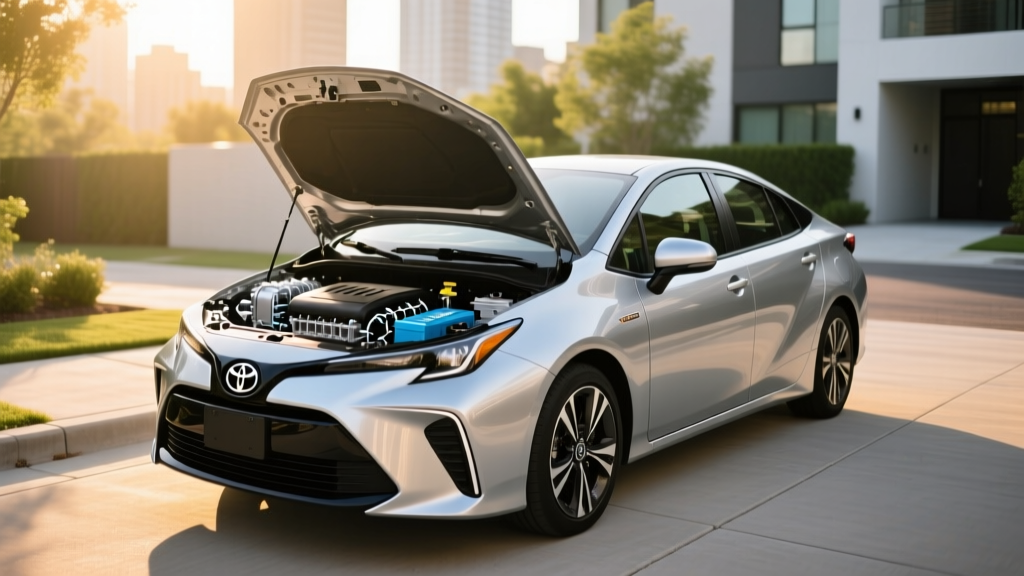
Toyota doesn't use a traditional "hybrid engine" in the way most people imagine. There isn't one single engine that switches between gas and electric. Instead, Toyota's Hybrid Synergy Drive is a full-parallel hybrid system that combines:
- An Atkinson-cycle gasoline engine — optimized for efficiency over raw power, with a higher expansion ratio than a standard Otto-cycle engine
- Two motor-generators (MG1 and MG2) — MG1 acts as a starter and generator, while MG2 drives the wheels and captures energy during regenerative braking
- A power-split device (planetary gearset) — this continuously variable transmission (eCVT) blends torque from the engine and electric motor without fixed gear ratios
- A nickel-metal hydride (NiMH) or lithium-ion (Li-ion) battery pack — typically 1.0 to 1.6 kWh for conventional HEVs, storing energy recaptured from braking and engine excess
The beauty of this system is that the car's computer decides in real time whether to run on the engine alone, the electric motor alone, or both simultaneously. At low speeds and light loads, the Prius can drive on electric power only for short distances. Under hard acceleration, both the engine and MG2 push the wheels together. During deceleration, MG2 reverses role and becomes a generator, sending energy back into the battery — this is regenerative braking.
Crucially, conventional Toyota hybrids never need to be plugged in. The battery is charged entirely by the engine and regenerative braking. If you want plug-in capability, you're looking at a Toyota PHEV — a fundamentally different setup we'll cover next.
HEV vs PHEV: Toyota's Two Hybrid Paths
Toyota offers two distinct hybrid architectures in 2026. Confusing them is one of the most common mistakes shoppers make, so let's draw a hard line:
Conventional Hybrid (HEV)
Examples: 2026 Toyota Prius, Camry Hybrid, RAV4 Hybrid, Highlander Hybrid, Corolla Hybrid, Sienna, Crown
- Battery: 1.0–1.6 kWh (Li-ion or NiMH)
- Electric-only driving: Very limited, ~0.5–1 mile at low speeds
- Plug-in charging: No — never needs to be plugged in
- Fueling: Gasoline only, like a standard car
- Best for: Drivers who want maximum MPG with zero behavior change
Plug-In Hybrid (PHEV)
Examples: 2026 Toyota Prius Prime, RAV4 Prime
- Battery: 13.6 kWh (Prius Prime) / 18.1 kWh (RAV4 Prime) — lithium-ion
- Electric-only range: 39–44 miles (Prius Prime) / 42 miles (RAV4 Prime) per EPA
- Plug-in charging: Yes — Level 1 (120V) or Level 2 (240V)
- Fueling: Gasoline + electricity; operates as a regular hybrid once battery is depleted
- Best for: Drivers with short commutes who can charge at home and want gas-free daily driving
The distinction matters enormously for your wallet and daily routine. An HEV is a "fill up and forget" vehicle that simply sips less fuel. A PHEV rewards you with electric-only commuting — but only if you charge it regularly. Drive a PHEV without ever plugging in, and you're carrying dead battery weight with minimal efficiency benefit over a standard HEV.
EPA Fuel Economy: What MPG Do Toyota Hybrids Actually Get?
Toyota's 2026 hybrid lineup covers a wide efficiency range. Here are the official EPA figures for the most popular models, sourced from fueleconomy.gov:
| 2026 Model | Type | City MPG | Hwy MPG | Combined MPG | EV Range (mi) |
|---|---|---|---|---|---|
| Prius (LE FWD) | HEV | 57 | 56 | 57 | — |
| Prius (XLE/Limited AWD) | HEV | 49 | 50 | 49 | — |
| Prius Prime (SE) | PHEV | — | — | 52 (hybrid mode) / 127 MPGe | 44 |
| Camry Hybrid (LE FWD) | HEV | 53 | 50 | 52 | — |
| Corolla Hybrid (LE AWD) | HEV | 47 | 41 | 44 | — |
| RAV4 Hybrid (AWD) | HEV | 41 | 38 | 40 | — |
| RAV4 Prime (AWD) | PHEV | — | — | 38 (hybrid) / 94 MPGe | 42 |
| Highlander Hybrid (AWD) | HEV | 35 | 35 | 35 | — |
| Sienna (FWD) | HEV | 36 | 36 | 36 | — |
Real-World MPG vs. EPA Stickers
One of the best-kept secrets about Toyota hybrids is that they frequently exceed their EPA ratings in real-world city driving. The Atkinson-cycle engine and aggressive regenerative braking shine in stop-and-go traffic where conventional gas cars are least efficient. Owners of the Prius LE consistently report 58–62 MPG in urban commuting during mild weather.
However, highway driving tells a different story. At sustained 70–80 mph speeds, aerodynamic drag dominates, and the hybrid system has fewer opportunities to recapture energy. Expect highway fuel economy to land 3–6 MPG below the EPA sticker on most Toyota hybrids, especially the RAV4 and Highlander due to their larger frontal area.
Cold weather also reduces efficiency. Below 40°F, the engine runs more frequently to maintain cabin heat and battery temperature, cutting city MPG by roughly 10–15%. This is less severe than the 20–30% range loss a full EV experiences in winter, but it's a real factor for northern-climate drivers.
Powertrain Output and Performance
Toyota hybrids are not performance vehicles, but the latest generation has closed the gap significantly. The redesigned Prius produces a combined 196 horsepower (FWD) or 199 hp (AWD) from its 2.0L four-cylinder engine plus electric motors — enough for a 0–60 mph time of approximately 7.2 seconds. That's a dramatic improvement from the previous generation's lethargic 10+ second sprint.
Here's a breakdown of the key powertrain figures across the 2026 lineup:
| Model | Engine | Combined HP | 0–60 mph | Drivetrain |
|---|---|---|---|---|
| Prius / Prius Prime | 2.0L I4 + motors | 196 (FWD) / 199 (AWD) | ~7.2 sec | FWD / eAWD |
| Camry Hybrid | 2.5L I4 + motors | 225 (FWD) / 232 (AWD) | ~7.0 sec | FWD / eAWD |
| Corolla Hybrid | 1.8L I4 + motors | 138 | ~9.0 sec | AWD |
| RAV4 Hybrid | 2.5L I4 + motors | 219 | ~7.4 sec | AWD |
| RAV4 Prime | 2.5L I4 + motors | 302 | ~5.7 sec | AWD |
| Highlander Hybrid | 2.5L I4 + motors | 243 | ~7.8 sec | FWD / eAWD |
| Sienna | 2.5L I4 + motors | 245 | ~7.5 sec | FWD / eAWD |
The RAV4 Prime stands out as a genuine performance sleeper: 302 combined horsepower and a 5.7-second 0–60 time make it one of the quickest compact SUVs on the market, hybrid or not. That power comes from a larger electric motor paired with the 18.1 kWh battery, which can deliver substantial current on demand.
PHEV Charging: Battery Size, Times, and DC Fast Charge Reality
If you're considering a Toyota PHEV, charging logistics are a key part of ownership. Here's what you need to know:
| Spec | Prius Prime | RAV4 Prime |
|---|---|---|
| Battery capacity (usable) | ~10.9 kWh | ~14.9 kWh |
| EPA electric-only range | 39–44 miles | 42 miles |
| Total range (EV + gas) | ~470+ miles | ~480+ miles |
| Level 1 charge (120V / 12A) | ~11 hours | ~12 hours |
| Level 2 charge (240V) | ~4 hours | ~2.5 hours |
| DC fast charging | No | No |
No Toyota PHEV currently supports DC fast charging. This is a deliberate engineering trade-off. The battery packs are small enough that Level 2 charging fully replenishes them overnight or during a workday, and adding DC fast-charge hardware would increase cost, weight, and packaging complexity for a marginal benefit. For PHEV buyers who charge at home every night, this is rarely a practical limitation.
A standard 120V household outlet (Level 1) will fully charge a Prius Prime in roughly 11 hours — sufficient for overnight top-ups. Upgrading to a 240V Level 2 home charger cuts that to about 4 hours, which means you can recharge during a workday if your employer offers charging stations.
Battery Warranty, Lifespan, and Replacement Cost
Toyota Hybrid Battery Warranty
Coverage: 10 years / 150,000 miles (whichever comes first) for all 2026 Toyota hybrid and PHEV models, applicable in all 50 states.
What's covered: Hybrid battery pack, battery control module, and related high-voltage components. Toyota warrants that the battery will retain sufficient capacity to operate the hybrid system properly.
Transferability: The hybrid battery warranty is fully transferable to subsequent owners at no cost — a significant resale-value advantage.
Battery longevity is consistently the top concern among hybrid shoppers. The data is reassuring: Toyota's hybrid battery packs have proven exceptionally durable. Real-world failure rates are low, and many Prius taxis and high-mileage commuters have exceeded 200,000 miles on the original battery. The NiMH packs in earlier models are particularly robust, while the newer lithium-ion packs in the current Prius and RAV4 Prime offer higher energy density with comparable longevity projections.
If a replacement is needed out of warranty, expect to pay between $2,000 and $4,500 for a new OEM hybrid battery depending on the model. Refurbished and aftermarket options are available for $1,000–$2,500. For context, a full EV battery replacement can cost $8,000–$20,000+, making Toyota's smaller hybrid packs far less financially risky over a 15-year ownership horizon.
Toyota's hybrid system also avoids the deep discharge cycles that accelerate degradation in full EVs. The battery operates within a narrow state-of-charge window (roughly 40–80%), which dramatically extends cycle life. You'll never see a "0%" or "100%" on a Toyota HEV — the system manages this buffer automatically.
Pricing and Tax Credit Eligibility
Toyota hybrids carry a modest premium over their gas-only counterparts, but that gap has narrowed significantly. Here's the 2026 pricing landscape:
| Model (Base Trim) | Starting MSRP | Federal Tax Credit |
|---|---|---|
| Prius LE | ~$28,350 | None (HEV) |
| Prius Prime SE | ~$33,445 | Up to $3,750* |
| Camry Hybrid LE | ~$29,995 | None (HEV) |
| Corolla Hybrid LE | ~$24,700 | None (HEV) |
| RAV4 Hybrid LE | ~$33,425 | None (HEV) |
| RAV4 Prime SE | ~$44,900 | Up to $3,750* |
| Highlander Hybrid LE | ~$41,670 | None (HEV) |
| Sienna LE | ~$38,885 | None (HEV) |
*Federal tax credit amounts for PHEVs are subject to IRS §30D rules including battery sourcing requirements, buyer income caps ($150K single / $300K joint), and MSRP limits ($55K for cars, $80K for SUVs/vans/trucks). Credit may be transferred to the dealer as a point-of-sale discount. Always verify current eligibility at irs.gov before purchasing. Conventional HEVs do not qualify for the federal clean vehicle credit.
The PHEV credit for the Prius Prime and RAV4 Prime is typically lower than the maximum $7,500 because Toyota's battery supply chains have not fully met the critical-mineral and battery-component sourcing thresholds set by the Inflation Reduction Act. As of 2026, qualifying PHEVs generally earn $3,750 (meeting one of two sourcing requirements but not both). This can change annually as sourcing rules tighten, so confirm with your dealer and tax professional.
Some states offer additional incentives for PHEVs — California, Colorado, and New York among them — but these vary widely. Conventional hybrids are eligible for no federal credit but make up for it with lower purchase prices and zero charging-infrastructure dependency.
Hybrid vs PHEV vs Full EV: Which Fits Your Life?
Choose a Toyota HEV If:
- You can't charge at home (apartment, street parking, no garage)
- You want zero behavior change — just fill up less often
- You drive 15,000+ miles/year and want proven reliability
- You want the lowest upfront cost in an electrified vehicle
- You regularly take long road trips and don't want to plan charging stops
Choose a Toyota PHEV If:
- Your daily commute is under 40 miles round-trip
- You have reliable home or workplace Level 2 charging
- You want electric-only daily driving but gas flexibility for road trips
- You qualify for the partial federal tax credit and state incentives
- You're not ready to commit to a full EV but want to reduce gas use significantly
Choose a Full EV If:
- You have home Level 2 charging and your daily driving is under 250 miles
- You want to eliminate gasoline entirely and minimize "fuel" cost per mile
- You qualify for the full $7,500 federal credit on a qualifying BEV
- You're comfortable with route planning for longer road trips
- You want zero tailpipe emissions and minimal drivetrain maintenance
For the majority of American drivers who lack reliable home charging access, a conventional Toyota HEV remains the most practical path to dramatically lower fuel consumption. You get 40–57 MPG combined without ever thinking about charging, range, or battery management.
The PHEV is the sweet spot for a narrower but growing audience: homeowners with garages who commute less than 40 miles daily. A RAV4 Prime owner who charges nightly might use zero gasoline for months during normal commuting, while retaining the ability to drive 480+ total miles on a road trip without a single charging stop.
Pros and Cons at a Glance
✓ Pros
- Best-in-class real-world fuel economy (Prius LE: 57+ MPG combined)
- Proven reliability — 25M+ hybrids sold globally, low battery failure rates
- 10-year / 150,000-mile hybrid battery warranty, fully transferable
- No charging infrastructure required (HEVs)
- Strong resale value — Toyota hybrids hold value better than most EVs
- AWD available across the lineup via rear electric motor (eAWD)
- RAV4 Prime: 302 hp, 42-mile EV range, genuine performance SUV
✗ Cons
- No DC fast charging on PHEVs — Level 2 only
- Conventional HEVs qualify for no federal tax credit
- PHEV credit limited to ~$3,750 due to battery sourcing rules
- eCVT can produce a "drone" under hard acceleration (less pronounced in current gen)
- RAV4 Prime wait times remain long — high demand, limited supply
- PHEV battery replacement cost: $4,000–$6,000 out of warranty
- Electric-only range on PHEVs drops 20–30% in cold weather
Frequently Asked Questions
How many MPG does a Toyota hybrid get?
It depends on the model. The 2026 Prius LE achieves an EPA-rated 57 MPG combined (57 city / 56 highway), making it one of the most efficient non-plug-in vehicles sold in the US. The RAV4 Hybrid returns 40 MPG combined, the Camry Hybrid 52 MPG combined, and the Highlander Hybrid 35 MPG combined. Real-world city MPG often exceeds EPA estimates by 3–5 MPG thanks to regenerative braking, while highway MPG may fall 3–6 MPG below the sticker at sustained high speeds.
How far can a Toyota PHEV go on electric only?
The 2026 Prius Prime achieves an EPA-rated 39–44 miles of electric-only range depending on trim (SE gets 44 miles; XSE gets 39 miles due to larger wheels and added weight). The RAV4 Prime delivers 42 miles of EV range. In warm weather with gentle driving, owners frequently report exceeding these figures by 3–5 miles. In cold weather (below 32°F), expect a 20–30% reduction due to cabin heating demands and reduced battery efficiency.
Do Toyota hybrids need to be plugged in?
No. Conventional Toyota hybrids (HEVs) — including the Prius, Camry Hybrid, RAV4 Hybrid, Corolla Hybrid, Highlander Hybrid, and Sienna — never need to be plugged in. The battery charges itself through regenerative braking and excess engine power. Only Toyota's PHEVs (Prius Prime and RAV4 Prime) benefit from plug-in charging, and even they operate perfectly as regular hybrids if you never plug them in.
Is a Toyota hybrid reliable, and what does battery replacement cost?
Toyota hybrids are among the most reliable vehicles on the road. The hybrid system has fewer wear components than a conventional powertrain — no traditional starter motor, no alternator, and the eCVT has no clutch packs or bands to wear out. The hybrid battery is warranted for 10 years / 150,000 miles. Out-of-warranty replacement costs range from $2,000–$4,500 for HEVs and $4,000–$6,000 for PHEVs. Refurbished batteries are available for less. Real-world data shows most Toyota hybrid batteries last well beyond 150,000 miles.
Does a Toyota hybrid qualify for a federal tax credit?
Conventional Toyota hybrids (HEVs) do not qualify for the federal §30D clean vehicle tax credit — this credit applies only to plug-in vehicles (PHEVs and BEVs). The Toyota PHEVs — Prius Prime and RAV4 Prime — may qualify for a partial credit of approximately $3,750, subject to IRS battery-sourcing requirements, buyer income limits ($150K single / $300K joint), and MSRP caps. The credit can be applied as a point-of-sale discount at the dealership. Always verify current eligibility at irs.gov and consult a tax professional before relying on credit estimates.
What's the difference between Toyota's eAWD and traditional AWD?
Toyota's electronic all-wheel drive (eAWD) uses a separate electric motor on the rear axle rather than a mechanical driveshaft connected to the engine. This means there's no physical link between the front and rear wheels — the rear motor activates only when the system detects slip or when extra traction is needed. It's lighter, more efficient, and has fewer moving parts than a traditional AWD system, but it provides less torque to the rear wheels than a mechanical system would. For snow and rain, eAWD is highly effective. For serious off-roading, it's not a substitute for a dedicated 4WD system.
How does a Toyota hybrid compare to a full EV like the Tesla Model 3 or Hyundai Ioniq 6?
A full EV eliminates gasoline entirely, delivers lower per-mile energy costs (typically $0.03–$0.05/mile on home electricity vs $0.10–$0.14/mile for a Toyota hybrid on gas), and requires less maintenance. However, EVs demand home charging access, longer trip planning around DC fast-charging stops, and carry higher upfront costs (before tax credits). A Toyota HEV costs less upfront, needs no charging infrastructure, and still delivers 40–57 MPG. If you can charge at home and drive under 250 miles daily, an EV may save more long-term. If charging access is uncertain or you frequently drive 400+ mile trips, a Toyota hybrid or PHEV is the lower-risk choice.