Quick Verdict: A Used Hybrid Bargain With Proven Efficiency
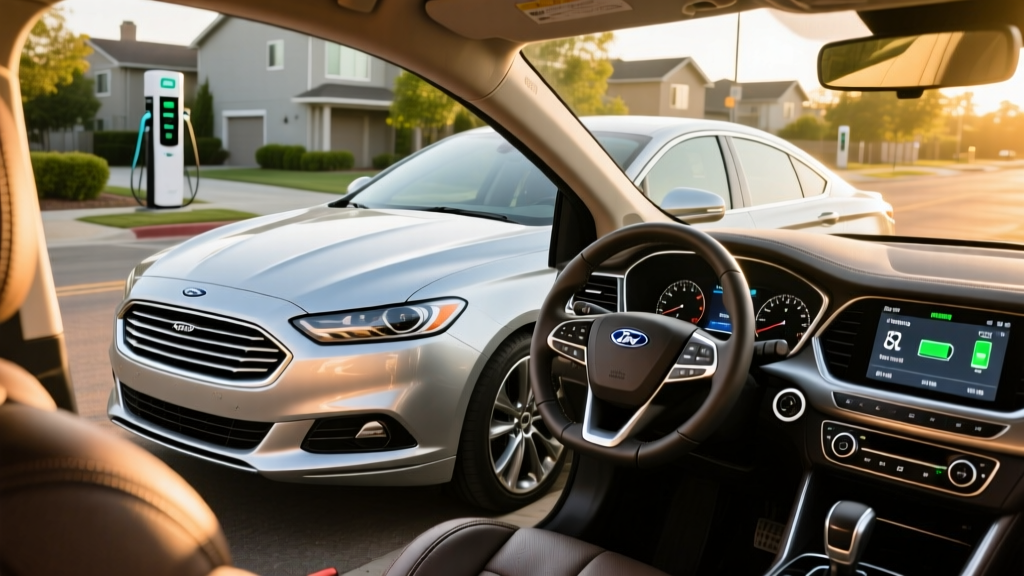
The 2018 Ford Fusion Hybrid Titanium remains one of the most compelling used midsize hybrid sedans on the market. Ford discontinued the Fusion after the 2020 model year, but the second-generation Hybrid — particularly the range-topping Titanium trim — holds up well in 2026 as a fuel-sipping daily driver that requires zero plug-in infrastructure. With an EPA-rated 42 MPG combined, a refined 2.0L Atkinson-cycle powertrain, and a hybrid battery backed by an 8-year/100,000-mile warranty, it bridges the gap between conventional gas sedans and full battery-electric vehicles for buyers who want efficiency without lifestyle change.
This guide covers the exact specs, real-world fuel economy expectations, battery longevity data, and ownership costs you need before purchasing a used 2018 Fusion Hybrid Titanium.
HEV vs PHEV: Which Fusion Hybrid Are You Looking At?
Ford offered two electrified Fusion variants in 2018, and confusing them is a common buyer mistake. Understanding the difference is critical before you shop.
| Attribute | Fusion Hybrid (HEV) | Fusion Energi (PHEV) |
|---|---|---|
| Powertrain type | Conventional hybrid — no plug | Plug-in hybrid — charges via outlet |
| Battery capacity | 1.4 kWh (usable ~1.0 kWh) | 7.6 kWh (usable ~5.8 kWh) |
| EPA combined MPG / MPGe | 42 MPG combined | 42 MPG (gas) / 97 MPGe (electric) |
| Electric-only range | N/A (EV assist only, ~1 mi) | 21 miles EV-only |
| Total range | ~735 miles | ~610 miles (EV + gas) |
| DC fast charging | No | No (Level 1/2 only) |
| Federal tax credit (when new) | None | Up to $4,007 (now expired) |
| Trunk space | 12.0 cu ft | 8.2 cu ft (battery intrusion) |
This article focuses on the Fusion Hybrid (HEV) — the non-plug-in model. If you're shopping for the Energi PHEV variant, the electric-only range and charging details differ significantly. The conventional Hybrid is the simpler, more affordable used-car play and doesn't require any home charging setup.
Fuel Economy: EPA Ratings vs Real-World MPG
The 2018 Ford Fusion Hybrid carries EPA ratings that still compare favorably against newer midsize hybrids in 2026. Here's the official breakdown from fueleconomy.gov:
| Driving Cycle | EPA Rating | Real-World Expectation |
|---|---|---|
| City | 43 MPG | 44–48 MPG (hybrids often exceed EPA in stop-and-go) |
| Highway | 41 MPG | 36–39 MPG (sustained 70+ mph reduces regen benefit) |
| Combined | 42 MPG | 39–44 MPG (varies with driving mix and climate) |
Why real-world numbers differ: Hybrids like the Fusion thrive in city driving where regenerative braking recaptures energy at every stoplight. On sustained highway cruises above 70 mph, the electric motor contributes less and the 2.0L engine carries the load, dropping efficiency by 3–5 MPG below the EPA highway estimate. In cold weather (below 35°F), expect an additional 2–4 MPG penalty as the engine runs more frequently for cabin heat and the battery's internal resistance increases.
Owners on Fuelly and similar tracking platforms consistently report lifetime averages between 39 and 44 MPG combined — right in line with expectations. Several high-mileage drivers report exceeding 45 MPG on city-heavy commutes, which is the Fusion Hybrid's sweet spot.
Powertrain, Performance, and Driving Dynamics
| Specification | Value |
|---|---|
| Engine | 2.0L Atkinson-cycle inline-4 |
| Engine output | 141 HP @ 6,000 rpm / 129 lb-ft torque |
| Electric motor output | 118 HP / 117 lb-ft |
| Net combined system output | 188 HP |
| Transmission | eCVT (planetary gearset, no fixed gears) |
| 0–60 mph | ~7.8 seconds |
| Drivetrain | Front-wheel drive |
| Curb weight | ~3,624 lbs |
| Fuel tank | 13.5 gallons |
| Trunk volume | 12.0 cu ft |
The eCVT in the Fusion Hybrid isn't a traditional belt-driven CVT — it uses a planetary gearset that seamlessly blends engine and motor power. The result is smooth, linear acceleration without the rubber-band drone associated with older CVT designs. The 188 combined horsepower is adequate for merging and passing, though this is a sedan tuned for efficiency, not sportiness.
The Titanium trim adds paddle shifters that simulate gear steps in the eCVT, a sportier suspension tune, and 18-inch alloy wheels. Those wheels cost roughly 1 MPG compared to the SE trim's 17-inch wheels — a minor trade-off for the upgraded appearance and handling.
Hybrid Battery Warranty & Longevity
Original warranty: 8 years / 100,000 miles (10 years / 150,000 miles in California and states adopting CARB emissions standards).
Warranty status in 2026: The 8-year/100,000-mile factory hybrid battery warranty on a 2018 model expired in 2026 by age, unless the vehicle has fewer than 100,000 miles AND you're in a CARB state where the 10-year provision applies. Verify remaining coverage with a Ford dealer using the VIN.
Real-world battery lifespan: Ford's Gen2 hybrid system has proven durable. Taxis and fleet Fusion Hybrids have exceeded 200,000 miles on the original battery pack. The 1.4 kWh battery is small and operates within a conservative state-of-charge window (roughly 40–60% SoC), which minimizes degradation. Most used 2018 Fusion Hybrids will have minimal capacity loss.
Replacement cost: A new OEM hybrid battery pack from Ford runs approximately $2,000–$3,500 including labor at a dealership. Third-party refurbished packs are available for $1,200–$2,000 installed. Given the battery's track record, replacement is unlikely for most buyers.
Titanium Trim: What You Get Over the SE
The Titanium was the top-of-the-line Fusion Hybrid trim for 2018, and its equipment list remains competitive against 2026 midsize sedans. Standard features on the Titanium include:
- Sony premium audio system with 12 speakers
- Leather-trimmed heated and cooled front seats
- Heated steering wheel
- SYNC 3 infotainment with 8-inch touchscreen, Apple CarPlay, and Android Auto
- Navigation system
- Adaptive cruise control with stop-and-go
- Lane-keeping system
- BLIS (Blind Spot Information System) with cross-traffic alert
- Rear view camera
- Ambient interior lighting
- 18-inch machine-finish alloy wheels
- LED taillamps and signature lighting
The adaptive cruise control on the Titanium is noteworthy — it can bring the car to a complete stop in traffic and resume, which is a valuable feature for commuters. Note that this is a basic driver-assist system (SAE Level 1), not a hands-free system like Ford's current BlueCruise. You must keep your hands on the wheel at all times.
Used Pricing and Tax Credit Reality in 2026
Ford discontinued the Fusion after the 2020 model year, so every 2018 Fusion Hybrid Titanium is now a used vehicle. As of early 2026, typical asking prices range from:
- $12,000–$15,000 for examples with 80,000–120,000 miles
- $15,000–$18,500 for examples with 40,000–75,000 miles in clean condition
- $18,500–$22,000 for low-mileage (under 40,000 miles) or CPO examples
Federal tax credit: The Fusion Hybrid (HEV) never qualified for the §30D federal EV tax credit, as it is a conventional hybrid with no plug-in capability. The Fusion Energi (PHEV) qualified for up to $4,007 when new, but that credit is no longer available on used purchases under current IRS §30D rules.
Used clean vehicle credit (§25E): The federal used clean vehicle credit of up to $4,000 (30% of sale price, capped at $4,000) applies only to used PHEVs and BEVs — not conventional hybrids. So the Fusion Hybrid HEV does not qualify. The Fusion Energi PHEV could qualify if the sale price is under $25,000, the buyer meets income limits ($75,000 single / $150,000 joint), and the vehicle is purchased through a licensed dealer. Confirm eligibility on irs.gov before relying on this credit.
Reliability, Maintenance, and Ownership Costs
The 2018 Fusion Hybrid benefits from Ford's mature hybrid architecture, which debuted in 2013 and received incremental updates through 2020. By the 2018 model year, most early-generation issues had been resolved.
Common issues to check on a used example:
- Brake actuator recall: Some 2013–2018 Fusion Hybrids were subject to a recall for the brake actuator assembly. Verify recall completion via NHTSA's VIN lookup.
- 12V battery drain: Like many hybrids, the Fusion can drain its 12V auxiliary battery if left sitting for extended periods. A dead 12V battery will prevent the car from starting even if the hybrid battery is full.
- eCVT cooling: The eCVT fluid should be changed per Ford's maintenance schedule (~every 60,000 miles). Neglected fluid can lead to premature wear.
- Infotainment glitches: Early SYNC 3 units can freeze or lag; software updates from Ford usually resolve this.
Estimated annual maintenance: $400–$600/year, which is lower than a comparable gas-only midsize sedan thanks to regenerative braking (less brake pad wear) and the Atkinson-cycle engine's simpler operation (no traditional starter motor, no alternator).
Insurance: Typically $1,200–$1,600/year depending on state and driver profile — comparable to a gas Fusion, slightly below full EV insurance premiums.
Who Should Choose the Fusion Hybrid vs a Full EV or Gas Car?
Choose the 2018 Fusion Hybrid If:
- You want 40+ MPG without plugging in or changing habits
- You lack access to home or workplace charging
- Your budget is $12,000–$18,000 for a well-equipped sedan
- You drive a city-heavy commute where hybrids shine
- You want a proven, low-risk powertrain with cheap battery replacement
- You value a full-size trunk (12.0 cu ft vs 8.2 in the Energi PHEV)
Look Elsewhere If:
- You want electric-only driving (consider a used Fusion Energi or a BEV like the Chevy Bolt)
- You need AWD — the Fusion Hybrid is FWD only (the Toyota Camry Hybrid offers AWD from 2020+)
- You want the latest tech — SYNC 3 is functional but dated vs 2026 infotainment
- You regularly drive highway-only routes above 75 mph (a diesel or efficient gas car may match hybrid MPG here)
- You want a new vehicle with full factory warranty remaining
The decision framework: If your daily driving involves stop-and-go traffic, suburban errands, or mixed commuting under 70 mph, the Fusion Hybrid's 42 MPG combined will save roughly $800–$1,200 annually in fuel compared to a 28 MPG gas midsize sedan (based on 15,000 miles/year and $3.20/gallon). If you have reliable Level 2 home charging and a short commute, a used BEV eliminates fuel costs entirely. If you drive 80%+ highway miles at high speed, the hybrid advantage narrows and a conventional efficient sedan may suffice.
Frequently Asked Questions
How many MPG does the 2018 Ford Fusion Hybrid actually get?
The EPA rates it at 43 city / 41 highway / 42 combined. Real-world owners average 39–44 MPG combined depending on driving mix. City-heavy drivers often exceed the EPA city rating, while sustained highway driving above 70 mph drops to 36–39 MPG.
Does the 2018 Fusion Hybrid need to be plugged in?
No. The Fusion Hybrid is a conventional hybrid (HEV). It charges its small 1.4 kWh battery through regenerative braking and the gasoline engine. You never plug it in. The Fusion Energi is the plug-in variant — make sure you know which one you're buying.
How long does the hybrid battery last, and what does replacement cost?
Ford's hybrid batteries routinely last 150,000–200,000+ miles based on fleet data. The original warranty was 8 years/100,000 miles (10 years/150,000 in CARB states). If replacement is needed, expect $2,000–$3,500 for a new OEM pack or $1,200–$2,000 for a refurbished unit.
Does the 2018 Fusion Hybrid qualify for any tax credits?
No federal tax credits apply to the conventional Fusion Hybrid (HEV). It was never eligible for §30D when new, and the used clean vehicle credit (§25E) covers only plug-in vehicles. State-level incentives for hybrids vary — check your state's energy or DMV website.
Is the 2018 Fusion Hybrid reliable?
Yes. The Gen2 Fusion Hybrid powertrain is one of Ford's most dependable offerings. The eCVT has no belts or clutches to wear, regenerative braking extends brake life, and the Atkinson-cycle engine operates under less stress than a conventional engine. Check for the brake actuator recall and verify maintenance records on any used example.
How does it compare to a Toyota Camry Hybrid?
The 2018 Camry Hybrid achieves 46–52 MPG combined (depending on trim and wheels) — roughly 5–10 MPG better than the Fusion Hybrid. However, used Camry Hybrids typically command $2,000–$4,000 more than equivalent Fusion Hybrids. If budget is the priority, the Fusion offers better value per dollar; if maximum MPG is the goal, the Camry wins.