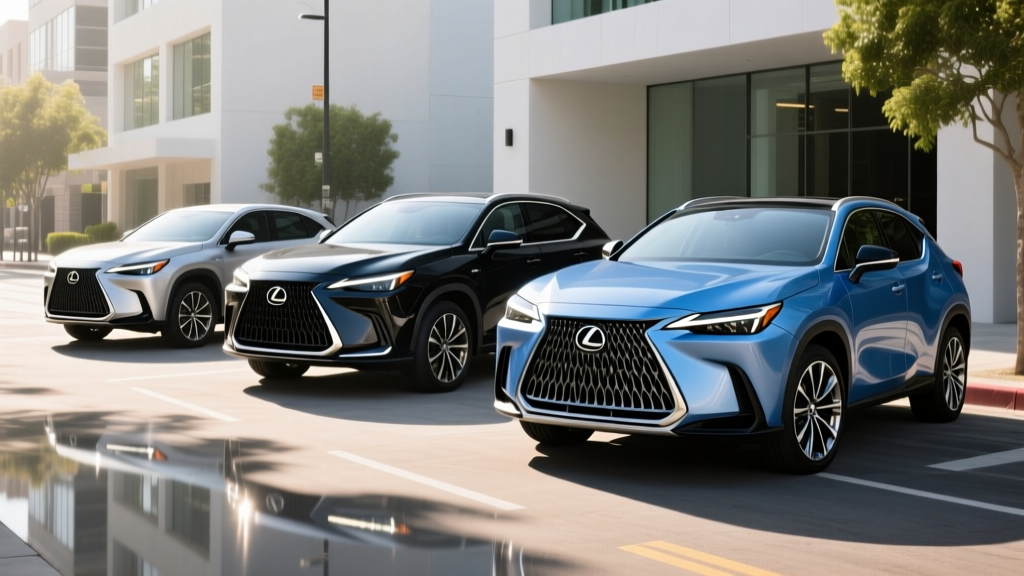
If you are shopping for a luxury compact or midsize SUV that sips fuel without demanding a lifestyle change, the Lexus crossover hybrid lineup deserves a long look. For the 2026 model year, Lexus fields five distinct hybrid crossovers spanning three nameplates: the subcompact UX 300h, the compact NX 350h and plug-in NX 450h+, and the midsize RX 350h and plug-in RX 450h+. Each pairs a gasoline engine with electric motors, but the powertrain math, electric-only capability, and ownership economics differ sharply between them.
This guide breaks down every 2026 Lexus crossover hybrid by the numbers — EPA fuel economy, PHEV electric range, battery capacity, horsepower, pricing, and federal tax credit eligibility — so you can match the right model to your commute, garage setup, and budget.
HEV vs PHEV: What Lexus Crossover Hybrids Actually Offer
Lexus sells two flavors of hybridization across its crossover range, and confusing them is the most common buyer mistake.
Conventional Hybrid (HEV)
Models: UX 300h, NX 350h, RX 350h
How it works: A small battery (typically 1.4–1.9 kWh) is recharged by the engine and regenerative braking. You never plug in. The electric motor assists the gas engine during acceleration and enables brief electric-only driving at low speeds.
Best for: Drivers without home charging access, apartment dwellers, or anyone who wants better MPG with zero behavioral change.
Plug-In Hybrid (PHEV)
Models: NX 450h+, RX 450h+
How it works: A much larger battery (18.1 kWh) stores enough energy for 30+ miles of electric-only driving. You plug in at home (Level 2) or on the go to recharge. Once the battery depletes, the vehicle operates as a conventional hybrid.
Best for: Drivers with home Level 2 charging and a commute under 35 miles who want EV-like daily driving with gas-engine backup for road trips.
The distinction matters for your wallet, your daily routine, and your tax return. Let's look at the numbers.
Fuel Economy: EPA MPG for Every 2026 Lexus Crossover Hybrid
Hybrid efficiency is where Lexus has built its reputation, and the 2026 lineup continues that trend. Below are the official EPA estimates alongside real-world expectations drawn from owner-reported data and independent testing.
| Model | Type | City MPG | Highway MPG | Combined MPG | Real-World Note |
|---|---|---|---|---|---|
| UX 300h (AWD) | HEV | 43 | 41 | 42 | City drivers often report 44–46 MPG; highway drops to ~38 at 75+ mph |
| NX 350h (AWD) | HEV | 41 | 37 | 39 | Expect 40–43 MPG in mixed city driving; ~35 MPG sustained highway |
| RX 350h (AWD) | HEV | 37 | 34 | 36 | Heavy city traffic favors the hybrid system — owners report 37–39 city |
| NX 450h+ (AWD) | PHEV | 38 (hybrid mode) | 37 (hybrid mode) | 37 (hybrid mode) / 84 MPGe | Hybrid-mode MPG matches NX 350h closely; MPGe applies during electric operation |
| RX 450h+ (AWD) | PHEV | 35 (hybrid mode) | 33 (hybrid mode) | 34 (hybrid mode) / 65 MPGe | Larger, heavier body reduces hybrid MPG slightly vs NX PHEV |
Key insight: Toyota/Lexus hybrid systems are series-parallel designs that shine in stop-and-go traffic, where the electric motor handles low-speed propulsion and the engine operates only in its most efficient RPM range. If most of your driving is urban or suburban, expect to meet or beat EPA city numbers. Sustained highway cruising above 70 mph is where these hybrids lose their advantage — aerodynamic drag and the added weight of hybrid components work against you.
PHEV Electric-Only Range and Charging: NX 450h+ and RX 450h+
For the two plug-in models, the electric-only range determines how much of your daily driving can be zero-emission.
| Spec | NX 450h+ | RX 450h+ |
|---|---|---|
| Battery capacity | 18.1 kWh (lithium-ion) | 18.1 kWh (lithium-ion) |
| EPA electric-only range | 37 miles | 35 miles |
| Real-world electric range | 32–36 mi (varies with temperature and speed) | 30–34 mi |
| Total combined range (electric + gas) | ~510 miles | ~480 miles |
| Level 2 charge time (240V, 3.3 kW onboard) | ~5.5 hours (0–100%) | ~5.5 hours (0–100%) |
| DC fast charging | No | No |
| Charge connector | J1772 | J1772 |
Charging reality check: Neither Lexus PHEV supports DC fast charging. The onboard charger is limited to 3.3 kW, meaning even on a Level 2 home charger (which can deliver 7–11 kW), the car will only accept 3.3 kW. That translates to roughly 5.5 hours from empty to full. For daily use this is a non-issue — plug in when you get home and the battery is full by morning. But it means public DC fast chargers (50–350 kW) offer no advantage over a standard Level 2 station for these vehicles.
Cold-weather caveat: In freezing temperatures (below 32°F), expect electric-only range to drop 20–30%. A 37-mile EPA range may shrink to 25–28 miles on a cold January morning. The battery's chemical reactions slow in the cold, and cabin heating draws additional power. If your commute is close to the EPA range limit in summer, plan for reduced electric coverage in winter.
Powertrain Specs: Horsepower, Engines, and Motors
Every 2026 Lexus crossover hybrid uses a four-cylinder gasoline engine paired with one or more electric motors. Here's how the powertrains stack up.
| Model | Engine | Combined HP | 0-60 mph | Drivetrain |
|---|---|---|---|---|
| UX 300h | 2.0L 4-cyl + 2 motors | 196 hp | 8.0 sec | AWD (e-AWD rear motor) |
| NX 350h | 2.5L 4-cyl + 3 motors | 244 hp | 7.2 sec | AWD (e-AWD rear motor) |
| NX 450h+ | 2.5L 4-cyl + 3 motors | 304 hp | 6.0 sec | AWD (e-AWD rear motor) |
| RX 350h | 2.5L 4-cyl + 3 motors | 250 hp | 7.4 sec | AWD (e-AWD rear motor) |
| RX 450h+ | 2.5L 4-cyl + 3 motors | 302 hp | 6.5 sec | AWD (e-AWD rear motor) |
The PHEV variants (NX 450h+, RX 450h+) use a more powerful electric motor system and the larger battery to deliver substantially more combined output — 304 hp in the NX and 302 hp in the RX. That extra power comes from the ability to draw high current from the 18.1 kWh pack during hard acceleration. The result is genuinely quick off-the-line performance that makes merging and passing effortless.
The HEV models prioritize smoothness and efficiency over sportiness. The NX 350h's 244 hp is adequate for confident highway merging, while the UX 300h's 196 hp feels sufficient around town but strained when fully loaded on steep grades. The RX 350h sits in between — adequate power for a family hauler, but not what you'd call brisk.
Pricing, Trims, and Federal Tax Credit Eligibility
Lexus positions its hybrid crossovers across a wide price band, from the entry-level UX to the well-equipped RX PHEV. Here are the starting MSRPs for the 2026 model year.
| Model | Base MSRP | Typical Well-Equipped Price | Federal Tax Credit (§30D) |
|---|---|---|---|
| UX 300h | $39,390 | $43,000–$46,000 | Not eligible (HEV) |
| NX 350h | $44,715 | $48,000–$54,000 | Not eligible (HEV) |
| NX 450h+ | $60,990 | $62,000–$67,000 | Eligible — up to $3,750* |
| RX 350h | $53,490 | $56,000–$62,000 | Not eligible (HEV) |
| RX 450h+ | $64,500 | $67,000–$73,000 | Eligible — up to $3,750* |
*Tax credit details: Under the IRS §30D New Clean Vehicle Credit, PHEVs must meet battery capacity (at least 7 kWh — both Lexus PHEVs qualify at 18.1 kWh), MSRP caps ($80,000 for SUVs — both qualify at base), buyer income limits ($300,000 joint / $150,000 single modified AGI), and critical mineral/battery component sourcing requirements to earn the full $7,500.
As of 2026, Toyota/Lexus PHEVs typically qualify for the $3,750 critical-minerals portion of the credit but not the $3,750 battery-component portion, due to supply-chain sourcing rules that favor North American battery manufacturing. This means eligible buyers can expect up to $3,750, which can be transferred to the dealer at point of sale as an immediate price reduction. Always verify current eligibility on the IRS website and consult a tax professional before relying on credit amounts for purchase decisions — sourcing requirements have tightened annually.
Conventional hybrids (UX 300h, NX 350h, RX 350h) do not qualify for the §30D federal credit. Some states offer separate hybrid incentives, but these vary widely. Check your state's energy office or Alternative Fuels Data Center for local programs.
Battery Warranty, Reliability, and Replacement Costs
Hybrid battery longevity is the single most common concern among first-time hybrid buyers. Here's what Lexus provides.
Lexus Hybrid Battery Warranty
Coverage: 10 years / 150,000 miles (whichever comes first) for all 2026 Lexus hybrid and PHEV models.
What's covered: Defects in materials and workmanship, plus capacity loss below a specified threshold (typically 70% of original capacity for PHEVs).
Transferability: Fully transferable to subsequent owners — a meaningful resale-value advantage.
Reliability track record: Lexus (and parent company Toyota) has the deepest hybrid production experience in the industry, dating to the 1997 Prius. The 2.5-liter four-cylinder engine used in the NX and RX hybrids is a proven, naturally aspirated design with no turbocharger complexity. The e-CVT transmission has no traditional gears, clutches, or belts to wear out — it's a planetary gearset that's essentially bulletproof in long-term use.
Battery replacement cost: If your hybrid battery fails outside the warranty window (years 11+), expect replacement costs in these ranges:
- HEV models (UX, NX 350h, RX 350h): $2,500–$4,000 for the battery pack, plus ~$500–$800 labor. The HEV packs are small (1.4–1.9 kWh) and relatively affordable.
- PHEV models (NX 450h+, RX 450h+): $6,000–$9,000 for the 18.1 kWh pack, plus $800–$1,200 labor. Larger batteries cost more, but PHEV packs also see gentler cycling (shallower depth of discharge in hybrid mode), which may extend their practical lifespan.
In practice, Toyota/Lexus hybrid batteries routinely last 150,000–200,000+ miles before significant degradation. Many first-generation Prius packs (far less advanced chemistry) are still running past 200,000 miles. The risk of an out-of-warranty battery failure is real but statistically low.
Who Should Buy a Lexus Crossover Hybrid — and Who Should Look Elsewhere
Not every driver is well-served by a hybrid. Here's a practical decision framework based on your situation.
Choose a Lexus HEV (UX 300h, NX 350h, RX 350h) if:
- You rent or live in an apartment with no charging access
- You want 35–43 MPG without changing any habits
- Your budget is under $55,000 and you don't want to stretch for a PHEV
- You drive 10,000–15,000 miles per year in mixed city/highway conditions
- You prioritize reliability and low maintenance over performance
Choose a Lexus PHEV (NX 450h+, RX 450h+) if:
- You have (or can install) a Level 2 home charger
- Your daily commute is under 35 miles round-trip
- You want EV-like quiet operation most days but need gas-engine range for road trips
- You qualify for the $3,750 federal tax credit based on income and sourcing
- You value the 302–304 hp performance bump over the HEV variants
Choose a full EV (e.g., Tesla Model Y, Hyundai Ioniq 5, Lexus RZ 450e) instead if:
- You have reliable home Level 2 charging and your daily driving is under 250 miles
- You want the full $7,500 federal tax credit (available on qualifying BEVs)
- You want zero tailpipe emissions and minimal drivetrain maintenance
- You rarely take road trips exceeding 300 miles without stopping
Pros and Cons: The Lexus Crossover Hybrid Verdict
Pros
- Class-leading fuel economy in the luxury compact/midsize SUV segment
- Standard AWD across all hybrid trims — no FWD compromise
- 10-year/150,000-mile hybrid battery warranty
- Lexus reliability and resale value consistently rank at the top
- PHEV models offer genuine 35-mile electric commutes with 480+ mile total range
- No range anxiety — gas engine covers any trip length
- NX 450h+ and RX 450h+ deliver 300+ hp for confident performance
Cons
- PHEV models carry a $15,000–$18,000 price premium over equivalent HEV trims
- No DC fast charging on PHEVs — 3.3 kW onboard charger is slow for public charging
- Federal tax credit on PHEVs is $3,750, not the full $7,500 (battery sourcing rules)
- HEV models do not qualify for any federal tax credit
- Highway MPG drops noticeably above 70 mph — hybrids favor city driving
- UX 300h cargo space is tight (17.1 cu ft behind rear seats) vs. competitors
- PHEV battery reduces cargo space slightly due to under-floor pack placement
Frequently Asked Questions
How many MPG does the Lexus crossover hybrid get?
It depends on the model. The UX 300h leads the lineup at 42 MPG combined (43 city / 41 highway). The NX 350h achieves 39 MPG combined (41 city / 37 highway). The RX 350h returns 36 MPG combined (37 city / 34 highway). PHEV models (NX 450h+, RX 450h+) achieve 34–37 MPG combined in hybrid mode after the electric range is depleted, plus 65–84 MPGe during electric operation. In real-world city driving, most owners report matching or slightly exceeding EPA city estimates thanks to the hybrid system's regenerative braking.
How far can the Lexus PHEV go on electric only?
The NX 450h+ delivers an EPA-rated 37 miles of electric-only range, while the RX 450h+ achieves 35 miles. Real-world results vary: expect 32–36 miles in mild weather and 25–28 miles in freezing conditions due to battery chemistry limitations and cabin heating demand. For commutes under 30 miles round-trip, most PHEV owners run almost entirely on electricity during the work week.
Hybrid vs PHEV vs EV — which is right for me?
If you can't charge at home, choose a conventional hybrid (HEV) — it requires no plug and delivers 36–42 MPG automatically. If you have home Level 2 charging and a short commute, a PHEV gives you EV-like daily driving with gas-engine flexibility for long trips. If you have home charging, rarely drive more than 250 miles in a day, and want the lowest operating costs plus the full $7,500 federal tax credit, a battery-electric vehicle (BEV) is the better long-term choice. The PHEV is the best compromise for one-car households that need maximum flexibility.
Is the Lexus hybrid reliable and what does a battery replacement cost?
Lexus and Toyota have produced millions of hybrids since 1997, and their hybrid systems are among the most proven in the industry. The 2.5L engine and e-CVT transmission are mechanically simple and durable. Lexus covers the hybrid battery for 10 years / 150,000 miles. Out-of-warranty HEV battery replacement runs $3,000–$4,800; PHEV replacement runs $6,800–$10,200. In practice, most Toyota/Lexus hybrid batteries last 150,000–200,000+ miles before significant degradation.
Does the Lexus crossover hybrid qualify for a tax credit?
Only the PHEV models (NX 450h+ and RX 450h+) qualify for the federal §30D New Clean Vehicle Credit, and the amount is up to $3,750 — not the full $7,500 — due to battery component sourcing requirements. Eligibility also depends on your income (under $300,000 joint / $150,000 single MAGI), the vehicle's MSRP (under $80,000 for SUVs), and current-year critical mineral rules. The credit can be transferred to the dealer at point of sale for an immediate price reduction. Conventional hybrid models (UX 300h, NX 350h, RX 350h) do not qualify for any federal tax credit. Check IRS.gov for the latest rules.
Do I need to plug in a Lexus hybrid?
No — unless you own a PHEV. The UX 300h, NX 350h, and RX 350h are conventional hybrids that recharge their small batteries through regenerative braking and the gasoline engine. You fuel them like any other car. The NX 450h+ and RX 450h+ are plug-in hybrids that benefit from being plugged in to recharge the larger 18.1 kWh battery for electric-only driving, but they will still operate as regular hybrids if you forget to plug in.