Toyota sells more hybrids than any other automaker, and nearly every one of them uses an automatic transmission — but not the kind most drivers expect. Instead of a traditional geared automatic or a belt-driven CVT, Toyota hybrids use an electronically controlled continuously variable transmission (eCVT) built around a planetary gearset. It's one of the most reliable drivetrains on the road, and it's the reason a Prius can deliver 57 MPG combined without ever shifting a gear.
If you've searched for a Toyota hybrid automatic and wondered what that actually means for your daily drive — how many MPG you'll really get, whether the battery will last, and whether you should consider a plug-in variant — this guide breaks down the entire 2026 lineup with exact EPA figures, real-world expectations, and ownership data.
How Toyota's Hybrid Automatic Transmission (eCVT) Works
Toyota's Hybrid Synergy Drive pairs a gasoline engine with one or two electric motor-generators through a planetary gearset. There are no fixed gear ratios, no torque converter, and no clutch packs to wear out. The system continuously blends engine and electric power based on throttle input, speed, and battery state of charge.
The result is seamless acceleration with zero shift shock. Drivers who've experienced older belt-driven CVTs (which can drone under hard acceleration) will notice Toyota's eCVT behaves differently — the engine RPM rises more naturally because the gearset allows the engine speed to vary independently of wheel speed. It's mechanically simpler than a conventional 8-speed or 10-speed automatic, which is why Toyota's hybrid transaxles routinely last well past 200,000 miles with basic fluid changes.
HEV vs. PHEV: Know Before You Buy
| Feature | Conventional Hybrid (HEV) | Plug-In Hybrid (PHEV) |
|---|---|---|
| Plug in to charge? | No — charges via regen and engine | Yes — plug in for electric-only miles |
| Electric-only driving | Very short distances at low speed | 25–44 miles depending on model |
| Battery size | ~1.0–1.6 kWh | 13.6–18.1 kWh |
| Federal tax credit | Not eligible (§30D requires plug-in) | Up to $7,500 (eligibility varies) |
| Best for | No home charging access; want MPG simplicity | Home charging + daily commute under 40 mi |
2026 Toyota Hybrid Automatic Lineup: EPA MPG & Specs
Every current Toyota hybrid uses the eCVT automatic. Below are the 2026 model-year EPA ratings compiled from fueleconomy.gov and Toyota's official specifications.
| Model | Type | Combined HP | EPA City | EPA Hwy | EPA Combined | Starting MSRP |
|---|---|---|---|---|---|---|
| Prius (FWD) | HEV | 194 hp | 57 | 56 | 57 | $28,550 |
| Prius (AWD-e) | HEV | 196 hp | 53 | 54 | 54 | $29,950 |
| Prius Prime (PHEV) | PHEV | 220 hp | 52 (hybrid) | 48 (hybrid) | 50 / 127 MPGe | $33,445 |
| Corolla Hybrid (AWD) | HEV | 138 hp | 51 | 44 | 48 | $24,350 |
| Camry (FWD) | HEV | 225 hp | 53 | 50 | 51 | $29,495 |
| Camry (AWD) | HEV | 232 hp | 51 | 49 | 50 | $30,895 |
| Crown | HEV | 236 hp | 42 | 41 | 41 | $42,390 |
| RAV4 Hybrid (AWD) | HEV | 219 hp | 41 | 38 | 39 | $33,575 |
| RAV4 Prime (PHEV) | PHEV | 302 hp | 40 (hybrid) | 36 (hybrid) | 38 / 94 MPGe | $44,665 |
| Highlander Hybrid (FWD) | HEV | 243 hp | 36 | 35 | 36 | $42,090 |
| Grand Highlander Hybrid | HEV | 245 hp | 37 | 34 | 36 | $45,830 |
| Sienna | HEV | 245 hp | 36 | 36 | 36 | $38,085 |
| Venza | HEV | 219 hp | 40 | 37 | 39 | $36,265 |
| Tundra i-FORCE MAX | HEV | 437 hp | 20 | 24 | 22 | $59,635 |
Prius Prime & RAV4 Prime: Plug-In Electric Range Deep Dive
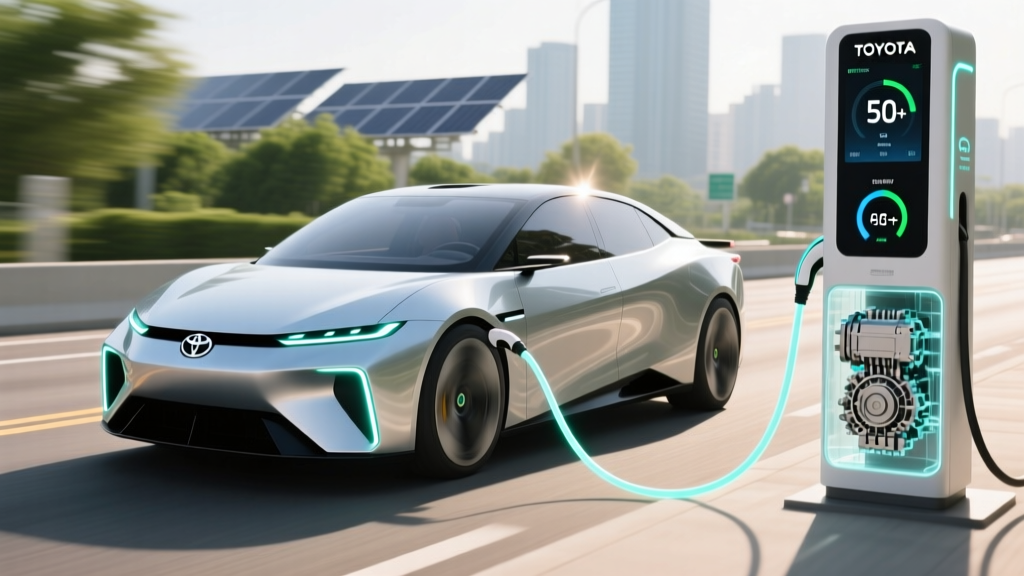
Toyota's two PHEV offerings — the Prius Prime and RAV4 Prime — are where the eCVT automatic transmission truly shines. Both blend electric-only propulsion with seamless gasoline handoff, and neither requires you to change how you drive.
| Spec | Prius Prime | RAV4 Prime |
|---|---|---|
| Battery (usable) | 13.6 kWh, lithium-ion | 18.1 kWh, lithium-ion |
| EPA electric-only range | 44 miles | 42 miles |
| Total combined range | ~440 miles | ~440 miles |
| Level 1 (120V) charge time | ~11 hours | ~12 hours |
| Level 2 (240V) charge time | ~4 hours | ~2.5 hours (6.6 kW onboard) |
| DC fast charge capable? | No | No |
| Combined horsepower | 220 hp | 302 hp |
| 0–60 mph | 6.6 sec | 5.7 sec |
Real-world electric range caveat: Expect 38–42 miles from the Prius Prime and 36–40 miles from the RAV4 Prime in mixed driving at moderate temperatures. Highway-heavy routes at 70+ mph or cold weather below 35°F will reduce electric-only range by 15–25%. Unlike full EVs, however, the gasoline engine seamlessly takes over — so you're never stranded.
Neither Toyota PHEV supports DC fast charging. This is a deliberate engineering choice: the batteries are small enough that Level 2 charging fully replenishes them overnight, and adding DC hardware would increase cost and weight for marginal benefit.
Real-World MPG vs. EPA Sticker: What Owners Actually See
Toyota hybrids consistently match or exceed their EPA city ratings in real-world driving — the opposite of most gasoline-only cars. This is because the EPA city cycle includes significant idle and low-speed driving, conditions where regenerative braking and electric-only operation maximize efficiency.
Real-World MPG Expectations by Driving Pattern
| Model | EPA Combined | City-Heavy Commute | Highway (70–80 mph) | Cold Weather (<30°F) |
|---|---|---|---|---|
| Prius FWD | 57 MPG | 58–62 MPG | 48–52 MPG | 48–53 MPG |
| Camry Hybrid | 51 MPG | 50–55 MPG | 44–48 MPG | 43–47 MPG |
| RAV4 Hybrid | 39 MPG | 38–42 MPG | 33–37 MPG | 32–36 MPG |
| Sienna | 36 MPG | 35–39 MPG | 30–34 MPG | 29–33 MPG |
The pattern is clear: city driving favors hybrids because the engine shuts off at stops and low speeds, and regenerative braking recaptures energy that a conventional car wastes as heat. Highway driving at sustained high speed is where hybrids lose their advantage — aerodynamic drag dominates, and the engine must run continuously. Cold weather reduces battery efficiency and requires engine runtime for cabin heat, reducing MPG by roughly 10–15%.
Battery Longevity, Warranty & Replacement Costs
Hybrid battery anxiety is the single most common concern among prospective buyers. The data is reassuring: Toyota's nickel-metal hydride (NiMH) and lithium-ion hybrid batteries have an exceptional longevity track record, with many original Prius batteries still functioning past 200,000 miles.
Toyota Hybrid Battery Warranty (2026 Models)
- Coverage: 10 years / 150,000 miles (whichever comes first)
- What's covered: Hybrid battery pack, hybrid control module, and related components
- Capacity threshold: Toyota warrants against defects and abnormal degradation; there is no published minimum capacity retention percentage (unlike full EV warranties which guarantee 70%)
- Transferable: Yes — warranty transfers to subsequent owners at no cost
- California-emissions states: Same 10/150,000 coverage (previously 10/150,000 under PZEV rules; now standardized)
Replacement cost if out of warranty: A new OEM hybrid battery from Toyota ranges from approximately $2,000–$3,500 for a Prius or Camry Hybrid, and $3,000–$5,000 for a RAV4 Hybrid or Sienna, depending on battery chemistry and capacity. Refurbished/reconditioned batteries from third-party shops run $1,000–$2,000. Individual cell module replacement (a common repair for older NiMH packs) can cost as little as $500–$1,200 at a specialist.
For context, a conventional automatic transmission replacement on a non-hybrid vehicle typically costs $3,000–$7,000. Toyota's eCVT, with its simple planetary gearset, rarely requires replacement — making the hybrid drivetrain arguably cheaper to maintain long-term than a traditional automatic.
Federal Tax Credit Eligibility: HEV vs. PHEV
This is where the distinction between conventional hybrids and plug-in hybrids matters most for your wallet.
- Conventional HEVs (Prius, Camry Hybrid, RAV4 Hybrid, Sienna, etc.): Not eligible for the federal §30D Clean Vehicle Credit. The IRS requires a plug-in capable vehicle with a minimum battery capacity of 7 kWh. Standard Toyota hybrids have batteries between 1.0–1.6 kWh.
- Prius Prime (PHEV): Qualifies for up to $7,500 under §30D, subject to: buyer income caps ($150K single / $300K joint AGI), MSRP cap ($55,000 for sedans — Prius Prime qualifies), battery critical-mineral and component sourcing requirements, and point-of-sale transfer option. Verify current eligibility on IRS.gov before purchasing, as sourcing rules tighten annually.
- RAV4 Prime (PHEV): The RAV4 Prime's MSRP ($44,665 base) falls under the $80,000 SUV cap. However, battery sourcing compliance must be verified per current-year rules. Some model years have qualified for the full $7,500; others have qualified for $3,750 or $0 depending on critical-mineral and component thresholds. Check the DOE's qualifying vehicle list for the specific model year you're purchasing.
State incentives: Several states offer additional rebates for PHEVs. California's CVRP previously offered up to $1,000 for PHEVs (program funding varies by year). New York, Colorado, and other states have their own incentive structures. Check your state energy office for current programs.
Who Should Buy a Toyota Hybrid Automatic?
Choose a Toyota HEV (Prius, Camry, RAV4 Hybrid) if:
- You don't have access to home or workplace charging
- You want maximum MPG with zero behavioral change — no plugging in, no range planning
- Your budget is under $40,000 and you want proven reliability
- You drive 15,000+ miles per year and want to minimize fuel spend without the upfront cost of an EV
- You live in an apartment or street-park and can't install a charger
Choose a Toyota PHEV (Prius Prime, RAV4 Prime) if:
- You have home Level 2 charging (or can install it) and a daily commute under 40 miles round-trip
- You want electric-only daily driving but need gasoline flexibility for road trips
- You qualify for the §30D tax credit and want to offset the PHEV price premium
- You want the fastest Toyota in the lineup (RAV4 Prime at 302 hp, 5.7 sec 0–60)
Choose a full EV instead if:
- You have reliable home charging and your daily driving is under 250 miles
- You want zero tailpipe emissions and the lowest per-mile energy cost
- You're ready to forgo gasoline entirely and your area has adequate DC fast charging for road trips
Toyota Hybrid Pros
- Class-leading reliability — eCVT has no belts, clutches, or torque converters to fail
- Real-world MPG often exceeds EPA city ratings
- 10-year/150,000-mile hybrid battery warranty
- No charging infrastructure required (HEV)
- Strong resale value — Prius and RAV4 Hybrid hold value better than most competitors
Toyota Hybrid Cons
- No DC fast charging on PHEVs — limits electric-only utility on longer trips
- HEV models ineligible for federal tax credit
- RAV4 Prime availability remains limited at many dealers; markups still occur
- eCVT lacks the engagement of a geared automatic — some drivers find it "numb"
- Highway MPG advantage narrows significantly vs. efficient gas cars at 75+ mph
Frequently Asked Questions
How many MPG does a Toyota hybrid automatic get?
It depends on the model. The 2026 Prius FWD leads the lineup at 57 MPG combined (57 city / 56 highway). The Camry Hybrid achieves 51 combined, the Corolla Hybrid gets 48, and the RAV4 Hybrid delivers 39 combined. In real-world city driving, many owners report exceeding EPA ratings by 2–5 MPG thanks to regenerative braking. Highway driving at 75+ mph typically drops 8–12 MPG below the combined rating.
How far can the Prius Prime and RAV4 Prime go on electric only?
The Prius Prime achieves 44 miles of EPA-rated electric-only range, and the RAV4 Prime achieves 42 miles. Real-world range is typically 38–42 miles for the Prius Prime and 36–40 for the RAV4 Prime in moderate temperatures. Below freezing or at sustained highway speeds, expect a 15–25% reduction. Once the battery depletes, both seamlessly switch to hybrid mode — the Prius Prime returns 50 MPG combined and the RAV4 Prime returns 38 MPG combined as hybrids.
Is Toyota's hybrid automatic transmission reliable?
Yes. Toyota's eCVT uses a planetary gearset with no wear-prone components like belts, clutch packs, or torque converters. It's widely regarded as one of the most durable automatic transmissions ever produced. Taxi fleets using Toyota hybrids routinely surpass 300,000 miles on the original transaxle. The only recommended maintenance is periodic fluid inspection and replacement per the maintenance schedule (typically every 60,000–100,000 miles).
What does a Toyota hybrid battery replacement cost?
A new OEM hybrid battery costs between $2,000 and $5,000 depending on the model (Prius on the low end, Sienna/Highlander on the high end). Refurbished batteries from independent shops run $1,000–$2,000. However, most Toyota hybrid batteries last the life of the vehicle — failure before 150,000 miles is uncommon, and all are covered by the 10-year/150,000-mile warranty. Individual cell module replacement, a common repair for aging NiMH packs, costs $500–$1,200.
Does a Toyota hybrid qualify for a tax credit?
Conventional Toyota hybrids (HEV) do not qualify for the federal §30D Clean Vehicle Credit because they lack plug-in capability and have batteries below the 7 kWh minimum. The Prius Prime and RAV4 Prime (PHEVs) may qualify for up to $7,500, but eligibility depends on your income (≤$150K single / ≤$300K joint), the vehicle's MSRP (under $55K sedan cap for Prius Prime, under $80K SUV cap for RAV4 Prime), and battery component/critical-mineral sourcing compliance. Always verify current-year eligibility at IRS.gov before purchasing.
Can I charge a Toyota hybrid at home?
Only the PHEV models (Prius Prime, RAV4 Prime) can be plugged in. Conventional hybrids (HEV) charge their small batteries entirely through regenerative braking and the gasoline engine — there is no plug and no need for one. For PHEV owners, a standard 120V outlet will fully charge the battery overnight (11–12 hours). A Level 2 (240V) home charger reduces this to 2.5–4 hours, which is ideal for topping up between commutes.
Hybrid vs. PHEV vs. full EV — which is right for me?
If you can't charge at home and want simplicity, choose an HEV. If you can charge at home and commute under 40 miles daily but want gas-engine backup for road trips, choose a PHEV. If you have reliable home charging, drive under 250 miles daily, and want the lowest operating cost with zero tailpipe emissions, choose a full EV. Toyota covers the first two categories best in the industry; for full EVs, you'll need to look at dedicated BEV platforms.