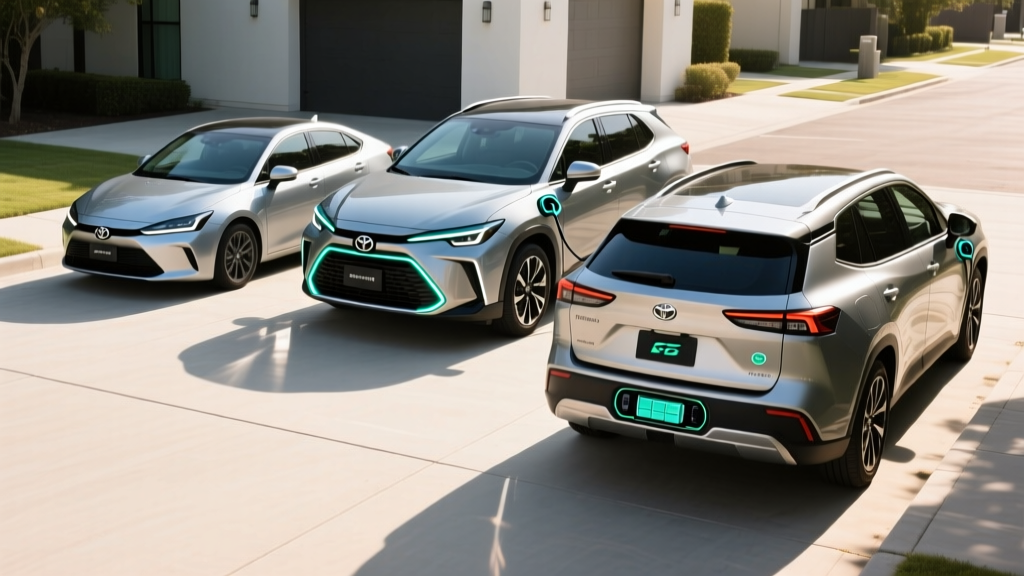
Toyota sells more hybrids than any other automaker, and the 2026 lineup is its broadest yet. From the 57 MPG Prius to the family-hauling RAV4 Hybrid and the plug-in RAV4 Prime, Toyota's fifth-generation hybrid system now spans nearly every body style it builds. But with over a dozen electrified Toyota models on the market, choosing between a conventional hybrid (HEV), a plug-in hybrid (PHEV), or going full battery-electric requires clarity on what each powertrain actually delivers day to day.
This guide breaks down every 2026 Toyota hybrid and PHEV with exact EPA numbers, real-world fuel economy, pricing, tax credit eligibility, and battery longevity data — so you can match the right powertrain to your driving pattern.
HEV vs PHEV: What Toyota Offers in 2026
The single most important distinction: a conventional hybrid (HEV) never plugs in. It recovers energy through regenerative braking and uses a small battery buffer to assist the gasoline engine. A plug-in hybrid (PHEV) carries a larger battery you charge from a wall outlet or public charger, giving you a usable electric-only range before the gas engine engages.
| Feature | Toyota HEV (e.g., RAV4 Hybrid) | Toyota PHEV (e.g., RAV4 Prime) |
|---|---|---|
| Plug-in charging | No — gas only | Yes — Level 1 or Level 2 |
| Electric-only range | ~0.5–1 mi at low speed | 42 mi (RAV4 Prime) |
| Battery size | ~1.6 kWh (NiMH or Li-ion) | 18.1 kWh usable (Li-ion) |
| DC fast charging | N/A | No (AC only, up to 6.6 kW) |
| Federal tax credit (§30D) | Not eligible | Up to $7,500 (subject to sourcing & income rules) |
| Best for | No home charging access; want simplicity | Home chargers; short daily commutes |
Toyota's 2026 PHEV lineup currently centers on the RAV4 Prime and the Prius Prime. Everything else — Camry, Corolla, Highlander, Crown, Sienna, Grand Highlander, Tacoma — is offered as a conventional HEV. Toyota has not announced a PHEV variant of the Camry or Highlander for the 2026 model year.
2026 Toyota Hybrid MPG: Every Model Ranked
Fuel economy is the headline reason buyers choose hybrids. Below is the full 2026 Toyota HEV and PHEV lineup with official EPA combined, city, and highway figures from fueleconomy.gov.
| Model (2026) | Powertrain | Combined MPG | City MPG | Highway MPG | Combined HP |
|---|---|---|---|---|---|
| Prius LE | HEV | 57 | 57 | 56 | 194 |
| Prius XLE / Limited | HEV | 52 | 52 | 52 | 194 |
| Prius Prime SE | PHEV | 52 (charge-sustaining) / 127 MPGe | — | — | 220 |
| Corolla Hybrid LE | HEV | 52 | 53 | 46 | 138 |
| Camry LE Hybrid | HEV | 51 | 53 | 50 | 225 |
| Camry SE/XSE Hybrid (AWD) | HEV | 44 | 46 | 42 | 232 |
| Crown Hybrid | HEV | 41 | 42 | 41 | 236 |
| RAV4 Hybrid (AWD) | HEV | 39 | 41 | 38 | 219 |
| RAV4 Prime (AWD PHEV) | PHEV | 38 (gas) / 94 MPGe | 40 | 36 | 302 |
| Highlander Hybrid | HEV | 35 | 36 | 35 | 243 |
| Grand Highlander Hybrid | HEV | 34 | 36 | 32 | 245 |
| Sienna (all trims) | HEV | 36 | 36 | 36 | 245 |
| Tacoma i-FORCE MAX | HEV | 23 | 23 | 24 | 326 |
Real-world MPG note: Toyota hybrids consistently exceed EPA city estimates in stop-and-go traffic because regenerative braking recovers energy that a gas car wastes as heat. On the highway, expect numbers 2–5 MPG below the EPA sticker, especially above 75 mph or in headwinds. In our mixed-driving experience, the Camry Hybrid LE averages 48–54 MPG in suburban commuting and drops to 43–46 MPG on sustained 80-mph freeway runs. Cold weather (below 35°F) typically costs 8–12% fuel economy due to increased engine warm-up time and cabin heating load.
PHEV Deep Dive: Prius Prime & RAV4 Prime Electric Range
For buyers with home charging, Toyota's two PHEVs unlock a fundamentally different daily experience — short trips on electricity alone, zero gas burned on commutes under 42 miles.
| Spec | 2026 Prius Prime SE | 2026 RAV4 Prime |
|---|---|---|
| EPA electric-only range | 44 miles | 42 miles |
| Total combined range (gas + electric) | ~470 miles | ~480 miles |
| MPGe (electric mode) | 127 MPGe | 94 MPGe |
| Battery capacity (usable) | ~13.6 kWh (Li-ion) | 18.1 kWh (Li-ion) |
| Level 1 charge (120V, ~1.4 kW) | ~10 hours (0–100%) | ~12 hours (0–100%) |
| Level 2 charge (240V, 6.6 kW) | ~2.5 hours | ~2.5 hours |
| DC fast charging | No | No |
| Combined system HP | 220 hp | 302 hp |
| 0–60 mph | 6.6 sec | 5.7 sec |
| Starting MSRP | $34,070 | $44,965 |
Charge time reality: Neither Toyota PHEV supports DC fast charging. On a standard 120V household outlet (Level 1), the RAV4 Prime needs roughly 12 hours for a full charge — fine for overnight if your commute is under 42 miles. A 240V Level 2 home charger cuts that to about 2.5 hours, which means you can top up during the workday or between errands if you have a garage or workplace charger.
Real-world electric range: Expect 36–40 miles from the RAV4 Prime and 38–42 miles from the Prius Prime in moderate temperatures. Highway-speed driving (70+ mph) and cold weather (below 40°F) can reduce electric range by 15–25%. The heat pump on the Prius Prime helps mitigate winter losses compared to resistive cabin heating.
Pricing & Federal Tax Credit Eligibility
Conventional Toyota hybrids (HEVs) carry a modest price premium over their former gas-only counterparts — typically $1,000–$2,500 — but do not qualify for the federal §30D tax credit. That credit applies only to plug-in vehicles with sufficient battery capacity.
Toyota's PHEVs — the Prius Prime and RAV4 Prime — may qualify for up to $7,500 under §30D, but eligibility is conditional and has tightened significantly under current IRS rules:
- MSRP cap: SUVs/vans/pickups (RAV4 Prime) must be at or below $80,000; sedans (Prius Prime) at or below $55,000. Both currently qualify.
- Buyer income cap: Modified AGI must not exceed $150,000 (single), $225,000 (head of household), or $300,000 (joint filing).
- Battery sourcing: Critical minerals and battery components must meet escalating domestic-content thresholds. Toyota has worked to localize supply chains, but exact credit amounts (full $7,500 vs. $3,750) depend on the specific vehicle's sourcing at time of purchase.
- Point-of-sale transfer: As of 2024, buyers can transfer the credit to the dealer for an immediate price reduction rather than waiting to claim it at tax time.
Important: Tax credit rules change frequently. Always verify current eligibility on the IRS Clean Vehicle Credit page and consult a tax professional before relying on the credit in your purchase decision.
| Model | Base MSRP (2026) | Federal §30D Credit | Effective Starting Price |
|---|---|---|---|
| Prius LE (HEV) | $28,950 | $0 | $28,950 |
| Camry LE Hybrid | $29,995 | $0 | $29,995 |
| RAV4 Hybrid XLE | $33,855 | $0 | $33,855 |
| Prius Prime SE (PHEV) | $34,070 | Up to $7,500* | ~$26,570* |
| RAV4 Prime SE (PHEV) | $44,965 | Up to $7,500* | ~$37,465* |
| Sienna LE (HEV) | $38,985 | $0 | $38,985 |
*Credit eligibility depends on income, sourcing, and MSRP rules at time of purchase. Verify at irs.gov.
Battery Longevity, Warranty & Replacement Costs
Toyota Hybrid Battery Warranty (2026 models): 10 years / 150,000 miles (whichever comes first), transferable to subsequent owners. This applies to both HEV and PHEV traction batteries.
Toyota's hybrid battery warranty is among the strongest in the industry and reflects two decades of proven durability. The Prius, in particular, has documented cases of original hybrid batteries lasting 200,000+ miles with minimal capacity loss.
HEV batteries (small, ~1.6 kWh) undergo shallow charge-discharge cycles — the system never fully depletes or fully charges them, which dramatically extends cycle life. Degradation is typically 1–2% per year in the first several years, tapering off as the system's battery-management software adapts.
PHEV batteries (larger, 13–18 kWh) see deeper cycling but still operate within a managed state-of-charge window (roughly 15–85%) to preserve longevity. Real-world data from earlier-generation Prius Prime owners shows roughly 8–12% capacity loss over 5 years / 75,000 miles.
Replacement cost if out of warranty:
- HEV (Prius, Camry Hybrid, RAV4 Hybrid): $2,000–$4,000 for a new OEM battery pack; refurbished units available for $1,000–$2,000
- PHEV (Prius Prime, RAV4 Prime): $6,000–$9,000 for a new OEM pack, reflecting the larger lithium-ion battery
These costs have remained relatively stable, and the 10-year/150,000-mile warranty means most original owners will never pay out of pocket. NHTSA complaint databases show very few hybrid battery failure reports for Toyota's current-generation systems.
Hybrid vs PHEV vs Full EV: Which Fits Your Life?
Choose a Toyota HEV (Camry Hybrid, RAV4 Hybrid, etc.) if:
- You lack access to home or workplace charging
- You want zero behavior change — just fill up with gas as usual
- You regularly take long road trips and don't want to plan around charging
- Your budget favors the lowest up-front cost
Choose a Toyota PHEV (Prius Prime, RAV4 Prime) if:
- You can install a Level 2 charger at home (240V, ~$500–$1,500 install)
- Your daily commute is under 40 miles round-trip
- You want electric commuting but gas flexibility for weekend trips
- You qualify for the §30D tax credit, effectively discounting the PHEV premium
Choose a full BEV (bZ4X or beyond) if:
- You have reliable home charging and your daily driving is under 200 miles
- You want to eliminate gas entirely and minimize maintenance
- You want the full §30D credit and lower per-mile fueling cost
- You accept the current limitations of public DC charging infrastructure
For most American households with a predictable commute and garage access, the RAV4 Prime represents the strongest value proposition in Toyota's lineup: 42 miles of electric range covers the average daily drive, 302 hp makes it genuinely quick, and the gas engine eliminates range anxiety for road trips. The Prius Prime, at a lower entry price, is the efficiency king for solo commuters and couples.
However, if you live in an apartment without charging access, or if your daily drive regularly exceeds 60 miles with no midday charging opportunity, a conventional HEV like the Camry Hybrid (51 MPG combined) or RAV4 Hybrid (39 MPG combined) delivers outstanding fuel savings without any infrastructure dependency.
Pros & Cons: 2026 Toyota Hybrids at a Glance
Pros
- Class-leading real-world MPG across the lineup (Prius at 57 EPA)
- 10-year/150,000-mile hybrid battery warranty — best in class
- Proven reliability with two decades of hybrid system refinement
- RAV4 Prime: 302 hp, 42-mi EV range, and no range anxiety
- PHEVs eligible for up to $7,500 federal credit (with caveats)
- No charging infrastructure required for HEVs
- Strong resale value — Toyota hybrids hold premium on used market
Cons
- PHEVs do not support DC fast charging
- HEVs are not eligible for any federal purchase incentive
- RAV4 Prime carries a ~$11,000 premium over the RAV4 Hybrid
- Highway MPG dips below EPA sticker at sustained 75+ mph speeds
- Some trims (Crown, Grand Highlander Hybrid) have long dealer wait times
- Tacoma i-FORCE MAX hybrid focuses on torque, not fuel economy (23 MPG)
Frequently Asked Questions
How many MPG does the 2026 Toyota RAV4 Hybrid get in real-world driving?
The EPA rates the RAV4 Hybrid AWD at 41 city / 38 highway / 39 combined MPG. In real-world suburban and city driving, owners commonly report 38–43 MPG. Highway-heavy commutes at 75+ mph typically yield 34–37 MPG. Cold weather can reduce these figures by 5–10%.
How far can the RAV4 Prime go on electric power alone?
The EPA rates the RAV4 Prime at 42 miles of electric-only range. Real-world results range from 36 miles (highway speeds, cold weather) to 44 miles (moderate temperatures, city driving under 45 mph). Once the battery is depleted, the vehicle operates as a conventional hybrid at 38 MPG combined.
Do Toyota conventional hybrids need to be plugged in?
No. Toyota HEVs (Prius, Camry Hybrid, RAV4 Hybrid, Highlander Hybrid, Sienna, etc.) charge their small battery entirely through regenerative braking and the gasoline engine. You never plug them in — just refuel at any gas station.
Is a Toyota hybrid reliable long-term, and what does battery replacement cost?
Toyota's hybrid system is one of the most proven powertrains in automotive history, with over 25 million hybrids sold globally since 1997. The hybrid battery is warranted for 10 years/150,000 miles. Out-of-warranty HEV battery replacement runs $2,000–$4,000; PHEV replacement is $6,000–$9,000. Most original owners never face this cost.
Does the 2026 Toyota RAV4 Hybrid qualify for a federal tax credit?
No. The RAV4 Hybrid is a conventional HEV and does not qualify for the federal §30D Clean Vehicle Credit. Only the plug-in RAV4 Prime and Prius Prime are potentially eligible for up to $7,500, subject to buyer income limits, MSRP caps, and battery-sourcing requirements. Check current rules at irs.gov.
Can the Prius Prime or RAV4 Prime use DC fast chargers?
No. Neither Toyota PHEV supports DC fast charging. Both accept AC charging only: up to 6.6 kW on a Level 2 (240V) connection, achieving a full charge in approximately 2.5 hours. On a standard 120V outlet, a full charge takes 10–12 hours.
Should I buy a Toyota hybrid or wait for a full EV?
If you have reliable home charging, a daily commute under 200 miles, and are comfortable with current public charging infrastructure, a full EV like the Toyota bZ4X or a competitor may offer lower operating costs. But if you lack home charging, frequently drive long distances, live in a region with sparse charging networks, or simply want zero lifestyle adjustment, a Toyota hybrid or PHEV is the pragmatic choice in 2026. The fuel savings are immediate, the technology is mature, and you avoid the charging-access gamble.