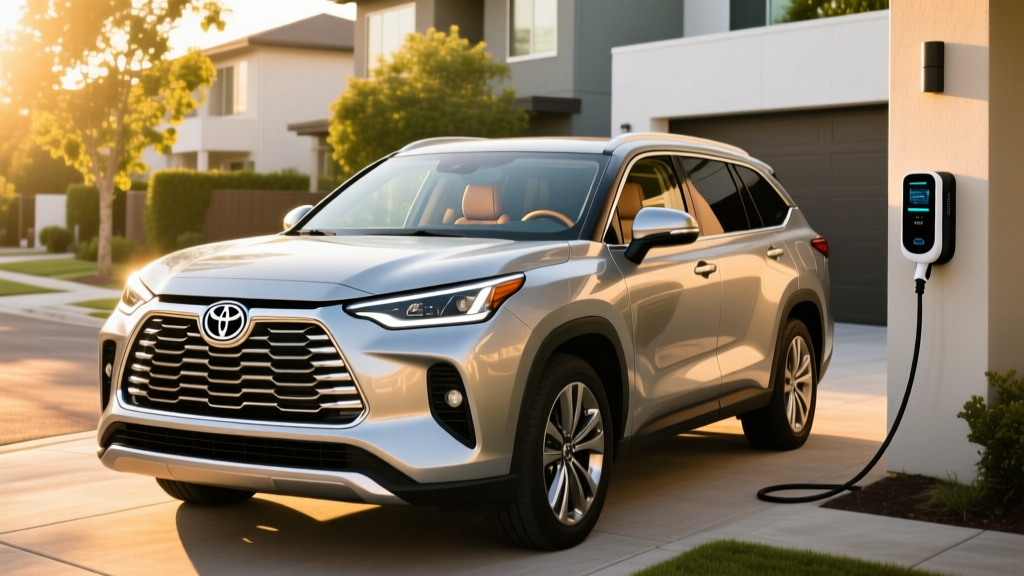
The Toyota Highlander has long been the default three-row crossover for families who want reliability without thinking too hard about it. The 2026 Toyota Highlander Platinum Hybrid sits at the top of that lineup, bundling Toyota's fourth-generation hybrid system with every premium feature the nameplate offers — panoramic roof, heated and ventilated second-row captain's chairs, a 12.3-inch infotainment display, and a 360-degree camera system. But at over $54,000, buyers need to know whether the hybrid powertrain justifies the premium over the turbocharged gas model, and whether a plug-in hybrid or full EV might serve them better.
This guide breaks down the real-world fuel economy, powertrain specifics, ownership costs, and battery longevity data you need before signing the paperwork.
How Many MPG Does the Highlander Hybrid Actually Get?
The EPA rates the 2026 Toyota Highlander Hybrid at 35 MPG combined across all trims, including the Platinum. That figure holds whether you choose front-wheel drive or the electronic on-demand AWD system (which the Platinum includes as standard). Here is the official breakdown from fueleconomy.gov:
| Cycle | MPG (EPA) |
|---|---|
| City | 35 |
| Highway | 35 |
| Combined | 35 |
The flat city/highway split is typical of Toyota's series-parallel hybrid architecture. The electric motors handle low-speed and stop-and-go driving where gasoline engines are least efficient, while the 2.5-liter inline-four takes over at steady highway speeds. In practice, this means:
- City and suburban driving: Many owners report 36–38 MPG in warm weather with moderate acceleration. The hybrid system recovers substantial energy through regenerative braking in stop-and-go traffic.
- Highway cruising at 70–80 mph: Expect 30–33 MPG. Aerodynamic drag dominates at speed, and the hybrid advantage narrows considerably.
- Cold weather (below 30°F): Plan for 28–32 MPG combined. The engine runs more frequently to heat the cabin and warm the hybrid battery, reducing electric-motor contribution.
- Loaded with passengers and cargo: A fully loaded Highlander with six occupants and roof cargo can drop 2–3 MPG from baseline figures.
Powertrain: 243 HP of Electrified Efficiency
The Highlander Hybrid uses Toyota's proven fourth-generation hybrid synergy drive. Unlike turbocharged competitors that prioritize peak power, this system optimizes for smoothness and efficiency:
| Component | Specification |
|---|---|
| Engine | 2.5L inline-4 (Atkinson cycle), 186 hp / 173 lb-ft |
| Front Electric Motor | 134 hp / 199 lb-ft |
| Rear Electric Motor (AWD) | 54 hp / 89 lb-ft |
| Combined Net Output | 243 hp |
| Transmission | eCVT (planetary gearset, no belt) |
| Drivetrain | Electronic on-demand AWD (Platinum standard) |
| 0–60 mph | ~7.8 seconds |
| Towing Capacity | 3,500 lbs |
The eCVT is worth clarifying: it is not a traditional belt-and-pulley continuously variable transmission. Toyota uses a planetary gearset that seamlessly blends engine and motor power with no fixed gear ratios and no belt to wear out. This design is a major reason Toyota hybrids have exceptional long-term reliability — there are fewer friction components to fail.
The rear electric motor on AWD models engages only when slip is detected or during hard acceleration, meaning the Highlander Hybrid operates as a front-wheel-drive vehicle in most steady-state cruising. This is why AWD carries no fuel-economy penalty on the EPA sticker.
Hybrid vs. Plug-In Hybrid vs. Full EV: Which Fits You?
A common question from Highlander shoppers is whether they should consider a plug-in hybrid (PHEV) or a full battery-electric vehicle instead. Here is the honest comparison:
HEV vs. PHEV vs. BEV — Quick Decision Matrix
| Factor | Highlander Hybrid (HEV) | PHEV (e.g., RAV4 Prime) | BEV (e.g., Kia EV9) |
|---|---|---|---|
| Needs to plug in? | No — self-charging | Yes, for EV range | Yes, always |
| Electric-only range | None (EV assist only) | 35–42 miles typical | 250–330 miles typical |
| Home charging needed? | No | Recommended (Level 2) | Essential (Level 2) |
| Three-row seating | Yes (7 or 8 seats) | Limited options | Kia EV9, Tesla Model X |
| Fuel cost (annual est.) | ~$1,500 | ~$800–$1,200 | ~$600–$900 |
| Upfront price premium | Low | Moderate | High |
Choose the Highlander Hybrid (HEV) if: You want a three-row family hauler with no change to your fueling habits. You live in an apartment or lack home-charging access. You take frequent long road trips and don't want to plan around charging stops.
Choose a PHEV if: Your daily commute is under 40 miles round-trip and you can install a Level 2 charger at home. You want some electric-only driving for local errands but the flexibility of gas for road trips. Note: Toyota does not currently offer a Highlander PHEV in the US market — the RAV4 Prime is the closest Toyota PHEV alternative, but it has only two rows.
Choose a full EV (BEV) if: You have reliable home charging, your daily driving is predictable, and you want to eliminate gasoline entirely. The Kia EV9 and Tesla Model X are the primary three-row BEV competitors, though both carry significantly higher starting prices.
2026 Highlander Platinum Hybrid Pricing & Tax Credits
The 2026 Toyota Highlander Hybrid Platinum carries an MSRP of approximately $54,070 (including destination charge). This positions it roughly $10,000 above the base LE Hybrid trim and about $6,000 above the mid-tier Limited Hybrid.
| Trim | MSRP (approx.) | Key Additions |
|---|---|---|
| LE Hybrid | $44,070 | Base hybrid, 8 seats, Toyota Safety Sense 2.5+ |
| XLE Hybrid | $47,570 | SofTex seats, sunroof, wireless charging |
| Limited Hybrid | $50,070 | Leather, 12.3" display, JBL audio |
| Platinum Hybrid | $54,070 | Panoramic roof, ventilated 2nd row, 360° camera, HUD |
Federal Tax Credit Eligibility
The Highlander Hybrid is a conventional hybrid (HEV), not a plug-in vehicle. Under IRS §30D clean vehicle credit rules, only plug-in electric vehicles (BEVs and PHEVs) with sufficient battery capacity qualify for the up-to-$7,500 federal tax credit. The Highlander Hybrid does not qualify for the §30D federal EV tax credit.
Some states offer their own incentives for conventional hybrids, but these are increasingly rare as state programs shift toward plug-in vehicles. Check your state's energy office or department of environmental quality for current programs. A few states still offer modest rebates ($250–$500) for high-MPG hybrids, but these change frequently.
Battery Longevity, Warranty & Replacement Cost
Hybrid battery anxiety is the number-one concern we hear from first-time hybrid buyers. Here is what the data actually shows:
Hybrid Battery Warranty & Lifespan
- Warranty: 10 years / 150,000 miles (whichever comes first) — Toyota's hybrid battery warranty is among the longest in the industry and applies in all 50 states.
- Battery type: Nickel-metal hydride (NiMH), approximately 1.87 kWh total capacity — this is a small, purpose-built hybrid battery, not a large EV traction pack.
- Real-world lifespan data: Toyota hybrid batteries routinely last 150,000–200,000+ miles before significant capacity loss. Taxi fleets using Toyota hybrid powertrains regularly exceed 300,000 miles on original batteries.
- Replacement cost (if needed out of warranty): $2,000–$4,000 for a refurbished or new hybrid battery pack, installed. Independent hybrid specialists often offer lower-cost options than dealerships.
- What "failure" actually means: Hybrid batteries rarely die catastrophically. Individual cells degrade over time, and the battery management system compensates. A "failed" hybrid battery usually means reduced fuel economy (2–4 MPG loss), not a stranded vehicle.
For context, the 1.87 kWh NiMH battery in the Highlander Hybrid is far smaller and less stressed than the 60–100 kWh lithium-ion packs in full EVs. It never deep-cycles — the system keeps it between roughly 40% and 80% state of charge at all times, which dramatically extends cell life. The thermal management is passive (air-cooled), but the small capacity and shallow cycling make this a non-issue in practice.
Platinum Trim: What You Get for the Premium
The Platinum is the top-of-line Highlander, and Toyota loads it with features that would be expensive add-ons from European competitors. Here is what distinguishes it from the Limited trim directly below:
- Panoramic glass roof with power sunshade — floods all three rows with light
- Heated and ventilated second-row captain's chairs (reduces seating from 7 to 6)
- Head-up display (HUD) — projects speed and navigation onto the windshield
- 360-degree panoramic camera with curb-view mode for tight parking
- Premium LED headlights with adaptive front-lighting
- Bird's-eye view camera with perimeter scan
- Digital rearview mirror with camera feed option
The Platinum also includes everything from the Limited: 12.3-inch touchscreen with wireless Apple CarPlay and Android Auto, 11-speaker JBL audio, leather-trimmed seats, heated and ventilated front seats, heated steering wheel, power-folding third row, and Toyota Safety Sense 2.5+ (adaptive cruise, lane-tracing assist, pre-collision with pedestrian detection, blind-spot monitor with rear cross-traffic alert).
Pros
- 35 MPG combined in a three-row SUV is class-leading
- 10-year / 150,000-mile hybrid battery warranty
- Proven reliability — eCVT has no belt to fail
- No plug-in charging required — zero lifestyle change
- Strong resale value (Toyota hybrids hold premium)
- Platinum trim rivals luxury SUVs at $20K less
Cons
- No federal EV tax credit eligibility
- 7.8-sec 0–60 feels leisurely for a $54K vehicle
- Third row is tight for adults on long trips
- Cargo space reduced vs. non-hybrid (battery placement)
- Platinum price approaches RAV4 Prime PHEV territory
- No DC fast charging capability (not a PHEV)
Reliability & Safety: The Data
Toyota's hybrid powertrain is among the most extensively validated in automotive history. The Highlander Hybrid specifically benefits from:
- IIHS rating: The Highlander has earned Top Safety Pick+ designation in recent model years, with Good ratings across all crash-test categories. The 2026 model carries forward the same body structure. Check iihs.org for the latest test results.
- NHTSA rating: Typically a 5-star overall rating. Verify at nhtsa.gov.
- J.D. Power & Consumer Reports: Toyota consistently ranks in the top 3 brands for long-term reliability. The hybrid system adds complexity but has an extraordinary track record — the Prius powertrain architecture (which the Highlander shares in principle) has been in production since 1997.
- Common issues to watch: The hybrid system itself is bulletproof. The most common Highlander complaints involve infotainment software glitches, not the powertrain. The water pump on the 2.5L engine should be monitored after 100,000 miles.
Frequently Asked Questions
Does the Toyota Highlander Hybrid need to be plugged in?
No. The Highlander Hybrid is a conventional hybrid (HEV). It charges its own battery through regenerative braking and the gasoline engine. You fuel it exactly like a regular gas car — just less often.
How far can the Highlander Hybrid drive on electric power alone?
The Highlander Hybrid cannot drive on electric power alone for any meaningful distance. The electric motors assist the gas engine during acceleration and can propel the vehicle at very low speeds (under 25 mph) for brief distances, but this is not "electric-only driving" in the PHEV sense. If you need 30–40 miles of pure electric range, you need a plug-in hybrid like the RAV4 Prime or a full BEV.
Is the Highlander Hybrid good for towing?
The hybrid is rated for 3,500 pounds — adequate for a small boat, utility trailer, or a pair of dirt bikes. It is not rated for heavy travel trailers. If you need 5,000+ lb towing, you will need to look at body-on-frame SUVs or the turbocharged gas Highlander (also 5,000 lbs in some configurations).
How does the Highlander Hybrid compare to the Kia Sorento Hybrid?
The Sorento Hybrid is slightly smaller and offers similar fuel economy (34–37 MPG combined). The Highlander has a more usable third row and slightly more cargo space. The Sorento PHEV variant offers 32 miles of electric-only range and may qualify for partial tax credits — worth considering if you can charge at home.
What happens if the hybrid battery dies?
The car will not operate. However, under Toyota's 10-year/150,000-mile warranty, replacement is covered. Out of warranty, expect $2,000–$4,000 for a replacement battery installed. In practice, the vast majority of Highlander Hybrids reach 150,000+ miles without battery replacement.
Does the Platinum Hybrid get worse MPG than lower trims?
No. All 2026 Highlander Hybrid trims — LE, XLE, Limited, and Platinum — carry the same EPA rating of 35 MPG combined. The additional weight of the Platinum's features is negligible relative to the vehicle's total mass.
Is the 2026 Highlander Hybrid worth it over the gas-only model?
If you plan to keep the vehicle 5+ years, the hybrid almost always wins on total cost of ownership. The hybrid premium over the gas turbo model is roughly $2,000–$3,000 depending on trim, which you recoup through fuel savings within 3–4 years at current gas prices (assuming 15,000 miles/year). You also gain smoother acceleration from stop and substantially lower emissions.