Quick Verdict: The Family Hauler That Sips Fuel
The Toyota Highlander Hybrid LE remains one of the most practical three-row SUVs for families who want serious fuel savings without plugging in. As a conventional hybrid electric vehicle (HEV), it requires zero lifestyle changes — no chargers, no range planning, no plug-in routines. You simply fill up with gas and go, while the hybrid system quietly slashes fuel consumption by roughly 40% compared to the non-hybrid Highlander.
For 2026, the Highlander Hybrid LE continues with Toyota's proven 2.5-liter four-cylinder hybrid powertrain, delivering an EPA-estimated 36 MPG combined. That's a remarkable figure for a 4,500-pound, three-row SUV. If you've been cross-shopping midsize SUVs and want hybrid efficiency without stepping into a full battery-electric vehicle (BEV), this trim is the value sweet spot in the Highlander Hybrid lineup.
HEV vs PHEV: Understanding What the Highlander Hybrid Is (and Isn't)
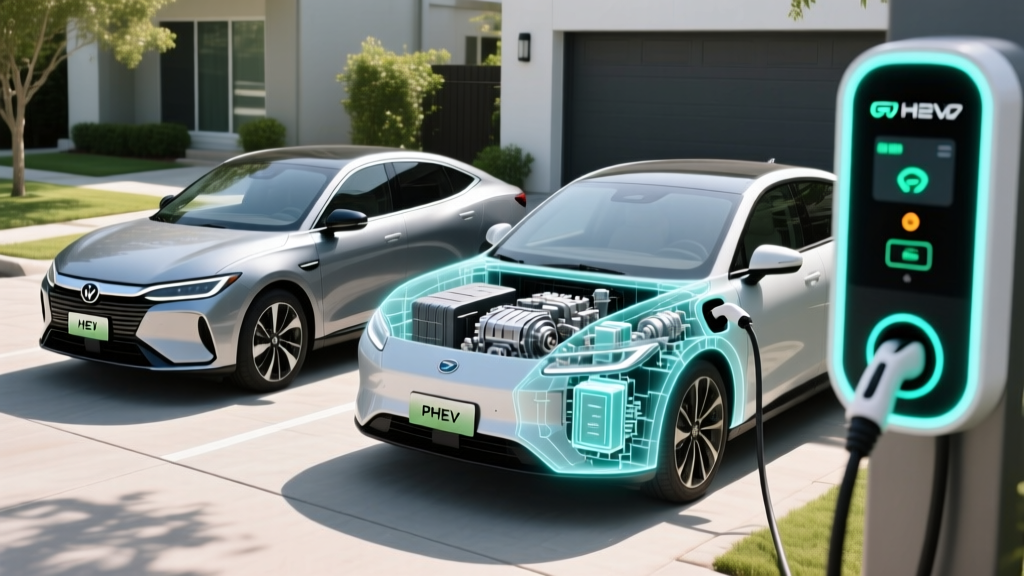
Before we dig into the numbers, it's essential to clarify what you're buying. The Toyota Highlander Hybrid is a conventional hybrid (HEV), not a plug-in hybrid (PHEV). Here's what that means in practice:
Conventional Hybrid (HEV) — Toyota Highlander Hybrid
- No plug required. The battery charges itself through regenerative braking and the gasoline engine.
- No electric-only range to speak of — the small battery assists the engine but can't propel the vehicle solo for meaningful distances.
- Always ready. Your range is limited only by the 17.9-gallon fuel tank, giving roughly 640+ miles between fill-ups.
- No federal EV tax credit. HEVs do not qualify under IRS §30D.
Plug-In Hybrid (PHEV) — Example: Toyota RAV4 Prime
- Must plug in to access meaningful electric-only driving (typically 35-42 miles on RAV4 Prime).
- Larger battery (18.1 kWh on RAV4 Prime) charged via Level 1 or Level 2 AC power.
- May qualify for tax credits depending on battery sourcing and current IRS rules.
- Higher purchase price to offset the larger battery and power electronics.
Toyota does not currently offer a Highlander PHEV in the US market. If you need plug-in electric range in a three-row Toyota, you'd need to look at the Grand Highlander Hybrid (also an HEV) or step outside Toyota to something like the Chrysler Pacifica PHEV minivan. For the Highlander, the hybrid system is strictly self-charging.
Fuel Economy: EPA Ratings and Real-World MPG
Fuel economy is the primary reason buyers choose the Highlander Hybrid over the gas-only model. Here's the official EPA breakdown for the 2026 Highlander Hybrid LE with all-wheel drive (the most common configuration):
| Driving Cycle | EPA Estimate | Real-World Expectation |
|---|---|---|
| City | 36 MPG | 37–40 MPG (hybrids excel in stop-and-go) |
| Highway | 35 MPG | 31–34 MPG (sustained 70+ mph reduces regen benefit) |
| Combined | 36 MPG | 33–37 MPG (varies with driving mix) |
Why real-world city MPG often beats the EPA sticker: Conventional hybrids recapture kinetic energy during braking and low-speed driving, which is exactly what city commutes involve. In our experience and owner-reported data from fueleconomy.gov, many Highlander Hybrid owners report 38-40 MPG in predominantly urban driving.
Why highway MPG drops: At sustained highway speeds, the electric motor provides less assistance and aerodynamic drag dominates. Expect 31-34 MPG on long road trips at 70-80 mph. Cold weather can knock another 2-3 MPG off due to reduced battery efficiency and increased engine load for cabin heating.
Total range: With a 17.9-gallon fuel tank and 36 MPG combined, you're looking at approximately 644 miles per tank. That's one fill-up per week for most commuters, or two stops on a cross-country drive.
Powertrain and Performance Specs
The Highlander Hybrid LE pairs a 2.5-liter Atkinson-cycle four-cylinder engine with two electric motors (front and rear) in Toyota's eAWD system. Here's the complete powertrain breakdown:
| Specification | Detail |
|---|---|
| Engine | 2.5L 4-cylinder Atkinson-cycle |
| Combined System Horsepower | 243 hp |
| Front Electric Motor | 134 hp / 199 lb-ft |
| Rear Electric Motor | 40 hp / 89 lb-ft (eAWD) |
| Transmission | eCVT (electronically controlled) |
| Drivetrain | Electronic On-Demand AWD |
| 0–60 mph | ~7.8 seconds |
| Hybrid Battery | ~1.6 kWh nickel-metal hydride (NiMH) |
| Towing Capacity | 3,500 lbs |
| Seating | 8 passengers (bench second row on LE) |
| Cargo (behind 3rd row) | 16.1 cu ft |
Performance note: 243 hp is adequate for daily driving and highway merging, but the Highlander Hybrid is not quick in the way a turbocharged gas SUV or a dual-motor EV feels. The eCVT delivers smooth, linear acceleration without shift shock, but it won't thrill anyone. The eAWD rear motor provides confident traction in rain and light snow — it's not a serious off-road system, but it activates seamlessly when front wheels slip.
The hybrid battery is small by design. At roughly 1.6 kWh, it's not meant to store significant energy for electric-only driving. It exists to buffer regenerative braking energy and provide electric motor assist during acceleration, reducing the load on the gasoline engine. This is fundamentally different from a PHEV's 15-20 kWh battery or a BEV's 70-100 kWh pack.
Pricing, Trims, and Tax Credit Eligibility
The 2026 Toyota Highlander Hybrid LE is the entry point into the hybrid lineup and offers strong value for a three-row AWD SUV:
| Trim | MSRP (est.) | Key Features |
|---|---|---|
| Hybrid LE | $41,070 | 8-passenger, Toyota Safety Sense 3.0, 8" touchscreen, 18" alloy wheels |
| Hybrid XLE | $45,070 | SofTex seats, 7-passenger (captain's chairs), power liftgate, wireless charging |
| Hybrid Limited | $50,470 | Leather, 12.3" touchscreen, panoramic roof, heated/ventilated front seats |
| Hybrid Platinum | $54,070 | Head-up display, 360° camera, panoramic moonroof, premium audio |
Does the Highlander Hybrid qualify for a federal tax credit? No. The IRS §30D Clean Vehicle Credit applies only to plug-in electric vehicles (BEVs and PHEVs) with sufficient battery capacity and qualifying critical-mineral/battery-component sourcing. The Highlander Hybrid, as a conventional HEV with a small NiMH battery, does not meet the plug-in requirement. There is currently no federal tax credit for conventional hybrids.
Some states offer separate incentives for efficient vehicles, but these are uncommon for HEVs and vary by jurisdiction. Check your state's energy office or department of revenue for current programs. A tax professional can confirm any local benefits.
Hybrid Battery Warranty
Toyota covers the Highlander Hybrid battery with a 10-year / 150,000-mile warranty (whichever comes first) in all 50 states, following California's CARB emissions warranty standard that Toyota adopted nationwide. This covers battery capacity loss below a defined threshold and any manufacturing defects. The hybrid system components (inverter, electric motors, control modules) are also covered under this warranty.
Battery Longevity and Replacement Costs
This is the top concern for hybrid buyers, and the data is reassuring. Toyota's hybrid systems have two decades of proven reliability across millions of vehicles. The Highlander Hybrid's NiMH battery is far less stressed than a BEV's lithium-ion pack — it operates in a narrow state-of-charge window (roughly 40-80%) managed by the vehicle's computer, which dramatically reduces degradation.
Real-world longevity data: Toyota Prius fleets routinely exceed 200,000 miles on the original hybrid battery. The Highlander Hybrid, introduced for the 2020 model year in its current generation, hasn't accumulated the same multi-decade data, but early reports from high-mileage owners and fleet operators show no systemic battery failure pattern.
Replacement cost if needed out of warranty: A replacement hybrid battery for the Highlander Hybrid currently runs approximately $3,000–$5,000 installed at a Toyota dealer, depending on labor rates. Third-party hybrid battery rebuilders offer refurbished units for $1,500–$3,000. For context, this is a fraction of BEV battery replacement costs ($10,000–$20,000+), and the likelihood of needing one within the 10-year/150,000-mile warranty window is low.
Maintenance advantage: The Highlander Hybrid has no timing belt (it uses a timing chain), the regenerative braking system extends brake pad life significantly (many owners report 80,000+ miles on original pads), and there's no traditional starter motor or alternator to fail. Overall maintenance costs trend lower than the gas-only Highlander over a 10-year ownership period.
Who Should Buy the Highlander Hybrid LE (and Who Shouldn't)
Choose the Highlander Hybrid LE If:
- You want a three-row SUV under $42K with AWD and 36 MPG
- You can't charge at home (apartment, street parking, no garage outlet)
- You take frequent long road trips and don't want to plan around chargers
- You prioritize Toyota's reliability track record and low cost of ownership
- You need 3,500-lb towing capacity for a small trailer or boat
- You want eight-passenger seating (LE's second-row bench)
Look Elsewhere If:
- You want electric-only driving or zero tailpipe emissions (consider a BEV like the Kia EV9 or Tesla Model X)
- You want plug-in electric range for short commutes (no Highlander PHEV exists; consider Pacifica PHEV)
- You need quick acceleration — 7.8 seconds to 60 is adequate, not sporty
- Cargo space behind the third row is critical (16.1 cu ft is tight; minivans offer more)
- You want the latest EV tech like V2L, OTA performance upgrades, or one-pedal driving
The decision framework is straightforward:
- Highlander Hybrid over a gas SUV if you drive 12,000+ miles per year and want to save roughly $500–$800 annually in fuel (at $3.50/gallon and 24 MPG gas vs. 36 MPG hybrid).
- Highlander Hybrid over a BEV if you lack home charging access, regularly drive 300+ miles in a day, live in extreme cold climates, or want lower upfront cost.
- Highlander Hybrid over a PHEV if you can't plug in at home or work, or if the PHEV price premium (typically $5,000–$8,000) doesn't pencil out for your mileage.
How the Highlander Hybrid LE Compares
In the three-row hybrid SUV segment, the Highlander Hybrid LE faces limited direct competition:
| Vehicle | EPA Combined MPG | HP | Starting MSRP | Seats |
|---|---|---|---|---|
| Toyota Highlander Hybrid LE | 36 MPG | 243 | $41,070 | 8 |
| Toyota Grand Highlander Hybrid | 34 MPG | 245 | $45,520 | 7–8 |
| Kia Sorento Hybrid | 34 MPG | 227 | $39,090 | 6 |
| Honda Pilot (gas only) | 22 MPG | 285 | $39,395 | 8 |
The Grand Highlander Hybrid offers more third-row and cargo space but costs $4,450 more and sacrifices 2 MPG. The Sorento Hybrid is cheaper but smaller, seats only six, and has less power. The Honda Pilot has no hybrid option. For pure value-per-MPG in a three-row package, the Highlander Hybrid LE occupies a unique position.
Frequently Asked Questions
How many MPG does the Toyota Highlander Hybrid LE get?
The EPA rates the 2026 Highlander Hybrid LE AWD at 36 MPG city, 35 MPG highway, and 36 MPG combined. In real-world city driving, many owners report 37-40 MPG thanks to regenerative braking. Highway driving at sustained speeds typically yields 31-34 MPG.
Does the Highlander Hybrid need to be plugged in?
No. The Highlander Hybrid is a conventional HEV, not a plug-in hybrid. It charges its own battery through regenerative braking and the gasoline engine. You never plug it in — you just fill it with gas like any other vehicle.
How far can the Highlander Hybrid go on electric only?
Effectively zero miles in practical terms. The hybrid battery is approximately 1.6 kWh and exists to assist the gasoline engine during acceleration, not to drive the vehicle independently. You may creep short distances (a few hundred feet) at very low speeds on electric power in parking lots, but this is not meaningful electric-only range. If you need real EV range, you need a PHEV or BEV.
Is the Highlander Hybrid reliable?
Toyota's hybrid systems are among the most proven in the automotive industry, with over 25 years of continuous refinement since the original Prius. The IIHS and owner surveys consistently rate the Highlander Hybrid highly for reliability. The hybrid battery is warranted for 10 years/150,000 miles, and replacement cost (if ever needed out of warranty) is approximately $3,000–$5,000 — far less than a BEV battery.
Does the Highlander Hybrid qualify for any tax credit?
No federal tax credit is available for the Highlander Hybrid. The IRS §30D Clean Vehicle Credit applies only to plug-in vehicles (BEVs and PHEVs) meeting battery sourcing and MSRP/income requirements. Conventional hybrids are not eligible. Check your state's incentive programs for any local benefits.
How long will the hybrid battery last?
Based on Toyota's track record with NiMH hybrid batteries, expect the Highlander Hybrid battery to last 150,000–200,000+ miles under normal use. Toyota's 10-year/150,000-mile warranty provides coverage, and the battery management system keeps the cells in a conservative state-of-charge window that minimizes degradation. Out-of-warranty replacement runs $3,000–$5,000 at a dealer.
Is the Highlander Hybrid worth it over the gas model?
If you drive 12,000+ miles per year, the hybrid's $3,000–$4,000 price premium over the gas Highlander typically pays for itself in fuel savings within 4-6 years. You also gain smoother acceleration from the electric motor assist, longer brake life from regenerative braking, and significantly lower fuel costs. For most buyers, the hybrid is the smarter buy.