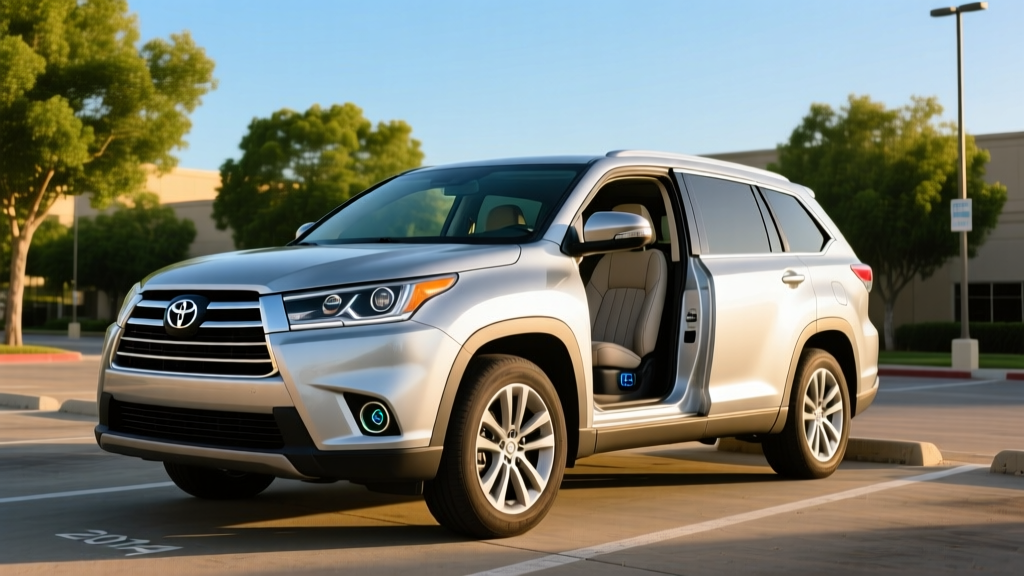
The 2014 Toyota Highlander Hybrid SUV occupies a specific niche in the used-car market: a three-row, all-wheel-drive family hauler that sips fuel without requiring a plug. More than a decade after its debut, buyers are still searching for this model — drawn by Toyota's hybrid reliability reputation and the promise of sub-30-MPG fuel economy in a vehicle that seats up to seven. But does a 10-plus-year-old hybrid battery hold up? What are the real ownership costs? This guide covers everything a used-car buyer needs to know before signing the paperwork.
HEV vs PHEV: What the 2014 Highlander Hybrid Actually Is
Let's clear up a common point of confusion right away. The 2014 Toyota Highlander Hybrid is a conventional hybrid electric vehicle (HEV), not a plug-in hybrid (PHEV). This distinction matters for your daily routine and your wallet.
Conventional Hybrid (HEV) — 2014 Highlander Hybrid
- No plug required. The battery recharges through regenerative braking and the gasoline engine.
- No electric-only driving range beyond brief low-speed assists (typically under 1 mile at very low speeds).
- Smaller battery pack (~1.9 kWh usable) — less to degrade, less to replace.
- No federal tax credit for used HEV purchases under current IRS §30D rules.
Plug-In Hybrid (PHEV) — Not Available for This Model Year
- Toyota did not offer a Highlander PHEV (called the Highlander Prime in later markets) until the 2026 model year in select regions.
- PHEVs offer 20–40 miles of electric-only range, larger batteries (18+ kWh), and plug-in charging capability.
- Some new PHEVs may qualify for partial federal credits depending on battery sourcing and income caps.
If you're looking at a 2014 Highlander Hybrid listing, you are buying a self-charging HEV. You will never need to find a charging station. You will, however, visit gas stations — just less often than with the non-hybrid V6 Highlander.
Fuel Economy: EPA Ratings and Real-World MPG
The headline number for the 2014 Toyota Highlander Hybrid is its EPA-estimated fuel economy. According to fueleconomy.gov, the 2014 Highlander Hybrid AWD achieves:
| Metric | EPA Estimate |
|---|---|
| City MPG | 27 MPG |
| Highway MPG | 28 MPG |
| Combined MPG | 28 MPG |
| Fuel Type | Regular Unleaded (87 octane) |
| Fuel Tank Capacity | 17.1 gallons |
| EPA Estimated Total Range | ~479 miles |
Real-World MPG: What Owners Actually Report
Toyota hybrids historically perform close to — and sometimes above — their EPA city estimates because regenerative braking recovers energy in stop-and-go traffic. Highway driving is where hybrids lose their advantage relative to city driving, though the 2014 Highlander Hybrid's numbers are remarkably flat across both.
Owner-reported data on Fuelly and Edmunds forums clusters around 24–27 MPG combined for real-world driving, with several factors pulling the number below the EPA sticker:
- Highway-heavy commutes at 75+ MPH reduce hybrid system benefit; expect 24–26 MPG.
- Cold weather (below 35°F) forces the engine to run more frequently for cabin heat, dropping city MPG by 2–4 points.
- Heavy cargo or towing (max tow rating: 3,500 lbs) will push consumption into the low 20s.
- Aging hybrid battery (more on this below) can reduce regenerative braking efficiency and cut 1–3 MPG if the pack is degraded.
For city-dominant drivers in moderate climates, hitting or slightly exceeding the 27 MPG city EPA figure is realistic. For highway commuters in northern states, budget for 24 MPG combined.
Powertrain Specs: Engine, Motors, and Combined Output
The 2014 Highlander Hybrid uses Toyota's well-proven Hybrid Synergy Drive system, pairing a 3.5-liter V6 Atkinson-cycle gasoline engine with two electric motor-generators and an electronically controlled CVT (eCVT).
| Specification | 2014 Highlander Hybrid AWD |
|---|---|
| Gasoline Engine | 3.5L V6 Atkinson-cycle |
| Engine Horsepower | 236 HP @ 5,800 RPM |
| Front Electric Motor | Permanent-magnet synchronous, 114 kW peak |
| Rear Electric Motor | Permanent-magnet synchronous, 50 kW peak |
| Combined Net System HP | 280 HP |
| Transmission | eCVT (electronically controlled CVT) |
| Drivetrain | Electronic On-Demand AWD (eAWD) |
| 0–60 MPH | ~7.8 seconds (est.) |
| Hybrid Battery | Nickel-Metal Hydride (NiMH), ~1.9 kWh usable |
| Towing Capacity | 3,500 lbs |
| Cargo Volume (behind 3rd row) | 13.8 cu ft |
| Cargo Volume (all rows folded) | 83.2 cu ft |
The eAWD system is worth noting: unlike mechanical AWD with a driveshaft, the rear axle is powered solely by the rear electric motor. This means the system can send up to 50 kW (67 HP) to the rear wheels when traction demands it, but under normal cruising, it operates primarily as a front-wheel-drive vehicle for efficiency. There is no center differential to service, no driveshaft U-joints to replace — a maintenance advantage.
Hybrid Battery Health: Degradation, Lifespan, and Replacement Cost
This is the single most important factor when buying any used hybrid, and the 2014 Highlander Hybrid is no exception. The NiMH battery pack in this model is smaller and less stressed than the lithium-ion packs in modern EVs, which works in its favor for longevity.
Original Battery Warranty
Toyota originally warranted the hybrid battery for 8 years / 100,000 miles in most states, and 10 years / 150,000 miles in California Air Resources Board (CARB) states (CA, CT, MA, ME, NJ, NY, OR, RI, VT, WA). For a 2014 model, factory warranty coverage has expired regardless of mileage as of 2024 at the latest.
Expected Battery Lifespan
Toyota's NiMH hybrid batteries have a strong track record. Data from fleet operators and long-term owners (including taxi services using Toyota hybrids) shows these packs commonly lasting 150,000–200,000 miles before significant degradation. "Significant degradation" here means a noticeable drop in fuel economy (2–4 MPG loss) and reduced electric-assist capability — not a total failure that leaves the car undrivable.
Key factors that accelerate NiMH degradation:
- Extreme heat exposure — vehicles parked outdoors in Arizona, Texas, or Florida climates see faster capacity loss.
- Frequent deep cycling — though the hybrid system's software prevents true deep discharge, aggressive driving patterns that constantly demand full battery assist can stress cells.
- High mileage — packs with 180,000+ miles should be inspected; those over 200,000 miles are living on borrowed time.
Battery Replacement Cost
If the hybrid battery fails or degrades beyond acceptable levels, here is the cost landscape as of 2026:
- New OEM Toyota battery pack: $3,000–$4,500 installed at a dealership (parts + labor).
- Refurbished/remanufactured pack: $1,500–$2,500 installed at an independent hybrid specialist.
- Individual cell replacement: Some shops replace only the failed module(s) for $500–$1,200, but this is a short-term fix if the rest of the pack is aging.
Before purchasing any 2014 Highlander Hybrid, request a hybrid battery health check from a Toyota dealer or qualified hybrid mechanic. They can read the pack's internal resistance, voltage variance across modules, and state of charge behavior under load. A pack showing more than 1.0V variance between modules is a red flag.
Pricing and Tax Credit Eligibility
The 2014 Toyota Highlander Hybrid was originally offered in two trims:
- LE: MSRP ~$40,270 (when new in 2014)
- Limited: MSRP ~$48,090 (when new in 2014)
On the used market in 2026, expect to pay:
- 2014 Highlander Hybrid LE (100K–130K miles): $14,000–$18,000
- 2014 Highlander Hybrid Limited (80K–120K miles): $17,000–$22,000
- Lower-mileage examples (under 80K): $20,000–$26,000 depending on condition and region
Does It Qualify for Any Tax Credit?
No. The 2014 Toyota Highlander Hybrid does not qualify for the federal §30D Clean Vehicle Credit. That credit applies only to plug-in electric vehicles (BEVs and PHEVs) meeting battery capacity, MSRP, income, and critical-mineral sourcing requirements — and only for qualifying new or used plug-in vehicles. A conventional HEV like this Highlander Hybrid has never been eligible for the federal plug-in credit, even when new.
Some states historically offered rebates for conventional hybrids, but most of those programs have ended or shifted to plug-in vehicles exclusively. Check your state's current energy office or DMV website for any remaining incentives, but do not count on any tax benefit for this purchase.
Hybrid vs PHEV vs Full EV: Which Powertrain Fits Your Needs?
If you're cross-shopping the 2014 Highlander Hybrid against newer plug-in options, here is a practical decision framework:
Choose the 2014 Highlander Hybrid (HEV) If:
- You cannot charge at home (apartment, street parking, no garage).
- Your budget is under $25,000 and you need three rows.
- You want minimal maintenance complexity — no plug, no charging apps, no range planning.
- You drive in a region with sparse public charging infrastructure.
- You prioritize proven long-term reliability over cutting-edge technology.
Consider a PHEV or Full EV Instead If:
- You have home Level 2 charging and want to eliminate most gas purchases.
- Your daily commute is under 30 miles (a PHEV can cover this electric-only).
- You want access to HOV lane stickers (available in CA, CO, and other states for plug-in vehicles).
- You qualify for the §30D federal credit on a new or used plug-in vehicle (up to $7,500 new / $4,000 used, subject to income and MSRP caps — see IRS guidelines).
- You want the latest ADAS safety features (the 2014 Highlander predates Toyota Safety Sense as standard equipment).
The honest reality: the 2014 Highlander Hybrid trades technology currency for financial pragmatism. You get a proven, efficient powertrain at a fraction of the cost of a new PHEV or EV — but you accept older infotainment, no adaptive cruise control, no automatic emergency braking, and a hybrid battery that is now an out-of-pocket maintenance item.
Reliability Ratings and Known Issues
The 2014 Highlander Hybrid benefits from Toyota's strong reliability reputation. The 3.5L 2GR-FXE V6 engine is one of Toyota's most durable powerplants, commonly reaching 250,000+ miles with basic maintenance. The eCVT transmission has no traditional gears or clutch packs to wear — it uses a planetary gearset that is remarkably robust.
Known issues to inspect before purchase:
- Hybrid battery cooling fan: Located behind the third-row seat area. If clogged with dust/debris, it can overheat the battery. Clean the filter regularly; replacement fan assemblies run $200–$400.
- Brake actuator assembly: Some 2014–2015 Toyota hybrids experienced premature wear in the regenerative brake actuator. Listen for unusual buzzing from the brake pedal area at startup. Replacement: $1,200–$1,800.
- Water pump (engine): The mechanical water pump on the 2GR-FXE can develop leaks around 100,000–130,000 miles. Budget $400–$600 for replacement.
- Inverter coolant pump: Separate from the engine water pump, this electric pump circulates coolant through the hybrid inverter. Check for proper flow; failure can trigger hybrid system warnings.
For safety context, the NHTSA gave the 2014 Highlander (non-hybrid tested, structurally identical) a 4-star overall safety rating. The IIHS rated it "Good" in moderate overlap front, side, roof strength, and head restraint tests. Note that this model predates standard automatic emergency braking — a feature that became widespread in the Highlander lineup starting with the 2020 redesign.
Frequently Asked Questions
How many MPG does the 2014 Toyota Highlander Hybrid get?
The EPA rates it at 27 city / 28 highway / 28 combined MPG. Real-world owners typically report 24–27 MPG combined depending on driving mix, climate, and battery health.
Does the 2014 Highlander Hybrid need to be plugged in?
No. This is a conventional hybrid (HEV), not a plug-in hybrid. The battery charges itself through regenerative braking and the gasoline engine. You will never need a charging station or home charger.
How long will the hybrid battery last?
Toyota's NiMH hybrid batteries typically last 150,000–200,000 miles before significant degradation. Many exceed this with proper maintenance (keeping the cooling fan filter clean, avoiding prolonged extreme-heat parking). At 2026, a 2014 model is 12 years old — age and heat exposure matter as much as mileage.
What does it cost to replace the hybrid battery?
A new OEM battery from Toyota costs $3,000–$4,500 installed. Refurbished packs from independent hybrid specialists run $1,500–$2,500 installed. Individual cell repairs cost $500–$1,200 but may not be a long-term solution.
Does the 2014 Highlander Hybrid qualify for any federal tax credit?
No. The federal §30D Clean Vehicle Credit applies only to plug-in electric vehicles (BEVs and PHEVs). Conventional hybrids like this model have never qualified. Some states previously offered hybrid rebates, but most have ended.
Is the 2014 Highlander Hybrid good for towing?
It has a 3,500-pound maximum tow rating, which covers small boat trailers, light utility trailers, and pop-up campers. Fuel economy while towing drops significantly — expect 18–21 MPG depending on trailer weight and terrain.
How does the 2014 Highlander Hybrid compare to a new hybrid SUV?
A 2026 Toyota Highlander Hybrid achieves 35–36 MPG combined — a meaningful 7–8 MPG improvement — and includes Toyota Safety Sense 2.5+ (automatic emergency braking, lane-keeping, adaptive cruise) as standard. However, a new model starts above $42,000. The 2014 model trades efficiency and safety tech for a price that is roughly half.
Final Verdict: Who Should Buy the 2014 Toyota Highlander Hybrid SUV?
The 2014 Toyota Highlander Hybrid SUV is the right choice for a specific buyer: someone who needs three rows, all-wheel drive, and hybrid-level fuel economy on a sub-$25,000 budget, and who cannot or does not want to plug in. Its 28 MPG combined EPA rating still holds up against many newer non-hybrid crossovers, and Toyota's hybrid powertrain durability is well-documented.
The risk is the battery. At 12+ years old, any original pack is operating on borrowed time, and a $2,000–$4,500 replacement should be factored into your purchase budget. Get a pre-purchase hybrid health check, negotiate the price with battery age in mind, and this generation Highlander Hybrid can deliver reliable, efficient family transportation for years to come.