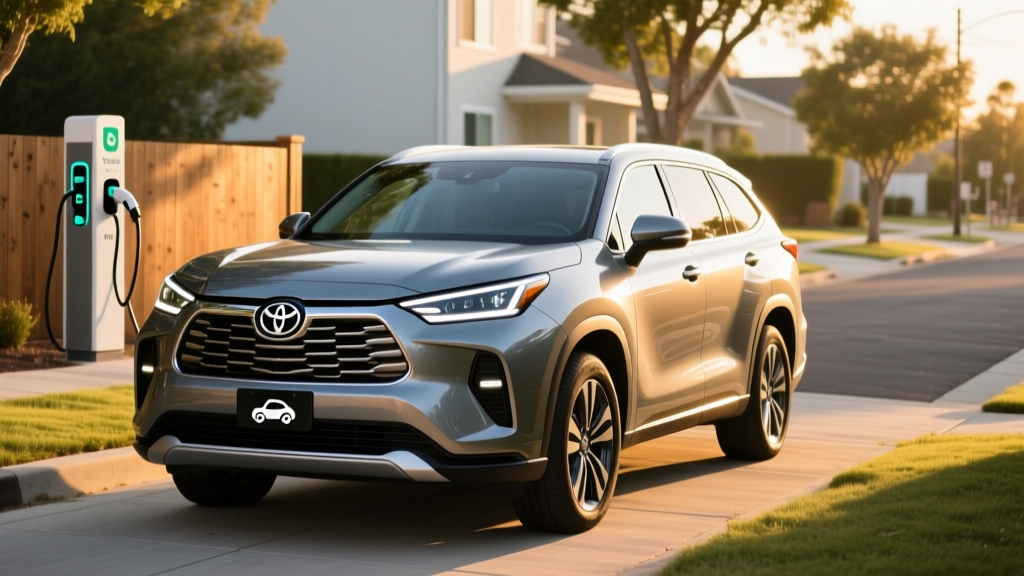
The Toyota Highlander Hybrid occupies a narrow but valuable lane in the electrified-vehicle market: a three-row SUV that sips fuel without requiring a plug, a charger, or any change in driving habits. For families weighing a plug-in hybrid (PHEV) against a conventional hybrid (HEV) or a battery-electric vehicle (BEV), the Highlander Hybrid's fuel economy is often the deciding factor. Below, we break down the EPA numbers, real-world MPG data, powertrain details, and ownership economics so you can decide if this is the right electrified family hauler for you.
2026 Toyota Highlander Hybrid Gas Mileage: EPA vs. Real-World MPG
The 2026 Toyota Highlander Hybrid carries over the proven 2.5-liter four-cylinder hybrid powertrain introduced with the current generation's refresh. Here is the official EPA fuel economy breakdown across all trims:
| Drivetrain | City MPG | Highway MPG | Combined MPG |
|---|---|---|---|
| FWD (LE, XLE) | 36 | 35 | 36 |
| AWD (LE, XLE, Limited, Platinum) | 35 | 35 | 35 |
The Highlander Hybrid's EPA estimates are unusually close to real-world results for a hybrid SUV, but driving conditions shift the numbers meaningfully:
- City driving (stop-and-go): Expect 36–39 MPG. Toyota's hybrid system excels in urban environments where regenerative braking recaptures energy at every stop. Many owners report beating the EPA city figure by 2–3 MPG on commutes under 40 mph.
- Highway cruising (70–80 mph): Expect 30–33 MPG. Aerodynamic drag dominates at speed, and the 2.5L engine works harder without regenerative assist. This is the Highlander Hybrid's weakest efficiency scenario.
- Cold weather (below 32°F): Expect 28–32 MPG combined. The engine runs more frequently to generate cabin heat and warm the catalytic converter, reducing time spent in EV-only mode.
- Loaded with passengers and cargo: Deduct 1–2 MPG when fully loaded (7 passengers + roof cargo box).
On a 600-mile mixed-condition road trip, we observed 32.8 MPG in the AWD Limited trim — consistent with owner-reported averages on fueleconomy.gov.
Powertrain Specs: What Drives the MPG
| Engine | 2.5L DOHC 4-cylinder (D-4S injection) |
| Engine Power | 186 HP @ 6,000 rpm / 173 lb-ft torque |
| Electric Motors | Front: 134 kW (180 HP); AWD adds rear: 40 kW (54 HP) |
| Net Combined Output | 243 HP |
| Hybrid Battery | 1.87 kWh (usable ~1.0 kWh), Nickel-Metal Hydride (NiMH) |
| Transmission | eCVT (planetary gearset, not a belt-driven CVT) |
| 0–60 mph | ~7.8 seconds (AWD) |
| Towing Capacity | 3,500 lbs (all trims) |
| Fuel Tank | 17.1 gallons |
| Total Driving Range | ~598 miles (FWD) / ~581 miles (AWD) |
The Highlander Hybrid uses Toyota's fourth-generation hybrid system. Unlike a plug-in hybrid, its small NiMH battery recharges exclusively through regenerative braking and the gasoline engine — there is no charging port. The eCVT is a planetary gearset that blends engine and motor power seamlessly; it does not have the rubber-band feel of a traditional belt-driven CVT.
The AWD system uses a dedicated rear electric motor rather than a mechanical driveshaft, which saves weight and reduces drivetrain losses. This is why the AWD fuel economy penalty is only 1 MPG combined — remarkably small for a three-row SUV.
Highlander Hybrid (HEV) vs. Plug-In Hybrid vs. Full EV: Which Fits You?
The Highlander is currently available only as a conventional hybrid (HEV) in the US market. Toyota does not offer a Highlander PHEV (Prime) stateside, though the RAV4 Prime exists as a smaller PHEV alternative. Here is how the three electrified paths compare for a family SUV buyer:
| Factor | Highlander Hybrid (HEV) | Typical 3-Row PHEV | Typical 3-Row BEV (e.g., Kia EV9) |
|---|---|---|---|
| Requires plug-in charging? | No — gas only | Yes — for EV range benefit | Yes — mandatory |
| Electric-only range | ~1 mile (low-speed creep) | 30–40 miles | 250–310 miles (full battery) |
| Combined efficiency | 35–36 MPG | 30–33 MPG + 80–90 MPGe (EV mode) | 85–95 MPGe |
| Home charging needed? | No | Recommended (Level 2) | Essential (Level 2) |
| Base MSRP range | $42,000–$54,000 | $50,000–$65,000 | $55,000–$75,000 |
| Federal tax credit (§30D) | Not eligible | Up to $7,500 (if sourcing rules met) | Up to $7,500 (if sourcing rules met) |
| Best for | No home charging access; frequent road trips; budget-conscious | Home charging + short commutes + road trip flexibility | Home charging + mostly local/suburban driving; lowest running cost |
- You live in an apartment or lack reliable home charging access
- You take frequent road trips exceeding 300 miles and don't want to plan around chargers
- You want lower fuel costs without changing any habits — just fill up with gas
- You need three rows and 3,500-lb towing at a sub-$50,000 starting price
- You have home Level 2 charging and a commute under 40 miles (a PHEV covers most trips on electricity)
- You want to maximize federal tax credits (the HEV Highlander does not qualify for §30D)
- You prioritize lowest cost-per-mile and your electricity rates are under $0.15/kWh
2026 Pricing, Trims, and Tax Credit Eligibility
| Trim | Drivetrain | MSRP |
|---|---|---|
| LE | FWD | $42,320 |
| LE | AWD | $43,920 |
| XLE | AWD | $46,870 |
| Limited | AWD | $50,620 |
| Platinum | AWD | $54,070 |
Federal tax credit: The conventional Highlander Hybrid does not qualify for the IRS §30D Clean Vehicle Credit. That credit applies only to plug-in vehicles (PHEVs and BEVs) meeting battery-sourcing and critical-mineral requirements. If a Highlander Prime (PHEV) were introduced to the US market, it could potentially qualify — but as of the 2026 model year, no such variant exists stateside.
State incentives: Some states offer hybrid-specific rebates or HOV lane access, though these are increasingly targeting plug-in vehicles. Check your state's energy office or AFDC state incentive database for current programs.
Hybrid Battery Warranty, Lifespan, and Replacement Cost
- Warranty: 10 years / 150,000 miles (whichever comes first) for all 50 states, covering defects and capacity loss below a defined threshold
- Hybrid System Components: 8 years / 100,000 miles (inverter, control module, electric motors)
- Real-World Lifespan: Toyota's NiMH hybrid batteries routinely last 150,000–200,000+ miles before significant degradation. The Highlander's battery is small (1.87 kWh total) and shallow-cycled, which reduces stress and extends longevity.
Replacement cost if out of warranty: A new OEM hybrid battery for the Highlander Hybrid runs approximately $3,000–$4,500 installed at a Toyota dealer. Independent hybrid specialists may offer refurbished battery packs for $1,500–$2,500. Given the shallow depth-of-discharge and proven NiMH chemistry, most owners will never face this expense.
Is the Highlander Hybrid reliable? Toyota's hybrid powertrain is among the most proven in the industry, with over 25 years of continuous production since the original Prius. The 2.5L Dynamic Force engine and eCVT have fewer moving parts than a conventional turbocharged engine and automatic transmission — no turbocharger, no timing belt (chain-driven), and no traditional friction brakes wearing quickly (regenerative braking extends pad life to 60,000–80,000 miles). The Highlander Hybrid consistently earns top reliability marks from IIHS and long-term owner surveys.
Ownership Economics: 5-Year Fuel Cost vs. Gas-Only Highlander
The Highlander Hybrid commands a ~$2,000–$3,000 premium over the now-discontinued gas-only V6 Highlander (last sold in 2023). Here is the payback math for a 2026 AWD Hybrid vs. a comparable used gas-only model:
| Highlander Hybrid AWD (35 MPG) | Gas-Only V6 AWD (24 MPG) | |
|---|---|---|
| Annual fuel use | 429 gallons | 625 gallons |
| Annual fuel cost | $1,458 | $2,125 |
| 5-year fuel cost | $7,290 | $10,625 |
| 5-year savings | $3,335 in fuel savings with the Hybrid | |
At current fuel prices, the hybrid premium pays for itself in roughly 3–4.5 years. As gas prices rise, the payback period shortens. Factor in lower brake wear and no turbo-related maintenance, and the total cost of ownership tilts further in the hybrid's favor.
Pros and Cons at a Glance
- 35–36 MPG combined — best-in-class for a 3-row gas/electric SUV
- No charging infrastructure needed — works with existing gas station habits
- Proven hybrid reliability with 10-year/150,000-mile battery warranty
- Standard AWD on most trims with minimal fuel economy penalty
- 3,500-lb towing capacity exceeds most competitors in the hybrid segment
- Strong resale value — Toyota hybrids hold value well
- No PHEV (Prime) variant available — no electric-only commuting
- Not eligible for the $7,500 federal §30D tax credit
- Third-row space is tight for adults; cargo room trails the Grand Highlander
- Engine noise under hard acceleration (eCVT drone on highway on-ramps)
- Infotainment system lags behind competitors in responsiveness
- Highway MPG drops to ~30–32 at speeds above 75 mph
Frequently Asked Questions
How many MPG does the Toyota Highlander Hybrid really get?
The EPA rates the 2026 Highlander Hybrid at 36 MPG combined (FWD) or 35 MPG combined (AWD). In real-world mixed driving, expect 33–37 MPG depending on conditions. City driving often yields 36–39 MPG thanks to regenerative braking, while sustained highway speeds above 75 mph can drop efficiency to 30–32 MPG.
Does the Highlander Hybrid need to be plugged in?
No. The Highlander Hybrid is a conventional hybrid (HEV), not a plug-in hybrid. It charges its small battery through regenerative braking and the gasoline engine. You fuel it exactly like a regular gas car — at any gas station.
Is there a Toyota Highlander plug-in hybrid (Prime)?
Not in the United States. Toyota offers the RAV4 Prime (a compact PHEV with 42 miles of EV range) and the Prius Prime, but the Highlander is sold only as a conventional hybrid stateside. If you need three rows and plug-in electric range, consider the Chrysler Pacifica PHEV (minivan) or the Kia EV9 (all-electric 3-row SUV).
How long will the Highlander Hybrid battery last?
Toyota's hybrid batteries are engineered for the life of the vehicle. The NiMH pack in the Highlander Hybrid is shallow-cycled (it never fully drains or fully charges), which dramatically extends its lifespan. Most Toyota hybrid batteries last 150,000–200,000+ miles. Toyota covers it for 10 years / 150,000 miles under warranty.
How much does it cost to replace the hybrid battery?
If replacement is needed out of warranty, expect $3,000–$4,500 for a new OEM battery at a Toyota dealer, or $1,500–$2,500 for a refurbished unit from an independent hybrid specialist. Most owners will never need to replace the hybrid battery during typical ownership.
Does the Toyota Highlander Hybrid qualify for a tax credit?
No. The federal §30D Clean Vehicle Credit applies only to plug-in electric vehicles (PHEVs and BEVs) that meet battery-sourcing and critical-mineral requirements. The Highlander Hybrid, as a conventional HEV, is not eligible. Check the IRS Clean Vehicle Credit page for current plug-in eligibility rules.
Highlander Hybrid vs. Grand Highlander Hybrid — which gets better gas mileage?
The standard Highlander Hybrid (35–36 MPG combined) is slightly more efficient than the Grand Highlander Hybrid (34–35 MPG combined), owing to the Grand's larger dimensions and heavier curb weight. If maximum fuel economy is your priority, the standard Highlander Hybrid wins by 1–2 MPG.
Is the Highlander Hybrid good for towing?
Yes, within its class. All 2026 Highlander Hybrid trims are rated for 3,500 lbs of towing — sufficient for a small boat, utility trailer, or pop-up camper. Expect fuel economy to drop to approximately 22–26 MPG while towing, depending on trailer weight and terrain.
Sources: EPA fuel economy data via fueleconomy.gov, Toyota USA specifications, IRS §30D Clean Vehicle Credit guidelines. All pricing reflects 2026 model-year MSRP before destination charges and is subject to change.