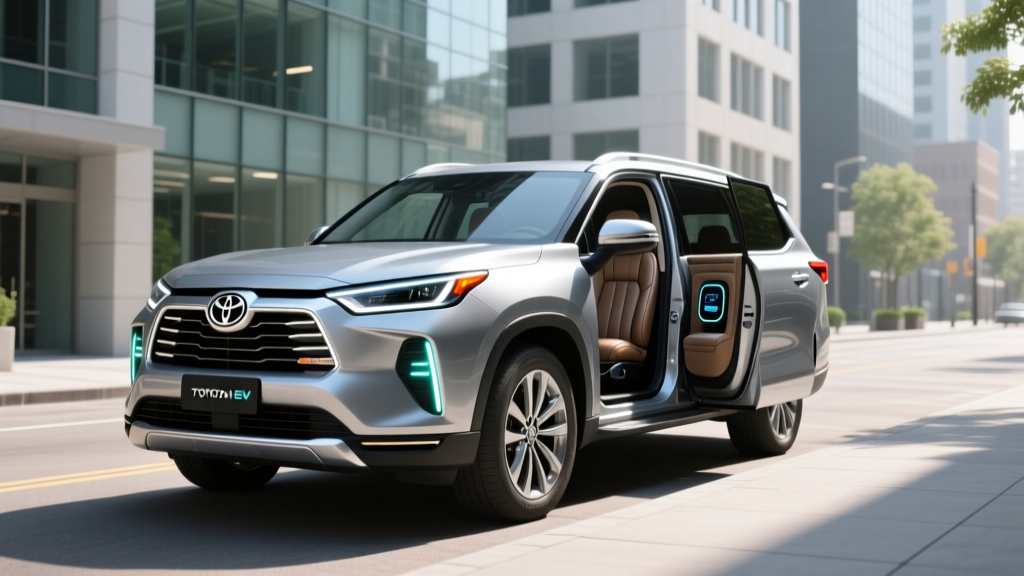
If you need three rows of seating but aren't ready to commit to a full battery-electric vehicle, the Toyota Grand Highlander PHEV (officially the Grand Highlander Hybrid MAX in some trims, with the plug-in variant sold as the Grand Highlander PHEV) occupies a compelling middle ground. For the 2026 model year, Toyota has refined its plug-in hybrid powertrain to offer meaningful electric-only commuting range wrapped in a family-hauler package that can still handle a cross-country road trip without a single charging stop.
But does the math actually work? Below, we break down the Grand Highlander PHEV's real-world efficiency, electric-only range, charging logistics, ownership costs, and how it stacks up against both its conventional hybrid sibling and full-electric competitors.
HEV vs. PHEV: Which Grand Highlander Are We Talking About?
Toyota sells the Grand Highlander with multiple electrified powertrains, and confusing them is easy. Here's the critical distinction:
| Feature | Grand Highlander Hybrid (HEV) | Grand Highlander PHEV |
|---|---|---|
| Plug-in charging required? | No — self-charging via regenerative braking and engine | Yes — plug in to access electric-only range |
| Electric-only driving | Very limited (low-speed, short distances) | ~32 miles EPA at full highway speeds |
| Battery capacity | ~1.6 kWh (small buffer) | ~18.1 kWh usable (larger traction battery) |
| Combined output | 245 hp (Hybrid) / 362 hp (Hybrid MAX) | 302 hp combined |
| EPA combined MPG (after battery depleted) | 34–36 MPG combined | 35 MPG combined (charge-sustaining mode) |
| Federal tax credit eligible? | No | Potentially — subject to §30D sourcing/income rules |
The conventional HEV never plugs in. It recovers energy during braking and uses a small battery to assist the gas engine, yielding excellent fuel economy without any change to your daily routine. The PHEV, by contrast, carries a much larger battery that you charge at home or at public Level 2 stations. When that battery is full, you can drive roughly 32 miles without the engine turning on at all — enough for most daily commutes and school runs. Once the battery is depleted, it operates just like a regular hybrid.
Fuel Economy and Electric-Only Range: The Numbers
Here's what the EPA says, and what you can actually expect in the real world:
| Metric | EPA Estimate | Real-World Expectation |
|---|---|---|
| Electric-only range | 32 miles | 27–30 mi (highway/cold weather); 32+ mi (city, mild temps) |
| MPGe (electric + gas combined) | 74 MPGe | Varies widely based on charging frequency |
| Combined MPG (gas-only, battery depleted) | 35 MPG | 33–37 MPG (hybrids often beat EPA in city driving) |
| City MPG (charge-sustaining) | 36 MPG | 37–40 MPG (regen braking excels in stop-and-go) |
| Highway MPG (charge-sustaining) | 34 MPG | 30–33 MPG (sustained 75+ mph reduces efficiency) |
| Total combined range | ~440 miles | ~400–460 miles depending on conditions |
The real-world advantage of hybrids in the city: Unlike gas cars, which get their worst mileage in stop-and-go traffic, the Grand Highlander PHEV actually improves in urban driving once the battery is depleted. Regenerative braking recovers kinetic energy at every stoplight, and the engine shuts off at idle. Many owners report beating the EPA city estimate by 2–4 MPG on suburban routes with frequent stops.
Cold-weather caveat: In temperatures below 32°F, expect electric-only range to drop by 20–30%. The battery's chemistry becomes less efficient, and cabin heating draws significant power. A 32-mile EPA electric range may shrink to 22–26 miles in January in northern states. The gas engine will also engage more readily to provide heat.
Powertrain and Performance Specs
| Specification | 2026 Grand Highlander PHEV |
|---|---|
| Engine | 2.5L inline-4 Atkinson-cycle |
| Electric motors | Front + rear (eAWD standard) |
| Combined system output | 302 hp / 320 lb-ft torque |
| 0–60 mph | ~6.8 seconds |
| Drivetrain | Electronic all-wheel drive (eAWD) |
| Transmission | eCVT (planetary gearset, no traditional gears) |
| Towing capacity | 3,500 lbs |
| Battery (traction) | ~18.1 kWh usable, lithium-ion |
| Charge time (Level 2, 240V) | ~4.5 hours (0–100%) |
| DC fast charging | Not supported |
| Charge port | J1772 (Level 2 AC) |
| Seating | 7 or 8 passengers (bench or captain's chairs) |
| Cargo (behind 3rd row) | ~20.6 cu ft |
The 302-hp combined output puts the PHEV between the base Hybrid (245 hp) and the performance-oriented Hybrid MAX (362 hp). It's adequately quick for merging and passing, and the instant torque from the electric motors makes it feel more responsive than the horsepower figure alone suggests.
No DC fast charging: This is a deliberate engineering choice common among PHEVs. The 18.1 kWh battery is small enough that Level 2 AC charging fully replenishes it overnight or during a workday. Adding DC fast-charge hardware would add cost, weight, and complexity for minimal benefit. If you need rapid charging, a full BEV is the better choice.
Charging at Home: What You'll Need
Because the Grand Highlander PHEV does not support DC fast charging, your home Level 2 setup is the primary refueling point. Here's what that looks like in practice:
- Level 1 (120V household outlet): ~12–14 hours for a full charge. Adequate if you drive less than 20 miles daily and can plug in overnight, but slow.
- Level 2 (240V, 32A recommended): ~4.5 hours for a full charge. A dedicated home Level 2 charger means you start every morning with a full battery. Installation typically costs $500–$1,500 depending on your electrical panel's proximity to the parking spot.
Most PHEV owners find that a Level 2 home charger is the single best investment for maximizing electric-only driving. Without home charging, you'll rely on the gas engine far more often, negating much of the PHEV's efficiency advantage over the conventional HEV.
Pricing, Trims, and Tax Credit Eligibility
The 2026 Toyota Grand Highlander PHEV starts at an MSRP of approximately $49,990 (base SE trim), with higher trims (XLE, Limited) pushing past $56,000. That positions it at a premium over the conventional Grand Highlander Hybrid, which starts around $42,000.
Federal tax credit (§30D): The Grand Highlander PHEV may qualify for up to $7,500 under the IRS Clean Vehicle Credit, but eligibility is not guaranteed for every buyer. Current requirements include:
- MSRP cap: SUVs/vans must have an MSRP at or below $80,000 — the Grand Highlander PHEV clears this.
- Buyer income cap: Modified adjusted gross income must not exceed $150,000 (single), $225,000 (head of household), or $300,000 (joint filers).
- Battery sourcing: Critical minerals and battery components must meet phased-in domestic-sourcing thresholds that tighten annually. Toyota's supply chain compliance varies by model year — verify current status on IRS.gov's qualified vehicle list.
- Point-of-sale transfer: As of 2024+, eligible buyers can transfer the credit to the dealer at purchase, reducing the out-of-pocket price immediately rather than waiting for a tax refund.
Because sourcing rules change and Toyota's eligibility status can shift, always confirm the specific VIN's credit status with your dealer and a tax professional before purchase. The conventional Grand Highlander Hybrid does not qualify for the §30D credit — it lacks sufficient battery capacity and plug-in capability.
Reliability, Battery Warranty, and Replacement Costs
Toyota Hybrid Battery Warranty: 10 years / 150,000 miles (whichever comes first) on the high-voltage traction battery, covered against defects and abnormal capacity loss. This applies nationwide and transfers to subsequent owners.
Toyota's hybrid reliability record is among the strongest in the industry. The Prius, RAV4 Hybrid, and Highlander Hybrid have demonstrated that Toyota's hybrid synergy drive system routinely exceeds 200,000 miles with minimal degradation. The Grand Highlander PHEV uses a proven iteration of this architecture.
Battery degradation reality: Unlike full EVs, where range loss is immediately noticeable, PHEV battery degradation is less impactful. Even if the 18.1 kWh battery loses 15–20% capacity over a decade (a conservative estimate based on Toyota's track record), you'd still get ~25 miles of electric range. The vehicle remains fully functional as a hybrid regardless.
Out-of-warranty replacement cost: If the traction battery fails after the 10-year/150,000-mile warranty, replacement typically runs $3,000–$5,000 at a Toyota dealership, including labor. Third-party refurbishers and independent hybrid shops often offer replacements for $1,500–$2,500. For context, this is substantially less than a full EV battery replacement and comparable to replacing an automatic transmission on a conventional vehicle.
The conventional 12V auxiliary battery (which powers accessories and starts the system) is a separate, standard automotive battery that will need replacement every 4–6 years at typical cost ($150–$300).
Grand Highlander PHEV vs. Full EV vs. Gas: Who Should Choose What?
Choose the Grand Highlander PHEV if:
- You can charge at home (Level 2 strongly recommended)
- Your daily driving is under 35 miles round-trip
- You need 3-row seating and regular road-trip capability
- You want EV-like commuting without range anxiety on long trips
- You live in an area with sparse DC fast-charging infrastructure
Choose a full EV (e.g., Kia EV9, Tesla Model X) if:
- You have reliable home charging and access to DC fast chargers for trips
- You want zero tailpipe emissions and the lowest per-mile fuel cost
- Your daily driving is under 250 miles and you road-trip 2–3 times per year
- You want maximum performance and instant torque
- You want to eliminate oil changes and engine maintenance entirely
Choose the conventional Grand Highlander Hybrid if: You cannot charge at home, you want the lowest upfront price, your daily commute is long (making the PHEV's electric range less impactful), or you simply want excellent fuel economy without changing any habits.
The PHEV's sweet spot is the household that drives 20–35 miles on most weekdays but takes 3–4 long road trips per year. In that scenario, you'll complete the majority of your daily miles on cheap electricity (roughly $0.12–$0.18/kWh depending on your utility, or about $2.20–$3.30 to "fill up" the battery) while the gas engine seamlessly handles weekend highway runs without any charging logistics.
Ownership Economics: 5-Year Cost Snapshot
| Cost Factor | Grand Highlander PHEV | Grand Highlander Hybrid (HEV) |
|---|---|---|
| Base MSRP (approx.) | $49,990 | $42,090 |
| Est. federal tax credit | $0–$7,500 (eligibility varies) | $0 |
| Fuel/energy cost (5 yr, 75K mi) | ~$4,500–$6,000 | ~$7,500–$8,500 |
| Maintenance (5 yr) | ~$2,800 | ~$2,800 |
| Home charger install | ~$800–$1,200 (one-time) | $0 |
| Insurance (5 yr avg) | ~$9,000 | ~$8,500 |
| Est. 5-year total (before credit) | ~$67,000–$69,500 | ~$60,900–$61,900 |
| Est. 5-year total (with $7,500 credit) | ~$59,500–$62,000 | ~$60,900–$61,900 |
The PHEV's higher sticker price is partially offset by lower fuel costs and potential tax credits. If you qualify for the full §30D credit and charge regularly at home, the 5-year total cost converges closely with the conventional hybrid — while giving you a noticeably quieter, smoother daily commute on electric power. Data from fueleconomy.gov confirms the PHEV variant's efficiency advantage when regularly charged.
Frequently Asked Questions
How many MPG does the Grand Highlander PHEV get?
Once the battery is depleted, the Grand Highlander PHEV achieves an EPA-estimated 35 MPG combined (36 city / 34 highway). In real-world city driving with frequent stops, many owners report 37–40 MPG thanks to regenerative braking. Highway driving at sustained speeds above 75 mph typically yields 30–33 MPG.
How far can the Grand Highlander PHEV go on electric only?
The EPA rates the Grand Highlander PHEV at 32 miles of electric-only range. In mild weather with city driving, you may match or slightly exceed that. In cold weather (below freezing) or at sustained highway speeds, expect 22–28 miles before the gas engine engages.
Does the Grand Highlander PHEV qualify for a tax credit?
It may qualify for up to $7,500 under the federal §30D Clean Vehicle Credit, subject to buyer income limits, battery-sourcing requirements, and MSRP caps. The vehicle's MSRP falls under the $80,000 SUV cap, but critical-mineral sourcing rules and your personal income determine final eligibility. Check the IRS qualified vehicle list and consult a tax professional before purchasing.
Is the Grand Highlander PHEV reliable? What about battery replacement cost?
Toyota's hybrid powertrains have an industry-leading reliability record spanning two decades. The traction battery is warrantied for 10 years / 150,000 miles. Out-of-warranty replacement typically costs $3,000–$5,000 at a dealer, or $1,500–$2,500 through independent hybrid specialists. Most Toyota hybrid batteries last well beyond 200,000 miles with minimal degradation.
Can the Grand Highlander PHEV DC fast charge?
No. The Grand Highlander PHEV charges via AC only — Level 1 (120V) or Level 2 (240V). A full charge on Level 2 takes approximately 4.5 hours. This is standard for most PHEVs, as the smaller battery doesn't require DC fast-charging infrastructure. Home Level 2 charging is the intended and most practical refueling method.
Should I get the PHEV or the regular Grand Highlander Hybrid?
If you can install a Level 2 charger at home and your daily driving is under 35 miles, the PHEV gives you near-EV commuting comfort with zero range anxiety on road trips. If you can't charge at home or your commute exceeds the electric range daily, the conventional HEV delivers excellent MPG at a lower purchase price and with no behavioral changes required.