Quick Verdict: Two Hybrid Paths, One Big SUV
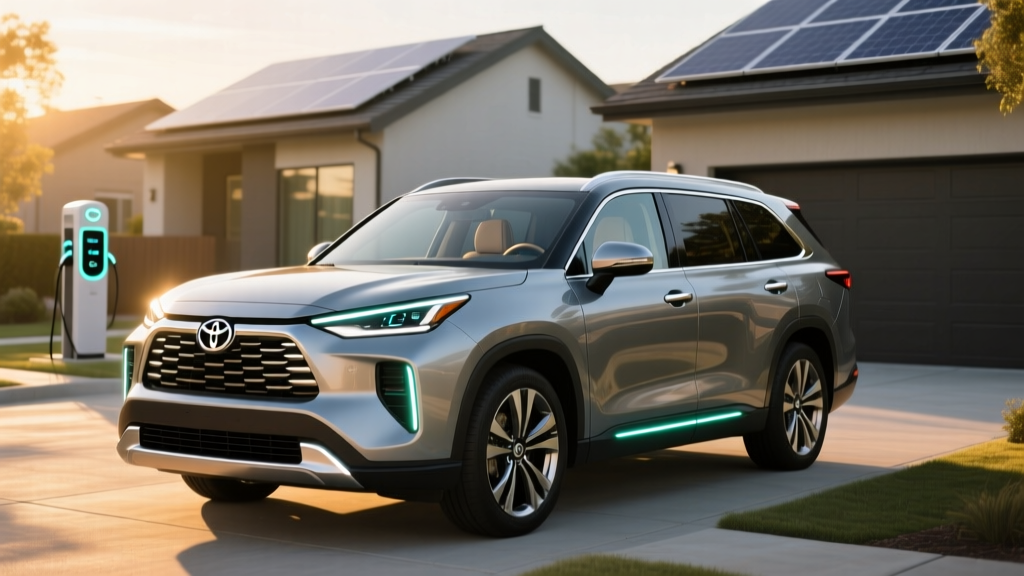
The 2026 Toyota Grand Highlander Hybrid offers two distinct powertrain choices that confuse many shoppers. The standard hybrid (HEV) pairs a 2.5-liter four-cylinder with electric motors for 245 horsepower and up to 36 MPG combined. The Hybrid Max steps up to a turbocharged 2.4-liter and dual motors for 362 horsepower, trading a few MPG for serious passing power. Neither is a plug-in hybrid — both generate electricity onboard through regenerative braking and the gasoline engine, so there's no plug, no electric-only range, and no range anxiety.
For families who need three usable rows, cargo space, and fuel bills that undercut any competing gas-only three-row SUV by 30–40%, the Grand Highlander Hybrid remains the segment benchmark. Here's every number that matters.
HEV vs PHEV: What the Grand Highlander Actually Is
Conventional Hybrid (HEV) — The Grand Highlander Hybrid is a self-charging hybrid. Its small traction battery (approximately 1.6 kWh usable, nickel-metal hydride) is replenished by the engine and regen braking. You never plug it in. It can creep short distances at low speed on electric power, but its primary job is to assist the gas engine and capture energy you'd otherwise waste as heat in the brakes.
Plug-In Hybrid (PHEV) — A PHEV like the Toyota RAV4 Prime carries a much larger battery (18.1 kWh) that you plug into a wall outlet for 42 miles of true electric-only driving before the gas engine kicks in. Toyota does not offer the Grand Highlander as a PHEV for 2026.
Full EV (BEV) — A battery-electric vehicle like the Kia EV9 has no gas engine at all. You plug in, charge a large battery pack (77–100 kWh), and drive 250–300+ miles on electricity alone.
If you want electric-only commuting in a three-row package, you'll need to look at BEVs or wait to see if Toyota expands PHEV availability. For the Grand Highlander, the decision is between the standard hybrid and the Hybrid Max.
Powertrain Specs: Standard Hybrid vs Hybrid Max
| Specification | Standard Hybrid | Hybrid Max |
|---|---|---|
| Engine | 2.5L inline-4 | 2.4L turbo inline-4 |
| Combined System HP | 245 hp | 362 hp |
| Combined Torque | 173 lb-ft (engine) | 400 lb-ft |
| Electric Motors | Front + rear (AWD e-Four) | Front + rear (Direct AWD) |
| Transmission | eCVT | 6-speed automatic |
| Drivetrain | AWD standard | AWD standard |
| 0–60 mph (est.) | ~7.8 sec | ~6.3 sec |
| Towing Capacity | 3,500 lb | 5,000 lb |
| Traction Battery | ~1.6 kWh NiMH | ~1.6 kWh NiMH |
The standard hybrid's eCVT isn't a traditional continuously variable transmission with a belt — it's a planetary gearset that blends engine and motor power seamlessly. It's the same architecture Toyota has refined over 25 years and millions of vehicles. The Hybrid Max uses a conventional 6-speed automatic because the turbo four needs fixed gear ratios to manage its 400 lb-ft torque delivery.
Fuel Economy: EPA Numbers and Real-World Expectations
| Powertrain | City MPG | Highway MPG | Combined MPG |
|---|---|---|---|
| Standard Hybrid AWD | 36 | 32 | 34 |
| Standard Hybrid FWD (LE) | 37 | 34 | 36 |
| Hybrid Max AWD | 27 | 28 | 27 |
Source: fueleconomy.gov — EPA estimates for 2025–2026 model year Grand Highlander Hybrid.
Real-World MPG: What to Actually Expect
Toyota hybrids routinely exceed their EPA city rating in stop-and-go driving because regenerative braking recaptures energy that gas-only vehicles waste. In suburban and urban driving at 25–45 mph, owners commonly report 35–38 MPG in the standard hybrid. Highway driving is where the sticker number holds or drops slightly: at 75 mph with a full load, expect 29–31 MPG in the standard hybrid.
The Hybrid Max's turbocharged engine and heavier powertrain components explain the 27 MPG combined figure. Real-world highway cruising yields around 26–28 MPG, while aggressive driving or towing pushes it into the low 20s. You're paying a 7–9 MPG penalty for 117 additional horsepower and 1,500 pounds of extra towing capacity.
Cold-weather impact is modest compared to full EVs. Expect a 3–5 MPG drop in the standard hybrid during freezing temperatures — the engine runs more often to heat the cabin and warm the catalytic converter. That still leaves you at 30+ combined in winter, far ahead of any gas-only competitor.
Pricing, Trims, and Tax Credit Eligibility
The 2026 Grand Highlander Hybrid starts at approximately $41,490 (LE AWD, including destination) and climbs to roughly $54,000 for a fully loaded Hybrid Max Platinum. Key trim pricing:
- LE Hybrid: ~$41,490 (standard hybrid, FWD available)
- XLE Hybrid: ~$45,500
- Limited Hybrid: ~$49,800
- Hybrid Max Limited: ~$50,300
- Hybrid Max Platinum: ~$54,000
Federal Tax Credit: Does It Qualify?
No. The Grand Highlander Hybrid does not qualify for the federal §30D Clean Vehicle Credit. Under current IRS rules, the §30D credit of up to $7,500 applies only to plug-in electric vehicles (BEVs and PHEVs) with sufficient battery capacity and compliant critical-mineral/battery-component sourcing. Conventional hybrids like the Grand Highlander Hybrid are excluded.
Some states offer their own hybrid incentives — check your state energy office or department of revenue. These tend to be smaller ($500–$1,500) and less common than EV credits.
Battery Warranty, Lifespan, and Replacement Cost
Hybrid Battery Warranty: Toyota covers the Grand Highlander Hybrid's traction battery for 10 years or 150,000 miles (whichever comes first) under its Hybrid Battery Warranty. This applies in all 50 states.
Hybrid System Components: The hybrid control module, inverter, and related components carry the same 10-year/150,000-mile coverage.
Powertrain Warranty: The gasoline engine and transmission are covered for 5 years / 60,000 miles.
How Long Will the Battery Last?
Toyota's nickel-metal hydride (NiMH) hybrid batteries are among the most proven in the industry. Data from millions of Prius, Camry Hybrid, and Highlander Hybrid vehicles on the road shows that these batteries commonly last 150,000–200,000+ miles with gradual capacity loss. Unlike a full EV battery, the hybrid battery is small and operates within a narrow state-of-charge window (roughly 40–80%), which dramatically reduces degradation.
The battery management system prevents deep discharge and overcharging — the two biggest killers of lithium-ion longevity. You'll notice slightly reduced fuel economy as the battery ages, but catastrophic failure before 150,000 miles is uncommon.
Replacement Cost
If the hybrid battery does fail outside warranty, a replacement from Toyota runs approximately $3,000–$4,500 including parts and labor. Refurbished units from independent hybrid specialists can bring that down to $1,500–$2,500. Individual cell modules can sometimes be replaced for under $1,000 if only a few cells are degraded. This is far less than a full EV battery replacement ($8,000–$20,000+).
Reliability Track Record
Toyota's hybrid system is one of the most reliable powertrains in any vehicle class. The eCVT planetary gearset has no belts, chains, or friction clutches to wear out — it's essentially bulletproof. The IIHS has evaluated the Grand Highlander, and Toyota's Safety Sense 3.0 suite (pre-collision, lane tracing, adaptive cruise) comes standard on every trim.
The most common hybrid-system complaints across the Toyota lineup relate to the 12V auxiliary battery (not the traction battery) dying after extended inactivity, and occasional inverter coolant pump recalls — which Toyota addresses under warranty. The Grand Highlander shares its TNGA-K platform and hybrid architecture with the Highlander Hybrid and Sienna, both of which have strong long-term reliability records.
Who Should Choose the Grand Highlander Hybrid?
Pros
- 34–36 MPG combined in a 3-row SUV — class-leading
- Usable third row fits adults on short trips
- No plug-in required — zero lifestyle change from a gas car
- Standard AWD on most trims
- 10-year/150k-mile hybrid battery warranty
- Hybrid Max offers 5,000-lb towing with 362 hp
- Strong resale value (Toyota hybrid demand)
Cons
- No electric-only driving — not a PHEV
- No federal tax credit eligibility
- Hybrid Max drops to 27 MPG combined
- Engine noise under hard acceleration (eCVT drone)
- Third-row cargo space tight when all seats are up
- No DC fast charging (not applicable — it's an HEV)
- Premium trims push past $54,000
Decision Framework
Choose the Grand Highlander Hybrid if: You need three rows, want 34+ MPG without plugging in, don't have reliable home charging access for an EV, and plan to keep the vehicle 8–10+ years.
Choose the Hybrid Max if: You tow a boat or trailer regularly (5,000-lb capacity), want confident highway merging with 362 hp, and accept the 27 MPG trade-off.
Look at a PHEV (RAV4 Prime, Tucson PHEV) if: You have a garage with a 120V or 240V outlet, commute under 35 miles round-trip, and want electric-only daily driving with gas-engine flexibility for road trips.
Look at a full EV (Kia EV9, Rivian R1S) if: You have Level 2 home charging, want zero tailpipe emissions, qualify for the $7,500 federal credit, and drive under 300 miles between charging stops.
Frequently Asked Questions
How many MPG does the Toyota Grand Highlander Hybrid get?
The standard hybrid gets 36 MPG combined (FWD) or 34 MPG combined (AWD) per the EPA. The Hybrid Max gets 27 MPG combined. In real-world city driving, the standard hybrid often returns 35–38 MPG thanks to aggressive regenerative braking.
Does the Grand Highlander Hybrid need to be plugged in?
No. It's a conventional hybrid (HEV), not a plug-in hybrid (PHEV). The battery charges itself through the gasoline engine and regenerative braking. You fuel it exactly like a gas car.
How far can the Grand Highlander Hybrid drive on electric power alone?
Only about 1 mile or less at very low speeds (under 25 mph) in EV mode. This is not designed for electric-only commuting — it's a brief assist feature for creeping through parking lots or driveways. For meaningful electric-only range, you need a PHEV or BEV.
Is the Grand Highlander Hybrid reliable? What about battery replacement cost?
Toyota's hybrid system has over 25 years of proven reliability. The hybrid battery is warranted for 10 years / 150,000 miles, and real-world data shows these NiMH batteries commonly last 150,000–200,000+ miles. Out-of-warranty replacement costs approximately $3,000–$4,500 from a dealer.
Does the Grand Highlander Hybrid qualify for a tax credit?
It does not qualify for the federal §30D Clean Vehicle Credit, which is limited to plug-in vehicles (BEVs and PHEVs). Check with your state revenue department for any local hybrid incentives, which are typically smaller and less common.
Standard Hybrid or Hybrid Max — which should I pick?
If fuel economy is your priority and you don't tow, the standard hybrid (34–36 MPG) is the clear winner. If you regularly tow (up to 5,000 lb) or want brisk acceleration (0–60 in ~6.3 seconds), the Hybrid Max's 362 hp and 6-speed automatic are worth the 7–9 MPG penalty.
How does the Grand Highlander Hybrid compare to the gas-only Grand Highlander?
The gas-only 2.4L turbo Grand Highlander returns roughly 24 MPG combined. The standard hybrid delivers 34–36 MPG — a 40–50% improvement — while adding standard AWD and only a modest price premium (~$1,500–$2,000 at the LE trim). The fuel savings typically pay back the hybrid premium within 2–3 years for an average driver.