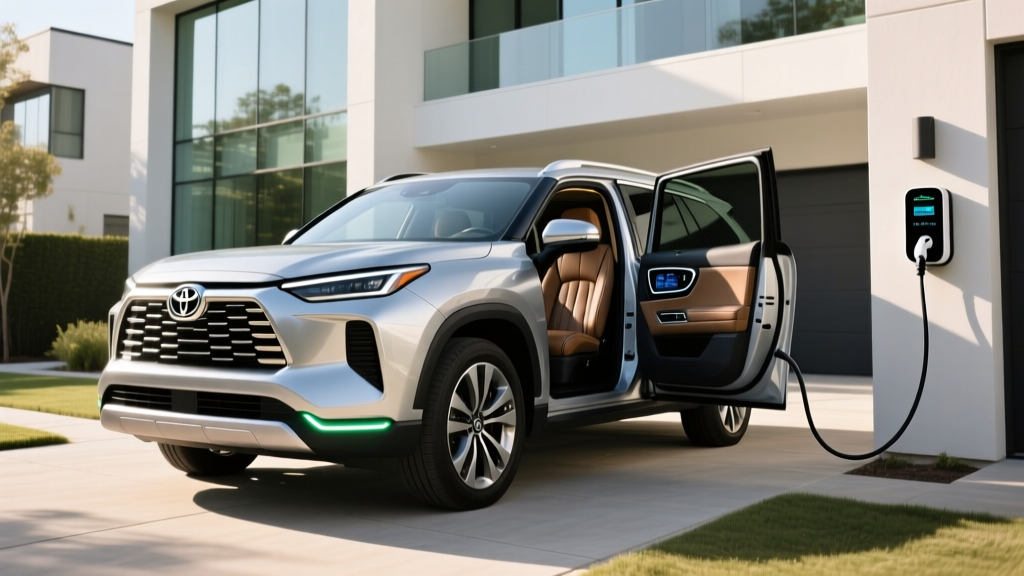
The 2026 Toyota Grand Highlander Hybrid MAX Platinum sits at the top of Toyota's three-row hybrid SUV lineup, pairing a turbocharged 2.4-liter engine with electric motors for 362 horsepower and an EPA-estimated 27 MPG combined. It's a conventional hybrid (HEV), not a plug-in — meaning no charging cables, no electric-only range, and no range anxiety. For families who need three rows, all-wheel drive, and fuel efficiency without lifestyle changes, this trim is one of the most compelling options on the market.
But the Platinum trim pushes the MSRP close to $58,000. Is the Hybrid MAX powertrain worth the premium over the standard Hybrid? Does it qualify for any federal tax credits? And how does real-world fuel economy compare to the EPA sticker? This guide breaks down every spec that matters.
HEV vs PHEV: What the Grand Highlander Hybrid Actually Is
Before diving into specs, it's critical to understand what you're buying. The Grand Highlander Hybrid MAX is a conventional hybrid electric vehicle (HEV). It charges its own small battery through regenerative braking and the gasoline engine. You never plug it in.
| Feature | HEV (Grand Highlander Hybrid MAX) | PHEV (e.g., RAV4 Prime) | BEV (e.g., Tesla Model X) |
|---|---|---|---|
| Plug-in charging | No — self-charging | Yes — Level 1/2 | Yes — Level 1/2/DC |
| Electric-only range | None (EV assist only) | 20–42 miles typical | 250–350+ miles |
| Battery size | ~1.5 kWh (NiMH/NMC) | 13–18 kWh | 75–100+ kWh |
| Federal tax credit (§30D) | Not eligible | Up to $7,500 (if eligible) | Up to $7,500 (if eligible) |
| Fuel needed | Gasoline | Gasoline + electricity | Electricity only |
The Grand Highlander also offers a standard Hybrid powertrain (non-MAX) that prioritizes efficiency over power. The MAX version adds a turbocharged engine and more aggressive tuning. Neither is a plug-in. If you want electric-only driving from Toyota in a three-row SUV, you'd need to look at the (currently limited) PHEV options or wait for future product announcements.
Powertrain Specs: 362 HP and Turbo Hybrid Torque
| Specification | Grand Highlander Hybrid MAX Platinum (2026) |
|---|---|
| Engine | 2.4L turbocharged 4-cylinder + electric motors |
| Combined horsepower | 362 hp |
| Combined torque | 400 lb-ft |
| Drivetrain | AWD (electronic rear motor) |
| Transmission | 6-speed automatic |
| 0–60 mph | ~5.8 seconds |
| Towing capacity | 5,000 lbs |
| Hybrid battery | ~1.5 kWh, sealed NiMH/NMC pack |
| Plug-in capable | No (HEV — self-charging) |
The Hybrid MAX uses Toyota's turbo-hybrid architecture, which differs significantly from the standard Grand Highlander Hybrid. The standard Hybrid pairs a naturally aspirated 2.5-liter four-cylinder with Toyota's eCVT for a more sedate 245 hp. The MAX swaps in the turbo 2.4L and a traditional 6-speed automatic, giving it a more responsive, torque-rich character — especially useful when merging onto highways or towing up to 5,000 pounds.
The electric motor in this system doesn't drive the vehicle independently for any meaningful distance. Instead, it fills torque gaps during acceleration, enables smooth stop-start, and captures energy during braking. The rear axle gets its own electric motor for AWD traction without a mechanical driveshaft.
Fuel Economy: EPA Ratings and Real-World MPG
Here's what the EPA says about the 2026 Grand Highlander Hybrid MAX — and what you should actually expect.
| Driving Condition | EPA Estimate | Real-World Expectation |
|---|---|---|
| City | 26 MPG | 27–29 MPG (hybrids often beat EPA in city) |
| Highway | 27 MPG | 24–26 MPG (turbo + boxy SUV hurts at speed) |
| Combined | 27 MPG | 25–27 MPG (mixed driving) |
The counterintuitive part: conventional hybrids often exceed their EPA city estimate because stop-and-go driving maximizes regenerative braking and electric-motor assist. On the highway, the turbo engine works harder, aerodynamic drag increases, and the hybrid system provides less benefit. Expect the real-world combined figure to land around 25–27 MPG depending on your driving mix, terrain, and climate.
For comparison, the standard Grand Highlander Hybrid (non-MAX) achieves an EPA-estimated 36 MPG combined. That's a 9-MPG advantage in exchange for 117 fewer horsepower. If maximum efficiency matters more than acceleration, the standard Hybrid is the clear winner. If you need the towing capacity and passing power, the MAX's fuel economy penalty is reasonable for a 362-hp, three-row SUV.
Pricing, Trims, and Tax Credit Eligibility
The 2026 Grand Highlander Hybrid MAX Platinum is the range-topping trim. Here's the pricing landscape:
| Trim | MSRP (approx.) | Powertrain |
|---|---|---|
| Hybrid MAX Limited | ~$53,000 | Turbo Hybrid MAX, 362 hp |
| Hybrid MAX Platinum | ~$58,000 | Turbo Hybrid MAX, 362 hp |
| Hybrid Limited (std) | ~$48,500 | Standard Hybrid, 245 hp |
The Platinum trim adds premium features like a panoramic roof, head-up display, heated and ventilated second-row captain's chairs, a 360-degree camera, and Toyota's highest-grade interior materials.
Does It Qualify for a Federal Tax Credit?
No. The Grand Highlander Hybrid MAX is a conventional HEV, not a plug-in vehicle. The federal §30D clean vehicle credit applies only to battery electric vehicles (BEVs) and plug-in hybrids (PHEVs) that meet battery sourcing, MSRP, and buyer income requirements. Conventional hybrids do not qualify.
- Vehicle must be a BEV or PHEV (not a conventional HEV)
- MSRP cap: $80,000 for SUVs, $55,000 for sedans
- Buyer income cap: $300K joint / $150K single (MAGI)
- Battery critical minerals and component sourcing thresholds
- Credit can be applied at point of sale as a down payment reduction
The Grand Highlander Hybrid MAX does not meet the first requirement. No federal credit applies. Some states may offer small hybrid rebates — check your state energy office for current programs.
Reliability, Battery Warranty, and Replacement Costs
Hybrid battery longevity is the top concern for buyers spending $58,000 on a Toyota. Here's what the data shows.
- Coverage: 10 years / 150,000 miles (whichever comes first)
- What's covered: Hybrid battery pack, hybrid control module, inverter
- Threshold: Warranty applies if battery capacity drops below a defined performance level
- Transferable: Yes, to subsequent owners
Toyota has been building hybrids since the 1997 Prius, and the brand's hybrid battery track record is among the best in the industry. The 2.4L turbo-hybrid system in the MAX is newer than the venerable 2.5L setup, but early reliability data from the 2024–2025 model years has been solid. Toyota's hybrid components are stress-tested across millions of vehicles globally.
What Does Hybrid Battery Replacement Cost?
If the hybrid battery fails outside warranty, replacement costs for a Toyota hybrid of this size typically range from $3,000 to $5,000 (parts and labor). This is far less than a full EV battery replacement ($10,000–$20,000+) because the HEV battery pack is small (~1.5 kWh). In practice, Toyota hybrid batteries routinely last 150,000–200,000+ miles with minimal degradation. The 10-year/150,000-mile warranty provides substantial coverage for most ownership periods.
The broader powertrain is covered by Toyota's standard 5-year/60,000-mile powertrain warranty, with the hybrid-specific components receiving the extended 10-year coverage.
Who Should Choose This Hybrid vs a PHEV or Full EV?
The Grand Highlander Hybrid MAX Platinum occupies a specific niche. Here's a decision framework to determine if it's right for you.
Choose the Grand Highlander Hybrid MAX Platinum if:
- You need three rows and AWD without plugging in
- You tow up to 5,000 lbs (boats, campers, trailers)
- You want strong acceleration (362 hp, ~5.8s 0–60) in a family SUV
- You lack access to home or workplace charging
- You take frequent long road trips where charging infrastructure is sparse
- You want Toyota's hybrid reliability with a 10-year battery warranty
Consider a PHEV (like the Toyota RAV4 Prime or upcoming three-row PHEVs) if:
- You have home charging and a short commute (<30 miles)
- You want some electric-only daily driving to cut fuel costs
- You want potential federal tax credit eligibility (up to $7,500)
Consider a full EV (like the Kia EV9 or Tesla Model X) if:
- You have reliable home Level 2 charging
- You want zero tailpipe emissions and the lowest per-mile energy cost
- You want maximum federal/state incentives
- You don't need 5,000-lb towing (most EVs are limited to 2,000–5,000 lbs)
The Hybrid MAX makes the most sense for buyers who prioritize power and convenience over maximum efficiency. If your daily driving is mostly city/suburban and you can charge at home, a PHEV or BEV will save more on fuel. But for apartment dwellers, frequent road-trippers, and towing families, the HEV approach eliminates charging logistics entirely while still delivering 27 MPG in a 362-hp package.
Real-World Ownership Considerations
Beyond the spec sheet, here's what daily life with the Grand Highlander Hybrid MAX Platinum looks like:
Fuel cost: At 27 MPG combined and $3.50/gallon regular unleaded (the MAX requires regular, not premium), fuel cost is approximately $0.13 per mile. A comparable gas-only three-row SUV at 21 MPG would cost about $0.17 per mile — a savings of roughly $400 per year at 15,000 miles driven.
Insurance: Expect insurance premiums to run 10–15% higher than the non-hybrid Grand Highlander due to the higher MSRP and hybrid-specific components. Get quotes before purchasing.
Maintenance: Toyota hybrids require no special maintenance beyond a standard gasoline vehicle. The regenerative braking system actually extends brake pad life (often 80,000+ miles before replacement). There's no transmission fluid to worry about on the standard schedule, and the hybrid system has no belts or brushes to replace.
Cold-weather performance: Unlike EVs, which can lose 20–30% of range in freezing temperatures, the Grand Highlander Hybrid MAX is minimally affected by cold weather. You may see a 1–2 MPG drop in winter due to engine warm-up cycles and winter fuel blends, but the gasoline engine provides cabin heat without drawing from a battery.
Pros and Cons
- 362 hp with 27 MPG combined — rare combination in a three-row SUV
- No plug-in required; fuel at any gas station
- 5,000-lb towing capacity
- 10-year/150,000-mile hybrid battery warranty
- Platinum trim is loaded with premium features
- Strong Toyota resale value and reliability record
- AWD standard via rear electric motor
- No federal tax credit eligibility (HEV, not PHEV/BEV)
- ~$58,000 MSRP for Platinum trim is steep
- Standard Hybrid gets 36 MPG — 9 MPG more for $10K less
- Third row is usable but tight for adults on long trips
- No electric-only driving mode
- Turbo-hybrid MAX is newer tech with less long-term track record than 2.5L system
Frequently Asked Questions
How many MPG does the Toyota Grand Highlander Hybrid MAX Platinum get?
The EPA rates it at 26 city / 27 highway / 27 combined. In real-world driving, expect 27–29 MPG in city conditions and 24–26 MPG on the highway. The combined real-world figure typically lands around 25–27 MPG.
Does the Grand Highlander Hybrid MAX plug in?
No. It is a conventional hybrid (HEV) that charges its own battery through regenerative braking and the gasoline engine. You never need to plug it in. This is different from a plug-in hybrid (PHEV), which has a larger battery and electric-only range.
How far can it go on electric only?
The Hybrid MAX has no meaningful electric-only range. The electric motors assist the gasoline engine during acceleration and low-speed maneuvers, but the vehicle cannot drive on electricity alone for any practical distance. If electric-only driving is a priority, consider a PHEV or BEV.
Does the Grand Highlander Hybrid qualify for any tax credit?
The federal §30D clean vehicle credit does not apply to conventional hybrids — only to plug-in hybrids and battery electric vehicles. The Grand Highlander Hybrid MAX is not eligible. Some states may offer minor hybrid incentives; check your local program.
Is the hybrid battery reliable and what does replacement cost?
Toyota covers the hybrid battery for 10 years / 150,000 miles. Toyota's hybrid batteries have an excellent longevity track record, routinely lasting 150,000–200,000+ miles. Out-of-warranty replacement typically costs $3,000–$5,000 — far less than EV battery replacement due to the small (~1.5 kWh) pack size.
Should I get the Hybrid MAX or the standard Hybrid?
Choose the MAX (362 hp, 27 MPG, ~$53K–$58K) if you need towing capacity, quick acceleration, and a sportier driving feel. Choose the standard Hybrid (245 hp, 36 MPG, ~$45K–$49K) if maximum fuel efficiency and lower cost are your priorities. The standard Hybrid saves roughly $500–$700 per year in fuel over the MAX.
How does the Grand Highlander Hybrid MAX compare to the Kia Sorento Hybrid?
The Sorento Hybrid offers slightly better fuel economy (~34 MPG combined) but significantly less power (261 hp) and less cargo space. The Grand Highlander is larger, more powerful, and more expensive. If you need genuine three-row comfort and towing, the Toyota wins. If budget and MPG are paramount, the Kia is worth a look.