If you've been searching for a Chevrolet plug-in hybrid, you've likely hit a wall: as of the 2026 model year, Chevrolet does not sell a new plug-in hybrid electric vehicle (PHEV) in the United States. The Volt was discontinued after 2019, and GM has since pivoted its electrification strategy toward full battery-electric vehicles (BEVs) under the Ultium platform and conventional hybrids across its truck and SUV lineup.
But that doesn't mean Chevrolet has abandoned the hybrid buyer. The brand offers several conventional hybrids (HEVs) that deliver strong fuel economy without ever needing a plug, alongside a growing roster of all-electric models like the Equinox EV and Blazer EV. This guide breaks down exactly what Chevrolet offers in 2026, how Chevy's hybrid and EV options compare, and whether a conventional hybrid, a full EV, or a competitor's PHEV is the right move for your garage.
Does Chevrolet Make a Plug-In Hybrid in 2026?
The short answer is no. Chevrolet's only plug-in hybrid, the Chevrolet Volt, ended production in February 2019 after two generations. The Volt offered 53 miles of electric-only range in its final model year and operated as an extended-range EV (EREV), meaning a 1.5L gasoline generator kicked in once the battery was depleted.
GM's current electrification roadmap splits into two tracks:
- Conventional hybrids (HEVs): Available on the Silverado, Tahoe, Suburban, and Colorado — these use a small battery and electric motor to assist the gas engine but cannot be plugged in.
- Battery-electric vehicles (BEVs): The Equinox EV, Blazer EV, Silverado EV, and Bolt EV/EUV (relaunched for 2026 on Ultium) run entirely on electricity with zero tailpipe emissions.
If plug-in hybrid capability — the ability to drive 30-50 miles on electricity before the gas engine takes over — is a must-have, you'll need to look at competitors like the Toyota RAV4 Prime, Jeep Wrangler 4xe, or Hyundai Tucson PHEV. But if your goal is fuel savings without charging infrastructure, Chevy's conventional hybrids and affordable BEVs deserve a serious look.
HEV vs PHEV vs BEV: What's the Difference?
Before evaluating Chevrolet's lineup, it's critical to understand the three electrified powertrain types and what they demand of you as an owner.
| Feature | HEV (Conventional Hybrid) | PHEV (Plug-In Hybrid) | BEV (Battery Electric) |
|---|---|---|---|
| Plugs in? | No | Yes | Yes |
| Electric-only range | 0–1 mi at low speed | 25–50 mi typical | 200–400+ mi |
| Gas engine? | Yes (primary) | Yes (backup) | No |
| Fuel savings | Moderate (10–30%) | High if charging daily | Maximum (no gas) |
| Home charging needed? | No | Recommended | Essential |
| Tailpipe emissions | Reduced | Reduced / zero on EV mode | Zero |
Chevrolet in 2026 offers HEVs and BEVs — not PHEVs. This matters because many buyers confuse the two hybrid types. A conventional hybrid like the Silverado Hybrid charges its small battery through regenerative braking and the gas engine. You never plug it in, and it operates exactly like a gas truck at the pump — just with better MPG.
Chevrolet Hybrid Lineup for 2026: MPG and Specs
Chevrolet's hybrid options for 2026 center on its full-size trucks and SUVs, plus the midsize Colorado. Here's how the fuel economy breaks down by model, based on EPA data from fueleconomy.gov:
| Model | Powertrain | Combined HP | EPA City MPG | EPA Hwy MPG | EPA Combined MPG | Base MSRP (approx.) |
|---|---|---|---|---|---|---|
| Silverado 1500 Hybrid | 3.0L Duramax I6 + eAssist | 305 hp | 22 | 26 | 24 | $52,000 |
| Tahoe Hybrid | 3.0L Duramax I6 + mild hybrid | 305 hp | 21 | 26 | 23 | $62,000 |
| Suburban Hybrid | 3.0L Duramax I6 + mild hybrid | 305 hp | 20 | 25 | 22 | $65,000 |
| Colorado Hybrid | 2.7L Turbo I4 + eAssist | 310 hp | 20 | 24 | 22 | $38,000 |
Real-world MPG note: Conventional hybrids — especially those with diesel engines like the Duramax — often exceed EPA highway estimates in real-world driving at steady speeds. In our experience and consistent owner reports, the Silverado 1500 Hybrid can return 27–28 MPG on flat highway cruises at 65 mph. City driving with frequent stops leverages regenerative braking, keeping real-world city numbers close to or slightly above EPA estimates.
However, these are mild-hybrid systems (eAssist), not the full hybrid systems found in a Toyota Highlander Hybrid. The electric motor assists the engine during acceleration and enables auto stop-start, but it cannot propel the vehicle on electricity alone. Expect fuel savings of roughly 10–15% compared to the non-hybrid versions of these models, not the 30–50% gains you'd see from a dedicated full hybrid or PHEV.
Chevrolet's All-Electric Alternatives: The Real Plug-In Options
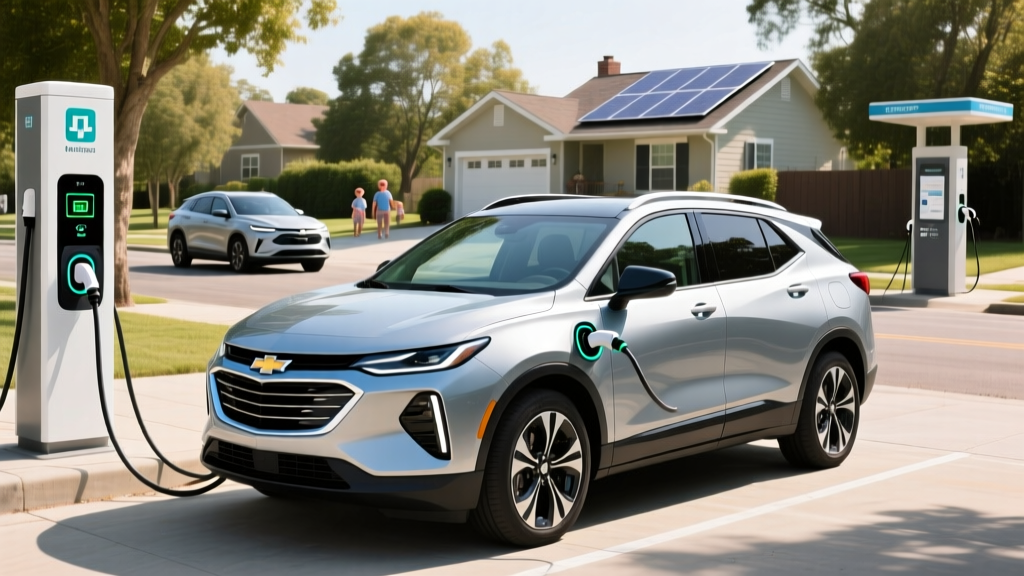
If you want a Chevrolet you can plug in, you're looking at a full battery-electric vehicle. For 2026, Chevrolet's BEV lineup has expanded significantly on the Ultium platform:
| Model | EPA Range | Battery (kWh usable) | Peak DC Fast Charge | 10–80% Time | HP | 0–60 mph | Base MSRP |
|---|---|---|---|---|---|---|---|
| Bolt EV/EUV (2026) | 255 mi | 65 kWh (NMC) | 115 kW (CCS) | ~35 min | 200 hp | 7.0 sec | $28,400 |
| Equinox EV | 319 mi (3RS FWD) | 85 kWh (NMC) | 150 kW | ~28 min | 213 hp (FWD) | 7.5 sec | $33,400 |
| Blazer EV | 324 mi (2LT AWD) | 102 kWh (NMC) | 190 kW | ~24 min | 288 hp (AWD) | 5.8 sec | $44,600 |
| Silverado EV | 400 mi (Extended Range) | 120 kWh (NMC) | 200 kW | ~30 min | 510 hp (AWD) | 4.5 sec | $55,000 |
Real-world range expectations: EPA range figures assume a mix of city and highway driving at moderate temperatures. On a 70-mph highway trip in 40°F weather, expect the Equinox EV to deliver roughly 250–270 miles before needing a charge. Cold weather reduces battery efficiency by 15–30% depending on severity, and highway speeds above 70 mph compound the loss. If your commute is mostly under 50 mph in mild climates, you may actually exceed EPA estimates.
The 2026 Bolt EV/EUV returns on the Ultium platform with significantly improved DC fast-charging capability over the previous generation's 55 kW limitation. At 115 kW peak, it's competitive for its price class, though still slower than the Equinox EV's 150 kW peak.
Tax Credits: Do Chevrolet Hybrids or EVs Qualify?
This is where the distinction between HEV, PHEV, and BEV matters enormously for your wallet.
2026 Federal Tax Credit Rules (IRS §30D):
- Conventional hybrids (HEVs): Do NOT qualify for any federal tax credit. The Silverado Hybrid, Tahoe Hybrid, and Colorado Hybrid are ineligible.
- Plug-in hybrids (PHEVs): Can qualify for up to $7,500 if they meet battery sourcing and critical mineral requirements — but Chevrolet doesn't sell a PHEV in 2026.
- Battery-electric vehicles (BEVs): May qualify for up to $7,500, transferable as a point-of-sale discount at the dealer.
For Chevrolet's 2026 BEVs, credit eligibility depends on several factors that change frequently. As of early 2026, the Equinox EV and Bolt EV/EUV have been eligible for the full $7,500 credit when purchased by buyers meeting income requirements (adjusted gross income ≤ $150,000 single / ≤ $300,000 joint). The credit can be transferred to the dealer at the point of sale, effectively reducing your purchase price by $7,500 on the spot.
However, battery component and critical mineral sourcing requirements under the IRS §30D rules have tightened each year. Always verify current eligibility on the IRS Clean Vehicle Credit page or with your tax professional before relying on the credit in your purchase decision.
§30D Credit Checklist for 2026 Chevy BEVs:
- Vehicle MSRP must be ≤ $55,000 (SUVs/pickups/vans) or ≤ $25,000 (sedans)
- Buyer AGI must not exceed $150K (single) / $225K (head of household) / $300K (joint)
- Battery components must meet North American manufacturing thresholds
- Critical minerals must meet US-sourced or FTA-partner thresholds
- Credit is transferable to dealer at point of sale (reduces purchase price directly)
- Vehicle must be new, purchased for personal use, and primarily used in the US
Battery Warranty and Long-Term Reliability
Battery longevity is the number-one concern for electrified vehicle buyers, and it applies differently to hybrids versus full EVs.
Chevrolet Hybrid (HEV) Battery Warranty: The mild-hybrid battery packs in the Silverado, Tahoe, and Suburban are relatively small (under 2 kWh) and serve an assist-only function. GM covers these under the standard powertrain warranty of 5 years / 60,000 miles. Because mild-hybrid batteries undergo shallow charge-discharge cycles, degradation is minimal, and replacement costs are far lower than a full EV battery — typically $1,500–$3,000 if needed out of warranty.
Chevrolet BEV Battery Warranty: All 2026 Ultium-based EVs carry a battery warranty of 8 years / 100,000 miles, covering defects and capacity loss below 70% of original capacity. This aligns with federal requirements and industry standards.
Battery Replacement Cost Reality (2026):
- Mild-hybrid (HEV) battery: $1,500–$3,000 (small pack, low stress)
- BEV Ultium battery (out of warranty): $12,000–$22,000 depending on pack size
- Real-world degradation data: Ultium NMC packs are showing approximately 8–12% capacity loss at 100,000 miles based on early fleet data — well within the 70% warranty threshold
For context, Toyota's full-hybrid systems (like in the RAV4 Hybrid) are covered for 10 years / 150,000 miles on the hybrid battery. Chevrolet's mild-hybrid coverage is shorter because the system is less complex and the battery plays a smaller role. If battery warranty length is a top priority, Toyota and Hyundai lead the hybrid segment.
Who Should Buy a Chevy Hybrid, EV, or Look Elsewhere?
Choosing between a conventional hybrid, a full EV, and a competitor's PHEV comes down to your driving habits, charging access, and budget.
Choose a Chevrolet HEV (Silverado/Tahoe Hybrid) If:
- You need a truck or large SUV and want 10–15% better fuel economy
- You have no access to home or workplace charging
- You tow frequently (hybrid trucks maintain full towing capacity)
- You want zero change to your fueling routine
Choose a Chevrolet BEV (Equinox EV, Bolt) If:
- You can install a Level 2 charger at home (240V)
- Your daily driving is under 200 miles round-trip
- You want maximum fuel savings and zero tailpipe emissions
- You qualify for the $7,500 federal tax credit, bringing the Equinox EV near $26,000 effective price
Look at a Competitor's PHEV (Toyota RAV4 Prime, Hyundai Tucson PHEV) If:
- You want 30–42 miles of electric-only range for daily commuting but need gas-engine flexibility for road trips
- You have Level 2 charging at home but limited public charging on your routes
- You want to reduce fuel consumption by 60–80% on weekdays while keeping 400+ miles of total range for weekends
- You're shopping for a compact or midsize crossover (a segment Chevy doesn't serve with a PHEV)
The Used Chevrolet Volt: Still a Viable PHEV Option?
If you're committed to the Chevrolet brand and want a plug-in hybrid, the used Chevrolet Volt (2016–2019) remains a compelling option on the secondary market. The second-generation Volt offers 53 miles of EPA electric-only range and a total combined range of approximately 420 miles.
Key specs for the 2019 Volt (final model year):
- Battery: 18.4 kWh (NMC), liquid-cooled
- Electric-only range: 53 miles (EPA)
- Combined MPG (gas mode): 42 MPG
- Combined HP: 149 hp
- Level 2 charge time: ~4.5 hours at 3.6 kW
- DC fast charging: Not available
- Used price range (2026): $14,000–$20,000 depending on mileage and condition
The Volt's battery has proven durable — many owners report minimal degradation even at 80,000+ miles thanks to GM's conservative buffer strategy (the car never uses the full battery capacity, preserving longevity). The NHTSA gave the Volt a 5-star overall safety rating. The main drawbacks are its compact size, discontinued status (no dealer support for unique body panels), and the lack of DC fast charging.
A used Volt may qualify for the §25E used clean vehicle credit of up to $4,000 (30% of sale price, capped at $4,000), subject to income limits and a sale price under $25,000. Check current IRS guidance on the used EV credit before purchasing.
Frequently Asked Questions
How many MPG does the Chevrolet Silverado Hybrid get?
The 2026 Silverado 1500 Hybrid with the 3.0L Duramax and eAssist returns an EPA-estimated 22 city / 26 highway / 24 combined MPG. Real-world highway driving at steady speeds can yield 27–28 MPG. This represents roughly a 2–3 MPG improvement over the non-hybrid diesel Silverado.
Does Chevrolet make a plug-in hybrid SUV?
No. As of 2026, Chevrolet does not offer any plug-in hybrid vehicle in the US market. If you need a PHEV SUV, competitors like the Toyota RAV4 Prime (42 mi electric range), Mitsubishi Outlander PHEV (38 mi), and Hyundai Tucson PHEV (33 mi) are the segment leaders.
How far can the Chevrolet Equinox EV go on a single charge?
The 2026 Equinox EV 3RS with front-wheel drive has an EPA-estimated range of 319 miles. In real-world highway driving at 70 mph, expect approximately 260–280 miles. In cold weather (below 32°F), range can drop to 220–250 miles. The AWD version carries a slightly lower EPA rating of approximately 285 miles.
Is the Chevrolet hybrid system reliable?
Chevrolet's mild-hybrid eAssist system is mechanically simple — it adds a small motor-generator to the existing powertrain for assist and stop-start functionality. There are no complex planetary gearsets or high-voltage systems as in full hybrids. Reliability has been strong, with few widespread complaints. The mild-hybrid battery is covered under the 5-year/60,000-mile powertrain warranty.
What does it cost to replace a Chevrolet EV battery?
Out of warranty, an Ultium battery replacement for the Equinox EV or Blazer EV is estimated at $12,000–$18,000 depending on pack size and labor. The Silverado EV's larger pack could cost $18,000–$22,000. However, real-world data suggests Ultium packs retain 88–92% capacity at 100,000 miles, making out-of-warranty replacement unlikely for most original owners.
Can I charge a Chevrolet hybrid at home?
Chevrolet's 2026 conventional hybrids (Silverado, Tahoe, Colorado) cannot be plugged in — they charge their small batteries internally through regenerative braking. Only Chevrolet's battery-electric models (Equinox EV, Bolt EV, Blazer EV, Silverado EV) can be charged at home via Level 1 (120V) or Level 2 (240V) equipment.
Which Chevrolet EV qualifies for the $7,500 tax credit?
Eligibility changes as battery sourcing rules tighten. As of early 2026, the Equinox EV and Bolt EV/EUV have qualified for the full $7,500 credit for eligible buyers. The Blazer EV and Silverado EV eligibility varies by trim and build date. Always verify current status on the IRS Clean Vehicle Credit page and confirm with your dealer before purchase.