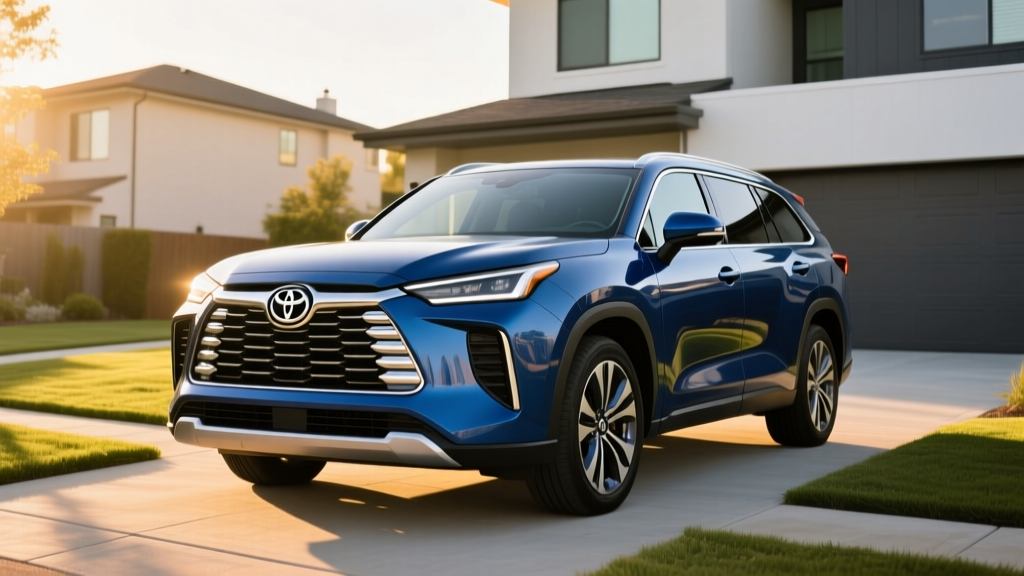
Three-row SUV buyers who want serious fuel savings without plugging in keep landing on the same shortlist, and the Toyota Grand Highlander Hybrid sits near the top. It pairs Toyota's proven hybrid synergy drive with a cabin large enough for adults in all three rows — a combination that matters when you're hauling a family across town or across the country. But with two distinct hybrid powertrains available and a plug-in sibling in the mix, understanding the Grand Highlander Hybrid hp output, efficiency, and real-world behavior is essential before you sign any paperwork.
This guide breaks down every number that matters: horsepower, EPA fuel economy, battery warranty, pricing, and how the Grand Highlander Hybrid stacks up against plug-in hybrids and full battery-electric alternatives for family duty.
Grand Highlander Hybrid Powertrain: Two Systems, Two Very Different HP Figures
Toyota offers the Grand Highlander Hybrid in two distinct powertrain configurations for the 2026 model year, and the horsepower gap between them is significant.
Hybrid MAX (Turbo Hybrid): This performance-oriented system pairs a 2.4-liter turbocharged four-cylinder engine with electric motors for a combined output of 362 horsepower and 400 lb-ft of torque. It uses a traditional six-speed automatic transmission rather than the eCVT found in the standard hybrid, delivering more linear acceleration and a 0–60 mph time in the low six-second range. Hybrid MAX is available exclusively on Limited and Platinum trims and comes standard with all-wheel drive.
Standard Hybrid (2.5L): The volume powertrain uses a 2.5-liter naturally aspirated four-cylinder paired with Toyota's fourth-generation hybrid system. Combined output is 245 horsepower (186 hp from the engine, supplemented by electric motors). It routes power through an electronically controlled continuously variable transmission (eCVT). Front-wheel drive is standard, with electronic on-demand AWD available.
| Specification | Standard Hybrid (2.5L) | Hybrid MAX (2.4T) |
|---|---|---|
| Engine | 2.5L inline-4, naturally aspirated | 2.4L inline-4, turbocharged |
| Combined Horsepower | 245 hp | 362 hp |
| Combined Torque | 176 lb-ft (engine) | 400 lb-ft |
| Transmission | eCVT | 6-speed automatic |
| Drivetrain | FWD or AWD | AWD standard |
| 0–60 mph (est.) | ~7.8 seconds | ~6.3 seconds |
| Towing Capacity | 3,500 lbs | 5,000 lbs |
The Hybrid MAX system's 362 hp figure is what most shoppers search for when looking up "Grand Highlander Hybrid hp," but the standard 245 hp system is the one that delivers the best fuel economy — and it's the one most buyers actually take home.
Fuel Economy: EPA Ratings and Real-World MPG
The Grand Highlander Hybrid's efficiency advantage over its gas-only competitors is the headline story here. According to fueleconomy.gov, the EPA rates the two powertrains quite differently:
| Powertrain | City MPG | Highway MPG | Combined MPG |
|---|---|---|---|
| Standard Hybrid (FWD) | 37 | 34 | 36 |
| Standard Hybrid (AWD) | 36 | 32 | 34 |
| Hybrid MAX (AWD) | 27 | 28 | 27 |
Real-World MPG vs. EPA Sticker
Toyota's hybrid systems historically perform at or slightly above EPA city estimates in stop-and-go driving because regenerative braking recaptures energy that a conventional powertrain wastes as heat. In mixed suburban driving, owners of the standard 2.5L hybrid commonly report 34–38 MPG combined, which tracks closely with the EPA figure.
Highway driving tells a different story. At sustained 75–80 mph speeds, expect the standard hybrid to deliver closer to 30–32 MPG — the aerodynamic drag of a large three-row SUV works against the hybrid system's city-biased strengths. The Hybrid MAX, with its turbo engine and conventional transmission, behaves more like a traditional gas vehicle and typically achieves 24–26 MPG in real-world mixed driving, somewhat below its EPA combined rating.
For context, the gas-only Grand Highlander (2.4T non-hybrid) earns just 24 MPG combined, making the standard hybrid's 36 MPG combined a 50% improvement in fuel efficiency — meaningful savings over 5+ years of ownership.
HEV vs. PHEV vs. EV: Which Grand Highlander Fits Your Life?
Toyota does not currently offer a plug-in hybrid (PHEV) version of the Grand Highlander in the U.S. market. The Highlander PHEV (sold in some global markets as the Kluger PHEV) remains unavailable stateside as of 2026. This means U.S. buyers choose between the conventional hybrid (HEV) and the gas-only model — or look outside the Toyota lineup for a plug-in three-row option.
| Factor | Grand Highlander Hybrid (HEV) | Typical 3-Row PHEV | Typical 3-Row BEV (e.g., Kia EV9) |
|---|---|---|---|
| Needs Plugging In? | No | Yes (for EV range) | Yes |
| Electric-Only Range | N/A (motor assists engine) | 30–40 miles | 250–300+ miles |
| Total Range | ~600+ miles | ~450–550 miles | 250–300 miles |
| Fueling/Charging Time | 5 min at gas station | 2–4 hrs (L2) / 5 min (gas) | 20–40 min (DC fast) |
| Home Charging Needed? | No | Recommended | Essential |
| Federal Tax Credit | Not eligible (§30D) | Up to $7,500 (if eligible) | Up to $7,500 (if eligible) |
| Best For | No-plug convenience, long trips | Short electric commutes + road trips | Home charging access, max savings |
Who Should Choose the Grand Highlander Hybrid?
The Grand Highlander Hybrid is the right call if you:
- Don't have access to home or workplace charging (apartment dwellers, street parkers)
- Take frequent road trips exceeding 300 miles where charging infrastructure is sparse
- Want the fuel savings of electrification without any behavioral changes
- Need three usable rows and cargo space for family duty
- Prefer Toyota's long-standing hybrid reliability track record
Look at a PHEV (like the Jeep Grand Cherokee 4xe or Mazda CX-90 PHEV) or a full BEV (like the Kia EV9 or Tesla Model X) if you have reliable Level 2 home charging and want to drive on electricity for daily commuting.
Pricing, Trims, and Tax Credit Eligibility
The 2026 Grand Highlander Hybrid lineup spans from the XLE to the Platinum trim, with Hybrid MAX reserved for the upper tiers.
| Trim | Powertrain | Starting MSRP (est.) |
|---|---|---|
| XLE (FWD) | Standard Hybrid 2.5L | $46,120 |
| XLE (AWD) | Standard Hybrid 2.5L | $47,720 |
| Limited (AWD) | Standard Hybrid 2.5L | $51,680 |
| Limited (AWD) | Hybrid MAX 2.4T | $55,070 |
| Platinum (AWD) | Hybrid MAX 2.4T | $59,150 |
Federal Tax Credit: Does the Grand Highlander Hybrid Qualify?
No. The Grand Highlander Hybrid is a conventional hybrid (HEV), not a plug-in electric vehicle. Under IRS §30D rules, the federal clean vehicle credit applies only to plug-in electric vehicles (PHEVs and BEVs) with battery capacities of at least 7 kWh. Conventional hybrids like the Grand Highlander Hybrid do not qualify for the $7,500 federal tax credit or the point-of-sale transfer option.
However, some states offer their own incentives for hybrid vehicles. Check your state's energy or environmental agency for current programs. Additionally, the fuel savings alone — roughly $700–$1,000 per year compared to the gas-only Grand Highlander at 15,000 miles driven annually — partially offset the hybrid's higher sticker price over time.
Battery Warranty, Reliability, and Replacement Costs
Hybrid battery longevity remains the top concern for first-time hybrid buyers. Toyota addresses this directly with one of the strongest hybrid battery warranties in the industry.
Toyota Hybrid Battery Warranty
Coverage: 10 years / 150,000 miles (whichever comes first)
What's covered: Hybrid battery pack, hybrid control module, and related hybrid system components
Capacity threshold: Toyota warrants the battery against defects and abnormal degradation. Unlike BEV warranties, there is no published minimum capacity retention percentage — coverage applies if the battery fails to function properly.
Transferability: Warranty transfers to subsequent owners, supporting resale value
Real-World Reliability Data
Toyota's hybrid systems have accumulated over two decades of real-world data since the original Prius launched. The hybrid battery in the Grand Highlander uses a nickel-metal hydride (NiMH) pack for the standard 2.5L hybrid system — a chemistry Toyota has refined across millions of vehicles. NiMH packs are less energy-dense than lithium-ion but are exceptionally durable and thermally stable.
Based on long-term data from the Highlander Hybrid and Camry Hybrid platforms:
- Most Toyota hybrid batteries last 150,000–200,000+ miles before needing replacement
- Failure within the warranty period is uncommon but covered
- Out-of-warranty replacement cost: $3,000–$5,000 for a new OEM battery pack, with refurbished options available for $1,500–$2,500
- Individual module replacement (rather than the full pack) can reduce costs further at independent hybrid specialists
The Hybrid MAX system uses a smaller lithium-ion battery pack, which operates differently — it's designed for higher power discharge to support the turbo engine's acceleration demands rather than extended electric-only driving. Toyota's 10-year/150,000-mile hybrid warranty covers this pack as well.
According to NHTSA recall data and reliability surveys, the Grand Highlander Hybrid's powertrain has not been subject to major battery-related recalls, and Toyota's hybrid system remains among the most proven in the industry.
Driving Dynamics: What 245 hp vs. 362 hp Actually Feels Like
Horsepower numbers tell only part of the story. The driving experience differs substantially between the two Grand Highlander Hybrid powertrains.
Standard Hybrid (245 hp): Around town, the electric motor's instant torque fills in the gaps where the 2.5L engine would otherwise feel sluggish. Merging onto highways is confident if unhurried. The eCVT keeps the engine in its most efficient RPM range, which means acceleration is smooth but never urgent. This powertrain rewards relaxed driving — push it hard and the engine drones at high RPM without a proportional increase in thrust. For daily commuting, school runs, and grocery trips, 245 hp is more than adequate for a vehicle in this class.
Hybrid MAX (362 hp): The turbo engine and conventional transmission transform the Grand Highlander's character. The 400 lb-ft of torque arrives low in the rev range, and the six-speed automatic delivers satisfying, predictable shifts. Overtaking on two-lane highways and merging at speed feel effortless. The trade-off is fuel economy — you're giving up roughly 9 MPG combined for this performance advantage. If you tow boats or trailers frequently, the Hybrid MAX's 5,000-lb towing capacity (vs. 3,500 lbs for the standard hybrid) may justify the fuel penalty.
Ownership Costs: 5-Year Outlook
Let's put the Grand Highlander Hybrid's fuel savings into concrete terms. Assuming 15,000 miles per year and $3.50/gallon regular fuel:
| Vehicle | Combined MPG | Annual Fuel Cost | 5-Year Fuel Cost |
|---|---|---|---|
| Grand Highlander Hybrid (FWD) | 36 | $1,458 | $7,292 |
| Grand Highlander Hybrid MAX (AWD) | 27 | $1,944 | $9,722 |
| Grand Highlander Gas (2.4T AWD) | 24 | $2,188 | $10,938 |
The standard hybrid saves roughly $3,646 in fuel costs over five years compared to the gas-only model — enough to offset most of the hybrid's price premium. The Hybrid MAX costs more to fuel but delivers substantially more performance and 1,500 lbs of additional towing capacity.
Insurance premiums for the Grand Highlander Hybrid run comparable to other midsize three-row SUVs. Check with your insurer for specific quotes, as hybrid surcharges have largely disappeared as the technology has become mainstream.
Pros and Cons at a Glance
Pros
- 36 MPG combined (standard hybrid) — best in the three-row SUV class
- True adult-capable third row with usable cargo space behind it
- No plug-in required — zero behavioral change from a gas vehicle
- 10-year / 150,000-mile hybrid battery warranty
- Hybrid MAX offers 362 hp and 5,000-lb towing for performance-oriented buyers
- Toyota's proven hybrid reliability and strong resale value
Cons
- No PHEV option available in the U.S. market
- Not eligible for the $7,500 federal §30D tax credit
- Standard hybrid can feel underpowered during aggressive highway merging
- Hybrid MAX fuel economy drops to 27 MPG combined — modest improvement over gas-only
- Higher starting price than non-hybrid competitors (Kia Telluride, Hyundai Palisade)
- Infotainment system lag reported by some owners
Frequently Asked Questions
How many MPG does the Grand Highlander Hybrid get?
The EPA rates the standard 2.5L hybrid at 37 city / 34 highway / 36 combined MPG (FWD). The Hybrid MAX achieves 27 city / 28 highway / 27 combined MPG. Real-world results for the standard hybrid typically fall between 33–38 MPG combined depending on driving style and conditions.
How much horsepower does the Grand Highlander Hybrid have?
The standard 2.5L hybrid produces 245 combined horsepower. The Hybrid MAX turbo hybrid produces 362 combined horsepower. Most buyers opt for the standard hybrid for its superior fuel economy, while the Hybrid MAX targets those prioritizing performance and towing.
Does the Grand Highlander Hybrid need to be plugged in?
No. The Grand Highlander Hybrid is a conventional hybrid (HEV). It charges its battery through regenerative braking and the gasoline engine. You never plug it in — you simply fill it with gas like any other vehicle.
Is the Grand Highlander Hybrid reliable?
Toyota's hybrid system is among the most proven in the automotive industry, with over 20 years of real-world deployment across millions of vehicles. The hybrid battery is covered by a 10-year / 150,000-mile warranty, and most packs last well beyond that mileage threshold.
What does it cost to replace the Grand Highlander Hybrid battery?
An OEM replacement hybrid battery costs approximately $3,000–$5,000 out of warranty. Refurbished packs and individual module replacements can reduce this to $1,500–$2,500 at qualified hybrid service centers. Given the 10-year warranty and typical battery lifespan of 150,000+ miles, most owners never face this expense.
Does the Grand Highlander Hybrid qualify for a tax credit?
The Grand Highlander Hybrid does not qualify for the federal §30D clean vehicle tax credit because it is a conventional hybrid, not a plug-in vehicle. The credit applies only to PHEVs and BEVs meeting battery sourcing, MSRP, and buyer income requirements. Some states may offer separate hybrid incentives — check your state's energy agency.
Is there a plug-in hybrid (PHEV) Grand Highlander?
As of the 2026 model year, Toyota does not offer a plug-in hybrid Grand Highlander in the United States. A Highlander PHEV exists in some international markets but has not been confirmed for U.S. sale. Buyers wanting a plug-in three-row SUV should consider alternatives like the Mazda CX-90 PHEV or the Kia EV9 (fully electric).
How does the Grand Highlander Hybrid compare to a full EV like the Kia EV9?
The Grand Highlander Hybrid offers 600+ miles of total range and 5-minute refueling, making it ideal for road trips and buyers without home charging access. A BEV like the Kia EV9 offers lower per-mile energy costs (roughly $0.04–$0.06/mile vs. $0.10–$0.13/mile for the hybrid), qualifies for the $7,500 federal tax credit, and produces zero tailpipe emissions — but requires reliable home or workplace charging and involves longer stops on road trips.