Quick Verdict: The 2026 Prius Prime Is a Bridge That Works
Toyota's 2026 Prius Plug-In Hybrid — marketed as the Prius Prime — occupies a rare sweet spot: 44 miles of electric-only driving for daily commutes, then a proven hybrid powertrain for road trips with zero range anxiety. Starting around $33,775, it undercuts most plug-in hybrids on price while delivering best-in-class electric range for its segment. For buyers who want EV-like daily driving but aren't ready to commit to a full battery-electric vehicle, the 2026 Prime remains the benchmark.
| Spec | Value |
|---|---|
| Electric-Only Range (EPA) | 44 miles |
| Combined Range (Electric + Gas) | ~480 miles |
| Battery Capacity (Usable) | 13.6 kWh (lithium-ion) |
| Combined Horsepower | 220 hp |
| MPG (Charge-Sustaining Hybrid Mode) | 48 city / 47 highway / 48 combined |
| MPGe (Charge-Depleting EV Mode) | 127 MPGe combined |
| Level 2 Charge Time (0–100%) | ~4 hours (3.3 kW onboard charger) |
| DC Fast Charging | Not available |
| 0–60 mph | 6.6 seconds |
| Base MSRP (SE trim) | $33,775 |
| Battery Warranty | 10 years / 150,000 miles |
HEV vs. PHEV: What's the Actual Difference?
Toyota sells two flavors of Prius for 2026, and buyers frequently confuse them. Here's the functional distinction:
| Feature | Prius (HEV) | Prius Prime (PHEV) |
|---|---|---|
| Plug-in Charging | No — charges via regenerative braking and engine | Yes — plug in for 44 mi electric range |
| Battery Size | ~1.0 kWh | 13.6 kWh usable |
| Electric-Only Driving | Brief low-speed assists only | Up to 44 miles at highway speeds |
| Combined MPG (Hybrid Mode) | 57 combined (LE) | 48 combined |
| Combined Horsepower | 194 hp (AWD) | 220 hp (FWD) |
| Base MSRP | $28,550 | $33,775 |
| Federal Tax Credit Eligibility | None | Potentially up to $3,750* |
The conventional Prius HEV never plugs in. It recovers energy through regenerative braking and its gasoline engine, delivering outstanding 57 MPG combined without any behavioral change. The Prius Prime (PHEV) adds a much larger 13.6 kWh battery and a more powerful electric motor, enabling genuine electric-only commuting. You plug it in at home or at a public Level 2 charger. When the battery depletes, it seamlessly transitions to hybrid mode — no range anxiety, no charging-desert worry.
*Tax credit caveat: The IRS §30D Clean Vehicle Credit rules for 2026 include battery critical-mineral sourcing requirements, buyer income caps ($150K single / $300K joint), and an MSRP cap of $55,000 for sedans. The Prius Prime qualifies on MSRP, but your actual credit depends on your tax liability and current sourcing compliance. Consult a tax professional before relying on a specific credit amount.
Electric-Only Range: The 44-Mile Commute Envelope
Real-World Expectation: 36–42 miles at highway speeds (65–75 mph); 40–46 miles in mixed city driving with moderate regen use. In cold weather (below 30°F), expect 28–35 miles due to cabin heating demands and reduced battery efficiency.
The 44-mile EPA rating is competitive — it covers the average American one-way commute (fueleconomy.gov data shows the median daily round trip is under 40 miles). In practice, the Prime's electric range shines in city and suburban driving where regenerative braking recaptures energy at every stoplight. Highway driving at sustained 70+ mph depletes the battery faster, as does running the HVAC system at full blast in extreme heat or cold.
The Prime uses a 13.6 kWh lithium-ion pack (NMC chemistry) with a usable buffer that protects long-term health. Toyota's thermal management is passive-to-mild — there's no aggressive liquid cooling like you'd find in a Tesla or Hyundai Ioniq, but the relatively small pack size and modest charge rates mean thermal stress stays low. The onboard charger maxes out at 3.3 kW on Level 2 AC, meaning a full 0–100% charge takes roughly 4 hours. There is no DC fast-charging capability — this is a home-and-destination charging vehicle by design.
Fuel Economy: EPA Numbers vs. Real-World Results
| Mode | City | Highway | Combined |
|---|---|---|---|
| Charge-Depleting (EV Mode) | 127 MPGe combined | ||
| Charge-Sustaining (Hybrid Mode) | 48 MPG | 47 MPG | 48 MPG |
When the battery is depleted and the Prime operates as a conventional hybrid, it returns 48 MPG combined — impressive for a 220-hp vehicle, though about 9 MPG short of the standard Prius HEV's 57 combined. That trade-off is the cost of carrying a 13.6 kWh battery pack that adds roughly 200 lbs over the HEV.
Real-world hybrid-mode MPG: Owners consistently report matching or slightly exceeding EPA city figures (48–52 MPG in stop-and-go traffic where regen thrives) but falling 2–4 MPG short on sustained highway runs (43–46 MPG at 75 mph). This is typical hybrid behavior — electric motor assist dominates in city driving, while the gasoline engine carries more load at highway speeds.
If you charge nightly and commute under 40 miles round-trip, you may use gasoline only on weekend road trips. Toyota's EV mode allows speeds up to approximately 84 mph on electric power alone, so highway merging and cruising are fully supported without the engine kicking in — provided you don't floor the accelerator.
Powertrain and Performance: 220 HP Changes the Story
The 2026 Prius Prime pairs a 2.0-liter four-cylinder Atkinson-cycle engine (150 hp) with a front-mounted electric motor (161 hp) for a combined system output of 220 horsepower. That's a substantial upgrade from the previous-generation Prime's 121 hp, and it transforms the driving character from "apologetically slow" to genuinely capable.
The 0–60 mph time of 6.6 seconds puts the Prime in the same territory as a Honda Accord Hybrid or Volkswagen GTI. Highway passing is confident. The CVT-like e-CVT power-split device still drones under hard acceleration, but the overall refinement is a generation ahead. Front-wheel drive is standard; all-wheel drive is not available on the Prime (it is on the standard Prius HEV).
Regenerative braking offers multiple levels of aggression, selectable through the shift lever's B-mode and through the multimedia settings. It's not quite one-pedal driving in the BEV sense — the Prime will creep at low speeds rather than coming to a full stop — but it recovers meaningful energy in city traffic and reduces brake wear significantly.
Pricing, Trims, and Tax Credit Eligibility
The 2026 Prius Prime is offered in three trims:
- SE: $33,775 — 17-inch alloy wheels, Toyota Safety Sense 3.0, 8-inch touchscreen, heated front seats, 44-mile electric range
- XSE: $36,775 — 19-inch wheels, 12.3-inch touchscreen, synthetic leather upholstery, wireless phone charging, power liftgate
- XSE Premium: $40,175 — Fixed glass roof, premium JBL audio (8 speakers), heated and ventilated front seats, digital rearview mirror, advanced park assist
All trims fall well under the IRS §30D MSRP cap of $55,000 for sedans. However, the full $7,500 credit is not guaranteed. The credit is split into two halves — $3,750 for critical-minerals sourcing and $3,750 for battery-component manufacturing — and compliance thresholds tighten annually. For 2026, check the latest IRS guidance on whether the Prime's battery sourcing qualifies for one or both halves. The credit is non-refundable but can be transferred to the dealer as a point-of-sale rebate under current rules.
- ✅ MSRP under $55,000 sedan cap (all trims qualify)
- ✅ Vehicle assembled in final assembly in North America (verify VIN on fueleconomy.gov)
- ⚠️ Buyer AGI under $150K (single) / $225K (head of household) / $300K (joint)
- ⚠️ Critical minerals and battery component sourcing — amounts vary by model year; confirm with dealer or IRS
- ✅ Credit can be applied at point of sale as a down-payment reduction
Reliability and Battery Warranty: What History Tells Us
Toyota's hybrid track record is among the strongest in the industry. The Prius lineage stretches back to 1997 globally and 2000 in the US, with millions of units on the road. The current-generation 13.6 kWh pack is a lithium-ion NMC design — a step up from the nickel-metal hydride packs in early Prius models in both energy density and longevity.
Real-world degradation data: Based on fleet and owner-reported data from the 2023–2025 Prius Prime generation (which shares this battery architecture), most owners see 5–8% capacity loss over the first 5 years / 60,000 miles. This translates to roughly 2–3 miles of electric range reduction — noticeable but not debilitating. Toyota's 70% capacity retention warranty threshold means you're covered if the pack drops below ~31 miles of range within the warranty window.
Battery replacement cost: Out of warranty, a Prius Prime traction battery replacement runs approximately $3,500–$5,500 including labor at a Toyota dealer. Third-party refurbishment shops offer reconditioned packs for $2,000–$3,000. However, given Toyota's hybrid reliability history, most owners will sell or trade the vehicle long before a replacement becomes necessary.
The conventional 12V auxiliary battery (a standard lead-acid or AGM unit that runs accessories and computers) may need replacement every 4–6 years at $150–$250, same as any other vehicle.
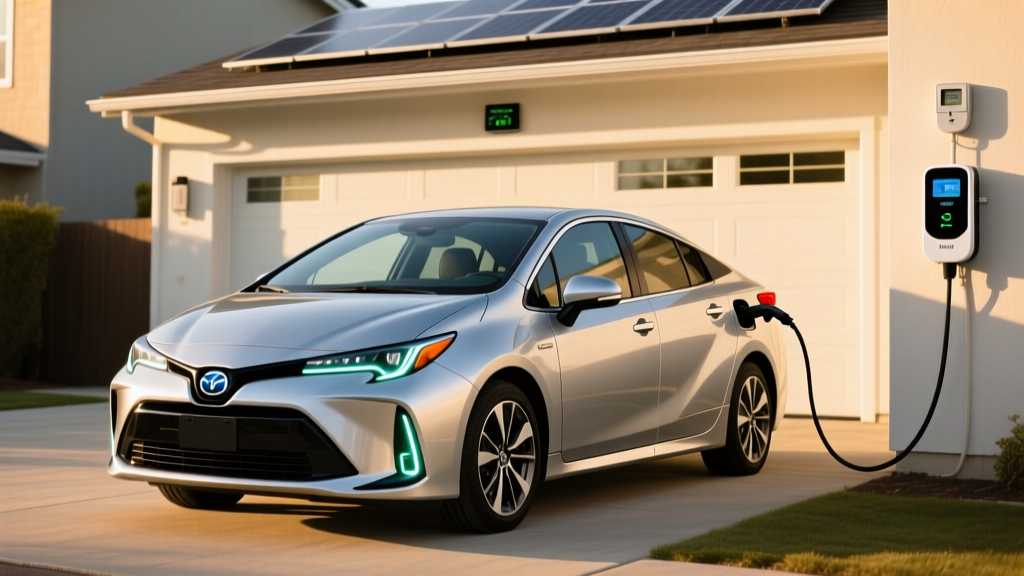
Charging at Home: What You Need
The Prius Prime's 3.3 kW onboard charger means charging is straightforward and doesn't require expensive electrical upgrades:
| Level | Power | 0–100% Time | Infrastructure Needed |
|---|---|---|---|
| Level 1 (120V outlet) | ~1.2 kW | ~11 hours | Standard household outlet; no install |
| Level 2 (240V) | 3.3 kW (car-limited) | ~4 hours | 240V outlet or wall charger; 15–20A circuit sufficient |
| DC Fast Charge | N/A | N/A | Not supported |
Because the Prime's onboard charger caps at 3.3 kW, there's no benefit to installing a 48-amp Level 2 charger. A basic 16-amp, 240V circuit with a NEMA 6-20 outlet (typically $200–$500 for an electrician to install if the panel has capacity) will max out the car's charging capability. Many owners find Level 1 charging from a standard 120V garage outlet sufficient — an overnight plug yields roughly 12–14 miles of range, which covers short commutes.
The J1772 connector is standard. No NACS (Tesla) adapter is needed for the Prime since it doesn't support DC fast charging, though a J1772-to-NACS adapter would allow use of Tesla's Level 2 Destination Chargers if desired.
Who Should Choose the Prius Prime vs. a Full EV or Gas Car?
- Your daily round-trip commute is under 44 miles and you can charge at home overnight
- You take road trips of 200+ miles several times a year and don't want to plan around charging stations
- You live in an apartment or area with limited public charging infrastructure
- You want to reduce gasoline consumption by 60–80% without fully eliminating the gas tank
- You cannot charge at home or work (no garage, no outlet access)
- Your commute is long (50+ miles one way) and you'd rarely use the electric range anyway
- You want the absolute lowest fuel cost without any plug-in behavior change ($5,200 less upfront vs. Prime SE)
- You have reliable home Level 2 charging and your daily driving is under 250 miles
- You want to eliminate gasoline purchases entirely and minimize maintenance (no oil changes, no spark plugs)
- You want access to DC fast charging for road trips (10–80% in 18–25 minutes on modern BEVs)
Pros and Cons
- Class-leading 44-mile electric range covers most commutes
- 220 hp is genuinely quick for a Prius (6.6s 0–60)
- 48 MPG hybrid mode eliminates range anxiety on road trips
- Low Level 2 charging infrastructure cost (3.3 kW needs only a 20A circuit)
- Toyota's proven 10-year/150K hybrid battery warranty
- Under $55K MSRP cap on all trims — tax credit eligible
- Toyota Safety Sense 3.0 standard (adaptive cruise, lane centering, auto emergency braking)
- No DC fast charging — public charging limited to Level 2
- 3.3 kW onboard charger is slow compared to BEVs (4 hours vs. 30 min for many EVs)
- FWD only — no AWD option (standard Prius HEV offers AWD)
- Rear seat and cargo space slightly reduced vs. standard Prius due to larger battery
- 9 MPG penalty in hybrid mode vs. standard Prius HEV (48 vs. 57)
- Cabin materials in SE trim are basic; premium feel requires XSE Premium
Frequently Asked Questions
How many MPG does the 2026 Prius Prime get?
In hybrid mode (after the battery is depleted), the EPA rates it at 48 city / 47 highway / 48 combined. In electric mode, it achieves 127 MPGe combined. Real-world city driving often yields 48–52 MPG in hybrid mode, while sustained highway driving drops to 43–46 MPG.
How far can the Prius Prime go on electric only?
The EPA rates it at 44 miles on a full charge. Expect 36–42 miles in real-world highway driving, and as low as 28–35 miles in sub-freezing temperatures due to cabin heating demands. This is sufficient for the majority of American daily commutes.
Does the 2026 Prius Prime qualify for a federal tax credit?
It may qualify for up to $3,750 under IRS §30D, depending on battery critical-mineral and component sourcing requirements for the 2026 model year. All trims meet the $55,000 MSRP cap. Buyer income limits apply ($150K single / $300K joint). The credit can be transferred to the dealer as a point-of-sale rebate. Always verify current eligibility on irs.gov or with a tax professional.
Is the Prius Prime reliable, and what does battery replacement cost?
Toyota's hybrid powertrains have decades of proven reliability. The lithium-ion traction battery carries a 10-year / 150,000-mile warranty against capacity loss below 70%. Out-of-warranty replacement costs approximately $3,500–$5,500 at a dealer, though third-party options exist for $2,000–$3,000. Most owners sell before replacement is needed.
Can I charge the Prius Prime on a regular household outlet?
Yes. Level 1 charging from a standard 120V outlet adds roughly 4 miles of electric range per hour, or about 12–14 miles overnight (8–10 hours). For the full 44-mile range, a 240V Level 2 outlet is recommended — but because the car's onboard charger caps at 3.3 kW, a simple 240V/20A NEMA 6-20 outlet is sufficient and typically costs $200–$500 to install.
Hybrid vs. PHEV vs. EV — which should I choose?
If you can charge at home and your commute is under 44 miles, the PHEV gives you EV-like daily driving with gas-powered road trip freedom. If you can't charge at home, the conventional HEV (standard Prius) delivers 57 MPG without any plug-in hassle. If you have home charging and rarely drive over 250 miles in a day, a full BEV eliminates gasoline entirely and offers lower running costs — at a higher upfront price and with road-trip charging planning.