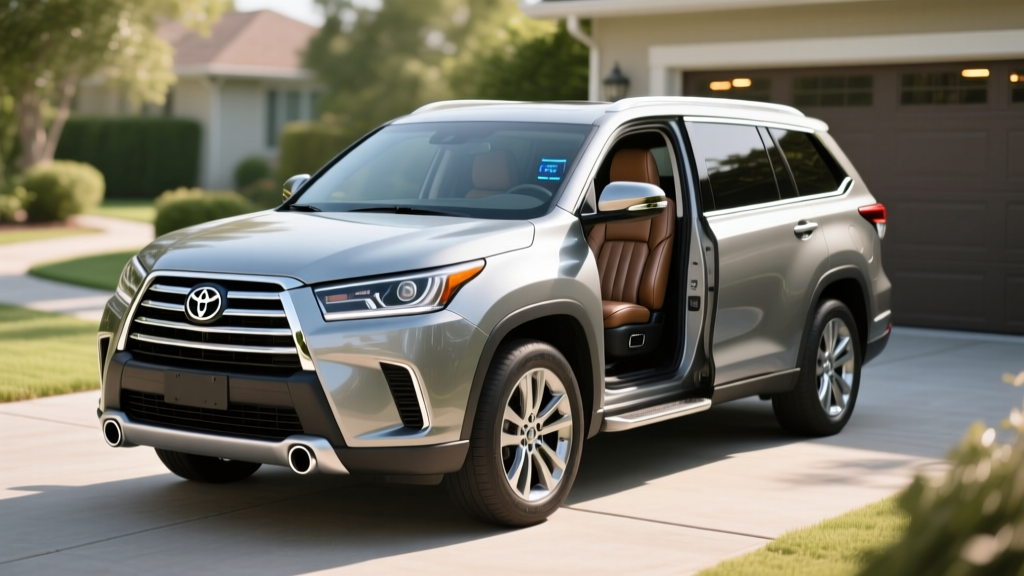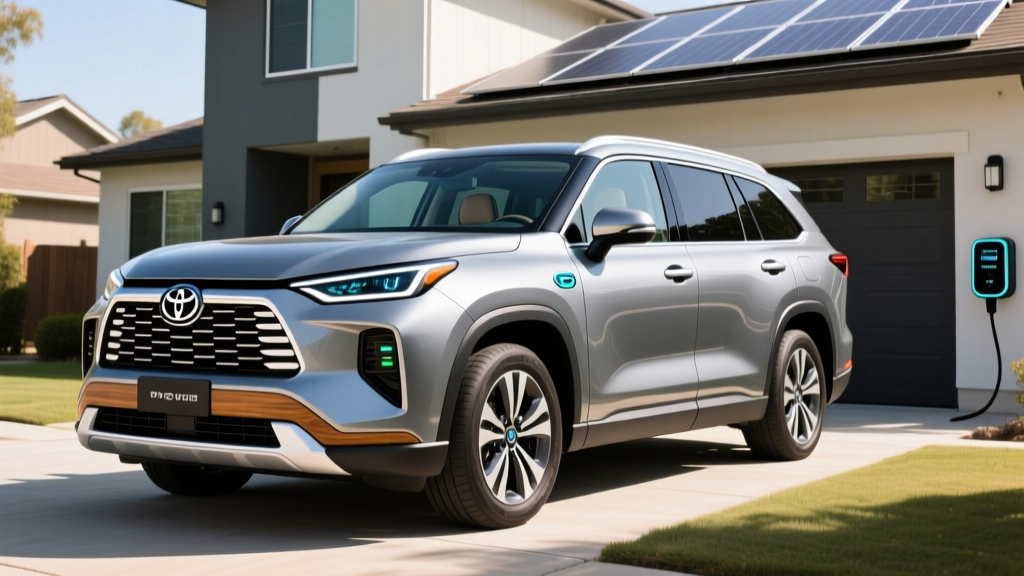
The Toyota Grand Highlander Hybrid fills a narrow but critical gap: a three-row family hauler that delivers genuine three-adult-row seating without the fuel penalty of a body-on-frame SUV. For 2026, Toyota offers this hybrid in two distinct powertrain flavors — a standard hybrid (HEV) and a Hybrid MAX performance variant — and neither requires you to plug in. This guide breaks down the real-world efficiency, powertrain specs, ownership costs, and battery longevity data you need before signing the paperwork.
HEV vs PHEV: What the Grand Highlander Hybrid Actually Is
Before examining specs, it's essential to clarify what you're buying. The Grand Highlander Hybrid is a conventional hybrid (HEV), not a plug-in hybrid (PHEV). That distinction matters enormously for daily ownership.
Conventional Hybrid (HEV) — Grand Highlander Hybrid
- No plug required. The battery recharges through regenerative braking and the gasoline engine.
- No electric-only driving range beyond low-speed, short-distance creep (under 1 mile at parking-lot speeds).
- No federal §30D tax credit eligibility — the IRS credit applies only to plug-in vehicles with sufficient battery capacity.
- Lower upfront cost and no home charging installation needed.
Plug-In Hybrid (PHEV) — Not Available for Grand Highlander
- Would offer 25-40 miles of electric-only range on a full charge.
- Requires Level 1 or Level 2 plug-in charging to realize efficiency benefits.
- May qualify for up to $7,500 federal tax credit (subject to MSRP caps, income limits, and battery sourcing rules under IRS §30D).
- Toyota currently offers the RAV4 Prime as its PHEV SUV, but no Grand Highlander PHEV exists for 2026.
If you were hoping to plug in the Grand Highlander and drive 30 electric miles to school drop-off, this isn't that vehicle. What it is: a self-charging hybrid that squeezes 34-36 MPG combined from a large three-row SUV without any behavioral change from a gas-car owner.
Fuel Economy: EPA Ratings vs Real-World MPG
Toyota offers the standard Grand Highlander Hybrid with front-wheel drive (FWD) or electronic on-demand all-wheel drive (AWD). The Hybrid MAX is AWD only. Here's how the EPA rates each configuration, per fueleconomy.gov:
| Powertrain | Drivetrain | City MPG | Highway MPG | Combined MPG |
|---|---|---|---|---|
| 2.5L 4-Cyl Hybrid | FWD | 37 | 34 | 36 |
| 2.5L 4-Cyl Hybrid | AWD | 36 | 32 | 34 |
| Hybrid MAX (2.4L Turbo) | AWD | 27 | 28 | 27 |
Real-World MPG: What Owners Actually See
Toyota hybrids historically meet or slightly exceed their EPA city ratings because regenerative braking recaptures energy in stop-and-go traffic where gas-only vehicles waste the most fuel. In real-world ownership:
- City and suburban driving: Expect 35-38 MPG from the FWD hybrid. Short trips with frequent stops maximize regen recovery.
- Highway cruising at 70-75 mph: Expect 30-33 MPG from the AWD hybrid. Hybrids lose their city advantage at sustained highway speeds, where the gas engine does most of the work.
- Cold weather (below 30°F): Expect a 10-15% drop, bringing the AWD hybrid down to roughly 29-31 MPG combined. The engine runs more frequently to provide cabin heat and maintain battery temperature.
- Hybrid MAX: This is a performance-tuned variant. Real-world mixed driving typically yields 24-26 MPG. If fuel economy is your priority, the standard hybrid is the clear choice.
For a family driving 15,000 miles per year, the difference between the AWD hybrid (34 MPG) and a comparable gas-only three-row SUV (22-24 MPG combined) saves roughly 200-250 gallons of fuel annually — approximately $600-$800 per year at $3.20/gallon.
Powertrain Specs: Horsepower, Engine, and Motors
| Specification | Standard Hybrid | Hybrid MAX |
|---|---|---|
| Engine | 2.5L inline-4 | 2.4L turbocharged inline-4 |
| Combined Horsepower | 245 hp | 362 hp |
| Combined Torque | 173 lb-ft (engine) + motor torque | 400 lb-ft |
| Electric Motors | 2 (FWD) / 3 (AWD, rear motor) | 2 (front + rear) |
| Transmission | eCVT (planetary gearset) | 6-speed automatic |
| 0-60 mph (est.) | ~7.8 sec | ~5.6 sec |
| Towing Capacity | 3,500 lbs | 5,000 lbs |
| Drivetrain | FWD or AWD | AWD only |
The standard hybrid uses Toyota's proven planetary-gearset eCVT — not a belt-and-cone CVT — which means there's no rubber-band effect under acceleration. The electric motors fill the torque gap at low RPM before the 2.5L engine reaches its power band, resulting in smooth, linear acceleration from stops.
The Hybrid MAX is a fundamentally different beast. The turbocharged 2.4L paired with a traditional 6-speed automatic delivers 362 horsepower and a sub-6-second 0-60 time. It's tuned for drivers who want V6-rivaling acceleration in a hybrid package, and the 5,000-lb towing capacity makes it viable for boat and camper trailers. The trade-off is 7 fewer MPG combined.
Pricing, Trims, and Tax Credit Eligibility
The 2026 Toyota Grand Highlander Hybrid is available across multiple trim levels. Pricing (MSRP, before destination charges):
- XLE (base hybrid): ~$47,000
- Limited: ~$52,000
- Platinum: ~$56,000
- Hybrid MAX Limited: ~$55,000
- Hybrid MAX Platinum: ~$59,000
Does the Grand Highlander Hybrid Qualify for a Federal Tax Credit?
No. The Grand Highlander Hybrid is a conventional HEV, not a plug-in vehicle. The federal IRS §30D Clean Vehicle Credit — up to $7,500 — applies only to plug-in electric vehicles (BEVs and PHEVs) that meet battery capacity, critical mineral sourcing, MSRP caps ($80,000 for SUVs), and buyer income limits. Since the Grand Highlander Hybrid cannot be plugged in and has a traction battery far below the §30D threshold, it does not qualify.
Some states offer separate rebates or HOV-lane access for conventional hybrids, but these programs vary widely by jurisdiction and change frequently. Check your state's energy office or department of environmental quality for current programs. A tax professional can confirm whether any local incentives apply to your purchase.
Battery Warranty, Lifespan, and Replacement Cost
Toyota Hybrid Battery Coverage
- Warranty: 10 years / 150,000 miles (whichever comes first), covering capacity loss below a defined threshold and defects.
- Battery chemistry: Nickel-metal hydride (NiMH) in the standard hybrid; lithium-ion in Hybrid MAX.
- Expected lifespan: Toyota hybrid batteries routinely last 150,000-200,000+ miles based on fleet data from Prius and Highlander Hybrid owners spanning two decades.
- Replacement cost (out of warranty): Approximately $3,000-$5,000 for a new OEM hybrid battery pack, plus $500-$1,000 labor. Refurbished packs are available for $1,500-$2,500.
Is the Grand Highlander Hybrid Reliable?
Toyota's hybrid powertrain is among the most proven in the industry. The 2.5L hybrid system has been in continuous production since the Camry Hybrid and RAV4 Hybrid, with millions of units on the road. The Highlander Hybrid has been sold since 2005. Common failure points in earlier Toyota hybrids (inverter coolant pump issues in 2006-2010 models) have been resolved in current-generation systems.
The hybrid battery is not a wear item in the way a 12V lead-acid battery is. Degradation is gradual — typically 1-2% capacity loss per year in normal climates — and the battery management system maintains a state-of-charge buffer (never charging to 100% or discharging to 0%) that significantly extends cycle life. In hot-climate states (Arizona, Texas), degradation may accelerate slightly, but the 10-year/150,000-mile warranty provides substantial coverage.
According to IIHS, the Grand Highlander carries strong crash-test ratings, and Toyota Safety Sense 3.0 (standard on all trims) includes pre-collision braking, lane-trace assist, adaptive cruise control, and road-sign assist.
Grand Highlander Hybrid vs Full EV vs Gas SUV: Which Fits You?
Choose the Grand Highlander Hybrid If:
- You need three usable rows and cargo space but want to avoid $4/gallon fuel costs.
- You cannot install a home Level 2 charger (apartment, street parking, no garage).
- You take frequent road trips exceeding 400 miles and don't want to plan around DC fast chargers.
- You want Toyota's long-term reliability track record with minimal maintenance (no oil changes beyond standard intervals, regenerative braking extends pad life to 80,000+ miles).
Choose a Full EV (e.g., Kia EV9, Tesla Model X) If:
- You have reliable home Level 2 charging and want near-zero fuel cost ($0.04-$0.06/mile on utility electricity vs $0.14-$0.18/mile on gas at 34 MPG).
- You qualify for the full $7,500 federal tax credit, narrowing the upfront price gap.
- Your daily driving is under 250 miles and you rarely tow.
- You want instant torque, a frunk, and zero tailpipe emissions.
The Practical Decision Framework
Grand Highlander Hybrid over gas: If you drive 12,000+ miles/year and plan to keep the vehicle 5+ years, the hybrid's fuel savings ($600-$800/year) offset its ~$2,000-$3,000 premium over a gas-only competitor within 3-5 years, before accounting for higher resale value.
Full EV over Grand Highlander Hybrid: Only if you have home charging access, your second vehicle covers long road trips, and the $7,500 credit applies to your EV purchase. A three-row EV like the Kia EV9 (304-mile range, ~$55,000 before credit) makes financial sense for suburban families with charging access.
Hybrid MAX over standard hybrid: Only if you need the 5,000-lb towing capacity or prioritize acceleration. The 7-MPG penalty costs roughly $350-$450 more per year in fuel at 15,000 miles/year.
Ownership Costs: 5-Year Outlook
| Cost Category | Grand Highlander Hybrid AWD | Gas-Only 3-Row SUV (22 MPG) |
|---|---|---|
| Purchase Price (MSRP avg) | $52,000 | $46,000 |
| Fuel (15,000 mi/yr × 5 yr, $3.20/gal) | $7,059 | $10,909 |
| Maintenance (5 yr est.) | $2,800 | $3,500 |
| Insurance (5 yr est.) | $9,500 | $8,800 |
| Estimated Resale (5 yr) | -$22,000 | -$18,000 |
| Net 5-Year Cost | ~$49,359 | ~$51,209 |
The hybrid's higher purchase price is partially offset by lower fuel costs, slightly lower maintenance (regenerative braking extends brake pad life significantly — many Toyota hybrid owners report 80,000-100,000 miles on original pads), and stronger resale value. Insurance premiums run slightly higher for hybrids, typically 5-8% more than gas equivalents.
Frequently Asked Questions
How many MPG does the Toyota Grand Highlander Hybrid get?
The standard hybrid achieves 36 MPG combined (37 city / 34 highway) in FWD form and 34 MPG combined (36 city / 32 highway) with AWD, per the EPA. The Hybrid MAX rates at 27 MPG combined. Real-world city driving often matches or slightly exceeds EPA figures; highway-only driving at 75 mph typically returns 30-33 MPG for the standard hybrid.
Does the Grand Highlander Hybrid need to be plugged in?
No. It is a conventional hybrid (HEV), not a plug-in hybrid. The battery charges through regenerative braking and the gasoline engine. There is no charging port, no electric-only range beyond parking-lot speeds, and no need for home charging infrastructure.
How far can the Grand Highlander Hybrid go on electric only?
Effectively zero miles at meaningful speeds. Like all conventional Toyota hybrids, it can creep on electric power alone at very low speeds (under 25 mph) for short distances — useful in a parking lot or driveway — but the gasoline engine engages almost immediately for normal driving. If you need 25-40 miles of electric-only commuting, you need a PHEV like the Toyota RAV4 Prime or a full BEV.
Is the Toyota hybrid battery expensive to replace?
A new OEM hybrid battery pack costs approximately $3,000-$5,000 plus $500-$1,000 in labor if replacement is needed out of warranty. However, Toyota's hybrid batteries are warranted for 10 years/150,000 miles, and fleet data shows most last well beyond 150,000 miles. Many first-generation Prius batteries lasted 200,000+ miles. The battery is not a routine maintenance item.
Does the Grand Highlander Hybrid qualify for any federal tax credit?
No. The IRS §30D Clean Vehicle Credit (up to $7,500) is available only for plug-in electric vehicles — battery-electric vehicles (BEVs) and plug-in hybrids (PHEVs) — that meet battery sourcing, MSRP, and buyer income requirements. The Grand Highlander Hybrid is a conventional HEV and does not qualify. Check your state's energy office for any local hybrid incentives, which vary by jurisdiction.
How does the Hybrid MAX differ from the standard hybrid?
The Hybrid MAX pairs a turbocharged 2.4L engine with electric motors for 362 combined horsepower (vs 245 hp standard), a 6-speed automatic (vs eCVT), and 5,000-lb towing capacity (vs 3,500 lb). The trade-off is 27 MPG combined vs 34-36 MPG, a higher starting price, and AWD-only availability. It's aimed at buyers who want performance and towing capability without going full gas-only.
Is the Grand Highlander Hybrid good for towing?
The standard hybrid tows up to 3,500 lbs — adequate for a small utility trailer, a pair of jet skis, or a lightweight pop-up camper. The Hybrid MAX tows 5,000 lbs, suitable for a mid-size boat or travel trailer. Neither matches a body-on-frame SUV's 7,000-9,000 lb capacity, but the Hybrid MAX's combination of 5,000-lb towing and 27 MPG is rare in the three-row segment.