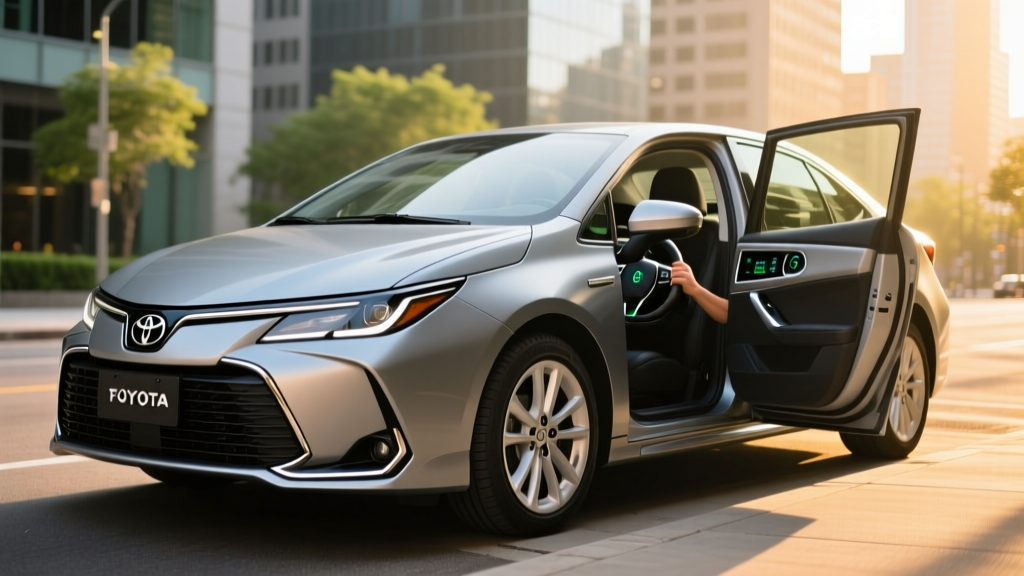
The 2020 Toyota Corolla Hybrid occupies a specific and increasingly rare niche: a conventional hybrid (HEV) that requires no plug, no behavior change, and no charging infrastructure — yet delivers fuel economy that rivals or beats many plug-in vehicles in daily commuting. With an EPA-rated 52 MPG combined, it remains one of the most efficient non-plug-in vehicles Toyota has ever sold. As of 2026, it is available only on the used market, which shifts the value proposition entirely toward total cost of ownership, long-term reliability, and battery longevity.
This guide covers the 2020 Corolla Hybrid's exact efficiency figures, powertrain specs, real-world MPG behavior, hybrid battery warranty and replacement economics, and how it stacks up against PHEVs and full EVs for different driver profiles.
HEV vs PHEV vs EV: Where the 2020 Corolla Hybrid Fits
Before examining specs, it's essential to clarify what the 2020 Corolla Hybrid is — and what it isn't. It is a conventional hybrid (HEV), not a plug-in hybrid (PHEV). This distinction drives every aspect of ownership.
| Attribute | HEV (2020 Corolla Hybrid) | PHEV (e.g., Prius Prime) | BEV (e.g., Tesla Model 3) |
|---|---|---|---|
| Plugs in? | No — self-charging via regen + engine | Yes — Level 1 or Level 2 | Yes — Level 1, 2, or DC fast |
| Electric-only range | ~1 mile at low speed | 25–44 miles (model dependent) | 250–360+ miles |
| Fuel/energy source | Gasoline only | Gasoline + grid electricity | Grid electricity only |
| Home charging install needed | None | Recommended (Level 2) | Essential (Level 2) |
| Federal tax credit (§30D) | Not eligible | Eligible (new, subject to rules) | Eligible (new, subject to rules) |
| Best for | No charging access, high-mileage commuters | Home chargers with short commutes | Home chargers, low fuel cost priority |
The 2020 Corolla Hybrid is engineered for drivers who want maximum fuel efficiency with zero infrastructure dependency. You fuel it at any gas station and drive. The hybrid system recovers energy during braking and deceleration, storing it in a small nickel-metal hydride (NiMH) traction battery that assists the gasoline engine during acceleration and enables brief electric-only movement at low speeds.
EPA Fuel Economy and Real-World MPG
The EPA rates the 2020 Toyota Corolla Hybrid at the following figures, which apply to the LE trim (the only hybrid trim offered for this model year):
| Metric | EPA Rating |
|---|---|
| City MPG | 53 |
| Highway MPG | 52 |
| Combined MPG | 52 |
| Fuel tank capacity | 11.4 gallons |
| EPA total range estimate | ~593 miles |
One counterintuitive characteristic of Toyota's hybrid synergy drive: city MPG often beats highway MPG. This is the opposite of conventional gas cars and is a direct result of regenerative braking recovering energy that would otherwise be lost as heat at low speeds, plus the engine shutting off at stops. If your commute is primarily urban or suburban with frequent stops, the Corolla Hybrid is optimized precisely for that pattern.
Powertrain: Engine, Motor, and Combined Output
The 2020 Corolla Hybrid uses Toyota's fourth-generation Hybrid Synergy Drive, sharing its core architecture with the contemporaneous Prius but tuned for the Corolla's sedan platform.
| Specification | Value |
|---|---|
| Engine | 1.8L 4-cylinder Atkinson cycle |
| Engine horsepower | 97 hp @ 5,200 rpm |
| Electric motor output | 71 hp (53 kW) |
| Net combined system horsepower | 121 hp |
| Transmission | Continuously variable (eCVT — planetary gearset, not belt-driven) |
| Drivetrain | Front-wheel drive (AWD-e not available on 2020 Corolla Hybrid) |
| 0–60 mph | ~9.5 seconds |
| Traction battery type | Nickel-metal hydride (NiMH), ~1.3 kWh |
| Curb weight | ~3,050 lbs |
The 121 hp combined output is modest, and the 9.5-second 0–60 time reflects a vehicle tuned for efficiency rather than acceleration. The eCVT is Toyota's planetary gearset design — not a traditional belt-and-cone CVT — which contributes to its reputation for durability since there are no friction bands or clutch packs to wear. The 1.3 kWh NiMH battery is small by modern standards but is never deeply discharged; Toyota's battery management system keeps the state of charge between roughly 40% and 80%, which dramatically extends cycle life.
Hybrid Battery Warranty, Lifespan, and Replacement Cost
Hybrid battery longevity is the single most common concern among used hybrid buyers, and it's the right question to ask. Here are the facts for the 2020 Corolla Hybrid.
Real-world battery lifespan: Toyota's NiMH hybrid batteries have an exceptionally well-documented track record. Data from Prius fleets and individual owner reports consistently show these batteries lasting 150,000–200,000+ miles before significant capacity loss. The key factor is Toyota's conservative state-of-charge windowing — by never allowing full charge or full discharge, the battery experiences far less stress than a BEV or PHEV battery that cycles through wider ranges.
Replacement cost if out of warranty:
- OEM new battery from Toyota: $2,000–$3,000 (part) + $500–$1,000 (labor) = approximately $2,500–$4,000 total
- Refurbished/remanufactured battery: $1,000–$2,000 installed
- Individual module replacement: Some independent hybrid specialists can replace only the failed modules within the pack for $500–$1,200, extending the pack's life at a fraction of full replacement cost
The realistic risk of needing a battery replacement on a 2020 Corolla Hybrid with under 100,000 miles is low. Most failures that do occur manifest as gradual capacity reduction (slightly lower MPG) rather than sudden failure. A hybrid battery health check via OBD-II scanner or at a Toyota dealer can assess remaining capacity before purchase.
Pricing and Tax Credit Eligibility in 2026
The 2020 Corolla Hybrid was sold new in a single LE trim with an MSRP of approximately $23,100 (including destination). As a used vehicle in 2026, pricing depends on mileage, condition, and region.
| Purchase Scenario | Estimated Price Range (2026) |
|---|---|
| Original MSRP (2020, LE trim) | $23,100 |
| Used, 40,000–60,000 miles, clean title | $16,000–$19,500 |
| Used, 60,000–90,000 miles, clean title | $13,500–$16,500 |
| Used, 90,000–120,000 miles | $11,000–$14,000 |
Federal tax credit: The 2020 Corolla Hybrid does not qualify for the IRS §30D Clean Vehicle Credit. This credit applies only to plug-in electric vehicles (PHEVs and BEVs) with sufficient battery capacity. Conventional hybrids like the Corolla Hybrid have been excluded from federal purchase incentives since the Energy Policy Act of 2005 era credits expired.
Used clean vehicle credit (§25E): Also not applicable — this credit (up to $4,000 for qualifying used EVs and PHEVs) similarly requires the vehicle to be a plug-in electric vehicle. The Corolla Hybrid's NiMH battery and non-plug-in architecture place it outside all current federal electrification incentives.
State-level incentives: A small number of states have offered rebates or HOV lane access for hybrids in the past, but most have shifted incentives exclusively to plug-in vehicles. Check your state's energy or environmental agency for current programs, but do not count on any incentive for this vehicle.
Who Should Buy the 2020 Corolla Hybrid — and Who Shouldn't
Choose the 2020 Corolla Hybrid if:
- You lack access to home or workplace charging (apartment, street parking, no garage)
- Your commute is urban or suburban with frequent stops — the exact scenario where this car's 53 city MPG shines
- You drive 15,000+ miles annually and want to minimize fuel spend without upfront EV premium
- You want Toyota's long-term reliability track record with minimal maintenance (no oil changes more frequent than a standard Corolla, brake pads last 80,000+ miles thanks to regen)
- You're buying used and want a sub-$18,000 vehicle with 50+ MPG and low ongoing cost
Consider a PHEV or BEV instead if:
- You have reliable Level 2 home charging and a commute under 30 miles — a PHEV like the Prius Prime lets you drive most days on electricity alone
- You want to eliminate gasoline entirely — a BEV like the Chevrolet Bolt EV or Hyundai Kona Electric offers 250+ miles of range with zero tailpipe emissions
- You're buying new and want to leverage the §30D federal tax credit (up to $7,500 for qualifying new EVs/PHEVs, subject to MSRP caps, income limits, and battery sourcing requirements)
- You prioritize acceleration and driving dynamics — the Corolla Hybrid's 121 hp and 9.5-second 0–60 are adequate but not engaging
Ownership Costs: 5-Year Projection for a Used 2020 Corolla Hybrid
For a buyer purchasing a 2020 Corolla Hybrid in 2026 at approximately $16,000 with 55,000 miles, here's a realistic 5-year ownership cost projection assuming 15,000 miles driven annually:
| Cost Category | 5-Year Estimate | Notes |
|---|---|---|
| Fuel (gasoline) | $4,900–$5,400 | At 52 MPG avg, $3.40/gal, 75,000 miles |
| Insurance | $5,500–$7,500 | Varies significantly by state, age, driving record |
| Maintenance | $2,000–$3,000 | Oil changes, tires (2 sets), cabin filter, brake fluid; brake pads likely still original |
| Repairs (out of warranty) | $500–$2,000 | Low risk for Toyota hybrid; budget for minor items |
| Depreciation | $4,000–$6,000 | From ~$16,000 to ~$10,000–$12,000 estimated resale |
| Total 5-year estimate | $17,000–$24,000 | Excluding purchase price; ~$3,400–$4,800/year |
The dominant cost is fuel, which is exactly where this vehicle's advantage lies. At 52 MPG, you'll spend roughly $980/year on gasoline — approximately half what a comparable non-hybrid compact sedan (30–32 MPG combined) would cost. Over 5 years, that fuel savings versus a gas-only Corolla (EPA ~34 MPG combined) totals approximately $2,300–$2,800.
Pros and Cons
Pros
- 52 MPG combined EPA — among the highest of any non-plug-in vehicle ever sold in the US
- No charging infrastructure required — works for apartment dwellers and street parkers
- Toyota's proven hybrid reliability with documented 150,000–200,000+ mile battery lifespan
- Low maintenance: regen braking extends pad life to 80,000+ miles; eCVT has no belts or friction components to replace
- Strong used-market value retention relative to non-hybrid competitors
- Competitive purchase price on the used market ($13,500–$19,500 depending on mileage)
- Standard Toyota Safety Sense 2.0 (pre-collision, lane departure, auto high beams, full-speed adaptive cruise)
Cons
- Modest 121 hp and ~9.5-second 0–60 — adequate for commuting, strained for highway merging with cargo
- Only one trim (LE) was offered — no premium options, no leather, no sunroof from factory
- AWD not available on 2020 Corolla Hybrid (AWD-e was Prius-only at the time)
- No federal or state tax credit eligibility as a non-plug-in hybrid
- Small 1.3 kWh battery means virtually no electric-only driving (brief low-speed movement only)
- Infotainment is functional but dated by 2026 standards; no wireless CarPlay on 2020 model
- Rear seat and trunk space slightly reduced vs. non-hybrid Corolla due to battery placement
Frequently Asked Questions
How many MPG does the 2020 Toyota Corolla Hybrid get?
The EPA rates it at 53 city / 52 highway / 52 combined MPG. In real-world driving, city MPG often exceeds the EPA rating (55–60 MPG in stop-and-go traffic), while sustained highway driving at 70+ mph typically yields 45–48 MPG. Cold weather reduces efficiency by approximately 5–10%.
Does the 2020 Corolla Hybrid need to be plugged in?
No. The 2020 Corolla Hybrid is a conventional hybrid (HEV), not a plug-in hybrid (PHEV). It charges its small traction battery entirely through regenerative braking and the gasoline engine. There is no charging port and no plug-in capability.
How far can the 2020 Corolla Hybrid drive on electric power alone?
Effectively less than 1 mile, and only at very low speeds (under 25 mph) in ideal conditions. The 1.3 kWh NiMH battery is not designed for meaningful electric-only range. Its purpose is to assist the gasoline engine during acceleration and to capture braking energy — not to replace the engine. If electric-only commuting is your goal, you need a PHEV (25–44 miles electric) or a BEV (250+ miles).
Is the 2020 Corolla Hybrid reliable?
Yes. Toyota's Hybrid Synergy Drive is among the most proven electrified powertrains in automotive history, with decades of fleet and consumer data supporting its longevity. The eCVT transmission has no wear-prone friction components, and the NiMH battery is conservatively managed to extend cycle life. The IIHS rated the 2020 Corolla a Top Safety Pick when equipped with specific headlights. The primary reliability risk on a used example is deferred maintenance from a prior owner — always request service records.
What does a hybrid battery replacement cost for the 2020 Corolla Hybrid?
An OEM new battery from Toyota costs approximately $2,500–$4,000 installed. Refurbished batteries run $1,000–$2,000 installed, and individual module replacement (a specialty service) can cost $500–$1,200. However, the likelihood of needing replacement before 150,000 miles is low based on historical Toyota hybrid data, and the original 8-year/100,000-mile warranty (10 years/150,000 miles in CARB states) may still partially cover a 2020 model in 2026.
Does the 2020 Corolla Hybrid qualify for any tax credit?
No. Federal tax credits under IRS §30D (new clean vehicles) and §25E (used clean vehicles) apply only to plug-in electric vehicles — PHEVs and BEVs with sufficient battery capacity. The Corolla Hybrid, as a conventional non-plug-in hybrid, does not qualify for any current federal purchase incentive. State-level hybrid incentives have largely been phased out in favor of plug-in vehicle programs.
How does the 2020 Corolla Hybrid compare to a used Prius?
The 2020 Prius (EPA 54–58 MPG combined depending on trim) is marginally more efficient and offers more cargo versatility as a liftback. The Corolla Hybrid trades 2–6 MPG for a more conventional sedan design, slightly quieter highway ride, and typically lower used-market pricing. Both share the same fundamental hybrid powertrain architecture and carry identical reliability expectations. Choose the Corolla Hybrid if you prefer a traditional trunk and lower cost; choose the Prius if cargo flexibility and maximum MPG matter more.