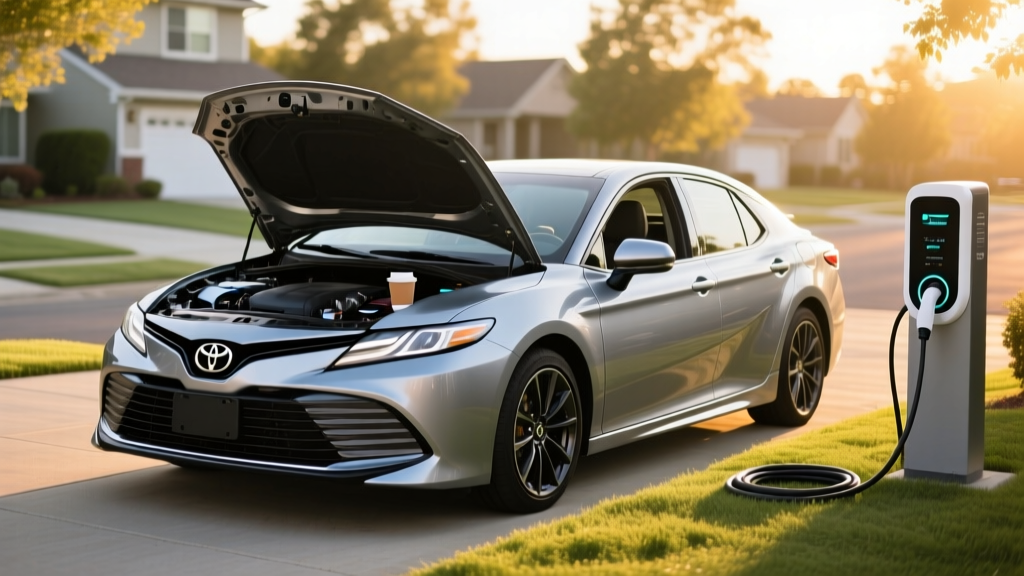
The 2026 Toyota Camry Hybrid lands in a sweet spot that full EVs still struggle to match for many buyers: exceptional fuel economy with zero charging infrastructure required. With the entire Camry lineup now exclusively hybrid for the 2025 redesign and continuing into 2026, Toyota has bet the sedan's future on its fifth-generation Toyota Hybrid System — and the numbers largely justify that bet.
This guide breaks down the Toyota Camry Hybrid MPG figures, real-world efficiency, powertrain details, battery longevity, and whether this HEV makes more sense for your situation than a plug-in hybrid or full battery-electric vehicle.
Toyota Camry Hybrid MPG: EPA Ratings and Real-World Results
The 2026 Camry Hybrid's headline number is its EPA-estimated combined fuel economy, which varies by trim and drivetrain. Front-wheel-drive (FWD) models achieve the highest ratings, while all-wheel-drive (AWD) variants trade a small efficiency penalty for added traction.
| Drivetrain | City MPG | Highway MPG | Combined MPG | Trims Available |
|---|---|---|---|---|
| FWD | 53 | 50 | 51 | LE, SE, XLE, XSE |
| AWD | 51 | 49 | 50 | LE, SE, XLE, XSE |
Source: EPA Fuel Economy
Real-World MPG: Where the Camry Hybrid Excels
Unlike most conventional vehicles, the Camry Hybrid frequently exceeds its EPA city rating in real-world urban driving. This is because stop-and-go traffic triggers frequent regenerative braking, which recaptures kinetic energy and recharges the hybrid battery — energy that would otherwise be wasted as heat in the brake pads of a gas-only car.
In mixed suburban commuting with moderate stoplights, expect 52–56 MPG on FWD trims. Highway driving at sustained 70–80 mph speeds will typically yield 46–50 MPG, as the electric motor contributes less at constant high velocity and aerodynamic drag dominates.
Powertrain: Fifth-Generation Toyota Hybrid System
The 2026 Camry pairs a 2.5-liter Dynamic Force four-cylinder engine with Toyota's latest hybrid transaxle. The system uses a lithium-ion hybrid battery (not nickel-metal hydride, which Toyota phased out for the Camry in prior generations) and a permanent-magnet electric motor integrated into the eCVT transaxle.
| Specification | FWD | AWD |
|---|---|---|
| Combined System Horsepower | 225 hp | 232 hp |
| Gas Engine | 2.5L 4-cyl, 184 hp | 2.5L 4-cyl, 184 hp |
| Front Electric Motor | 100 kW | 100 kW |
| Rear Electric Motor (AWD) | N/A | 30 kW |
| Transmission | eCVT | eCVT |
| 0–60 mph (est.) | ~7.1 sec | ~6.8 sec |
| Fuel Tank | 13.2 gal | 13.2 gal |
| Total Driving Range (est.) | ~673 mi | ~660 mi |
The AWD system uses a dedicated rear electric motor — there is no mechanical driveshaft connecting the engine to the rear wheels. This "eAWD" approach engages the rear motor automatically during acceleration, low-traction conditions, or when the system detects slip, then disengages to preserve efficiency during steady-state cruising.
HEV vs. PHEV vs. EV: Which Powertrain Fits You?
The Camry Hybrid is a conventional hybrid electric vehicle (HEV). It cannot be plugged in, has no electric-only driving range to speak of (the motor assists the engine but cannot propel the car alone for meaningful distances at speed), and refuels exclusively at gas stations. This is fundamentally different from a plug-in hybrid (PHEV) or a battery-electric vehicle (BEV).
| Factor | HEV (Camry Hybrid) | PHEV (e.g., Toyota RAV4 Prime) | BEV (e.g., Tesla Model 3) |
|---|---|---|---|
| Plug in to charge? | No | Yes (Level 1/2) | Yes (Level 1/2/DC) |
| Electric-only range | ~0 mi (motor assist only) | 25–42 mi typical | 250–360+ mi |
| Home charging needed? | No | Recommended (120V possible) | Essential (240V) |
| Fuel/energy cost per mile | ~$0.07 (gas) | ~$0.04 (elec) / $0.07 (gas) | ~$0.04 (elec) |
| Federal tax credit (§30D) | Not eligible | Up to $7,500 (if eligible) | Up to $7,500 (if eligible) |
| Best for | No home charging; long trips | Short commute + road trips | Home charging + daily driving |
Choose the Camry Hybrid (HEV) if you lack reliable access to home or workplace charging, regularly drive more than 40 miles between stops, want minimal behavioral change from a gas car, or prioritize lowest upfront cost with strong fuel savings.
Consider a PHEV instead if you can install a Level 2 charger at home, your daily commute is under 40 miles round-trip (covering most driving on electricity), and you still want a gas engine for road trips without range anxiety.
Consider a BEV if you have home charging, want the lowest per-mile energy cost, qualify for the full federal tax credit, and your typical trips fall within 250 miles or you're comfortable with DC fast charging on road trips.
Pricing, Trims, and Tax Credit Eligibility
The 2026 Camry Hybrid starts at a competitive MSRP, especially considering that every Camry is now hybrid — there is no cheaper gas-only version to compare against. Pricing reflects the hybrid system as standard equipment.
| Trim | FWD MSRP | AWD MSRP |
|---|---|---|
| LE | $29,495 | $30,995 |
| SE | $30,995 | $32,495 |
| XLE | $34,495 | $35,995 |
| XSE | $35,495 | $36,995 |
Prices include destination charge. Source: Toyota
Federal Tax Credit: Not Eligible
The Camry Hybrid does not qualify for the IRS §30D Clean Vehicle Credit. Under current IRS rules, the §30D credit applies only to plug-in electric vehicles (PHEVs and BEVs) with a battery capacity of at least 7 kWh that meet critical mineral and battery component sourcing requirements. Conventional hybrids like the Camry HEV have a small hybrid battery (approximately 1.0 kWh) and cannot be plugged in, making them ineligible.
Battery Warranty, Lifespan, and Replacement Cost
Hybrid battery longevity is consistently the top concern among first-time hybrid buyers. Toyota addresses this with one of the strongest hybrid battery warranties in the industry.
• 10 years / 150,000 miles (whichever comes first) for 2020 and newer models
• Covers battery capacity loss below a defined threshold and defects
• Transferable to subsequent owners
• Hybrid system components (inverter, motor, control module) also covered under the same term
How Long Does the Camry Hybrid Battery Actually Last?
Toyota's lithium-ion hybrid battery in the Camry is a low-stress component. Unlike a BEV battery that cycles between 10% and 90% state of charge daily, the Camry's hybrid battery operates in a narrow band — typically between 40% and 80% state of charge. The system never fully charges or fully depletes the pack, which dramatically extends cycle life.
Based on data from previous-generation Camry Hybrids and Toyota's broader hybrid fleet (over 20 million hybrids sold globally), the hybrid battery routinely lasts 150,000–200,000+ miles before significant degradation. Many first-generation Prius batteries exceeded 200,000 miles with the older NiMH chemistry; the current lithium-ion packs are expected to perform at least as well.
Battery Replacement Cost
If the hybrid battery does fail outside warranty, replacement costs have come down significantly:
- New OEM battery from Toyota: $2,000–$3,500 (parts + labor at dealership)
- Refurbished/remanufactured battery: $1,000–$2,000 (independent hybrid specialists)
- Individual module replacement: $300–$800 (if only specific cells have failed, a qualified technician can replace modules rather than the entire pack)
For context, a conventional car's automatic transmission replacement can cost $3,000–$5,000. The hybrid battery is not the financial liability many buyers fear — especially given the 10-year/150,000-mile warranty coverage.
Reliability and Long-Term Ownership Costs
Toyota's hybrid powertrain is among the most proven in the automotive industry. The Camry Hybrid benefits from several reliability advantages inherent to its design:
- No traditional starter motor: The hybrid system starts the engine via the electric motor, eliminating a common failure point.
- No alternator: The hybrid battery and DC-DC converter handle 12V charging, removing another wear component.
- Regenerative braking: Significantly reduces brake pad wear. Many Camry Hybrid owners report 80,000–100,000 miles on original brake pads.
- eCVT simplicity: Toyota's eCVT uses a planetary gearset with no belts, chains, or clutch packs — mechanically simpler than a conventional automatic or belt-driven CVT.
Estimated 5-Year Cost of Ownership
| Cost Factor | Camry Hybrid (FWD LE) | Comparable Gas Sedan (est.) |
|---|---|---|
| Fuel (75,000 mi, $3.50/gal) | $5,147 | $8,824 (30 MPG combined) |
| Maintenance (5 yr) | ~$2,200 | ~$3,000 |
| Brake pad replacement | Likely $0 (regen extends life) | $300–$500 |
| Insurance (avg) | ~$7,500 | ~$7,000 |
| Estimated 5-yr total (fuel + maint) | ~$7,347 | ~$12,124 |
The Camry Hybrid saves an estimated $4,500–$5,000 over five years in fuel and maintenance alone compared to a 30-MPG gas sedan — effectively offsetting much of the vehicle's purchase premium over time.
Who Should Buy the Camry Hybrid?
- Choose the Camry Hybrid if: You want 50+ MPG with no charging, drive 12,000–20,000 miles/year, lack home charging access, take regular road trips over 300 miles, or want a proven powertrain with strong resale value.
- Look at a PHEV instead if: You can charge at home, your daily commute is under 35 miles, and you want to drive mostly on electricity while keeping a gas backup.
- Go full BEV if: You have reliable Level 2 home charging, qualify for the §30D tax credit, want the lowest per-mile cost, and your longest regular trip is under 250 miles.
- Stick with gas if: You drive under 8,000 miles/year (fuel savings won't offset the hybrid premium in a reasonable timeframe) or you're buying a used vehicle with a very tight budget.
Pros and Cons
- 51 MPG combined (FWD) — among the best midsize sedans
- No plug-in charging required
- 10-year/150,000-mile hybrid battery warranty
- AWD available on all trims
- Strong resale value and Toyota reliability record
- 673-mile total range eliminates refueling stops on most road trips
- No federal tax credit eligibility
- No electric-only driving mode for zero-emission miles
- Higher upfront cost than discontinued gas-only Camry
- eCVT drone under hard acceleration (common hybrid trait)
- AWD adds ~1 MPG penalty and $1,500 to MSRP
Frequently Asked Questions
How many MPG does the Toyota Camry Hybrid get?
The 2026 Camry Hybrid FWD is EPA-rated at 53 city / 50 highway / 51 combined MPG. AWD models achieve 51 city / 49 highway / 50 combined. Real-world mixed driving typically yields 48–54 MPG, with city driving often exceeding the EPA rating thanks to regenerative braking.
Does the Camry Hybrid need to be plugged in?
No. The Camry Hybrid is a conventional HEV. Its battery is charged by the gasoline engine and through regenerative braking. You refuel it like any other gas car — at a gas station. There is no plug, no charging cable, and no electric-only range.
Is the Toyota Camry Hybrid reliable?
Toyota's hybrid system is one of the most reliable powertrains in the industry, with over two decades of continuous refinement. The hybrid battery carries a 10-year/150,000-mile warranty. The eCVT has fewer moving parts than a conventional automatic, and regenerative braking dramatically extends brake pad life. NHTSA and IIHS ratings for the current-generation Camry are strong — check IIHS for the latest test results.
What does it cost to replace the Camry Hybrid battery?
A new OEM replacement hybrid battery costs $2,000–$3,500 installed at a Toyota dealer. Refurbished options are available for $1,000–$2,000. However, most Camry Hybrid batteries last 150,000–200,000+ miles, and failures within the 10-year/150,000-mile warranty period are covered at no cost.
Does the Camry Hybrid qualify for any tax credit?
The Camry Hybrid does not qualify for the federal §30D Clean Vehicle Credit, which is limited to plug-in vehicles (PHEVs and BEVs) with batteries of at least 7 kWh. Some states offer hybrid-specific rebates or HOV lane access — check your state's energy office for current programs.
Camry Hybrid vs. a full EV: which saves more money?
A full EV (like the Tesla Model 3 or Hyundai Ioniq 6) has a lower per-mile energy cost (~$0.04/mile vs. ~$0.07/mile for the Camry Hybrid) and may qualify for a $7,500 federal tax credit. However, the Camry Hybrid has a lower purchase price, no home charging installation cost ($500–$2,000), no range anxiety on long trips, and strong resale value. For buyers who drive 15,000+ miles/year and lack home charging, the Camry Hybrid often delivers a better total cost of ownership. For those with home charging and shorter commutes, a BEV typically wins on long-term economics.