Quick Verdict: The Camry Hybrid's Efficiency Edge
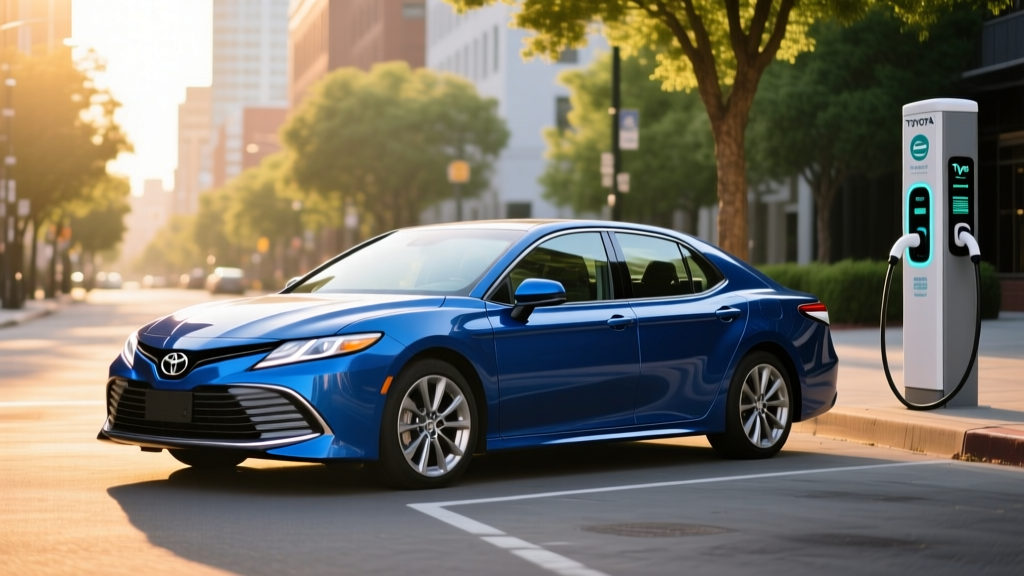
The 2025-2026 Toyota Camry Hybrid is now exclusively a hybrid — Toyota dropped the gas-only four-cylinder after the ninth-generation redesign. That decision paid off. The Camry Hybrid delivers up to 51 MPG city on front-wheel-drive trims, making it one of the most efficient midsize sedans on the market without requiring a plug, a charging routine, or any change to how you refuel.
For buyers researching Toyota Camry Hybrid fuel economy, the headline numbers are strong, but real-world behavior matters more than the sticker. City driving is where this powertrain shines, often exceeding EPA estimates, while highway cruising at 75+ mph brings the numbers closer to 42-45 MPG. This guide breaks down every efficiency figure, the hybrid powertrain specs, battery longevity, and how the Camry Hybrid stacks up against plug-in hybrids and full EVs.
EPA MPG and Real-World Toyota Camry Hybrid Fuel Economy
The ninth-generation Camry Hybrid (2025-2026 model years) uses Toyota's fifth-generation hybrid system. EPA ratings differ by drivetrain:
| Drivetrain | City MPG | Highway MPG | Combined MPG | Trims Available |
|---|---|---|---|---|
| FWD | 51 | 49 | 50 | LE, SE |
| AWD (Electronic On-Demand) | 49 | 47 | 48 | LE, SE, XLE, XSE |
Real-World MPG vs. EPA Sticker
EPA Combined: 50 MPG (FWD) / 48 MPG (AWD)
Real-world expectation: Expect 46-52 MPG in mixed city/suburban driving. Hybrids routinely exceed EPA city estimates in stop-and-go traffic thanks to regenerative braking and electric-only low-speed operation. Sustained highway driving at 75-80 mph typically yields 42-45 MPG. In cold weather (below 30°F), expect a 5-10% reduction as the engine runs more frequently to generate cabin heat.
For context, the outgoing gas-only 2024 Camry 4-cylinder rated 28 city / 39 highway / 32 combined. The hybrid's 56% combined improvement is substantial — roughly $600-$800 less per year in fuel at 15,000 miles driven and $3.40/gallon regular unleaded.
Powertrain Specs: Fifth-Generation Toyota Hybrid System
Every 2026 Camry Hybrid pairs a 2.5-liter inline-four Atkinson-cycle engine with one or two electric motors, depending on drivetrain. There is no turbocharger, no plug, and no range-extender gimmick — this is a conventional self-charging hybrid (HEV).
| Engine | 2.5L 4-cyl Atkinson-cycle |
| Engine Output | 184 hp / 163 lb-ft |
| Electric Motor (FWD front) | 134 hp / 155 lb-ft |
| Rear Motor (AWD only) | 40 hp / 89 lb-ft |
| Net Combined System Output | 225 hp (FWD) / 232 hp (AWD) |
| Transmission | eCVT (planetary gearset) |
| Hybrid Battery | 1.1 kWh (usable ~0.6 kWh), Lithium-ion |
| 0-60 mph | ~7.2 sec (FWD) / ~7.0 sec (AWD) |
| Fuel Tank | 13.2 gallons (regular 87 octane) |
| Total Driving Range | ~630-660 miles per tank |
The 1.1 kWh traction battery is small by design. It enables electric-only crawling at low speeds (typically under 25 mph for short distances), regenerative braking capture, and torque-fill during acceleration. This is not a plug-in hybrid — you cannot charge it externally, and it offers no meaningful electric-only highway range. The engine and motor work in concert at all times above low-speed creep.
HEV vs. PHEV: Why the Camry Is Not a Plug-In
Conventional Hybrid (HEV) — Camry Hybrid: No plug. Battery charges via regenerative braking and engine. Electric-only operation limited to low-speed, short-distance. No federal tax credit. Lower purchase price.
Plug-in Hybrid (PHEV) — e.g., Toyota RAV4 Prime, Prius Prime: Requires plugging in. Larger battery (13-18 kWh). 25-44 miles electric-only range before engine engages. Eligible for up to $7,500 federal tax credit if requirements met. Higher purchase price.
The Camry lineup does not currently offer a PHEV variant in the U.S. market. If you need electric-only commuting capability, look to the Prius Prime (44 miles EV range) or a competing PHEV sedan.
Camry Hybrid vs. PHEV vs. Full EV: Which Fits Your Drive?
Choosing between a conventional hybrid, plug-in hybrid, and battery-electric vehicle depends on your daily mileage, charging access, and budget. Here's a practical decision framework:
Choose the Camry Hybrid (HEV) If:
- You lack reliable home or workplace charging access
- You drive 30-60 miles daily in mixed city/highway conditions
- You want maximum fuel savings with zero routine change — just fill up at any gas station
- Upfront budget matters: the Camry Hybrid LE starts at $29,495 (2025 MY MSRP)
- You regularly take long road trips and don't want to plan charging stops
Choose a PHEV (Prius Prime, etc.) If:
- You have home Level 2 charging and a commute under 40 miles round-trip
- You want daily electric-only driving but gas flexibility for weekend trips
- You qualify for the §30D federal tax credit (up to $7,500, subject to MSRP caps, income limits, and battery-sourcing rules)
Choose a Full EV (BEV) If:
- You have reliable home charging (Level 2, 240V)
- Your daily driving is under 250 miles and you can plan road-trip DC fast-charging
- You want the lowest per-mile fuel cost (~$0.04-$0.06/mile on home electricity vs. ~$0.10-$0.12/mile in the Camry Hybrid)
- You want zero tailpipe emissions and minimal powertrain maintenance
Pricing, Trims, and Tax Credit Eligibility
The 2026 Toyota Camry Hybrid carries over the pricing structure introduced with the ninth-gen redesign. All trims are hybrid-only:
| Trim | Drivetrain | MSRP | Federal Tax Credit |
|---|---|---|---|
| LE | FWD | ~$29,495 | None |
| LE | AWD | ~$30,995 | None |
| SE | FWD | ~$31,095 | None |
| SE | AWD | ~$32,595 | None |
| XLE | AWD | ~$34,595 | None |
| XSE | AWD | ~$35,595 | None |
Tax credit note: The Camry Hybrid is a conventional HEV, not a plug-in vehicle. It does not qualify for the IRS §30D New Clean Vehicle Credit, which applies only to BEVs and PHEVs meeting battery-sourcing, MSRP, and buyer-income requirements. No federal purchase incentive applies to conventional hybrids. Some states may offer minimal rebates for high-efficiency vehicles, but these vary by jurisdiction — check your state energy office for current programs.
Battery Warranty, Lifespan, and Replacement Cost
Hybrid battery longevity is the single most common concern among first-time hybrid buyers. Toyota's track record here is well-established across millions of Prius, Camry Hybrid, and RAV4 Hybrid units on the road.
Toyota Hybrid Battery Warranty
Coverage: 10 years / 150,000 miles (whichever comes first), transferable to subsequent owners.
What's covered: Hybrid traction battery, hybrid control module, and related hybrid-system components.
Capacity threshold: Toyota warrants the battery against defects and abnormal loss of function. Unlike BEV warranties, there is no published State of Health (SoH) percentage threshold — coverage applies if the hybrid system fails to operate normally.
Additional hybrid component warranty: Hybrid system control ECU, inverter, and related components covered under the same 10yr/150k term.
Real-world lifespan data: Toyota's nickel-metal-hydride and lithium-ion hybrid batteries routinely last 150,000-200,000+ miles before significant degradation. Failures before 100,000 miles are uncommon. The 1.1 kWh battery in the Camry Hybrid operates within a narrow state-of-charge window (roughly 40-80%), which dramatically reduces cell stress compared to a BEV that cycles between 10-90%.
Replacement cost if out of warranty: A new OEM hybrid battery pack for the Camry Hybrid runs approximately $2,500-$4,000 including labor at a Toyota dealer. Independent hybrid specialists often offer refurbished packs for $1,500-$2,500. Given the battery's small size relative to a BEV's 60-100 kWh pack, this is a fraction of what a full EV battery replacement would cost.
Pros, Cons, and Ownership Realities
Pros
- 50 MPG combined (FWD) — among the best in any midsize sedan
- No charging infrastructure needed; 630+ mile total range per tank
- Standard Toyota Safety Sense 3.0 (adaptive cruise, lane-keeping, AEB, road-sign assist)
- 10-year/150,000-mile hybrid battery warranty
- Strong resale value — Toyota midsize sedans historically retain value well
- AWD available across all trims for $1,500 premium
- 232 hp (AWD) provides confident highway merging
Cons
- No PHEV option — cannot drive on electric-only for commutes
- No federal tax credit eligibility
- eCVT drone under hard acceleration (characteristic of planetary hybrid systems)
- Rear-seat space slightly tighter than some rivals (38.0" legroom)
- Infotainment can feel dated vs. competitors at XLE/XSE price points
- Cold-weather MPG drops 5-10% due to engine running for cabin heat
Frequently Asked Questions
How many MPG does the 2026 Toyota Camry Hybrid actually get?
The EPA rates the FWD Camry Hybrid at 51 city / 49 highway / 50 combined MPG. The AWD version rates 49/47/48. In real-world mixed driving, owners commonly report 46-52 MPG, with city-heavy routes often exceeding the EPA city estimate thanks to regenerative braking. Sustained highway speeds above 75 mph bring the figure down to roughly 42-45 MPG.
Does the Camry Hybrid need to be plugged in?
No. The Camry Hybrid is a conventional self-charging hybrid (HEV). Its small 1.1 kWh battery charges through regenerative braking and the gasoline engine. You never plug it in. If you want a Toyota sedan that plugs in for electric-only commuting, consider the Prius Prime (PHEV, 44 miles EV range).
Does the Toyota Camry Hybrid qualify for a federal tax credit?
No. The IRS §30D New Clean Vehicle Credit applies only to plug-in electric vehicles (BEVs and PHEVs) that meet battery-sourcing, MSRP cap, and buyer-income requirements. Conventional hybrids like the Camry Hybrid are not eligible for any federal purchase incentive. Check your state for any local efficiency rebates.
How long will the Camry Hybrid battery last, and what does replacement cost?
Toyota warrants the hybrid battery for 10 years / 150,000 miles. Real-world data from millions of Toyota hybrids shows these batteries commonly last 150,000-200,000+ miles. If replacement is needed out of warranty, expect $2,500-$4,000 for a new OEM pack at a dealer, or $1,500-$2,500 for a refurbished unit from an independent hybrid specialist.
Is the Camry Hybrid better than a full EV for my commute?
It depends on charging access. If you can install a Level 2 home charger and your daily round-trip is under 250 miles, a BEV will cost less per mile to fuel (~$0.04-$0.06/mile on home electricity vs. ~$0.10-$0.12/mile in the Camry Hybrid). But if you lack home charging, drive long irregular routes, or live in an area with sparse DC fast-charging infrastructure, the Camry Hybrid offers strong efficiency with zero lifestyle change — just refuel at any gas station in 3 minutes.
How does the Camry Hybrid compare to the Honda Accord Hybrid?
The 2025 Accord Hybrid rates 48 combined MPG (FWD Sport/LX trims), putting it 2 MPG behind the Camry Hybrid FWD. The Accord Hybrid's two-motor system delivers a smoother, more EV-like feel at low speeds, while the Camry's eCVT is slightly more noticeable under hard throttle. Both carry excellent hybrid battery warranties (Toyota: 10yr/150k; Honda: 10yr/150k). The Camry Hybrid offers AWD; the Accord Hybrid does not.