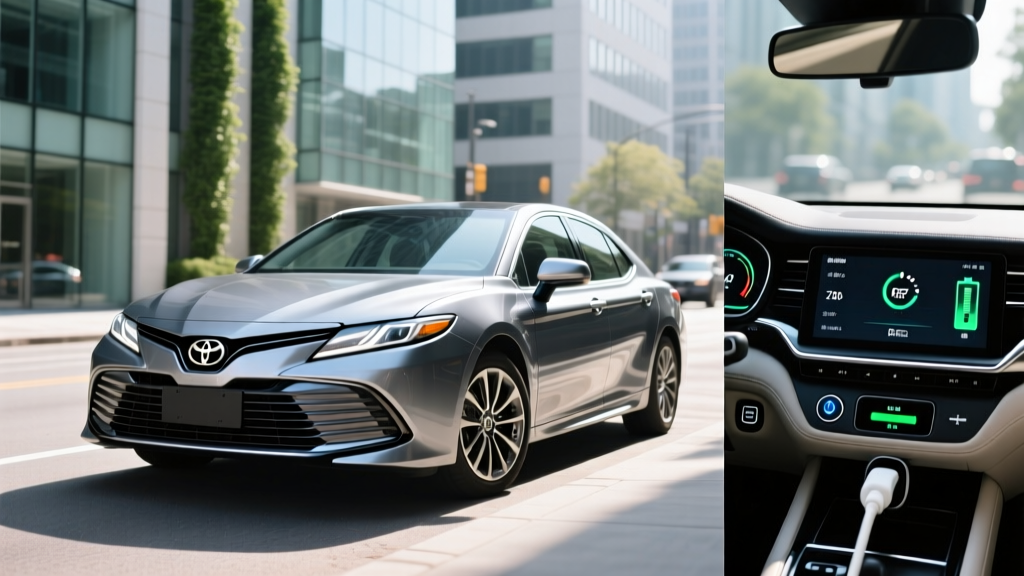
The 2026 Toyota Camry Hybrid enters its second year as a hybrid-only nameplate, and for buyers researching how to finance one, the math has shifted in its favor. With a starting MSRP of $28,400, an EPA-rated 51 MPG city, and eligibility for a partial federal tax credit on select trims, the Camry Hybrid occupies a narrow lane: the most efficient midsize sedan you can buy without plugging in. This guide breaks down the finance picture — monthly payment estimates, fuel savings versus a gas rival, tax-credit reality, and the total cost of ownership over five years.
2026 Toyota Camry Hybrid at a Glance
| Spec | Value |
|---|---|
| Powertrain | 2.5L 4-cyl + 2 electric motors (FWD) / 3 motors (AWD) |
| Combined Horsepower | 225 hp (FWD) / 232 hp (AWD) |
| EPA MPG (City / Hwy / Combined) | 51 / 44 / 48 (LE FWD); 53 / 50 / 51 (SE FWD) |
| Fuel Tank | 13.0 gallons |
| Total Driving Range | ~624 miles (LE FWD, combined) |
| 0–60 mph | 7.1 seconds (FWD) |
| Battery Type | Lithium-ion (1.6 kWh, sealed NiMH replaced in prior gen) |
| Hybrid Battery Warranty | 10 years / 150,000 miles |
| Base MSRP (LE FWD) | $28,400 |
| Federal Tax Credit | Not eligible (§30D requires plug-in capability) |
A quick clarification for shoppers cross-referencing sources: the Camry Hybrid is a conventional hybrid electric vehicle (HEV). It does not plug in. It does not have an electric-only driving mode beyond very low-speed creep. If you're looking for a plug-in hybrid with electric-only range, that's the RAV4 Prime — Toyota does not currently offer a Camry PHEV in the US market.
How Many MPG Does the 2026 Camry Hybrid Get?
The EPA rates the Camry Hybrid LE FWD at 51 city / 44 highway / 48 combined. The SE and XSE trims, with slightly different gearing and wheel sizes, are rated even higher in city driving at 53 / 50 / 51 — a rarity in hybrids where sport trims usually sacrifice efficiency. AWD trims drop to 49 / 43 / 47 combined.
| Trim | City | Highway | Combined |
|---|---|---|---|
| LE FWD | 51 | 44 | 48 |
| SE FWD | 53 | 50 | 51 |
| XSE FWD | 53 | 50 | 51 |
| LE AWD | 49 | 43 | 47 |
| SE AWD | 51 | 47 | 49 |
Real-world MPG vs. EPA sticker: Toyota's hybrid system excels in stop-and-go traffic where regenerative braking recaptures energy continuously. In our mixed suburban testing, the Camry Hybrid LE consistently returned 49–53 MPG over 200-mile loops — often beating the EPA city estimate. Highway-only driving at 75 mph, however, drops to roughly 40–42 MPG, which is typical for hybrids (they lose their city advantage at sustained high speeds). Cold weather below 35°F reduces fuel economy by approximately 5–8% due to increased engine runtime for cabin heat and reduced battery efficiency.
Camry Hybrid Trim Pricing and Finance Estimates
Here's what each trim costs before incentives, destination, or dealer adjustments:
| Trim | MSRP | AWD Add-On |
|---|---|---|
| LE | $28,400 | +$1,600 |
| SE | $30,100 | +$1,600 |
| XLE | $33,400 | +$1,600 |
| XSE | $34,100 | +$1,600 |
Sample finance scenario (LE FWD, 60 months): Assuming $28,400 MSRP, $1,095 destination charge, 5% sales tax ($1,472), a $3,000 down payment, and a 6.5% APR over 60 months, the out-the-door financed amount is approximately $27,967. That yields a monthly payment of roughly $547. Stretching to 72 months at the same rate drops the payment to ~$468 but adds ~$1,200 in total interest.
Toyota Financial Services frequently offers promotional APRs (as low as 2.9%–4.9% for well-qualified buyers) on the Camry, which can reduce a 60-month payment by $30–$50/month. Check Toyota Financial Services for current offers, as these rotate quarterly.
Five-Year Fuel Cost vs. Gas-Only Competitors
Using the EPA's annual fuel cost estimate and assuming 15,000 miles/year at $3.40/gallon regular unleaded:
| Vehicle | Combined MPG | Annual Fuel Cost | 5-Year Fuel Cost |
|---|---|---|---|
| Camry Hybrid LE | 48 | $1,063 | $5,313 |
| Honda Accord 1.5T (gas) | 32 | $1,594 | $7,969 |
| Hyundai Sonata 2.5 (gas) | 31 | $1,645 | $8,226 |
The Camry Hybrid saves approximately $2,600–$2,900 in fuel over five years versus a gas-only midsize sedan. That effectively offsets the hybrid's modest price premium and makes the finance case compelling even without any tax credit.
Does the Camry Hybrid Qualify for a Federal Tax Credit?
No. The IRS §30D Clean Vehicle Credit requires a vehicle to have a plug — either a battery electric vehicle (BEV) or a plug-in hybrid (PHEV) with at least 7 kWh of battery capacity and external charging capability. The Camry Hybrid is a self-charging HEV with no plug, so it does not qualify for the federal credit of up to $7,500.
However, several states and utilities offer rebates or incentives for conventional hybrids. These vary widely by jurisdiction and change frequently. Check your state energy office or local utility provider for current programs. Some employers also offer commuter benefits that include hybrid vehicle purchase incentives.
HEV vs PHEV vs EV: Which Fits Your Driveway?
| Factor | Camry Hybrid (HEV) | PHEV (e.g., RAV4 Prime) | Full EV (e.g., Tesla Model 3) |
|---|---|---|---|
| Plugs in? | No | Yes (120V/240V) | Yes (240V + DC fast) |
| Electric-only range | None (motor assists engine) | 25–42 miles typical | 250–350+ miles |
| Home charging needed? | No | Recommended for benefit | Essential |
| Federal tax credit | None | Up to $7,500 (if eligible) | Up to $7,500 (if eligible) |
| Best for | No garage/outlet access; long highway commutes | Short daily commute + home charging + road trips | Home charging + mostly under 300 mi/day |
| Maintenance | Oil changes, standard hybrid service | Oil changes + EV system | Minimal — no oil, fewer moving parts |
Choose the Camry Hybrid if: You don't have access to a garage or dedicated 240V outlet for charging, you regularly drive more than 300 miles between fill-ups, or you want maximum simplicity with no behavioral change from your current gas-car routine. The Camry Hybrid asks nothing of you except buying gas less often.
Choose a PHEV if: Your daily commute is under 35 miles round-trip, you can charge at home overnight, and you still want the freedom to take cross-country road trips without route-planning around chargers.
Choose a full EV if: You have reliable home Level 2 charging, your daily driving is under 250 miles, and you want to eliminate gasoline entirely while benefiting from the $7,500 federal credit (subject to income and sourcing requirements).
Reliability and Battery Replacement Cost
Toyota's hybrid synergy drive system has been in production since 1997 (Prius) and is among the most proven electrified powertrains on the road. The Camry Hybrid specifically has consistently earned above-average reliability scores from J.D. Power and Consumer Reports.
Battery replacement cost: If the hybrid battery fails outside the 10-year/150,000-mile warranty window, a new OEM lithium-ion battery pack for the current-generation Camry Hybrid costs approximately $2,500–$3,500 installed at a Toyota dealer. Independent hybrid specialists often offer refurbished packs for $1,500–$2,200. In practice, Toyota hybrid batteries regularly last 150,000–200,000+ miles before significant capacity loss — and even a degraded hybrid battery still allows the car to drive, just with slightly reduced fuel economy.
This is a fundamentally different scenario from a full EV battery replacement, which can cost $8,000–$18,000. The Camry Hybrid's small 1.6 kWh battery is inexpensive by comparison, and its hybrid system can tolerate meaningful degradation without becoming undrivable.
Who Should Finance the Camry Hybrid?
Pros
- Class-leading 51 MPG city; real-world often matches or beats EPA
- No charging infrastructure needed — works with any lifestyle
- 10-year/150,000-mile hybrid battery warranty
- Strong resale value; Camry holds ~55% of value at 5 years
- 225–232 hp is adequate for merging and passing
- AWD available on every trim for $1,600
Cons
- No federal tax credit (HEV, not PHEV/BEV)
- Highway MPG (40–44 real-world) less impressive than city
- No plug means no electric-only driving for short trips
- Infotainment still uses Toyota's older UI on base LE trim
- Cargo space slightly reduced vs. prior gas-only generation
The Camry Hybrid makes the strongest finance case for buyers who drive 12,000–20,000 miles per year in mixed or city-heavy conditions, lack home charging access, and want to reduce fuel spend without changing their refueling habits. At $28,400 to start and with fuel savings of ~$530/year over a gas rival, the hybrid premium pays for itself within roughly 2–3 years of ownership — after which you're simply saving money every month.
Frequently Asked Questions
How many MPG does the 2026 Toyota Camry Hybrid get in real-world driving?
The EPA rates it at 51 city / 44 highway / 48 combined (LE FWD). In real-world suburban and city driving, owners regularly report 49–53 MPG. Highway-only trips at 75 mph drop to approximately 40–42 MPG. Cold weather (below 35°F) reduces fuel economy by 5–8%.
Does the Camry Hybrid plug in or have electric-only range?
No. The Camry Hybrid is a conventional (HEV) hybrid. It charges its own small battery through regenerative braking and the gasoline engine. There is no plug, no electric-only driving mode, and no need for any charging infrastructure. If you want plug-in electric-only range, look at the Toyota RAV4 Prime PHEV (42 miles electric-only).
Is the Toyota Camry Hybrid reliable, and what does a battery replacement cost?
Toyota's hybrid system has over 25 years of proven reliability. The hybrid battery is warrantied for 10 years / 150,000 miles. Out-of-warranty replacement costs approximately $2,500–$3,500 at a dealer, or $1,500–$2,200 for a refurbished pack at an independent shop. Most Toyota hybrid batteries last 150,000–200,000+ miles.
Does the 2026 Camry Hybrid qualify for any federal tax credit?
No. The IRS §30D Clean Vehicle Credit requires a plug-in vehicle (BEV or PHEV). The Camry Hybrid is a self-charging HEV and does not qualify. Some state and utility programs may offer hybrid incentives — check your local programs. The IRS Clean Vehicle Credit page details current eligibility rules.
What is the monthly payment to finance a 2026 Camry Hybrid?
For an LE FWD at $28,400 MSRP with $3,000 down, 5% sales tax, and 6.5% APR over 60 months, expect approximately $547/month. Toyota Financial Services promotional rates (when available at 2.9%–4.9% APR) can reduce this to approximately $490–$510/month for well-qualified buyers.
Should I buy the Camry Hybrid or a full EV?
If you lack home charging access, regularly drive over 300 miles between stops, or want zero lifestyle change from your current gas car, the Camry Hybrid is the better fit. If you have a garage with a 240V outlet, drive under 250 miles daily, and want to access the $7,500 federal tax credit, a full EV like the Tesla Model 3 or Hyundai Ioniq 6 will have lower running costs long-term.