Quick Verdict: The Subaru XV Crosstrek Hybrid at a Glance
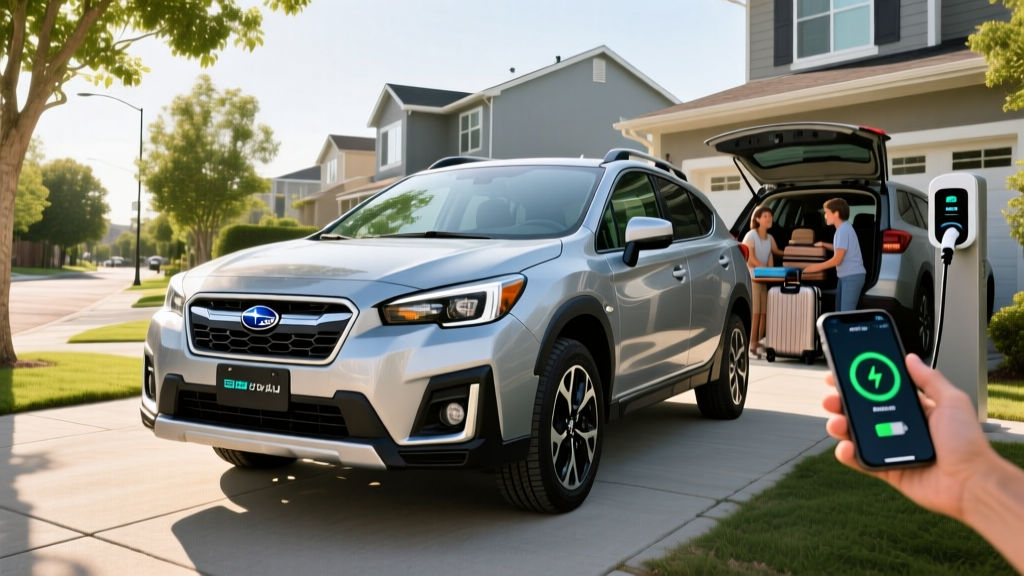
The Subaru XV Crosstrek Hybrid (sold as the Crosstrek Hybrid in the US market) is a plug-in hybrid (PHEV) that pairs Subaru's symmetrical all-wheel drive with a modest electric-only range and a gasoline engine for extended trips. If you've been searching for a Subaru XV Crosstrek Hybrid, you're likely weighing its fuel economy against its practicality as a daily commuter that can also handle weekend adventures without range anxiety.
Here's the honest take: this PHEV excels as a bridge vehicle for drivers who want some electric driving without committing to a full battery-electric vehicle (BEV). But its relatively small battery, limited DC fast-charging capability, and pricing that pushes close to fully electric competitors mean buyers need to do the math carefully.
| Specification | Value |
|---|---|
| Powertrain | 2.0L Boxer-4 + electric motor (PHEV) |
| Combined Horsepower | 148 hp |
| Battery Capacity | 8.8 kWh (lithium-ion) |
| EPA Electric-Only Range | 17 miles |
| Total Combined Range | ~480 miles |
| EPA MPG (gas only, combined) | 35 MPG |
| MPGe (electric + gas combined) | 90 MPGe |
| Level 2 Charge Time (0-100%) | ~2 hours at 3.3 kW |
| DC Fast Charging | Not available |
| 0-60 mph | ~9.5 seconds |
| Drivetrain | Symmetrical AWD (standard) |
| Base MSRP (when available) | ~$36,845 |
| Battery Warranty | 8 years / 100,000 miles |
HEV vs PHEV: Understanding What the Crosstrek Hybrid Actually Is
A common source of confusion with the Subaru XV Crosstrek Hybrid is whether it's a conventional hybrid (HEV) like the Toyota Prius or a plug-in hybrid (PHEV) like the Toyota RAV4 Prime. The answer matters enormously for your daily routine and fuel costs.
| Feature | Conventional Hybrid (HEV) | Plug-In Hybrid (PHEV) |
|---|---|---|
| Plug in to charge? | No — regenerative braking only | Yes — plug in for full battery charge |
| Electric-only range | 1-2 miles at low speed | 10-40+ miles depending on model |
| Battery size | 1-2 kWh | 8-20+ kWh |
| Home charging needed? | No | Recommended for full benefit |
| Tax credit eligible? | No federal credit | Varies by battery sourcing (§30D) |
| Subaru example | Crosstrek (mild hybrid assist) | Crosstrek Hybrid (this PHEV) |
The Subaru XV Crosstrek Hybrid is a PHEV. That means you can plug it in at home (Level 1 or Level 2) to get up to 17 miles of pure electric driving before the 2.0-liter Boxer engine kicks in. Without plugging in, it still operates as a hybrid, but you lose the electric-only range benefit and the fuel savings that come with it.
Fuel Economy: EPA Numbers vs Real-World MPG
Fuel economy is the primary reason most buyers consider the Subaru XV Crosstrek Hybrid. Here's how the EPA rates it, along with what you can actually expect in daily driving.
| Driving Mode | EPA Rating | Real-World Expectation |
|---|---|---|
| Electric-only (first 17 mi) | 90 MPGe | Varies with temperature; expect 12-15 mi in cold weather |
| Gas-only (after battery depleted) | 35 MPG combined | 33-37 MPG; higher in city, lower on highway |
| City (gas mode) | 36 MPG | 37-40 MPG (hybrids excel in stop-and-go) |
| Highway (gas mode) | 34 MPG | 30-33 MPG at 70+ mph |
| Combined (charged daily) | 90 MPGe / 35 MPG | Highly dependent on commute length and charging habits |
Real-world context: If your daily commute is under 17 miles round-trip and you charge nightly, you may go weeks without burning gasoline. Subaru's PHEV system prioritizes electric drive at lower speeds, making it efficient for suburban errands. However, on sustained highway trips at 75 mph, expect the gas engine to dominate, and real-world fuel economy drops to the low 30s. According to fueleconomy.gov, the Crosstrek Hybrid's combined rating assumes a mix of charged and depleted-battery driving.
Hybrids of all types tend to outperform their EPA city ratings in real-world stop-and-go traffic because regenerative braking recaptures energy that a gas-only car wastes as heat. The Crosstrek Hybrid is no exception — owners who do mostly city driving frequently report 38-40 MPG in gas-only mode.
Electric-Only Range and Charging: What to Expect
The Crosstrek Hybrid's 8.8 kWh battery pack delivers an EPA-rated 17 miles of electric-only range. That's on the lower end of the PHEV spectrum — competitors like the Toyota RAV4 Prime offer 42 miles, and the Hyundai Tucson PHEV delivers around 33 miles. For comparison, the Kia Niro PHEV manages roughly 33 miles on its larger battery.
Seventeen miles is enough to cover short commutes, school drop-offs, and grocery runs without using a drop of fuel. But if your one-way commute exceeds 15 miles, you'll be running the gas engine for a significant portion of your drive.
Charging Specifications
| Charging Level | Power | Time (0-100%) | Notes |
|---|---|---|---|
| Level 1 (120V household outlet) | ~1.4 kW | ~5 hours | Works overnight; no special equipment needed |
| Level 2 (240V home charger) | 3.3 kW | ~2 hours | Requires J1772 connector; ideal for daily use |
| DC Fast Charging | N/A | N/A | Not supported — PHEV batteries are too small to justify |
The 3.3 kW onboard charger is modest by BEV standards, but for an 8.8 kWh battery, a full Level 2 charge in roughly two hours is practical. Plug in when you get home, and the battery is full well before your morning commute. A standard 120V outlet also works, though a full charge takes around five hours.
Cold-weather caveat: Lithium-ion batteries lose efficiency in freezing temperatures. Expect electric-only range to drop to approximately 12-15 miles when temperatures fall below 32°F. The gas engine may also engage sooner to provide cabin heat, further reducing electric-only distance. Subaru does not include a dedicated battery thermal management heater in the Crosstrek Hybrid, unlike some BEVs with heat pump systems.
Powertrain and Performance
The Subaru XV Crosstrek Hybrid pairs a 2.0-liter horizontally opposed (Boxer) four-cylinder engine with an electric motor integrated into the continuously variable transmission (CVT). Combined system output is 148 horsepower — adequate for daily driving but not quick by modern standards.
The electric motor provides instant torque from a stop, which makes the Crosstrek Hybrid feel more responsive around town than its gas-only sibling. Subaru's symmetrical all-wheel drive is standard, giving it a traction advantage over front-wheel-drive PHEV competitors in snow and rain. Ground clearance remains at 8.7 inches, preserving the Crosstrek's reputation as a capable light-off-road vehicle.
The 0-60 mph time of approximately 9.5 seconds places it in the middle of the compact crossover pack. Highway passing power is acceptable but requires the CVT to hold higher RPMs. The transition between electric and gas power is generally smooth, though you'll notice the Boxer engine's characteristic rumble when it engages under hard acceleration.
Pricing, Tax Credits, and Ownership Costs
The Subaru Crosstrek Hybrid has historically carried a base MSRP around $36,845 (destination included). Availability has been inconsistent — Subaru limited US distribution primarily to California Air Resources Board (CARB) states to meet zero-emission vehicle credit requirements. If you're outside a CARB state, finding a new Crosstrek Hybrid at a dealership may be difficult, and the used market may be your best option.
Federal Tax Credit Eligibility
Under current IRS §30D rules, plug-in hybrids may qualify for a federal tax credit of up to $7,500, but eligibility depends on several factors that change frequently:
- MSRP cap: SUVs must be priced at or below $80,000 (the Crosstrek Hybrid qualifies)
- Buyer income cap: Modified adjusted gross income must not exceed $150,000 (single) or $300,000 (joint)
- Battery sourcing: Critical minerals and battery components must meet phased-in domestic sourcing requirements that tighten annually through 2032
- Point-of-sale transfer: As of 2024, eligible buyers can transfer the credit to the dealer for an immediate price reduction
Important: The Subaru Crosstrek Hybrid's battery sourcing has historically not met the full critical-mineral requirements for the maximum $7,500 credit under recent IRS rules. Buyers should verify current-year eligibility on the IRS clean vehicle credits page before purchasing. The credit amount may be $3,750, $7,500, or $0 depending on the model year and current sourcing rules.
State-level incentives vary significantly. CARB states like California, New York, and Colorado may offer additional rebates of $1,000-$3,000 for PHEVs. Check your state's energy or environmental agency for current programs.
Battery Longevity, Warranty, and Replacement Cost
Crosstrek Hybrid Battery Warranty
Hybrid battery coverage: 8 years / 100,000 miles (whichever comes first)
Capacity retention threshold: Subaru warrants the hybrid battery against defects and excessive capacity loss. If the battery falls below a functional threshold during the warranty period, Subaru will repair or replace it at no cost.
Hybrid system warranty: Additional hybrid-specific components (inverter, electric motor, control modules) are also covered under the 8-year/100,000-mile warranty.
Battery longevity is a top concern for hybrid buyers, and it's a fair one. The Crosstrek Hybrid's 8.8 kWh lithium-ion pack is relatively small and operates within a conservative state-of-charge window — Subaru's battery management system never fully charges or fully depletes the pack to reduce stress on the cells. This approach significantly extends cycle life.
Real-world degradation data: Toyota and Subaru PHEV systems (which share engineering roots) have demonstrated excellent long-term battery health. Owners commonly report less than 10% capacity loss over 8-10 years and 100,000+ miles. The smaller battery size actually works in favor of longevity because charge/discharge cycles are shallower.
Replacement cost: If the hybrid battery requires replacement outside of warranty, expect a cost between $4,000 and $7,000 including parts and labor. This is considerably less than a full BEV battery replacement ($10,000-$20,000+) because the PHEV pack is much smaller. Independent hybrid battery repair shops can sometimes replace individual cell modules for $1,500-$3,000, extending the pack's life at lower cost.
The conventional 12V auxiliary battery (which powers electronics and starts the system) is a separate component that typically needs replacement every 4-6 years at a cost of $150-$300.
Reliability: What Owners and Data Show
Subaru's hybrid system has proven reliable in real-world use. The Crosstrek platform itself scores well in IIHS safety testing, earning top marks in crashworthiness. The hybrid variant adds no significant mechanical complexity beyond the electric motor and battery — and these components have fewer moving parts than a traditional transmission.
Common reliability concerns for the Crosstrek platform (gas and hybrid) include:
- CVT shudder or hesitation at low speeds (addressed in software updates on newer model years)
- Head gasket issues on older 2.0L Boxer engines (largely resolved in post-2018 models)
- Infotainment system lag (improved in recent model-year refreshes)
The hybrid-specific components — battery, inverter, electric motor — have not been a significant source of complaints. Subaru's decision to use a proven, conservative hybrid system rather than pushing the boundaries of battery technology has paid dividends in reliability.
Who Should Choose the Subaru XV Crosstrek Hybrid?
Choose the Crosstrek Hybrid if:
- Your daily commute is under 17 miles round-trip and you can charge at home
- You need all-wheel drive for snow, rain, or light off-road use
- You want to reduce fuel consumption without committing to a full EV
- You take regular road trips where charging infrastructure is sparse
- You live in a CARB state where the model is readily available
Choose a Full EV (BEV) instead if:
- You want zero tailpipe emissions and lower per-mile fuel costs
- Your daily driving exceeds 200 miles and you want minimal maintenance
- You have reliable home charging and access to DC fast chargers for road trips
- You want to qualify for the full $7,500 federal tax credit (more BEVs currently qualify)
Choose the Gas-Only Crosstrek if:
- You cannot charge at home (apartment, no garage, street parking)
- The PHEV price premium ($4,000-$6,000 over gas models) doesn't pencil out for your mileage
- You live outside a CARB state and cannot find a Crosstrek Hybrid locally
Pros
- Standard AWD — rare among PHEVs in this price range
- 17 miles electric-only covers many short commutes
- 8.7 inches of ground clearance for dirt roads and snow
- Strong reliability record for hybrid components
- 8-year/100,000-mile hybrid battery warranty
- Charges on a standard 120V outlet in ~5 hours
Cons
- 17-mile electric range is below class leaders (RAV4 Prime: 42 mi)
- No DC fast charging capability
- Limited US availability (mostly CARB states)
- Modest 148 hp — not a quick vehicle
- Federal tax credit eligibility is uncertain due to battery sourcing rules
- PHEV price premium may not justify fuel savings for low-mileage drivers
Frequently Asked Questions
How many MPG does the Subaru XV Crosstrek Hybrid get?
The EPA rates the Crosstrek Hybrid at 35 MPG combined in gas-only mode (36 city / 34 highway), and 90 MPGe when factoring in electric-only driving. In real-world city driving, owners commonly report 37-40 MPG in gas mode thanks to regenerative braking. Highway driving at sustained speeds drops real-world numbers to the low 30s.
How far can the Crosstrek Hybrid go on electric only?
The EPA rates it at 17 miles of electric-only range. In warm weather with gentle driving, you may see 18-19 miles. In freezing temperatures or with aggressive acceleration, expect 12-15 miles. Once the battery is depleted, the gas engine takes over seamlessly and you can drive up to approximately 480 total combined miles before refueling.
Does the Subaru Crosstrek Hybrid qualify for a federal tax credit?
It may qualify for a partial or full federal tax credit under IRS §30D, but eligibility depends on current-year battery sourcing requirements, your income, and the vehicle's MSRP. Historically, the Crosstrek Hybrid has not consistently met the critical-mineral sourcing thresholds required for the full $7,500 credit. Check the fueleconomy.gov tax credit database for the specific model year you're considering.
Is the Subaru XV Crosstrek Hybrid reliable?
Yes. Subaru's hybrid system is conservative and proven, sharing engineering principles with Toyota's hybrid technology. The hybrid battery and components carry an 8-year/100,000-mile warranty. Real-world data shows minimal battery degradation over time, and the hybrid system adds few failure points compared to the gas-only model.
What does it cost to replace the hybrid battery?
Out-of-warranty hybrid battery replacement runs approximately $4,000-$7,000 at a Subaru dealer. Independent hybrid specialists can sometimes repair the pack by replacing individual modules for $1,500-$3,000. Given the conservative battery management and 8-year warranty, most owners will never need a replacement during typical ownership.
Can I charge the Crosstrek Hybrid at home?
Yes. It charges on a standard 120V household outlet (Level 1) in about 5 hours, or on a 240V Level 2 charger in about 2 hours using the J1772 connector. A Level 2 home charger is recommended for daily use but not required — many owners charge overnight on a standard outlet and wake up to a full battery every morning.
Hybrid vs PHEV vs EV — which is right for me?
A conventional hybrid (HEV) is best if you can't charge at home and want better MPG with no behavior change. A PHEV like the Crosstrek Hybrid is ideal if you can charge at home, have a short commute, but also need the flexibility for long road trips. A full EV (BEV) makes the most sense if you have reliable home charging, want the lowest per-mile fuel cost, and your typical trips fall within the vehicle's range. The Crosstrek Hybrid sits in the PHEV sweet spot: electric for daily errands, gas for everything else.
Sources: EPA fuel economy data from fueleconomy.gov, IRS clean vehicle credit rules from irs.gov, IIHS safety ratings from iihs.org. Specifications reflect the most recent available model year. Tax credit rules are subject to change — verify current eligibility before purchase.