The Ram 1500 Goes Electrified: What Buyers Need to Know
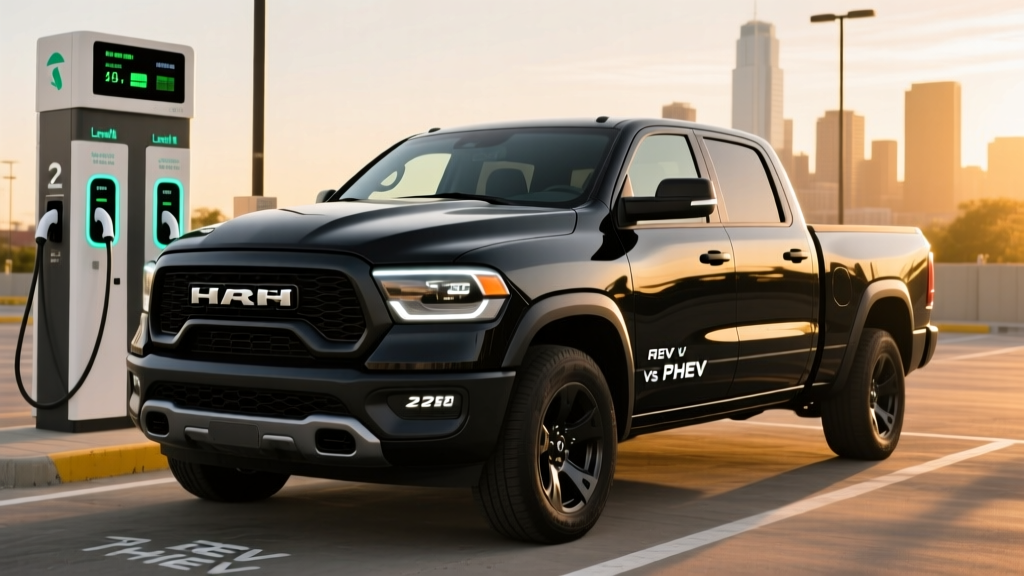
The full-size pickup segment has resisted electrification longer than almost any other, but the 2026 Ram 1500 lineup now offers two distinct hybrid-adjacent powertrains that matter for truck buyers: the Ram 1500 Ramcharger, a range-extended electric vehicle (EREV) with a gas engine that never drives the wheels, and the Ram 1500 with the Hurricane inline-six, which uses a 48-volt mild-hybrid system (eTorque) for efficiency gains without plug-in capability. Neither is a conventional plug-in hybrid (PHEV) in the Toyota RAV4 Prime sense, and that distinction matters enormously when you're comparing fuel economy, tax credits, and daily drivability.
This guide breaks down every electrified Ram 1500 option available for the 2026 model year — exact MPG figures, electric-only range, battery capacity, towing ratings, pricing, and whether any of these trucks qualify for federal tax incentives under current IRS §30D rules.
HEV vs PHEV vs EREV: Where the Ram 1500 Fits
Before diving into specs, it's essential to understand what type of hybrid each Ram 1500 variant actually is. Conflating these categories is the most common mistake truck shoppers make.
| Type | Plug-In? | Electric-Only Range | Ram 1500 Example |
|---|---|---|---|
| HEV (Hybrid) | No — charges via regenerative braking and engine | None (motor assists engine only) | Ram 1500 Hurricane I6 with eTorque 48V mild-hybrid |
| PHEV (Plug-In Hybrid) | Yes — plug in to charge a larger battery | Typically 20–50 miles | Not currently offered in Ram 1500 |
| EREV (Range-Extended EV) | Yes — plug in to charge; gas engine acts as generator only | ~145 miles (Ramcharger) | 2026 Ram 1500 Ramcharger |
The key difference: a conventional hybrid (HEV) like the Hurricane eTorque system never needs a plug — it recovers energy during braking and coasting to assist the engine. A PHEV has a larger battery you charge externally for meaningful electric-only driving before the engine kicks in. The Ramcharger is an EREV, which is closer to a battery-electric vehicle (BEV) with an onboard generator: the wheels are always driven by electric motors, and the gas engine only generates electricity to extend range.
2026 Ram 1500 Ramcharger (EREV): Electric Range, MPG, and Powertrain
The Ramcharger is the headline act. It pairs a 92 kWh usable battery pack with dual electric motors (full-time AWD) and a 3.6-liter Pentastar V6 that functions solely as a generator — it has no mechanical connection to the wheels.
| Specification | 2026 Ram 1500 Ramcharger |
|---|---|
| Powertrain Type | EREV (Range-Extended Electric Vehicle) |
| Combined Horsepower | 663 hp |
| Combined Torque | 615 lb-ft |
| Electric Motors | Dual (front + rear), full-time AWD |
| Battery Capacity | 92 kWh (usable), NMC chemistry |
| Electric-Only Range | EPA-estimated ~145 miles |
| Total Combined Range | EPA-estimated ~690 miles |
| Range Extender Engine | 3.6L Pentastar V6 (generator only) |
| Fuel Tank | 26 gallons |
| MPG (Engine Running) | ~20–22 MPG combined (estimated, generator mode) |
| MPGe (Electric Mode) | ~65 MPGe combined (estimated) |
| Max DC Fast Charge | ~150 kW peak |
| 10–80% DC Charge Time | ~35–40 minutes |
| Level 2 Charge Rate | ~11.5 kW |
| Level 2 Full Charge Time | ~8.5 hours |
| 0–60 mph | 4.4 seconds |
| Max Towing Capacity | ~14,000 lbs (when properly equipped) |
| Max Payload | ~2,625 lbs |
| Base MSRP | ~$69,995 (before destination, estimated) |
Real-World Range Reality Check: The EPA-estimated 145-mile electric range assumes moderate temperatures and mixed driving. Expect approximately 115–130 miles of electric range in highway-heavy driving (70+ mph), and as low as 95–110 miles in freezing temperatures (below 32°F) due to battery chemistry limitations and cabin heating draw. The 690-mile total range figure assumes the V6 generator runs at optimal efficiency — real-world total range with aggressive driving or heavy towing will be lower, closer to 500–580 miles.
The Ramcharger's dual-motor setup delivers 663 horsepower and 615 lb-ft of torque, making it the quickest Ram 1500 ever sold — the 4.4-second 0–60 time beats even the last-gen V8 Hemi models. But the real innovation is the series-hybrid architecture: because the V6 only generates electricity, it can run at its most efficient RPM regardless of vehicle speed, which improves fuel economy when the battery is depleted compared to a conventional truck engine that must respond to throttle demands directly.
Charging the Ramcharger
With a 150 kW peak DC fast-charging capability, the Ramcharger can add roughly 50 miles of electric range in about 10 minutes at a compatible station. However, like all large battery packs, the charge curve tapers significantly above 80% state of charge (SoC) — the final 20% can take nearly as long as the first 80%. For daily use, Level 2 home charging at 11.5 kW will replenish the full 92 kWh battery overnight in about 8.5 hours.
The Ramcharger uses the NACS (Tesla-style) connector for 2026, giving it access to the Tesla Supercharger network alongside Electrify America and other networks via adapter where needed.
2026 Ram 1500 Hurricane I6 with eTorque: The Mild-Hybrid Option
If you're not ready to plug in, the Hurricane twin-turbo inline-six with Ram's eTorque 48-volt mild-hybrid system is the more conventional choice. This is a true HEV — no plug, no electric-only driving. The 48V system provides torque fill during acceleration, smoother stop-start operation, and modest efficiency gains through regenerative braking.
| Configuration | City MPG | Highway MPG | Combined MPG |
|---|---|---|---|
| Hurricane I6 Standard Output (420 hp) 4×2 | 18 | 25 | 21 |
| Hurricane I6 Standard Output (420 hp) 4×4 | 17 | 24 | 20 |
| Hurricane I6 High Output (540 hp) 4×4 | 15 | 21 | 17 |
Source: fueleconomy.gov EPA estimates. Your actual mileage will vary based on driving conditions, terrain, and climate control use.
Real-World MPG vs EPA
Mild-hybrid systems like eTorque show their biggest advantage in stop-and-go city driving, where regenerative braking recaptures energy that would otherwise be lost. In real-world mixed suburban driving, owners report seeing 1–2 MPG above the EPA city figure. However, on sustained highway trips at 75+ mph, the mild-hybrid system provides minimal benefit — expect highway MPG to match or fall slightly below the EPA sticker, especially with larger tire packages, the 540 hp High Output tune, or when towing.
The Hurricane Standard Output at 420 hp and 21 MPG combined is a meaningful improvement over the outgoing 5.7L Hemi V8 (rated at roughly 17 MPG combined in 4×4 form), while delivering more torque (468 lb-ft vs 395 lb-ft). The High Output 540 hp version sacrifices economy for performance — its 17 MPG combined is comparable to a traditional V8 truck, but with significantly stronger acceleration.
Pricing, Trims, and Tax Credit Eligibility
Pricing for the 2026 Ram 1500 electrified lineup spans a wide range depending on powertrain and trim:
| Model | Starting MSRP (estimated) | Tax Credit Eligibility |
|---|---|---|
| Ram 1500 Hurricane I6 SO (eTorque) — Tradesman | ~$52,000 | Not eligible (conventional HEV) |
| Ram 1500 Hurricane I6 HO (eTorque) — Limited | ~$73,000 | Not eligible (conventional HEV) |
| Ram 1500 Ramcharger — R/T trim | ~$69,995 | Eligibility depends on sourcing rules |
| Ram 1500 Ramcharger — Laramie / Limited | ~$78,000–$85,000 | Eligibility depends on sourcing rules |
Federal Tax Credit: What Actually Applies
IRS §30D Clean Vehicle Credit — Key Rules for 2026:
- Vehicle type: Only plug-in vehicles (PHEVs and BEVs/EREVs) with ≥7 kWh battery qualify. The Hurricane eTorque mild-hybrid does NOT qualify — it has a small 48V battery, not a traction pack.
- MSRP cap: Trucks and SUVs must have an MSRP at or below $80,000. Higher-trim Ramchargers may exceed this limit.
- Buyer income cap: Adjusted gross income must not exceed $150,000 (single), $225,000 (head of household), or $300,000 (joint).
- Battery sourcing: Critical minerals and battery components must meet escalating domestic-sourcing percentages. Vehicles with battery cells or minerals from "foreign entities of concern" (FEOC) may be disqualified.
- Point-of-sale transfer: Eligible buyers can transfer the credit to the dealer for an upfront price reduction rather than claiming it on their tax return.
The Ramcharger's 92 kWh battery makes it a candidate for the §30D credit (up to $7,500), but eligibility hinges entirely on battery-sourcing compliance, which Stellantis has not fully confirmed for all trims. Always verify current eligibility on the fueleconomy.gov tax credit page and consult a tax professional before relying on the credit in your purchase decision. The Hurricane eTorque models, being conventional hybrids, are definitively not eligible for any federal plug-in vehicle credit.
Battery Warranty, Reliability, and Replacement Costs
Battery longevity is the top concern for any electrified vehicle buyer, and the answer differs significantly between the mild-hybrid Hurricane and the Ramcharger EREV.
| Coverage | Hurricane eTorque (48V) | Ramcharger (92 kWh HV Battery) |
|---|---|---|
| Hybrid/EV Battery Warranty | 8 years / 100,000 miles | 8 years / 100,000 miles (minimum 70% capacity retention) |
| Powertrain Warranty | 5 years / 60,000 miles | 5 years / 60,000 miles |
| Estimated Replacement Cost (out of warranty) | $1,500–$3,000 (48V pack) | $15,000–$22,000 (92 kWh pack) |
| Expected Battery Lifespan | 15+ years (small pack, low stress) | 15–20 years with proper care (NMC) |
The 48V eTorque system in the Hurricane trucks is low-risk: the battery pack is small (roughly 0.5 kWh equivalent), operates at low voltage, and experiences minimal cycling. Replacement cost is comparable to a traditional 12V battery upgrade — generally under $3,000. These systems have been in production since 2019 across Ram and Jeep models, and failure rates have been low.
The Ramcharger's 92 kWh NMC pack is a different story. NMC (nickel-manganese-cobalt) chemistry offers excellent energy density but is more sensitive to high-temperature degradation and frequent charging to 100% SoC. Ram warrants the pack for 70% capacity retention at 8 years/100,000 miles, which is the federal minimum for EV batteries. In practice, most NMC packs lose 10–15% capacity over the first 100,000 miles under normal use. To maximize longevity:
- Set daily charge limit to 80–90% SoC (use 100% only for long trips)
- Use preconditioning before DC fast charging to avoid cold-battery stress
- Avoid leaving the truck at 100% SoC for extended periods in hot weather
- Level 2 home charging is gentler on the pack than frequent DC fast charging
Out-of-warranty replacement for a 92 kWh pack is expensive — $15,000 to $22,000 based on current NMC cell pricing and labor. However, industry data shows that catastrophic battery failures within the warranty period are rare, and most degradation is gradual rather than sudden.
Ramcharger vs Hurricane eTorque vs Full EV: Which Truck Fits You?
Choose the Hurricane eTorque (HEV) if:
- You have no access to home or workplace charging
- You want a familiar refueling experience — gas stations only, no plugs
- Your daily driving is under 40 miles and you tow regularly on weekends
- Budget is a primary concern (starting ~$52K vs ~$70K for Ramcharger)
- You want the lowest complexity and proven powertrain reliability
Choose the Ramcharger (EREV) if:
- You can install a Level 2 home charger and want to drive electric daily
- Your commute is under 100 miles round-trip (covering most days on battery alone)
- You want EV-smooth acceleration and one-pedal driving around town
- You still need 690+ miles of total range for long road trips or remote job sites
- You want a potential $7,500 federal tax credit to offset the higher MSRP
Choose a full BEV (e.g., Ford F-150 Lightning, Rivian R1T, Silverado EV) if:
- You want zero tailpipe emissions and no gas engine maintenance whatsoever
- You have reliable home charging and your trips rarely exceed 250–300 miles
- You value lower long-term operating costs (electricity vs gasoline, no oil changes)
- You're willing to plan charging stops on longer road trips
The Ramcharger occupies a unique middle ground: it eliminates range anxiety entirely (the V6 generator ensures you'll never be stranded) while delivering genuine EV driving dynamics for daily commuting. For truck owners who need to tow long distances through areas with sparse charging infrastructure, this is a compelling advantage over a pure BEV. The trade-off is higher upfront cost, the complexity of maintaining both an electric powertrain and a gas engine, and the weight penalty of carrying both systems.
Towing, Payload, and Real-World Truck Capability
Electrified trucks face scrutiny on capability, and Ram's approach differs by powertrain:
| Capability | Hurricane I6 SO (eTorque) | Hurricane I6 HO (eTorque) | Ramcharger (EREV) |
|---|---|---|---|
| Max Towing | ~11,580 lbs | ~9,100 lbs | ~14,000 lbs |
| Max Payload | ~2,300 lbs | ~1,800 lbs | ~2,625 lbs |
The Ramcharger's 14,000-lb tow rating is impressive on paper, but towing at max capacity will dramatically reduce electric range — expect electric-only range to drop to 40–60 miles when towing near the limit, with the V6 generator kicking in much sooner. Total range while towing heavy loads will likely fall to 300–400 miles. The Hurricane models maintain more predictable range behavior under load since their efficiency degrades more linearly.
Ownership Costs: 5-Year Outlook
A realistic 5-year cost comparison requires assumptions about driving patterns, fuel prices, and electricity rates. Here's a framework based on 15,000 miles/year, $3.50/gallon regular fuel, and $0.14/kWh home electricity:
| Cost Factor | Hurricane I6 SO (eTorque) 4×4 | Ramcharger (EREV) |
|---|---|---|
| 5-Year Fuel/Energy Cost | ~$12,500 (gasoline only) | ~$6,800 (electricity + gasoline mix, assuming 70% electric driving) |
| Maintenance (5 years) | ~$3,200 (oil changes, filters, spark plugs) | ~$2,400 (less engine runtime, but dual-system complexity) |
| Insurance (estimated annual) | ~$1,800–$2,200/year | ~$2,200–$2,800/year (higher vehicle cost) |
| Potential Tax Credit | $0 | Up to $7,500 (if eligible) |
The Ramcharger's energy savings are substantial if you can charge at home and drive mostly within its electric range. The break-even point versus the Hurricane depends heavily on your local electricity rate, how much you drive on electric vs. generator power, and whether you qualify for the federal credit. For a buyer who commutes 40 miles daily on battery and takes a handful of long road trips, the Ramcharger could save $4,000–$6,000 in energy costs over five years — partially offsetting its higher purchase price.
Frequently Asked Questions
How many MPG does the hybrid Ram 1500 get?
The Hurricane I6 Standard Output with eTorque achieves an EPA-estimated 21 MPG combined (18 city / 25 highway) in 4×2 configuration and 20 MPG combined in 4×4. The High Output 540 hp version drops to 17 MPG combined. The Ramcharger doesn't have a traditional MPG rating — it delivers ~65 MPGe in electric mode and roughly 20–22 MPG when the V6 generator is running.
How far can the Ramcharger go on electric only?
The EPA-estimated electric-only range is approximately 145 miles. In real-world highway driving at 70+ mph, expect 115–130 miles. In cold weather (below freezing), plan for 95–110 miles of electric range. Once the battery depletes, the V6 generator extends total range to an estimated 690 miles.
Does the Ramcharger need to be plugged in?
You don't have to plug it in — the V6 generator will keep the battery charged and the truck driving. However, to benefit from the electric range, lower operating costs, and reduced engine wear, plugging in at home (Level 2) is strongly recommended. Without plug-in charging, you're essentially driving a heavy series-hybrid and losing the primary economic advantage.
Does the hybrid Ram 1500 qualify for a tax credit?
The Hurricane eTorque mild-hybrid does NOT qualify for any federal plug-in vehicle tax credit — it is a conventional HEV. The Ramcharger EREV may qualify for up to $7,500 under IRS §30D, but eligibility depends on MSRP (must be ≤$80,000 for trucks), buyer income limits, and battery-sourcing compliance. Always check fueleconomy.gov and consult a tax professional for your specific situation.
Is the hybrid Ram 1500 reliable? What about battery replacement cost?
The Hurricane eTorque system has been in production since 2019 and has demonstrated low failure rates. The 48V battery replacement costs $1,500–$3,000 out of warranty. The Ramcharger is a new platform, so long-term reliability data is not yet available; the 92 kWh NMC pack carries an 8-year/100,000-mile warranty, and out-of-warranty replacement is estimated at $15,000–$22,000. Both trucks include a 5-year/60,000-mile powertrain warranty.
Can I tow with the Ramcharger?
Yes — the Ramcharger is rated for up to ~14,000 lbs when properly equipped. However, towing near max capacity will drastically reduce electric-only range (to roughly 40–60 miles) and total combined range (to approximately 300–400 miles). For frequent heavy towing, the Hurricane eTorque may offer more predictable range behavior, though at a lower max tow rating.
What's the difference between the Ramcharger and the Ford F-150 PowerBoost hybrid?
The F-150 PowerBoost is a conventional full hybrid (HEV) — no plug, no electric-only range. Its 3.5L V6 and electric motor work together to drive the wheels, achieving roughly 23–25 MPG combined. The Ramcharger is an EREV — the gas engine never drives the wheels, it only generates electricity. The Ramcharger offers 145 miles of electric-only driving but costs significantly more and requires plug-in access to realize its efficiency benefits.
Ram 1500 Ramcharger (EREV) — Pros
- 145 miles electric-only range eliminates most daily gas use
- 690-mile total range removes range anxiety on road trips
- 663 hp and 4.4-second 0–60 — quickest Ram 1500 ever
- 14,000-lb tow rating leads the electrified truck segment
- Potential $7,500 federal tax credit (eligibility varies)
Ram 1500 Ramcharger (EREV) — Cons
- Starting MSRP near $70K — premium over Hurricane models
- Heavy dual-system complexity (EV powertrain + gas generator)
- Towing significantly cuts electric range
- No long-term reliability data yet on the EREV platform
- Out-of-warranty battery replacement: $15,000–$22,000