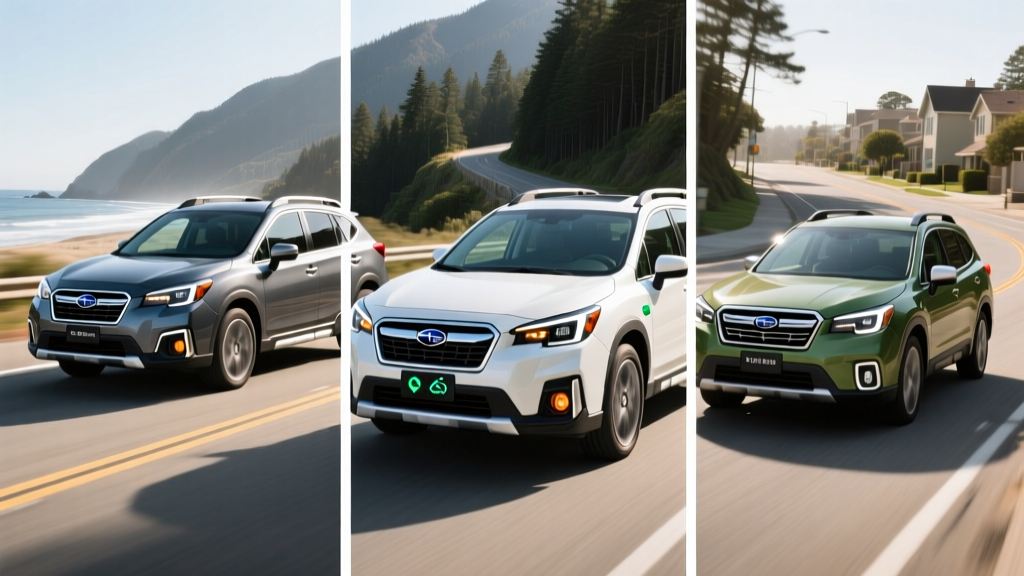
If you've searched for Subaru hybrid MPG hoping to find a plug-in option, here's the straight answer: as of the 2026 model year, Subaru's U.S. lineup relies exclusively on conventional hybrid (HEV) powertrains. There's no Crosstrek Plug-In, no Forester PHEV, and no Outback Prime. Subaru discontinued its sole plug-in — the Crosstrek Hybrid PHEV — after the 2023 model year, and has not reintroduced one since. What you can buy is a growing roster of mild-to-strong conventional hybrids that pair Subaru's signature all-wheel drive with meaningful fuel-economy gains over their gas-only counterparts.
This guide covers the real MPG numbers, the powertrain details, the ownership economics, and the decision framework for whether a Subaru HEV, a competitor's PHEV, or a full EV is the right call for your driveway.
HEV vs PHEV: What Subaru Actually Sells in 2026
Before parsing the MPG tables, it's essential to distinguish the two hybrid categories — because Subaru only plays in one of them.
Conventional Hybrid (HEV) — What Subaru Offers
- Small battery (typically 0.5–1.5 kWh) charged by the engine and regenerative braking
- No plug, no charging cable, no home charger needed
- Electric motor assists the gas engine; brief EV-only driving at low speeds
- Fuel economy improvement: 15–35% over the gas-only equivalent
- No federal §30D tax credit eligibility
Plug-In Hybrid (PHEV) — Not Currently in Subaru's Lineup
- Larger battery (10–20+ kWh) that charges via plug (Level 1 or Level 2)
- 20–40+ miles of electric-only driving before the gas engine engages
- Combined electric + gas range often exceeds 400 miles
- May qualify for the federal §30D tax credit (up to $7,500) if MSRP, income, and battery-sourcing rules are met
- Examples: Toyota RAV4 Prime, Hyundai Tucson PHEV, Jeep Wrangler 4xe
The practical upshot: if you want a Subaru with electrified efficiency, you're choosing a self-charging hybrid. If you need plug-in electric range, you'll be shopping a different brand — or waiting to see if Subaru's announced partnership with Toyota yields a future PHEV product.
2026 Subaru Hybrid MPG: Full Lineup Breakdown
Subaru expanded its hybrid offerings significantly for 2025–2026, introducing hybrid variants across the Crosstrek, Forester, and Outback. Below are the official EPA figures from fueleconomy.gov, paired with the gas-only baselines for context.
| Model (2026) | Powertrain | EPA City | EPA Highway | EPA Combined | Combined HP | Starting MSRP |
|---|---|---|---|---|---|---|
| Crosstrek Hybrid | 2.5L 4-cyl + electric motor (HEV) | 36 | 34 | 35 | 194 hp | $30,495 |
| Crosstrek (gas baseline) | 2.5L 4-cyl | 27 | 34 | 29 | 182 hp | $27,195 |
| Forester Hybrid | 2.5L 4-cyl + electric motor (HEV) | 35 | 33 | 34 | 194 hp | $36,495 |
| Forester (gas baseline) | 2.5L 4-cyl | 26 | 33 | 29 | 180 hp | $31,995 |
| Outback Hybrid | 2.5L 4-cyl + electric motor (HEV) | 33 | 30 | 32 | 194 hp | $39,995 |
| Outback (gas baseline) | 2.5L 4-cyl | 26 | 32 | 28 | 182 hp | $34,795 |
All three hybrids use Subaru's updated e-Boxer hybrid system mated to a Lineartronic CVT and Symmetrical All-Wheel Drive. The electric motor is integrated into the transmission housing, providing low-speed electric assist and regenerative braking without adding a second axle or a large battery pack.
Real-World MPG: How Subaru Hybrids Actually Perform
EPA stickers tell part of the story. In practice, conventional hybrids — Subaru's included — tend to exceed their EPA city ratings in stop-and-go traffic, where the electric motor does the most work and regenerative braking recaptures energy constantly. Highway driving is a different equation: at sustained 70–80 mph speeds, the gas engine carries nearly all the load, and real-world MPG often lands 2–4 MPG below the EPA highway figure.
What to Expect in Actual Driving
- City / suburban commuting: Crosstrek Hybrid owners commonly report 36–39 MPG — meeting or beating the 36 city EPA rating. The Forester Hybrid tracks similarly at 34–37 MPG in urban cycles.
- Highway cruising (70–80 mph): Expect 30–32 MPG in the Crosstrek Hybrid and 29–31 MPG in the Outback Hybrid. Aerodynamic drag at speed erodes the hybrid advantage.
- Cold weather (below 30°F): Hybrid MPG drops 10–15% in winter. The engine runs more frequently to heat the cabin and keep the catalytic converter at operating temperature. Plan for 28–31 combined MPG in the Crosstrek Hybrid during January in the northern U.S.
- Mountain / high-altitude driving: Subaru's AWD hybrid system handles elevation changes well, but sustained climbs will push fuel consumption to 22–26 MPG. Descents with regen braking partially recover the deficit.
The hybrid premium makes the most sense for drivers whose daily route includes significant low-speed and stop-start segments. If your commute is 90% interstate at 75 mph, the MPG gap between the hybrid and gas Crosstrek narrows considerably.
Powertrain Details: The e-Boxer Hybrid System
Subaru's e-Boxer pairs a naturally aspirated 2.5-liter flat-four (Boxer) engine with an electric motor integrated into the CVT transmission. Here's the mechanical breakdown:
| Specification | Detail |
|---|---|
| Engine | 2.5L horizontally opposed 4-cylinder (FB25) |
| Engine output | 182 hp / 178 lb-ft torque |
| Electric motor | Integrated in CVT, ~12 hp / 49 lb-ft assist |
| Combined system output | 194 hp |
| Hybrid battery | ~1.1 kWh lithium-ion (self-charging, no plug) |
| Transmission | Lineartronic CVT with manual mode |
| Drivetrain | Symmetrical All-Wheel Drive (standard) |
| 0–60 mph | ~8.5 sec (Crosstrek Hybrid), ~8.8 sec (Forester Hybrid) |
| Towing capacity | 1,500 lbs (Crosstrek), 1,500 lbs (Forester Hybrid) |
The 1.1 kWh battery is small by PHEV or EV standards, but it's sufficient for the hybrid's role: smoothing out stop-start, providing electric torque fill at low RPM, and enabling brief engine-off coasting. It charges entirely through regenerative braking and engine-driven generation — you never plug it in.
Compared to Toyota's Hybrid Synergy Drive (as used in the RAV4 Hybrid), Subaru's system prioritizes AWD capability and off-road traction over maximum efficiency. The result is slightly lower combined MPG than a RAV4 Hybrid's 39 MPG combined, but with Subaru's X-Mode terrain management and 8.7 inches of ground clearance on the Crosstrek.
Battery Warranty, Lifespan, and Replacement Cost
Battery longevity is the top concern for hybrid buyers, and it's worth addressing directly. Subaru's hybrid battery is a sealed lithium-ion pack designed to last the life of the vehicle under normal use.
Subaru Hybrid Battery Warranty
- Hybrid battery warranty: 8 years / 100,000 miles (whichever comes first)
- In California and states adopting CARB emissions standards: 10 years / 150,000 miles for hybrid components
- Capacity threshold: Warranty covers defects and abnormal degradation; Subaru does not publish a specific capacity-retention percentage trigger as EV manufacturers do
- Powertrain warranty: 5 years / 60,000 miles (covers engine, transmission, and hybrid motor)
Real-world data from Subaru's earlier hybrid models (the 2014–2023 Crosstrek Hybrid PHEV and the XV Hybrid) shows hybrid battery packs routinely lasting 150,000–200,000+ miles without significant degradation. The small battery in a conventional HEV undergoes shallower charge-discharge cycles than a PHEV or EV battery, which reduces stress on the cells.
If replacement is needed out of warranty, expect a dealer-installed hybrid battery pack to cost between $2,500 and $4,000 including labor. Independent hybrid specialists often offer refurbished packs for $1,500–$2,500. For context, this is dramatically less than EV battery replacement ($8,000–$20,000+) because the HEV pack is roughly 1/50th the capacity.
Who Should Choose a Subaru Hybrid vs. a PHEV or Full EV?
The right choice depends on your charging access, daily mileage, and how you use your vehicle. Here's a practical decision framework:
Choose a Subaru Hybrid (HEV) If:
- You don't have access to home or workplace charging (apartment, street parking, no garage outlet)
- You want AWD capability for snow, dirt roads, or trailheads without an efficiency penalty
- Your daily driving is under 60 miles and you want better fuel economy without behavior changes
- You want a lower purchase price and zero charging-cable management
- You regularly drive in areas with sparse public charging infrastructure
Choose a Competitor's PHEV If:
- You have reliable Level 2 home charging and a daily commute under 35 miles
- You want electric-only driving for daily errands but gas-engine range for road trips
- You qualify for the §30D federal tax credit (see eligibility rules below)
- Models to consider: Toyota RAV4 Prime (42 mi EV range, 94 MPGe), Hyundai Tucson PHEV (33 mi EV range)
Choose a Full EV (BEV) If:
- You have home Level 2 charging and your daily driving is under 250 miles
- You want zero tailpipe emissions and the lowest per-mile fuel cost
- You're ready for the maintenance-free powertrain and the charging-curve learning curve
- Models to consider: Hyundai Ioniq 5 (311 mi EPA), Tesla Model Y (310 mi EPA), Subaru Solterra (228 mi EPA — Subaru's only current BEV, co-developed with Toyota)
Federal Tax Credits: Do Subaru Hybrids Qualify?
Under the current IRS §30D rules for 2026, conventional hybrids (HEVs) do not qualify for the federal clean vehicle tax credit. The credit applies only to battery electric vehicles (BEVs) and plug-in hybrids (PHEVs) that meet specific battery capacity, critical mineral sourcing, MSRP, and buyer income thresholds.
Since Subaru does not currently sell a PHEV or qualify its BEV (the Solterra) under the latest sourcing requirements, there is effectively no federal tax credit available for new Subaru purchases as of early 2026. This is a meaningful cost consideration when comparing a Subaru hybrid against, say, a RAV4 Prime or a Ford Escape PHEV that may still qualify for up to $7,500 at point of sale.
Some states offer their own rebates for hybrids — check your state energy office or the Alternative Fuels Data Center for current state-level incentives. These vary widely and change frequently, so always confirm before purchasing.
5-Year Ownership Cost: Subaru Hybrid vs. Gas vs. EV
The hybrid premium over the gas model ranges from $3,300 (Crosstrek) to $5,200 (Outback). Whether that pays for itself depends on your mileage and local gas prices.
| Cost Factor (5 yrs / 75,000 mi) | Crosstrek Hybrid ($30,495) | Crosstrek Gas ($27,195) | Ioniq 5 EV ($42,600) |
|---|---|---|---|
| Purchase price | $30,495 | $27,195 | $42,600 |
| Federal tax credit | $0 | $0 | $0–$7,500* |
| Fuel/energy cost | ~$5,800 (gas, $3.40/gal avg) | ~$7,500 (gas, $3.40/gal avg) | ~$3,200 (electricity, $0.14/kWh avg) |
| Maintenance | ~$2,800 | ~$3,200 | ~$1,500 |
| Estimated insurance (5 yr) | ~$7,500 | ~$7,200 | ~$8,800 |
| 5-year total (before credit) | ~$54,095 | ~$52,295 | ~$56,100 |
*Ioniq 5 §30D credit eligibility depends on current-year sourcing and income rules. Confirm at irs.gov before purchase.
The Crosstrek Hybrid saves roughly $1,700 in fuel over five years versus the gas model, but the $3,300 price premium means you don't fully break even at the pump alone. The payoff comes from lower emissions, slightly stronger acceleration, and potentially better resale value as hybrid demand grows.
Pros and Cons: Subaru Hybrid Ownership
Pros
- 35 MPG combined (Crosstrek) with standard AWD — rare in the compact crossover segment
- No plug required; zero charging infrastructure dependency
- Subaru's X-Mode and 8.7" ground clearance retained for light off-road use
- Hybrid battery warranty of 8 yr / 100,000 mi (10 yr / 150,000 mi in CARB states)
- City MPG often exceeds EPA rating in real-world stop-and-go driving
- Lower maintenance costs than gas-only models (less brake wear from regen, no plug complexity)
Cons
- No PHEV option — cannot drive on electric-only power for meaningful distances
- No federal tax credit eligibility (unlike competing PHEVs and EVs)
- Highway MPG advantage over gas model is modest (30–32 vs 32 for gas Crosstrek)
- Hybrid premium of $3,300–$5,200 takes 4–6 years to recoup through fuel savings alone
- Towing capacity limited to 1,500 lbs (unchanged from gas models)
- CVT drone under hard acceleration remains a Subaru hallmark
Frequently Asked Questions
How many MPG does the 2026 Subaru Crosstrek Hybrid get?
The EPA rates the 2026 Crosstrek Hybrid at 36 city / 34 highway / 35 combined MPG. In real-world city driving, many owners report 36–39 MPG. Highway driving at 75 mph typically yields 30–32 MPG. Cold weather reduces combined efficiency by 10–15%.
Does Subaru make a plug-in hybrid in 2026?
No. Subaru discontinued the Crosstrek Hybrid PHEV after the 2023 model year and has not introduced a replacement plug-in hybrid as of 2026. All current Subaru hybrids are conventional (HEV) — they self-charge through regenerative braking and the engine, with no plug-in capability.
How far can a Subaru hybrid drive on electric-only power?
Subaru's current HEV system can operate on electric power alone for only very short distances — typically under 1 mile at speeds below 25 mph. This is designed for low-speed maneuvering and stop-start smoothing, not meaningful electric-only commuting. For 20–40 miles of electric range, you'd need a PHEV from another brand.
Is the Subaru hybrid battery reliable, and what does replacement cost?
Subaru's hybrid batteries have proven reliable, with many lasting 150,000–200,000+ miles based on data from earlier hybrid models. The battery is covered by an 8-year / 100,000-mile warranty (10 years / 150,000 miles in CARB states). Out-of-warranty replacement costs $2,500–$4,000 at a dealer, or $1,500–$2,500 from an independent hybrid specialist using refurbished cells.
Does the 2026 Subaru hybrid qualify for any tax credit?
No. Under current IRS §30D rules, conventional hybrids (HEVs) are not eligible for the federal clean vehicle tax credit. Only plug-in hybrids (PHEVs) and battery electric vehicles (BEVs) can qualify, subject to MSRP caps ($55,000 for cars, $80,000 for SUVs/trucks), buyer income limits, and battery-sourcing requirements. Some states may offer separate hybrid rebates — check the Alternative Fuels Data Center for details.
How does the Subaru Forester Hybrid MPG compare to the Toyota RAV4 Hybrid?
The 2026 Forester Hybrid achieves 34 MPG combined (35 city / 33 highway), while the Toyota RAV4 Hybrid achieves 39 MPG combined (41 city / 38 highway) per EPA estimates on fueleconomy.gov. The RAV4 Hybrid's efficiency advantage comes from Toyota's more mature hybrid system and a slightly lighter platform. The Forester Hybrid's trade-off is Subaru's superior ground clearance (8.7" vs 8.1"), X-Mode terrain system, and standard EyeSight safety suite.
Should I buy a Subaru hybrid or just go full electric?
It depends on your charging access and driving patterns. If you have home Level 2 charging, drive under 250 miles daily, and want the lowest per-mile cost, a full EV like the Hyundai Ioniq 5 or Tesla Model Y is more efficient long-term. If you lack charging access, frequently drive in remote areas, or need worry-free AWD without range planning, the Subaru hybrid delivers meaningful MPG gains with zero lifestyle changes.
Bottom Line: Subaru Hybrid MPG in Context
Subaru's 2026 hybrid lineup delivers a genuine fuel-economy upgrade — 35 MPG combined in the Crosstrek Hybrid is a 21% improvement over the gas model — without requiring any change to how you fuel or maintain your vehicle. The e-Boxer system is proven, the AWD capability is uncompromised, and the hybrid battery warranty provides long-term peace of mind.
The gap in Subaru's strategy is the absence of a PHEV. Competitors like Toyota (RAV4 Prime: 42 miles EV, 94 MPGe) and Hyundai (Tucson PHEV: 33 miles EV) offer plug-in options that dramatically cut fuel use for drivers with home charging — and may qualify for federal tax credits that Subaru's hybrids cannot. If plug-in electric range matters to you, Subaru doesn't yet have an answer.
But if your priority is simple — better MPG, standard AWD, no plug, no hassle — the 2026 Subaru hybrid lineup is one of the most practical ways to cut fuel costs without cutting capability.