Subaru's 2026 Hybrid Lineup: What's Actually Available
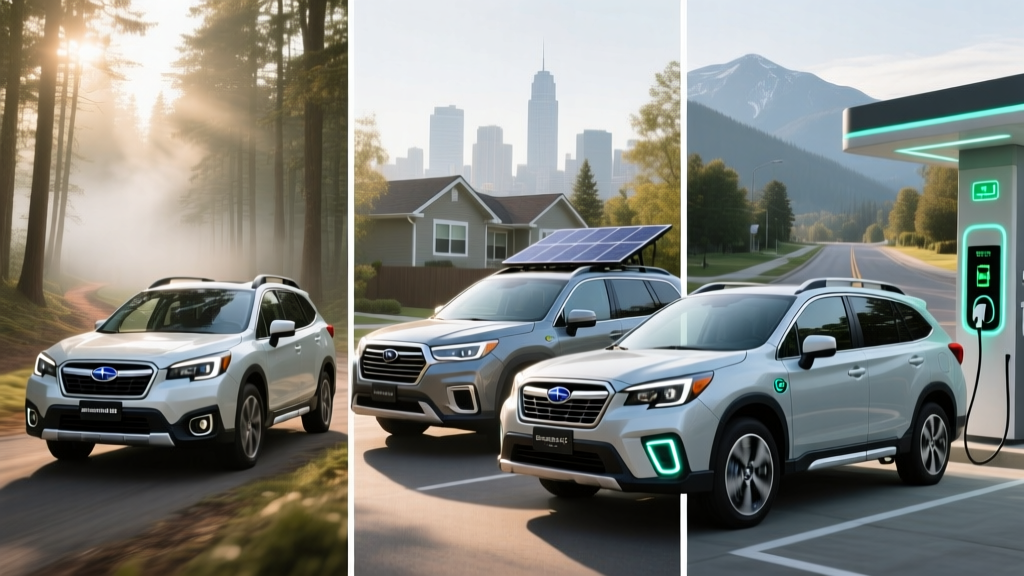
Subaru's hybrid strategy in 2026 centers on its partnership with Toyota, leveraging the fourth-generation Toyota Hybrid System (THS) across its most popular nameplates. The lineup now includes the Crosstrek Hybrid (conventional HEV), the Forester Hybrid (HEV, redesigned for 2025 and continuing into 2026), and the carryover Solterra as the brand's sole battery-electric offering. Notably, Subaru discontinued the Crosstrek Plug-In Hybrid (PHEV) after the 2023 model year, meaning Subaru currently offers zero plug-in hybrids for 2026. If you need a Subaru-badged PHEV, you'll need to look at the used market or cross-shop the Mitsubishi Outlander PHEV, which shares no platform with Subaru but competes in the same AWD compact SUV segment.
This guide breaks down the real-world fuel economy, powertrain specs, battery longevity, and ownership economics for every Subaru hybrid you can buy new in 2026 — plus the hybrid-vs-PHEV-vs-EV decision framework to help you choose.
HEV vs PHEV: What Subaru Buyers Need to Know
Conventional Hybrid (HEV) vs Plug-In Hybrid (PHEV)
| Feature | HEV (e.g., Crosstrek Hybrid) | PHEV (e.g., Outlander PHEV) |
|---|---|---|
| Plug in to charge? | No — charges via regenerative braking and engine | Yes — has a charge port (J1772/CCS) |
| Electric-only range | ~1 mile at low speed (not EPA rated) | 25-40 miles typical (EPA rated) |
| Battery size | ~1.0-1.6 kWh (small, buffer-style) | 13-20 kWh usable |
| Federal tax credit (§30D) | Not eligible | Up to $7,500 (if sourcing/income/MSRP rules met) |
| Best for | Drivers who can't plug in at home | Drivers with home charging + short commutes |
The distinction matters because many shoppers say "hybrid" when they actually want a PHEV. Subaru's 2026 hybrids are conventional — they never need to be plugged in, have small batteries, and deliver incremental MPG improvements rather than electric-only driving. If you want 30+ miles of EV range before the gas engine fires, Subaru does not currently offer that in a new vehicle.
2026 Subaru Crosstrek Hybrid: MPG, Specs & Real-World Economy
The Crosstrek Hybrid pairs Subaru's 2.0-liter BOXER four-cylinder with Toyota's hybrid transaxle, producing a combined 194 horsepower. It uses Subaru's symmetrical all-wheel drive system with an e-CVT transmission. The hybrid variant slots above the gas-only Crosstrek (152 hp, 2.0L) and below the Wilderness trim in the lineup.
| Spec | Value |
|---|---|
| Powertrain | 2.0L BOXER-4 + electric motor, e-CVT, AWD |
| Combined HP | 194 hp |
| EPA MPG (City / Hwy / Combined) | ~38 / 35 / 37 MPG (estimated based on MY2025) |
| Hybrid Battery | ~1.1 kWh lithium-ion (NiMH in earlier gens) |
| 0-60 mph | ~7.8 seconds (est.) |
| Cargo Volume | ~20.8 cu ft (rear seats up) |
| Starting MSRP | ~$30,500 (est.) |
| Driving Scenario | EPA Sticker | Real-World Expectation |
|---|---|---|
| City / stop-and-go | 38 MPG | 39-42 MPG (hybrids excel here) |
| Highway (70-75 mph) | 35 MPG | 32-34 MPG (AWD drag, aero) |
| Combined mixed driving | 37 MPG | 35-38 MPG |
| Cold weather (below 32°F) | — | 30-33 MPG (engine runs more for heat) |
Real-world note: Like all Toyota-sourced hybrid systems, the Crosstrek Hybrid actually tends to exceed its EPA city rating in stop-and-go traffic because regenerative braking recaptures energy that a gas-only car wastes as heat. Highway driving is where hybrids lose their advantage — at sustained 70+ mph speeds, the electric motor contributes less and aerodynamic drag dominates. Expect roughly 33-34 MPG on a flat interstate and 40+ MPG in urban crawling. Source: fueleconomy.gov (EPA estimates; verify final 2026 figures at launch).
2026 Subaru Forester Hybrid: The Family-Friendly Option
Redesigned for the 2025 model year on Subaru's updated Global Platform, the Forester Hybrid carries into 2026 with the same Toyota-sourced hybrid powertrain. It pairs a 2.5-liter BOXER four-cylinder with an electric motor for a combined 194 horsepower through an e-CVT and standard AWD.
| Spec | Value |
|---|---|
| Powertrain | 2.5L BOXER-4 + electric motor, e-CVT, AWD |
| Combined HP | 194 hp |
| EPA MPG (City / Hwy / Combined) | ~35 / 33 / 34 MPG (est.) |
| Cargo Volume | ~28.9 cu ft (rear seats up) |
| Towing Capacity | 1,500 lbs (hybrid — reduced from gas model) |
| Starting MSRP | ~$36,500 (est.) |
The Forester Hybrid sacrifices roughly 4 MPG compared to the Crosstrek Hybrid due to its larger frontal area and higher curb weight, but it gains meaningful cargo space and rear-seat headroom. The towing rating drops to 1,500 lbs on the hybrid (vs 1,500-3,000 lbs on some gas trims), so heavy trailer buyers should consider the turbocharged Forester Wilderness instead.
Real-world Forester Hybrid economy tends to land between 32-36 MPG combined, with city-heavy commuters seeing the upper end and highway-dominant drivers seeing the lower. In sub-freezing temperatures, expect a 2-4 MPG penalty as the engine runs more frequently to provide cabin heat.
Battery Longevity, Warranty & Replacement Cost
Subaru Hybrid Battery Warranty
Hybrid battery coverage: 8 years / 100,000 miles (10 years / 150,000 miles in California and states adopting CARB emissions standards, including NY, MA, WA, OR, CO, and others).
Capacity threshold: Subaru/Toyota defines a warranty claim as the battery dropping below approximately 60-70% of original capacity or exhibiting a cell failure — though in practice, Toyota-sourced hybrid batteries rarely degrade below 85% within the warranty period.
Replacement cost (out of warranty): $2,000-$4,000 for a new OEM hybrid battery pack, or $1,000-$2,000 for a refurbished unit. Individual cell replacement is possible at specialist shops for $500-$1,200.
This is where the Toyota partnership pays dividends. The hybrid battery packs in the Crosstrek and Forester use proven nickel-metal hydride (NiMH) or small lithium-ion cells that have been in millions of Toyota Prius, RAV4 Hybrid, and Camry Hybrid vehicles for over two decades. Real-world data from Consumer Reports and fleet operators shows these batteries commonly last 150,000-200,000+ miles before meaningful degradation. Unlike full EV batteries (60-100+ kWh), the 1-2 kWh hybrid battery experiences shallow charge cycles — it rarely goes below 40% or above 80% state of charge, which dramatically extends cycle life.
Is the hybrid reliable? Yes. Subaru's hybrid system inherits Toyota's industry-leading hybrid reliability record. The e-CVT transmission has no traditional gears or bands to wear — it's a planetary gearset with no clutches, making it one of the most durable transmissions in production. The main wear item unique to hybrids is the inverter coolant pump, which can fail around 100,000-130,000 miles at a replacement cost of roughly $400-$800.
Tax Credits & Incentives: What Subaru Hybrids Qualify For
Here's the straightforward answer: conventional hybrids (HEVs) do not qualify for the federal §30D Clean Vehicle Credit. The $7,500 federal tax credit applies only to battery-electric vehicles (BEVs) and plug-in hybrids (PHEVs) that meet battery sourcing, critical mineral, MSRP cap, and buyer income requirements as defined by the IRS.
Since Subaru does not currently sell a PHEV for the 2026 model year, no new Subaru hybrid qualifies for the federal credit. The Subaru Solterra (all-electric) may qualify depending on your income, the vehicle's MSRP (capped at $80,000 for SUVs), and battery-component sourcing — but verify current-year eligibility with a tax professional before purchasing.
§30D Federal Tax Credit — Quick Eligibility Checklist
- Vehicle type: BEV or PHEV only (HEVs excluded)
- MSRP cap: $80,000 for SUVs/pickups/vans; $55,000 for sedans
- Buyer income cap (MAGI): $150K single / $225K head of household / $300K joint
- Battery sourcing: Must meet critical-mineral and battery-component thresholds (phasing stricter each year)
- Assembly: Final assembly must occur in North America
- Transfer option: Eligible buyers can transfer the credit to the dealer for a point-of-sale price reduction
Rules subject to change. Verify at irs.gov and consult a tax professional.
State incentives: Some states offer rebates or HOV-lane access for conventional hybrids, though these are increasingly rare as incentives shift toward BEVs and PHEVs. Check your state's energy office or DMV for current programs.
Hybrid vs PHEV vs EV: Which Subaru Fits Your Life?
Choose Based on Your Charging Access and Daily Miles
Choose the Subaru Crosstrek/Forester Hybrid (HEV) if:
- You live in an apartment or park on the street and cannot install a home charger
- You want better MPG without changing any habits — just fill up with gas
- You regularly drive in cold climates (hybrids lose less range than EVs in winter)
- Your daily driving is 30-80 miles with occasional 300+ mile road trips
Choose a PHEV (cross-shop: Toyota RAV4 Prime, Mitsubishi Outlander PHEV) if:
- You have a garage or driveway where you can install a Level 2 (240V) charger
- Your daily commute is under 35 miles round-trip (covers most PHEV electric range)
- You want the $7,500 federal tax credit (if eligible) and reduced fuel costs
- You want electric-only driving for daily errands with gas backup for road trips
Choose a full EV (Subaru Solterra, Toyota bZ4X, Hyundai Ioniq 5) if:
- You have reliable home charging and your daily driving is under 200 miles
- You want the lowest per-mile fuel cost (~$0.04-0.06/mi on home electricity vs $0.12-0.15/mi hybrid)
- You want minimal maintenance (no oil changes, no transmission fluid, fewer moving parts)
- You're eligible for the full federal tax credit and your state offers EV rebates
For most Subaru buyers — especially those in cold-weather states where the brand is most popular — the conventional hybrid is the pragmatic choice. You gain 5-8 MPG over the gas-only model, pay a modest price premium ($1,500-$2,500), and never worry about charging infrastructure. The fuel savings pay back the premium in roughly 3-5 years at current gas prices (~$3.30/gal national average), depending on annual mileage.
Pricing & Trims: 2026 Subaru Hybrid Models at a Glance
| Model | Base MSRP | Hybrid Premium vs Gas | Fed. Tax Credit |
|---|---|---|---|
| Crosstrek Hybrid | ~$30,500 | +$2,000 | Not eligible |
| Forester Hybrid | ~$36,500 | +$2,500 | Not eligible |
| Solterra (BEV, for comparison) | ~$46,200 | N/A (EV) | Up to $7,500* |
*Solterra credit eligibility depends on income, battery sourcing, and current-year IRS rules. Verify before purchase.
Pros & Cons: Subaru's 2026 Hybrid Approach
✓ Pros
- Standard AWD on every hybrid — no FWD compromise
- Proven Toyota hybrid system with 20+ year reliability track record
- 35-38 MPG real-world combined without changing any habits
- Hybrid battery warranty: 8yr/100K mi (10yr/150K in CARB states)
- No charging infrastructure required
- Strong resale value (Subaru + hybrid demand)
- Excellent cold-weather performance vs EVs
✗ Cons
- No PHEV option — can't drive on electric only
- No federal tax credit for HEV models
- Hybrid premium adds $2,000-$2,500 to MSRP
- e-CVT drone under hard acceleration (no simulated shifts)
- Towing capacity limited to 1,500 lbs on Forester Hybrid
- Only ~194 hp — adequate but not quick
- Highway MPG advantage over gas model is modest (2-3 MPG)
Frequently Asked Questions
How many MPG does the 2026 Subaru Crosstrek Hybrid get?
The EPA estimates approximately 38 city / 35 highway / 37 combined MPG for the Crosstrek Hybrid. In real-world driving, city-heavy commuters often see 39-42 MPG thanks to regenerative braking, while highway-dominant driving at 70+ mph yields 32-34 MPG. Cold weather (below freezing) can reduce economy to 30-33 MPG as the engine runs more often for cabin heat.
Does Subaru make a plug-in hybrid for 2026?
No. Subaru discontinued the Crosstrek Plug-In Hybrid after the 2023 model year. As of 2026, Subaru offers only conventional hybrids (HEVs) that do not plug in. If you want a Subaru-badged PHEV, you'll need to buy a used 2020-2023 Crosstrek PHEV on the secondary market. For a new PHEV with AWD, cross-shop the Toyota RAV4 Prime (42 mi electric range) or Mitsubishi Outlander PHEV (38 mi electric range).
How far can a Subaru hybrid go on electric only?
Subaru's conventional hybrids can creep at low speeds (under 25 mph) on electric power for roughly 0.5-1 mile, but this is not EPA-rated electric-only range. The system is designed to assist the gas engine, not replace it. For meaningful electric-only driving (25-42 miles), you need a PHEV, which Subaru does not currently offer.
Is the Subaru hybrid system reliable?
Yes. Subaru's hybrid system is sourced from Toyota, which has produced over 25 million hybrid vehicles since 1997. The e-CVT planetary gearset has no wear-prone clutches or bands, and the hybrid battery undergoes shallow charge cycles that extend longevity. Real-world data shows these batteries commonly last 150,000-200,000+ miles. The hybrid battery is covered by an 8-year/100,000-mile warranty (10 years/150,000 miles in CARB states).
What does it cost to replace a Subaru hybrid battery?
An out-of-warranty OEM hybrid battery replacement costs approximately $2,000-$4,000 including labor. Refurbished batteries are available for $1,000-$2,000, and individual cell replacement at specialist hybrid shops runs $500-$1,200. However, given the proven longevity of Toyota-sourced hybrid batteries, most owners will never need this repair during typical ownership.
Do Subaru hybrids qualify for any tax credits?
Conventional hybrids (HEVs) do not qualify for the federal §30D Clean Vehicle Credit, which is limited to BEVs and PHEVs. No 2026 Subaru hybrid is eligible. Some states may offer small rebates for hybrids, but these are becoming rare. If tax credits are a priority, consider the Subaru Solterra (BEV) or a competing PHEV like the RAV4 Prime — but verify current-year eligibility at IRS.gov before purchasing.
Hybrid vs gas Crosstrek: is the hybrid worth the premium?
The hybrid costs roughly $2,000 more than the equivalent gas-only Crosstrek and gains approximately 7-8 MPG combined (37 vs ~29 MPG). At $3.30/gallon and 12,000 miles/year, the hybrid saves about $380/year in fuel. That's a roughly 5-year payback period. If you plan to keep the vehicle 7+ years, drive mostly in the city, or value the slightly smoother stop-start behavior, the hybrid is worth it. If you drive mostly highway or plan to sell within 3 years, the gas model may make more financial sense.