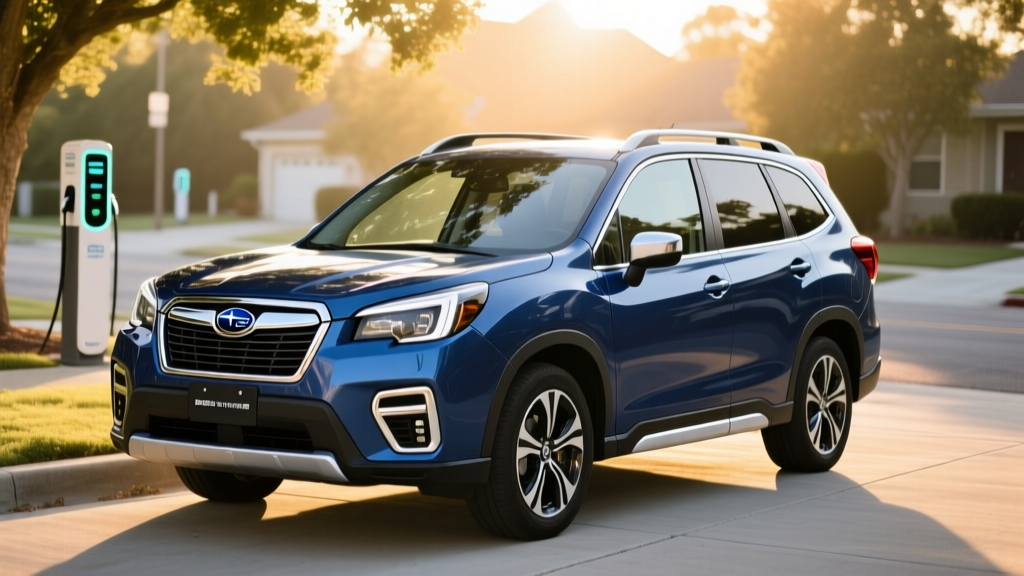
Subaru reintroduced the Forester Hybrid for the 2025 model year after a multi-year hiatus, and the 2026 model carries forward the same efficient series-parallel hybrid system. For buyers researching Forester Hybrid miles per gallon, the headline number is 35 MPG combined EPA — a substantial improvement over the gas-only Forester's 29 MPG combined. But as with any hybrid, real-world results depend heavily on your driving mix, climate, and whether you're doing mostly city or highway miles.
This guide breaks down the 2026 Subaru Forester Hybrid's fuel economy, powertrain, ownership costs, and how it stacks up against both the gas Forester and competing hybrid SUVs — so you can decide whether the hybrid premium makes financial sense for your driving pattern.
2026 Forester Hybrid MPG: EPA Ratings and Real-World Numbers
The 2026 Subaru Forester Hybrid carries EPA fuel economy ratings that reflect its series-parallel hybrid architecture, which excels in stop-and-go city driving where regenerative braking recaptures energy and the electric motor handles low-speed propulsion.
| Metric | Forester Hybrid | Forester Gas (2.5L AWD) |
|---|---|---|
| City MPG | 35 MPG | 26 MPG |
| Highway MPG | 34 MPG | 33 MPG |
| Combined MPG | 35 MPG | 29 MPG |
| Annual Fuel Cost (est.) | ~$1,650 | ~$2,000 |
Source: fueleconomy.gov
The Forester Hybrid's EPA city rating of 35 MPG is where this powertrain shines — and real-world city drivers often match or slightly exceed that figure because hybrids recapture more energy in heavy traffic. Highway driving is a different story: at sustained 70-80 MPH speeds, expect 30-32 MPG as the gasoline engine does most of the work and the boxy Forester shape creates aerodynamic drag. In cold weather (below 30°F), plan for a 5-8% reduction across the board as the engine runs more frequently to generate cabin heat and the battery is less efficient. Owners in mild climates doing mixed suburban driving commonly report 33-36 MPG on owner forums.
Hybrid vs. Gas Forester: Where the MPG Advantage Comes From
The 2026 Forester Hybrid pairs a 2.5-liter horizontally opposed (Boxer) four-cylinder engine with an electric motor integrated into Subaru's Lineartronic CVT transmission. The system operates as a series-parallel hybrid — meaning it can drive the wheels with the electric motor alone at low speeds, the gasoline engine alone at cruising speeds, or both simultaneously under hard acceleration.
| Specification | Detail |
|---|---|
| Engine | 2.5L Boxer 4-cylinder |
| Electric Motor | Integrated AC motor in CVT |
| Combined System Horsepower | 194 HP |
| Transmission | Lineartronic CVT |
| Drivetrain | Symmetrical AWD (standard) |
| Hybrid Battery | ~1.1 kWh lithium-ion (self-charging) |
| 0-60 MPH | ~7.4 seconds |
| Towing Capacity | 1,500 lbs |
The gas-only 2026 Forester produces 180 HP from the same 2.5L Boxer engine without electric assist. The hybrid's additional 14 HP and instant electric torque give it noticeably stronger acceleration from a stop and during highway passing maneuvers. Standard symmetrical all-wheel drive is retained on the hybrid, which is a key differentiator — most competing hybrid SUVs offer AWD only as an option or use a separate rear electric motor that reduces cargo space.
HEV vs. PHEV: What the Forester Hybrid Is (and Isn't)
Conventional Hybrid (HEV)
The Forester Hybrid is this type. It never plugs in. The small battery charges through regenerative braking and the gasoline engine. You simply drive it like a normal car and it delivers better MPG automatically.
- No plug-in charging required
- Small battery (~1.1 kWh)
- Cannot drive on electric-only for meaningful distances
- No federal tax credit under §30D
Plug-In Hybrid (PHEV)
A PHEV has a larger battery (typically 12-20 kWh) and a charge port. You plug it in to get 20-40 miles of electric-only range before the gas engine kicks in. Subaru does not currently offer a Forester PHEV in the U.S.
- Requires plug-in charging for EV range
- Larger battery (12-20+ kWh)
- 20-40 miles electric-only range
- May qualify for §30D federal tax credit (up to $7,500)
This distinction matters because some buyers confuse the Forester Hybrid with a plug-in vehicle. You cannot charge the Forester Hybrid at home or at a public station — it generates all its own electricity. If you want plug-in capability with electric-only commuting range from Subaru, the closest option in the Subaru lineup is the Solterra (a full battery-electric SUV with 222-228 miles of EPA range).
Pricing, Trims, and Tax Credit Eligibility
The 2026 Forester Hybrid is offered across multiple trim levels, with the hybrid powertrain typically adding a premium over the equivalent gas-only trim. Here's the current MSRP structure:
| Trim | MSRP (est.) | Hybrid Premium Over Gas |
|---|---|---|
| Sport Hybrid | ~$36,500 | + $2,500 |
| Limited Hybrid | ~$39,500 | + $2,500 |
| Touring Hybrid | ~$42,500 | + $2,500 |
Destination charge (~$1,420) not included. Prices are estimates based on 2025 carryover pricing; confirm with Subaru.com.
The Forester Hybrid does not qualify for the IRS §30D Clean Vehicle Credit (up to $7,500). That credit applies only to plug-in electric vehicles — battery-electric vehicles (BEVs) and plug-in hybrids (PHEVs) with a minimum battery capacity of 7 kWh. Since the Forester Hybrid is a conventional self-charging HEV with a ~1.1 kWh battery, it falls outside §30D eligibility. Some states and utilities offer rebates for conventional hybrids, but these vary widely by jurisdiction — check your state energy office or local utility for current programs.
Battery Warranty, Reliability, and Replacement Costs
2026 Forester Hybrid — Battery & Powertrain Warranty
| Hybrid Battery Warranty | 8 years / 100,000 miles (10 years / 150,000 miles in CARB states) |
| Hybrid System Components | 8 years / 100,000 miles |
| Powertrain Warranty | 5 years / 60,000 miles |
| Bumper-to-Bumper | 3 years / 36,000 miles |
Subaru's hybrid battery warranty is competitive with the industry standard. The 8-year/100,000-mile coverage is federally mandated for hybrid battery components, and in California Air Resources Board (CARB) states — which include California, New York, Massachusetts, and about a dozen others — that extends to 10 years / 150,000 miles. The warranty covers the hybrid battery pack if its capacity drops below a defined threshold (typically 60-70% of original capacity) or if any cell fails.
Battery replacement cost: If you need a hybrid battery replacement out of warranty, expect to pay between $2,000 and $4,000 for a Subaru hybrid battery pack, including labor. This is significantly less than a full EV battery replacement (which can exceed $10,000-$15,000) because the Forester Hybrid's battery is small (~1.1 kWh). However, hybrid battery failures before 150,000 miles are uncommon based on data from Toyota and Subaru's shared hybrid technology partnerships.
Reliability outlook: Subaru's hybrid system benefits from technology developed in partnership with Toyota, whose hybrid systems have demonstrated 200,000+ mile longevity in models like the Prius and RAV4 Hybrid. The Forester Hybrid's relatively small battery and conservative powertrain tuning reduce thermal stress — the primary driver of battery degradation. Early reliability data from the 2025 reintroduction is positive, though long-term data specific to the Forester Hybrid is still accumulating.
Forester Hybrid vs. Competing Hybrid SUVs
| Vehicle | Combined MPG | AWD Standard? | HP | Starting MSRP |
|---|---|---|---|---|
| Subaru Forester Hybrid | 35 MPG | Yes | 194 | ~$36,500 |
| Toyota RAV4 Hybrid | 39 MPG | Yes | 219 | ~$33,500 |
| Honda CR-V Hybrid | 37 MPG | No (AWD +$1,500) | 204 | ~$35,000 |
| Ford Escape Hybrid | 37 MPG | No (AWD +$2,000) | 210 | ~$34,000 |
| Hyundai Tucson Hybrid | 35 MPG | Yes | 226 | ~$34,500 |
Sources: fueleconomy.gov, manufacturer specifications.
The Forester Hybrid trades best-in-class MPG for standard AWD, strong outward visibility, and Subaru's reputation for all-weather capability. The Toyota RAV4 Hybrid delivers 4 MPG more combined and starts roughly $3,000 lower, making it the efficiency and value leader. However, the Forester's standard AWD (which costs $1,500-$2,000 extra on most competitors), higher ground clearance (8.7 inches), and EyeSight driver-assistance suite make it compelling for buyers in snow-belt states who prioritize capability over maximum fuel savings.
Who Should Buy the Forester Hybrid — and Who Shouldn't
✓ Choose the Forester Hybrid If
- You live in a region with harsh winters and need standard AWD
- Your commute involves heavy stop-and-go traffic (where the hybrid system delivers maximum benefit)
- You want better MPG without changing your fueling habits — no plug-in required
- You value Subaru's safety reputation, EyeSight ADAS, and high ground clearance for light off-road use
- You plan to keep the vehicle 8+ years (within warranty coverage)
✗ Look Elsewhere If
- Maximum MPG is your top priority — the RAV4 Hybrid delivers 39 MPG combined for less money
- You want electric-only commuting range — consider a PHEV like the Toyota RAV4 Prime (42 mi EV range) or a full BEV
- You want to qualify for the $7,500 federal tax credit — that requires a plug-in vehicle
- You drive predominantly highway miles — the hybrid advantage shrinks to just 1-2 MPG over the gas Forester at sustained high speeds
- Budget is tight — the hybrid premium adds ~$2,500 with a multi-year payback period
Conventional Hybrid (Forester Hybrid): Best for drivers who want MPG improvement with zero lifestyle change. No plug, no range anxiety, no charging apps. Pay more upfront, save at the pump gradually.
Plug-In Hybrid (e.g., RAV4 Prime): Best for drivers with a short commute (under 30 miles) who can charge at home and want to drive mostly electric on weekdays but need gas flexibility for road trips. May qualify for tax credits.
Full EV (e.g., Subaru Solterra): Best for drivers with home charging access, predictable daily mileage under 200 miles, and a desire to eliminate gas entirely. Qualifies for federal and state incentives; lowest per-mile "fuel" cost but higher upfront price.
Hybrid Payback: How Long to Recoup the Premium
At a $2,500 hybrid premium over the gas Forester, with a 6 MPG combined improvement (35 vs. 29), and assuming $3.40/gallon gas and 12,000 miles driven annually:
| Annual gas cost (Forester Gas, 29 MPG) | $1,407 |
| Annual gas cost (Forester Hybrid, 35 MPG) | $1,166 |
| Annual fuel savings | $241 |
| Simple payback period | ~10.4 years |
At current gas prices, the hybrid premium takes roughly a decade to recoup through fuel savings alone. This calculation shifts favorably if gas prices rise, if you drive more than 12,000 miles per year, or if your driving is predominantly city (where the MPG gap widens). It's also worth noting that the hybrid's stronger acceleration, quieter low-speed operation, and lower brake wear (thanks to regenerative braking) provide non-fuel benefits that aren't captured in this calculation.
Frequently Asked Questions
How many MPG does the 2026 Forester Hybrid get?
The EPA rates the 2026 Forester Hybrid at 35 MPG city, 34 MPG highway, and 35 MPG combined. Real-world results vary: city-heavy drivers may match or exceed 35 MPG, while highway-dominant drivers should expect 30-32 MPG. Cold weather reduces efficiency by roughly 5-8%.
Does the Forester Hybrid need to be plugged in?
No. The Forester Hybrid is a conventional (self-charging) hybrid. Its small battery charges through regenerative braking and the gasoline engine. You never plug it in — just fill up with gas as you would with any car.
Is the Forester Hybrid a PHEV?
No. Subaru does not currently sell a plug-in hybrid (PHEV) version of the Forester in the United States. The Forester Hybrid is a conventional HEV only. If you need plug-in capability, look at the Toyota RAV4 Prime or a full EV like the Subaru Solterra.
Does the Forester Hybrid qualify for any tax credit?
No. The federal §30D Clean Vehicle Credit applies only to plug-in electric vehicles (BEVs and PHEVs) with batteries of at least 7 kWh. The Forester Hybrid's ~1.1 kWh battery does not meet this threshold. Check your state and local utility for possible hybrid rebates, but no federal credit is available.
How reliable is the Forester Hybrid battery?
Subaru covers the hybrid battery for 8 years/100,000 miles (10 years/150,000 miles in CARB states). Based on data from Toyota's long-running hybrid systems (which share engineering principles), hybrid batteries commonly last 150,000-200,000+ miles before significant degradation. Out-of-warranty replacement costs approximately $2,000-$4,000.
How does the Forester Hybrid compare to the gas Forester on the highway?
The advantage narrows significantly at highway speeds. The hybrid rates at 34 MPG highway vs. the gas model's 33 MPG — just a 1 MPG improvement. The hybrid's real benefit is in city driving, where it gains 9 MPG (35 vs. 26). If your driving is 80%+ highway, the hybrid premium is harder to justify on fuel savings alone.