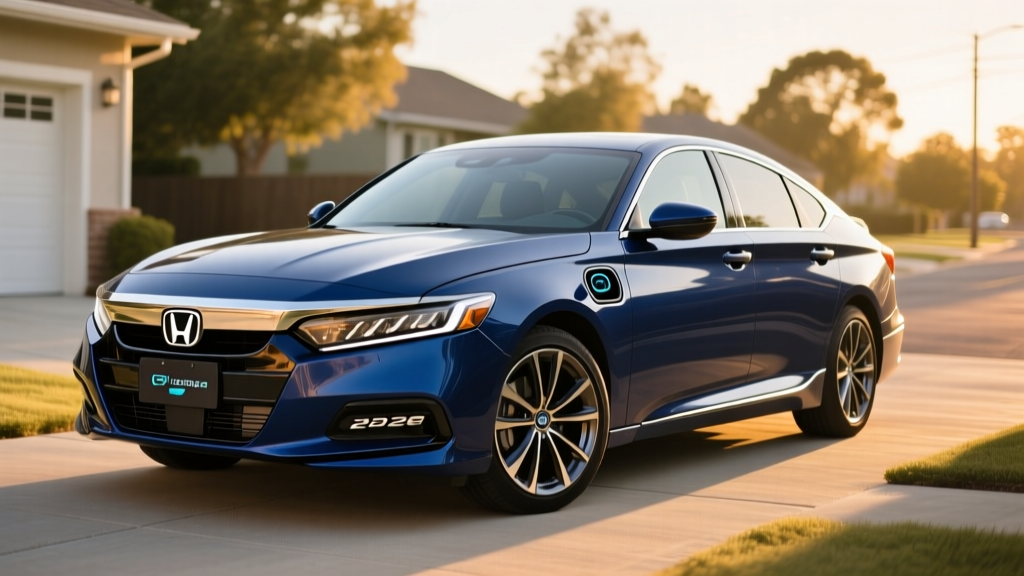
If you've been searching for a Honda Accord plug-in hybrid, you're not alone — the idea of pairing Honda's best-selling sedan with a rechargeable battery and electric-only commuting is compelling. But here's the reality check every buyer needs in 2026: Honda does not currently sell a plug-in hybrid (PHEV) version of the Accord in the United States.
The last Accord Plug-In Hybrid was sold for the 2014 and 2015 model years as a limited-volume compliance car available only in California and Oregon. Since then, Honda has offered the Accord exclusively as a conventional hybrid (HEV) — no plug required — alongside the standard turbocharged gasoline model. For 2026, the Accord Hybrid remains one of the most efficient midsize sedans on the market, but it is not a PHEV.
This guide covers exactly what Honda offers today, why the Accord PHEV disappeared, how the current Accord Hybrid performs, and what alternatives exist if plug-in electric range is a must-have.
The Accord PHEV History: What Happened to Honda's Plug-In Sedan?
The 2014–2015 Honda Accord Plug-In Hybrid was Honda's first PHEV sold in the US. It featured a 6.7 kWh lithium-ion battery, an electric-only range of roughly 13 miles (EPA), and a combined gasoline-electric range of about 570 miles. It qualified for a $2,500 federal tax credit at the time. However, it was priced around $40,000 — a significant premium over the conventional Accord Hybrid — and Honda discontinued it after two model years to focus on its broader hybrid strategy and, eventually, the Clarity Plug-In Hybrid (2017–2021).
The Clarity PHEV offered a far more usable 47 miles of electric range and was the spiritual successor to the Accord Plug-In. Honda discontinued the Clarity after the 2021 model year, leaving US buyers without any Honda plug-in sedan. As of 2026, Honda has not announced a replacement PHEV for the US market.
HEV vs PHEV: Understanding What Honda Sells Today
Before evaluating the 2026 Accord Hybrid, it's essential to understand the difference between the two hybrid types — because confusing them leads to wrong expectations at the dealership.
Conventional Hybrid (HEV) vs Plug-In Hybrid (PHEV)
| Feature | HEV (e.g., 2026 Accord Hybrid) | PHEV (e.g., Toyota RAV4 Prime) |
|---|---|---|
| Plugs in to charge? | No — charges via regenerative braking and the engine | Yes — has a larger battery you plug into a wall or charger |
| Electric-only range | ~1 mile or less at low speeds | 25–50+ miles depending on model |
| Battery size | ~1.0–1.5 kWh (small, assists engine) | 13–20 kWh (large, supports EV driving) |
| DC fast charging? | N/A | Rarely — most PHEVs are Level 1/2 only |
| Federal tax credit (§30D) | Not eligible | Up to $7,500 if battery sourcing, MSRP, and income caps are met |
| Best for | Drivers who want efficiency with zero behavior change | Drivers with home charging who want short EV commutes + gas road trips |
The 2026 Honda Accord is a conventional HEV. You never plug it in. You simply fill it with gas and drive. The hybrid system automatically manages the electric motor and gasoline engine to maximize fuel economy. This is a feature, not a limitation — for buyers without access to home or workplace charging, an HEV eliminates the infrastructure question entirely.
2026 Honda Accord Hybrid: MPG, Powertrain, and Real-World Efficiency
For 2026, the Accord Hybrid is powered by Honda's two-motor hybrid system pairing a 2.0-liter Atkinson-cycle four-cylinder engine with twin electric motors. The combined system output is 204 horsepower and 247 lb-ft of torque, routed to the front wheels through Honda's e-CVT (which uses a fixed gear ratio rather than a traditional belt-and-pulley CVT).
| Metric | Sport / Sport-L Trims | EX-L / Sport Touring Trims |
|---|---|---|
| City MPG | 51 | 51 |
| Highway MPG | 44 | 44 |
| Combined MPG | 48 | 48 |
| Fuel Tank | 12.8 gal | 12.8 gal |
| Est. Total Range | ~614 mi | ~614 mi |
Source: EPA / fueleconomy.gov
Real-World MPG: What Owners Actually See
Honda's hybrid system excels in city driving, where the electric motor handles most low-speed propulsion and the engine acts primarily as a generator. In real-world ownership, many Accord Hybrid drivers report meeting or slightly exceeding the 51 MPG city figure, particularly in stop-and-go traffic where regenerative braking recaptures energy continuously. Highway driving is the relative weak point — sustained 70+ mph cruising leans more heavily on the gasoline engine, and real-world highway numbers often land in the 40–44 MPG range depending on speed, wind, and terrain.
For mixed commuting (60% city / 40% highway), expect an honest 46–50 MPG combined in moderate temperatures. Cold weather (below 35°F) typically reduces hybrid efficiency by 5–10% due to increased engine runtime for cabin heat and reduced battery efficiency — a factor worth budgeting if you live in northern climates.
Pricing, Trims, and Tax Credit Eligibility
The 2026 Honda Accord Hybrid is available across four trims. Pricing is competitive within the midsize hybrid sedan segment:
| Trim | MSRP (approx.) | Combined MPG | Key Features |
|---|---|---|---|
| Sport Hybrid | ~$33,500 | 48 | 19" wheels, wireless CarPlay/Android Auto, Honda Sensing |
| Sport-L Hybrid | ~$35,000 | 48 | Leather-trimmed seats, heated front seats |
| EX-L Hybrid | ~$36,500 | 48 | Leather, power moonroof, heated rear seats |
| Sport Touring Hybrid | ~$39,500 | 48 | Bose audio, navigation, wireless charging, ventilated front seats |
Federal Tax Credit: Does the Accord Hybrid Qualify?
No. The Honda Accord Hybrid is a conventional HEV, not a plug-in vehicle. The federal §30D Clean Vehicle Credit — which offers up to $7,500 — applies only to battery electric vehicles (BEVs) and plug-in hybrids (PHEVs) that meet strict battery component sourcing, critical mineral, MSRP cap, and buyer income requirements as defined by the IRS. Conventional hybrids like the Accord Hybrid have never qualified for this credit.
Some states offer modest rebates or HOV lane access for hybrids, but these vary widely by jurisdiction. Check your state's energy or DMV website for current programs.
Battery Warranty, Reliability, and Replacement Cost
Honda Accord Hybrid Battery Warranty
Hybrid battery coverage: 8 years / 100,000 miles (10 years / 150,000 miles in CARB states including CA, CT, MA, ME, NJ, NY, OR, RI, VT, WA)
Warranty trigger: Significant loss of battery capacity or complete failure
Powertrain warranty: 5 years / 60,000 miles (covers engine, motors, e-CVT)
How Reliable Is the Accord Hybrid System?
Honda's two-motor hybrid system is now in its fourth generation and has been deployed across the Accord, CR-V, and Civic Hybrid lineups. The system has proven durable in long-term ownership — the lithium-ion hybrid battery (approximately 1.3 kWh in the current Accord) is small, lightly stressed, and managed by a sophisticated thermal system that avoids the deep charge/discharge cycles that accelerate degradation in larger EV batteries.
Real-world data from owner communities and reliability surveys indicates that Accord Hybrid batteries routinely last well beyond the warranty period, with many reaching 150,000–200,000+ miles without significant capacity loss. This is fundamentally different from BEV battery concerns — the Accord's hybrid battery is an assist component, not the primary energy source, so moderate degradation has minimal impact on drivability.
Battery Replacement Cost
If replacement is eventually needed, a new Honda Accord Hybrid battery pack typically costs between $2,000 and $4,000 including labor at a dealership — significantly less than a BEV traction battery replacement ($10,000–$20,000+). Refurbished or aftermarket hybrid batteries are available for $1,000–$2,500 from independent hybrid specialists, offering a cost-effective path for older vehicles.
Who Should Buy the Accord Hybrid vs a PHEV or Full EV?
The absence of a Honda Accord plug-in hybrid means buyers must choose between three distinct paths. Here's a practical decision framework:
Choose the Accord Hybrid (HEV) if:
- You don't have home or workplace charging access
- You want maximum simplicity — no plugs, no charging apps, no behavior change
- Your commute is long or unpredictable (40+ miles one way)
- You want 48 MPG combined without thinking about it
- Budget is $33K–$40K
Choose a PHEV (e.g., Toyota Prius Prime) if:
- You have reliable Level 1 or Level 2 home charging
- Your daily commute is under 40 miles round-trip
- You want electric-only weekday driving + gas flexibility for road trips
- You want to potentially qualify for the §30D tax credit
- You're open to a hatchback or crossover body style
Choose a Full EV (e.g., Tesla Model 3, Hyundai Ioniq 6) if:
- You have home Level 2 charging or reliable workplace charging
- You want zero gasoline purchases and minimal maintenance
- Your daily driving is under 250 miles and you can plan road-trip charging
- You want the lowest per-mile fuel cost (~$0.04–0.06/mi on home electricity)
- You're eligible for the full $7,500 federal credit
PHEV Alternatives: What If You Really Want a Plug-In Honda?
If plug-in capability is non-negotiable, Honda currently does not offer any PHEV in the US market as of 2026. Your closest alternatives include:
- Toyota Prius Prime (PHEV): 44 miles electric-only, 52 MPG combined as hybrid, starts ~$33,000. The closest sedan alternative with plug-in capability.
- Toyota RAV4 Prime (PHEV): 42 miles electric-only, 38 MPG combined, 302 HP, starts ~$44,000. A crossover, but the most popular PHEV in the US.
- Hyundai Tucson PHEV: 33 miles electric-only, 35 MPG combined, starts ~$38,000. Compact crossover with AWD.
- Used Honda Clarity Plug-In Hybrid (2017–2021): 47 miles electric-only, available on the used market for $18,000–$28,000 depending on mileage and condition. The last Honda PHEV sedan.
Pros and Cons: 2026 Honda Accord Hybrid
✓ Pros
- 48 MPG combined — among the most efficient midsize sedans sold
- No plug-in required; zero behavior change from a gas car
- 204 HP provides confident passing and merging power
- Spacious interior with 16.7 cu ft trunk (hybrid battery under rear seats)
- Honda Sensing ADAS suite standard on all trims
- Proven hybrid reliability with 8–10 year battery warranty
- Smooth, quiet ride quality; refined cabin at this price point
✗ Cons
- No plug-in option — cannot drive on electric-only power for commutes
- Not eligible for the $7,500 federal §30D tax credit
- Highway MPG (44) lags behind city (51) noticeably
- No all-wheel-drive option (FWD only)
- e-CVT drone under hard acceleration (common to all Honda hybrids)
- Infotainment system functional but not class-leading in responsiveness
Frequently Asked Questions
Does Honda make a plug-in hybrid Accord in 2026?
No. Honda does not sell a plug-in hybrid version of the Accord in the United States for the 2026 model year. The Accord is available as a conventional hybrid (HEV) only. The last Accord Plug-In Hybrid was sold in 2014–2015, and Honda's subsequent PHEV (the Clarity) was discontinued after 2021.
How many MPG does the 2026 Honda Accord Hybrid get?
The EPA rates the 2026 Accord Hybrid at 51 city / 44 highway / 48 combined MPG across all hybrid trims. Real-world results typically match or slightly exceed the city figure in stop-and-go traffic, while sustained highway driving may yield 40–44 MPG. Source: fueleconomy.gov.
How far can the Accord Hybrid go on electric only?
The Accord Hybrid is not a plug-in vehicle and does not have a meaningful electric-only range. The hybrid battery (~1.3 kWh) assists the gasoline engine and powers the car at very low speeds for brief distances (under 1 mile), but it cannot sustain highway-speed electric-only driving. If you need 25–45 miles of electric-only commuting, you need a PHEV or BEV.
Is the Honda Accord Hybrid reliable, and what does a battery replacement cost?
Yes. Honda's fourth-generation two-motor hybrid system has demonstrated strong reliability in long-term use. The hybrid battery is covered by an 8-year/100,000-mile warranty (10 years/150,000 miles in CARB states). Most hybrid batteries last well beyond the warranty period. If replacement is needed, expect to pay $2,000–$4,000 for a new OEM battery including labor — far less than a full EV battery replacement.
Does the Honda Accord Hybrid qualify for any tax credit?
The Accord Hybrid does not qualify for the federal §30D Clean Vehicle Credit, which is limited to plug-in electric vehicles (BEVs and PHEVs). Some states offer hybrid-specific incentives or HOV lane stickers, but these vary by location. Check your state's energy office or DMV for current programs. For federal credit rules, see the IRS Clean Vehicle Credits page.
What Honda PHEV alternatives exist?
As of 2026, Honda sells no PHEVs in the US. The closest Honda product with a plug was the Clarity Plug-In Hybrid (discontinued 2021), available on the used market. For a new PHEV sedan, the Toyota Prius Prime is the most direct competitor. For a Honda-branded electrified vehicle, the Accord Hybrid and CR-V Hybrid remain the current offerings.
Hybrid vs PHEV vs EV — which should I choose?
Choose a conventional hybrid (HEV) like the Accord Hybrid if you lack home charging or want zero lifestyle change. Choose a PHEV if you have home charging and a short commute but want gas flexibility for longer trips. Choose a full EV (BEV) if you have reliable charging access, want the lowest operating cost, and can plan around DC fast charging for road trips. The right answer depends entirely on your charging access, daily mileage, and willingness to adapt.
Specifications and pricing reflect 2026 model year data available at time of publication. Federal and state incentive rules are subject to change. Always verify current IRS §30D eligibility at irs.gov and confirm MSRP with your local Honda dealer before purchasing.