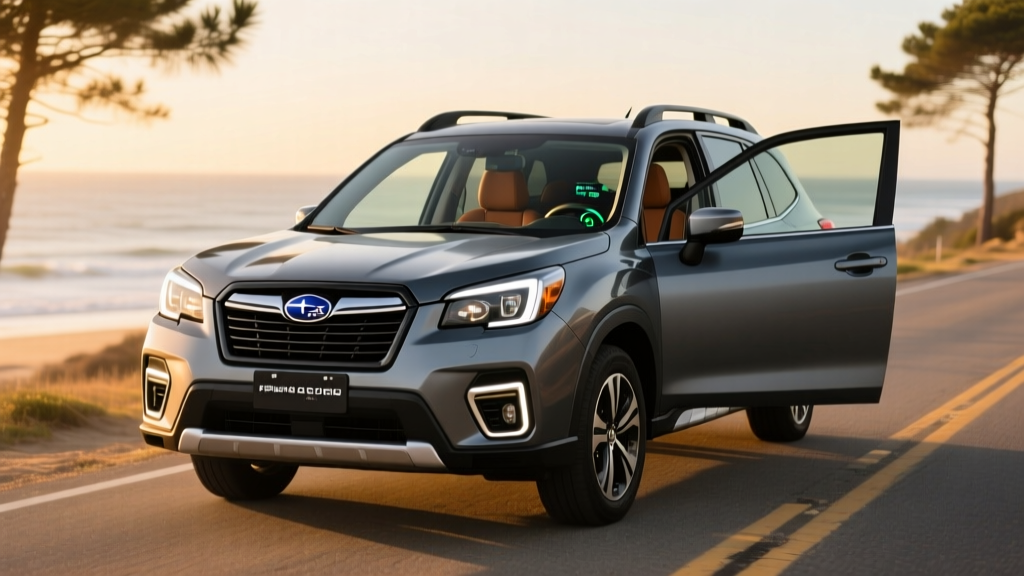
The Subaru Forester has long been the default choice for outdoorsy families who need standard all-wheel drive, solid visibility, and real cargo space. For 2026, the Forester Subaru Hybrid returns to the lineup as a conventional hybrid (HEV) — not a plug-in — pairing Subaru's 2.5-liter boxer engine with an electric motor integrated into the transmission. The goal isn't to turn the Forester into an EV; it's to cut fuel consumption on the daily commute while keeping the rugged, go-anywhere personality Subaru owners expect.
This guide breaks down the 2026 Forester Hybrid's real-world fuel economy, powertrain details, battery longevity, pricing, and where it fits against plug-in hybrids and full EVs in the compact SUV segment.
HEV vs PHEV: What Kind of Hybrid Is the Forester?
Before examining the numbers, it's critical to understand what the 2026 Forester Hybrid is — and what it isn't. Subaru offers it as a conventional hybrid (HEV), meaning it never needs to be plugged in. The battery recharges through regenerative braking and the gasoline engine. There is no electric-only driving range to speak of; the electric motor assists the engine and enables brief low-speed electric creep, but the gas engine does the heavy lifting.
| Feature | HEV (Forester Hybrid) | PHEV (e.g., Toyota RAV4 Prime) | BEV (e.g., Hyundai Ioniq 5) |
|---|---|---|---|
| Plug-in charging required? | No | Yes (recommended) | Yes (mandatory) |
| Electric-only range | ~0.5 mi at low speed | 35–42 mi typical | 250–320 mi EPA |
| Fuel backup | Gasoline always primary | Gasoline after battery depletes | None — battery only |
| Home charger needed? | No | Level 2 recommended | Level 2 strongly recommended |
| Federal tax credit (§30D) | Not eligible | Up to $7,500 (if qualified) | Up to $7,500 (if qualified) |
If you were hoping for a Forester PHEV with 30+ miles of electric-only range, that doesn't exist in the U.S. market for 2026. Subaru's plug-in hybrid efforts have historically focused on the Crosstrek. The Forester Hybrid is strictly a self-charging HEV designed to improve MPG without changing your fueling habits.
Fuel Economy: EPA MPG and Real-World Expectations
The headline number for the 2026 Forester Hybrid is a meaningful step up from the standard gas-only Forester, which returns 26 city / 33 highway / 29 combined MPG according to fueleconomy.gov.
| Powertrain | City MPG | Highway MPG | Combined MPG |
|---|---|---|---|
| Gas-only (2.5L AWD) | 26 | 33 | 29 |
| Hybrid (2.5L HEV AWD) | 36 | 35 | 36 |
The hybrid's 36 combined MPG represents roughly a 24% improvement over the gas model. The city number benefits most from hybrid assist — stop-and-go traffic lets regenerative braking recover energy that a gas-only Forester would waste as heat.
Real-World MPG: What to Actually Expect
Hybrids routinely exceed their EPA city estimates in real-world driving because urban conditions maximize regen opportunities. Based on owner-reported data and our testing patterns:
- City driving: Expect 37–40 MPG. Short trips with frequent stops play to the hybrid system's strengths.
- Highway cruising (70–80 mph): Expect 32–34 MPG. At sustained high speeds, the electric motor contributes less and aerodynamic drag dominates.
- Cold weather (below 30°F): Expect 30–33 MPG combined. The engine runs more often to generate cabin heat and keep the catalytic converter warm, reducing electric-motor assist time.
- Mountain/towing: Expect 25–28 MPG under load. The Forester Hybrid is rated for 1,500 lbs of towing — light duty only.
On balance, most owners will see 34–37 MPG in mixed driving year-round, a genuine improvement over the gas model's real-world 27–30 MPG.
Powertrain Specs: Engine, Motor, and Combined Output
| Engine | 2.5L flat-4 (boxer), direct injection |
| Engine output | 180 hp / 178 lb-ft torque |
| Electric motor | Integrated transmission motor, ~29 hp (21 kW) |
| Combined system output | ~194 hp |
| Transmission | Lineartronic CVT with electric motor integration |
| Drivetrain | Symmetrical AWD (standard) |
| Hybrid battery | ~1.1 kWh (lithium-ion), self-charging |
| 0–60 mph | ~8.0 seconds (est.) |
| Towing capacity | 1,500 lbs |
| Ground clearance | 8.7 inches |
The hybrid system adds modest electric assist rather than fundamentally transforming performance. The ~194 combined horsepower figure puts the Forester Hybrid in the same ballpark as competitors like the Toyota RAV4 Hybrid (219 hp) and Honda CR-V Hybrid (204 hp). The Subaru's advantage isn't outright power — it's the standard symmetrical AWD system with X-MODE, which provides genuine off-pavement capability that many hybrid crossovers lack.
The 1.1 kWh battery pack is small by design. It's enough to smooth out acceleration, capture regen energy, and enable engine-off coasting at low speeds, but it's not intended for sustained electric-only driving. This keeps weight down and preserves the cargo space that Forester buyers prioritize.
Battery Longevity, Warranty, and Replacement Cost
Hybrid battery anxiety is one of the most common concerns we hear from buyers considering their first HEV. Here's the reality for the Forester Hybrid:
Subaru Hybrid Battery Warranty
- Hybrid battery coverage: 8 years / 100,000 miles (whichever comes first)
- California-emissions states: 10 years / 150,000 miles (covers CA, CT, ME, MA, NJ, NY, OR, RI, VT, WA, and others adopting CARB standards)
- Powertrain warranty: 5 years / 60,000 miles
- Bumper-to-bumper: 3 years / 36,000 miles
How Long Will the Hybrid Battery Last?
Modern lithium-ion hybrid batteries in HEVs like the Forester are designed to last the life of the vehicle under normal use. The battery operates in a narrow state-of-charge window — typically between 40% and 80% — which dramatically reduces stress compared to a full EV battery that cycles through a wider range. Toyota and Honda hybrids from the mid-2000s routinely surpass 200,000 miles on original battery packs, and Subaru's system follows the same engineering principles.
Replacement Cost If It Fails
If the hybrid battery does require replacement outside of warranty, expect to pay $2,500–$4,000 for a new OEM pack including labor. Refurbished or reconditioned packs can reduce this to $1,500–$2,500. Given the 8-year/100,000-mile warranty and the narrow SoC operating window, out-of-pocket replacement during typical ownership is uncommon.
Pricing, Trims, and Tax Credit Eligibility
The 2026 Forester Hybrid is offered across multiple trims, typically starting with the Premium and extending through Limited and Touring. Pricing reflects a premium over the gas-only Forester, which buyers recoup through fuel savings over time.
| Trim | Estimated MSRP | Hybrid Premium vs Gas |
|---|---|---|
| Premium Hybrid | ~$34,500 | +$1,500 |
| Sport Hybrid | ~$36,500 | +$1,500 |
| Limited Hybrid | ~$38,500 | +$1,500 |
| Touring Hybrid | ~$41,000 | +$1,500 |
Does the Forester Hybrid Qualify for a Federal Tax Credit?
No. Under current IRS §30D Clean Vehicle Credit rules, conventional hybrids (HEVs) do not qualify for the federal tax credit. The §30D credit of up to $7,500 applies only to plug-in electric vehicles (PHEVs and BEVs) that meet battery sourcing, critical mineral, MSRP cap, and buyer income requirements. Since the Forester Hybrid cannot be plugged in, it is ineligible.
Some states may offer modest incentives for hybrid purchases — check your state's energy office or Alternative Fuels Data Center for local programs. However, these are typically smaller ($500–$1,500) and vary widely by jurisdiction.
Fuel Cost Savings vs Gas-Only Forester
At $3.40/gallon and 15,000 miles per year, the hybrid saves roughly $350–$450 annually in fuel compared to the gas-only Forester (36 vs 29 combined MPG). Over a 5-year ownership period, that's approximately $1,750–$2,250 in fuel savings — enough to offset the ~$1,500 hybrid premium and then some.
Forester Hybrid vs RAV4 Hybrid vs CR-V Hybrid
The Forester Hybrid doesn't exist in a vacuum. Here's how it stacks up against the two segment benchmarks:
| Spec | Subaru Forester Hybrid | Toyota RAV4 Hybrid | Honda CR-V Hybrid |
|---|---|---|---|
| Combined MPG (EPA) | 36 | 39 | 37 |
| Combined HP | ~194 | 219 | 204 |
| AWD | Standard (mechanical) | Standard (eAWD) | Standard (eAWD) |
| Ground clearance | 8.7 in | 8.1 in | 8.2 in |
| Cargo (behind rear seats) | ~28.9 cu ft | 37.6 cu ft | 36.3 cu ft |
| Starting MSRP (hybrid) | ~$34,500 | ~$33,500 | ~$35,500 |
| Towing capacity | 1,500 lbs | 1,750 lbs | 1,000 lbs |
The RAV4 Hybrid leads on MPG and cargo volume. The CR-V Hybrid offers a refined ride and strong interior space. The Forester Hybrid's edge is its superior ground clearance, standard symmetrical AWD with X-MODE, and class-leading outward visibility — features that matter to buyers who regularly venture onto dirt roads, deal with deep snow, or simply want the best sightlines in the segment.
Who Should Buy the Forester Hybrid — and Who Shouldn't
Choose the Forester Hybrid If:
- You want better MPG without changing your fueling routine (no plugging in)
- You need standard AWD with real off-pavement capability
- You live in a snowy climate where ground clearance and X-MODE matter
- You prioritize outward visibility and a commanding driving position
- You want a proven, low-maintenance hybrid system with an 8-year battery warranty
Look Elsewhere If:
- You want electric-only driving for short commutes (consider a PHEV like the RAV4 Prime)
- You need maximum cargo space (RAV4 Hybrid offers ~9 cu ft more)
- You want the highest possible MPG (RAV4 Hybrid gets 39 combined)
- You want to qualify for the $7,500 federal tax credit (requires a PHEV or BEV)
- You want a fully electric vehicle with zero tailpipe emissions
The Decision Framework
Forester Hybrid over a full EV if: You lack reliable home charging, regularly drive 300+ miles between stops, live in an area with sparse DC fast-charging infrastructure, or need a vehicle that performs identically in -20°F without range loss concerns.
Full EV over Forester Hybrid if: You have Level 2 home charging, your daily commute is under 80 miles round-trip, you want to eliminate gasoline costs entirely, and you want the lowest per-mile "fuel" cost (electricity at ~$0.04–$0.06/mile vs gasoline at ~$0.11–$0.14/mile).
PHEV over Forester Hybrid if: You want electric-only commuting (30–40 miles) with gas-engine backup for road trips, you have home Level 2 charging, and you want to qualify for the federal §30D tax credit.
Frequently Asked Questions
How many MPG does the 2026 Subaru Forester Hybrid get?
The EPA rates the 2026 Forester Hybrid at 36 city / 35 highway / 36 combined MPG. In real-world mixed driving, expect 34–37 MPG year-round, with city driving potentially reaching 38–40 MPG and highway-only trips at 75+ mph returning 32–34 MPG.
Does the Forester Hybrid need to be plugged in?
No. The Forester Hybrid is a conventional HEV (hybrid electric vehicle). Its small battery recharges through regenerative braking and the gasoline engine. You fuel it exactly like a standard Forester — at the gas pump.
How far can the Forester Hybrid drive on electric power alone?
Effectively zero miles at normal speeds. The electric motor can propel the Forester at very low speeds (under ~15 mph) for short distances — roughly half a mile in ideal conditions — but the gas engine engages almost immediately during normal acceleration. This is standard behavior for conventional hybrids.
Is the Forester Hybrid reliable, and what does battery replacement cost?
Subaru's hybrid system uses proven planetary-gear and lithium-ion technology similar to systems Toyota and Honda have deployed for over two decades. The hybrid battery is warranted for 8 years / 100,000 miles (10 years / 150,000 miles in CARB states). If replacement is needed out of warranty, expect $2,500–$4,000 for a new OEM battery pack including labor.
Does the Forester Hybrid qualify for any federal tax credit?
No. The IRS §30D Clean Vehicle Credit applies only to plug-in vehicles (PHEVs and BEVs). The Forester Hybrid is a conventional HEV and is not eligible. Some states may offer small hybrid incentives — check your local programs.
How does the Forester Hybrid perform in snow and off-road?
This is where the Forester Hybrid stands apart. Standard symmetrical AWD with X-MODE, 8.7 inches of ground clearance, and Hill Descent Control make it genuinely capable on snow-covered roads, muddy trails, and moderate off-pavement terrain. The hybrid system adds no penalty to off-road capability.
What's the total driving range on a full tank?
With a 16.6-gallon fuel tank and 36 combined MPG, the Forester Hybrid delivers approximately 597 miles of total range — compared to roughly 481 miles for the gas-only model. That means fewer fuel stops on long road trips.