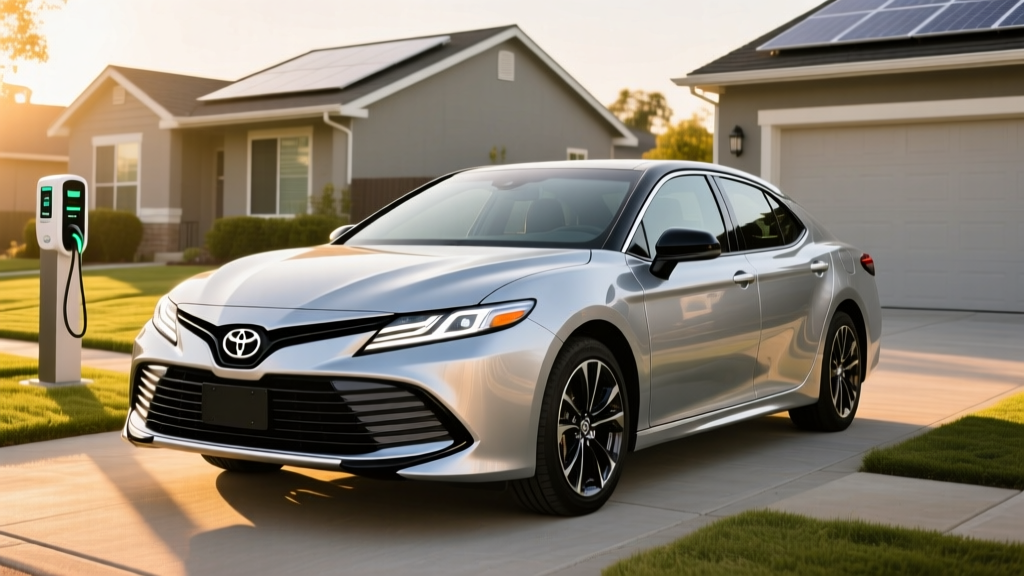
The 2025 Toyota Camry arrived with an all-hybrid lineup — no gas-only option — making it one of the most fuel-efficient midsize sedans on the market. For buyers researching Camry hybrid mileage, the numbers are compelling: up to 51 MPG combined on the front-wheel-drive LE trim, with all-wheel-drive variants still delivering over 44 MPG combined. But EPA stickers only tell part of the story. This guide breaks down real-world fuel economy, the hybrid powertrain, long-term battery reliability, and how the Camry Hybrid stacks up against PHEVs and full EVs for different driving lifestyles.
How Many MPG Does the Camry Hybrid Actually Get?
The 2025 Camry Hybrid uses Toyota's fifth-generation hybrid system, pairing a 2.5-liter four-cylinder engine with electric motors. EPA ratings vary by trim and drivetrain, with front-wheel-drive models achieving the highest numbers. Here's the official breakdown from fueleconomy.gov:
| Trim | Drivetrain | City MPG | Highway MPG | Combined MPG |
|---|---|---|---|---|
| LE | FWD | 53 | 50 | 51 |
| SE / XLE | FWD | 48 | 47 | 47 |
| LE | AWD | 51 | 49 | 50 |
| SE / XLE / XSE | AWD | 44 | 43 | 44 |
The FWD LE achieves its 51 MPG combined partly through lower curb weight and aero-optimized wheels. Moving to SE or XLE trims adds weight from larger wheels, sport-tuned suspension, and additional equipment, dropping the combined rating by 4–7 MPG. AWD models gain a rear electric motor for traction but carry a modest efficiency penalty.
Real-World MPG: What Owners Actually See
Toyota hybrids have a well-documented tendency to exceed their EPA city ratings in stop-and-go driving, where regenerative braking recaptures energy most effectively. However, highway-heavy commutes and cold weather shift the balance.
- City-dominant commuting: 48–55 MPG (FWD LE) — regenerative braking maximizes efficiency at low speeds
- Mixed driving (50/50 city-highway): 44–50 MPG — aligns closely with EPA combined
- Highway-dominant (70+ mph sustained): 39–45 MPG — hybrid advantage diminishes at high constant speeds
- Cold weather (below 32°F): Expect a 5–12% drop — engine runs more often for cabin heat and battery warm-up
Owners on fuel-tracking platforms like Fuelly consistently report lifetime averages between 43 and 50 MPG for FWD models, with some hypermilers exceeding 55 MPG on city routes. The Camry Hybrid's real-world efficiency is among the best in the midsize sedan segment, rivaling the Honda Accord Hybrid (48 combined) and significantly outperforming the Hyundai Sonata Hybrid (44–47 combined).
The Powertrain: What Makes It This Efficient
The 2025 Camry is exclusively hybrid — Toyota eliminated the conventional gas-only Camry for this generation. Every trim uses the same core powertrain architecture:
| Specification | Detail |
|---|---|
| Engine | 2.5L Dynamic Force 4-cylinder (Atkinson cycle) |
| Engine Output | 184 hp / 163 lb-ft torque |
| Front Electric Motor | 134 hp / 155 lb-ft |
| Rear Electric Motor (AWD only) | 40 hp / 89 lb-ft |
| Net Combined Horsepower | 225 hp (FWD) / 232 hp (AWD) |
| Transmission | Electronic Continuously Variable (eCVT) |
| Hybrid Battery | Lithium-ion, ~1.6 kWh (self-charging, not plug-in) |
| 0–60 mph | ~7.1 seconds (FWD), ~6.8 seconds (AWD) |
This is a conventional hybrid electric vehicle (HEV), not a plug-in hybrid (PHEV). The small lithium-ion battery charges exclusively through regenerative braking and the gasoline engine — there is no charging port, and you never plug it in. The eCVT isn't a belt-driven CVT like those in some competitors; Toyota's planetary gearset design is mechanically simpler and has proven exceptionally durable over millions of vehicles.
HEV vs PHEV vs EV: Which Powertrain Fits You?
With the Camry now hybrid-only, buyers choosing this sedan are already opting for electrification. But the broader question remains: should you go conventional hybrid (HEV), plug-in hybrid (PHEV), or full battery-electric (BEV)?
- No plug-in required
- 44–51 MPG combined
- No electric-only range
- ~$28,700 starting MSRP
- No federal tax credit
- Plug in for 42 mi electric
- 38 MPG after battery depletes
- 42 mi electric-only range
- ~$44,000 starting MSRP
- May qualify for §30D credit
- Plug in to charge always
- 120–140 MPGe combined
- 272–363 mi range
- ~$39,000 starting MSRP
- $7,500 §30D credit (if eligible)
- Choose the Camry Hybrid (HEV) if: You lack home charging access, drive 10,000–15,000 miles/year, want the lowest purchase price, and don't want to think about plugging in. It's the simplest path to 45+ MPG.
- Choose a PHEV if: You have home Level 2 charging, your daily commute is under 40 miles round-trip (covering most driving on electricity), but you still want gas-engine range for road trips.
- Choose a BEV if: You have reliable home charging, want the lowest per-mile fuel cost (~$0.04/mi vs ~$0.07/mi for the Camry Hybrid), and are ready to plan around DC fast charging on road trips.
Pricing and Tax Credit Eligibility
The 2025 Camry Hybrid starts at $28,700 MSRP for the LE FWD trim, including destination charge. Here's the trim-level breakdown:
| Trim | FWD MSRP | AWD MSRP |
|---|---|---|
| LE | $28,700 | $30,200 |
| SE | $30,200 | $31,700 |
| XLE | $33,400 | $34,900 |
| XSE | — | $35,600 |
Federal tax credit: The Camry Hybrid is a conventional HEV, not a plug-in vehicle. It does not qualify for the IRS §30D Clean Vehicle Credit (up to $7,500), which applies only to battery-electric vehicles and plug-in hybrids meeting battery-sourcing, MSRP, and buyer income requirements. There is no current federal incentive for conventional hybrids.
State incentives: A handful of states offer rebates or reduced registration fees for hybrids, but these vary widely and change frequently. Check your state's energy office or DMV for current programs. Some employers and utilities also offer hybrid purchase incentives.
For a detailed breakdown of §30D eligibility rules (which apply to PHEVs and BEVs, not the Camry HEV), consult the IRS Clean Vehicle Tax Credits page.
Hybrid Battery Reliability and Warranty
Hybrid battery longevity is consistently one of the top concerns for first-time hybrid buyers. Toyota's track record here is among the best in the industry, drawing on over 25 years of hybrid production since the original Prius.
- Hybrid Battery: 10 years / 150,000 miles (whichever comes first), covering defects and capacity loss below a defined threshold
- Hybrid System Components: 8 years / 100,000 miles (inverter, transaxle, control module)
- Basic Vehicle Warranty: 3 years / 36,000 miles
- Powertrain Warranty: 5 years / 60,000 miles
The 2025 Camry Hybrid uses a lithium-ion hybrid battery pack — a significant upgrade from the nickel-metal hydride (NiMH) packs in earlier Toyota hybrids. Lithium-ion chemistry offers better energy density, lighter weight, and improved charge/discharge efficiency. The battery is relatively small (~1.6 kWh usable) because it only needs to buffer energy for acceleration assist and regenerative capture, not sustain electric-only driving.
Real-world longevity data: Toyota hybrid batteries from the NiMH era (2001–2018 Prius, earlier Camry Hybrids) routinely lasted 150,000–200,000+ miles before needing replacement. The lithium-ion packs in current models are expected to match or exceed this. Independent fleet data and owner surveys show hybrid battery failure before 100,000 miles is rare.
Replacement cost: If the hybrid battery does need replacement outside warranty, expect $2,000–$4,000 for a new OEM pack at a Toyota dealer, or $1,500–$2,500 for a refurbished unit from a third-party specialist. Given the 10-year/150,000-mile warranty and typical battery longevity exceeding 150k miles, most owners will never face this expense during their ownership.
Driving Impressions and Practical Ownership
The 2025 Camry Hybrid is not a performance sedan, but 225–232 combined horsepower makes it genuinely quick for the segment. The 0–60 mph time of roughly 7.0 seconds beats many turbocharged four-cylinder midsize sedans, and the electric motor's instant torque gives strong low-speed acceleration for merging and passing.
Ride quality is composed and quiet, with the hybrid system nearly silent at low speeds. The transition between electric-only and engine-on driving is seamless — most drivers won't notice when the engine fires up. Braking feel is linear for a hybrid, with a natural blend of regenerative and friction braking that avoids the grabby pedal feel that plagued earlier Toyota hybrids.
Practical notes for ownership:
- Fuel tank: 13.2 gallons — at 51 MPG combined (LE FWD), that's roughly 670 miles of range per tank
- Cargo: 15.1 cu ft trunk — competitive with Accord Hybrid and Sonata Hybrid; the hybrid battery is packaged under the rear seat, preserving trunk space
- Maintenance: No oil changes needed more frequently than gas cars (10,000-mile intervals with synthetic), no timing belt (chain-driven), regenerative braking extends brake pad life significantly — many owners report 60,000+ miles on original pads
- Insurance: Typically comparable to gas Camry trims; hybrids don't carry the insurance premium penalty that some EVs do
Camry Hybrid vs. the Competition
| Metric | Toyota Camry Hybrid | Honda Accord Hybrid | Hyundai Sonata Hybrid |
|---|---|---|---|
| EPA Combined (best trim) | 51 MPG | 48 MPG | 47 MPG |
| Combined HP | 225–232 | 204 | 192 |
| 0–60 mph | ~7.0 sec | ~7.5 sec | ~8.0 sec |
| Starting MSRP | $28,700 | $33,655 | $30,250 |
| AWD Available? | Yes | No | No |
| Hybrid Battery Warranty | 10 yr / 150k mi | 8 yr / 100k mi | 10 yr / 100k mi |
| Trunk Volume | 15.1 cu ft | 16.7 cu ft | 16.0 cu ft |
The Camry Hybrid leads on fuel economy, horsepower, and price. The Accord Hybrid offers more trunk space and a slightly more refined interior. The Sonata Hybrid sits in between on efficiency and price but offers a solar roof panel option (on the Limited trim) that adds a small amount of supplemental charging. Safety ratings are strong across all three — check IIHS ratings for the 2025 Camry for the latest crash-test results.
Frequently Asked Questions
Does the Camry Hybrid need to be plugged in?
No. The Camry Hybrid is a conventional hybrid (HEV), not a plug-in hybrid (PHEV). It charges its own small battery through regenerative braking and the gasoline engine. You fuel it exactly like a regular gas car — there is no charging port.
How does the Camry Hybrid achieve 51 MPG?
The 51 MPG combined rating applies to the FWD LE trim specifically. It achieves this through a combination of the Atkinson-cycle engine (which prioritizes efficiency over peak power), regenerative braking that recaptures kinetic energy, electric-only operation at low speeds, and lightweight construction. Heavier trims and AWD reduce the rating to 44–50 MPG combined.
Is the Camry Hybrid slower than the old gas Camry?
No. The 2025 Camry Hybrid produces 225–232 combined horsepower, compared to the outgoing gas-only Camry's 203 hp (4-cylinder) or 301 hp (V6). The hybrid is quicker to 60 mph than the base gas four-cylinder was, and the electric motor's instant torque makes it feel responsive in everyday driving. Only the old V6 was significantly faster.
Will the hybrid battery need replacing, and how much does it cost?
Toyota's hybrid batteries are designed to last the life of the vehicle. The 10-year/150,000-mile warranty covers battery defects and excessive capacity loss. Historical data from Toyota hybrids shows most batteries lasting 150,000–200,000+ miles. If replacement is needed outside warranty, expect $2,000–$4,000 for a new OEM pack.
Does the Camry Hybrid qualify for any federal tax credit?
No. The IRS §30D Clean Vehicle Credit applies only to plug-in electric vehicles (BEVs and PHEVs) with sufficient battery capacity. The Camry Hybrid is a conventional HEV and does not qualify. Some states may offer hybrid-specific incentives — check your state's energy office for current programs.
How does cold weather affect Camry Hybrid MPG?
Expect a 5–12% fuel economy reduction in sustained cold weather (below 32°F). The engine runs more frequently to generate cabin heat and maintain battery temperature. Short trips in cold weather see the largest penalty because the engine doesn't reach optimal operating temperature. Using seat heaters instead of cranking the cabin heat can help recover some efficiency.
Camry Hybrid or a used EV — which saves more money?
It depends on your charging access and mileage. The Camry Hybrid costs ~$0.07–$0.09 per mile in fuel at current gas prices. A used EV like a Chevrolet Bolt or Nissan Leaf costs ~$0.03–$0.05 per mile on home electricity. Over 5 years at 12,000 miles/year, an EV saves roughly $2,000–$3,500 in fuel. However, the Camry Hybrid has a lower purchase price (~$28,700 new vs $15,000–$25,000 for a used EV), no charging installation cost, and no range or charging-infrastructure concerns. If you can charge at home and drive under 200 miles daily, a used EV likely wins on total cost. If you lack home charging or frequently drive long distances, the Camry Hybrid is the simpler, lower-risk choice.