Subaru's plug-in hybrid lineup has been narrow for years, and buyers searching for an electrified Subaru often hit a wall of confusion between conventional hybrids and true plug-ins. If you're asking "does Subaru have a plug-in hybrid?" — the answer is yes, but with important caveats about availability, electric range, and whether it's the right fit for your commute.
For 2026, Subaru continues to offer the Crosstrek Hybrid as its sole plug-in hybrid electric vehicle (PHEV) in select U.S. markets, while expanding conventional hybrid (HEV) options across the Forester and Outback. This guide breaks down exactly what Subaru's PHEV delivers, how it compares to a full EV or gas car, and whether it qualifies for federal tax incentives.
Does Subaru Have a Plug-In Hybrid? The Short Answer
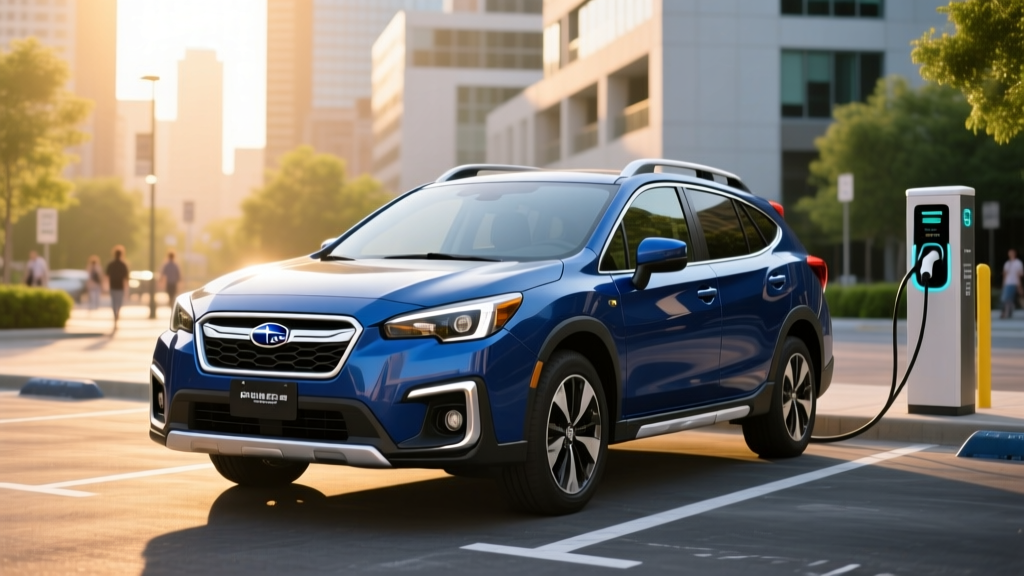
Yes. Subaru sells one plug-in hybrid model: the Crosstrek Hybrid. It pairs a 2.0-liter flat-four engine with an electric motor and an 8.8 kWh (usable) lithium-ion battery pack, delivering an EPA-estimated 17 miles of electric-only range before the gasoline engine engages.
However, Subaru also offers conventional hybrids (HEVs) — which do not plug in — on models like the Forester Hybrid and Outback Hybrid. These are fundamentally different vehicles. Let's clarify that distinction before going further.
HEV vs PHEV: What's the Difference?
| Feature | Conventional Hybrid (HEV) | Plug-In Hybrid (PHEV) |
|---|---|---|
| Plugs in to charge? | No — charges via regenerative braking and engine | Yes — can charge from a wall outlet or charger |
| Electric-only range | 0–2 miles at low speed | 10–40+ miles depending on model |
| Battery size | ~1.0–1.5 kWh | ~8–20+ kWh |
| Federal tax credit | None under §30D (new clean vehicle credit requires plug-in) | Potentially eligible (subject to MSRP, income, sourcing rules) |
| Best for | Drivers who want better MPG without changing habits | Drivers with short commutes who can charge at home |
Subaru's Forester Hybrid and Outback Hybrid are HEVs — they never plug in, have small batteries, and use the electric motor only to assist the gas engine. The Crosstrek Hybrid is the PHEV — it plugs in and can drive on electricity alone for short trips.
2026 Subaru Crosstrek Hybrid: Full Powertrain Specs
| Specification | 2026 Crosstrek Hybrid (PHEV) |
|---|---|
| Powertrain | 2.0L Boxer-4 + electric motor (PHEV) |
| Combined horsepower | 148 hp (net system output) |
| Battery capacity (usable) | 8.8 kWh lithium-ion |
| Electric-only range (EPA) | 17 miles |
| Total combined range | ~440 miles (electric + gasoline) |
| EPA MPGe (electric mode) | 90 MPGe combined |
| EPA MPG (hybrid/gas mode) | 35 MPG combined |
| Drivetrain | Symmetrical AWD (standard) |
| Level 1 charging (120V) | ~5 hours (0–100%) |
| Level 2 charging (240V) | ~2.5 hours (0–100%) |
| DC fast charging | Not supported |
| Charging connector | J1772 (Level 1/2 only) |
| 0–60 mph | ~9.5 seconds |
| Cargo volume | 20.8 cu ft (rear seats up) |
| Starting MSRP | ~$36,500 |
Fuel Economy: How Many MPG Does the Crosstrek Hybrid Get?
| Driving Mode | City | Highway | Combined |
|---|---|---|---|
| Electric-only (MPGe) | — | — | 90 MPGe |
| Hybrid (gas engine active) | 35 MPG | 34 MPG | 35 MPG |
Once the 17-mile electric buffer is depleted, the Crosstrek Hybrid operates as a conventional hybrid, returning an EPA-estimated 35 MPG combined. That's a meaningful improvement over the gas-only Crosstrek, which returns roughly 27–30 MPG combined depending on trim.
Real-World MPG vs. EPA Estimates
Subaru's hybrid system, derived from Toyota's THS architecture, tends to perform close to its EPA ratings in mixed driving. In city-heavy commutes under 40 mph, some owners report exceeding the EPA city figure by 1–3 MPG thanks to aggressive regenerative braking. On sustained highway driving above 70 mph, expect fuel economy to dip to roughly 31–33 MPG — the boxy crossover profile creates aerodynamic drag that hybrids can't fully overcome at speed.
Cold weather also matters. In sub-freezing temperatures, the gasoline engine will engage sooner to provide cabin heat, reducing your electric-only range from 17 miles to roughly 10–12 miles. This is typical for all PHEVs without dedicated heat-pump systems.
Electric-Only Range: How Far Can It Go on Electricity?
EPA electric-only range: 17 miles
Real-world expectation: 13–17 miles (warm weather, moderate speed); 10–12 miles (cold weather or highway speeds above 60 mph)
Seventeen miles of electric range is modest by 2026 PHEV standards. For comparison, the Toyota RAV4 Prime delivers 42 miles of electric range, and the Hyundai Tucson PHEV offers 33 miles. The Crosstrek Hybrid's smaller 8.8 kWh battery limits its electric-only capability, making it best suited for very short commutes — think school drop-offs, grocery runs, or a 5-mile drive to the train station.
If your daily round-trip commute is under 15 miles and you can charge at home overnight, you may drive weeks without visiting a gas station. If your commute exceeds 20 miles, the Crosstrek will spend most of its time in hybrid mode, where it functions as a competent 35-MPG AWD crossover but loses its electric advantage.
Charging the Crosstrek Hybrid
The Crosstrek Hybrid charges via a J1772 connector on Level 1 (120V household outlet) or Level 2 (240V home charger or public station). A full charge takes about 5 hours on a standard wall outlet, or roughly 2.5 hours on a Level 2 charger rated at 3.3 kW or higher.
Critical limitation: The Crosstrek Hybrid does not support DC fast charging. You cannot use CCS or CHAdeMO rapid chargers. For a vehicle with only 17 miles of electric range, this is less of a practical issue — there's little reason to fast-charge an 8.8 kWh battery — but it means you can't top up quickly on road trips.
Pricing, Tax Credits, and Total Cost
The 2026 Subaru Crosstrek Hybrid starts at approximately $36,500 (including destination), placing it roughly $8,000–$10,000 above the base gas-only Crosstrek. That premium buys you AWD standard, the PHEV powertrain, and a modestly upgraded interior.
Federal Tax Credit Eligibility (§30D)
Does the Crosstrek Hybrid qualify for the federal clean vehicle credit? Under current IRS §30D rules, PHEV eligibility depends on several factors:
- Battery capacity: Must be ≥7 kWh — the Crosstrek's 8.8 kWh pack qualifies.
- MSRP cap: SUVs/vans must be ≤$80,000 — the Crosstrek Hybrid clears this easily.
- Buyer income cap: AGI must not exceed $150,000 (single) / $300,000 (joint).
- Battery component sourcing: Must meet critical-mineral and battery-component requirements that phase in annually. Subaru has historically sourced components from Japan, which may or may not satisfy current-year sourcing thresholds.
- Point-of-sale transfer: Eligible buyers can apply the credit at purchase, reducing the upfront cost.
Check the latest eligibility on IRS.gov before purchasing. Sourcing requirements change annually and can disqualify a previously eligible model mid-year.
If the Crosstrek Hybrid qualifies for the full $7,500 credit, the effective price drops to roughly $29,000 — competitive with higher-trim gas Crosstreks. However, sourcing compliance has been a challenge for Subaru in recent years, so verify current status with your dealer and the IRS database before assuming eligibility.
Battery Warranty, Reliability, and Replacement Cost
Subaru PHEV Battery Warranty
Hybrid battery warranty: 8 years / 100,000 miles (whichever comes first)
Powertrain warranty: 5 years / 60,000 miles
Capacity retention threshold: Subaru warrants the battery against defects and abnormal capacity loss. If the battery falls below approximately 70% of original capacity within the warranty period, Subaru will repair or replace it.
Is the Crosstrek Hybrid Reliable?
The Crosstrek Hybrid's PHEV system shares significant engineering with Toyota's plug-in hybrid architecture, which has a strong reliability track record across the Prius Prime and RAV4 Prime. Subaru's conventional Symmetrical AWD system adds proven all-weather capability. IIHS has historically rated the Crosstrek well in crashworthiness tests.
The primary reliability concern is the battery pack. Lithium-ion PHEV batteries degrade slowly over time and with charge cycles. Based on industry data from similar-capacity packs, expect the Crosstrek's 8.8 kWh battery to retain 85–90% of its capacity after 5 years and 60,000 miles under normal use. After 10 years, 75–80% retention is typical — meaning your 17-mile electric range might shrink to roughly 13 miles.
Battery Replacement Cost
Out-of-warranty replacement for the Crosstrek Hybrid battery pack typically ranges from $4,000 to $6,500 including parts and labor, based on current dealer pricing for similar Subaru/Toyota PHEV packs. This is a significant expense, but it rarely occurs within the first 10–12 years of ownership. Most PHEV batteries outlast the vehicle's useful life.
Crosstrek Hybrid vs. Full EV vs. Gas Car: Which Should You Choose?
Choose the Crosstrek Hybrid (PHEV) if:
- Your daily commute is under 15 miles round-trip and you can charge at home
- You need standard AWD for snow, rain, or light off-road use
- You want electric commuting but can't commit to a full EV due to road-trip needs or lack of charging infrastructure
- You live in a state with limited public charging (the gas engine eliminates range anxiety entirely)
Choose a full EV (e.g., Hyundai Ioniq 5, Tesla Model Y) if:
- You have reliable Level 2 home charging
- Your daily driving is under 250 miles and you take road trips infrequently
- You want dramatically lower per-mile fuel costs (electricity vs. gasoline)
- You want access to the full $7,500 federal credit (EVs have broader current eligibility)
Choose the gas Crosstrek or a conventional HEV if:
- You can't charge at home (apartment, street parking, no garage outlet)
- Your commute is long (30+ miles) — the PHEV premium won't pay back in fuel savings
- You want the lowest upfront price (gas Crosstrek starts ~$26,500)
- You drive very few miles per year — the hybrid premium takes years to recoup
5-Year Cost Snapshot
Assuming 12,000 miles/year, $3.50/gallon gas, and $0.14/kWh electricity:
| Cost Factor | Gas Crosstrek (27 MPG) | Crosstrek Hybrid PHEV | Comparable EV (3.5 mi/kWh) |
|---|---|---|---|
| Fuel/energy (5 yr) | $7,778 | ~$5,200 (mixed EV/gas) | ~$2,400 |
| Maintenance (5 yr) | ~$2,500 | ~$2,200 | ~$1,200 |
| Purchase premium vs. gas base | $0 | ~$10,000 | ~$14,000 |
| Federal tax credit | $0 | $0–$7,500* | $0–$7,500* |
*Credit eligibility varies by buyer income, battery sourcing compliance, and MSRP. Verify on IRS.gov.
Pros and Cons of the Subaru Crosstrek Hybrid
Pros
- Standard Symmetrical AWD — genuine all-weather capability
- 17 miles electric covers short commutes emissions-free
- 35 MPG hybrid mode beats gas Crosstrek by ~5–8 MPG
- Proven Toyota-derived PHEV powertrain reliability
- No range anxiety — gas engine covers any distance
- 8-year/100,000-mile hybrid battery warranty
Cons
- Only 17 miles of electric range — low for 2026 PHEV standards
- No DC fast charging capability
- ~$10,000 premium over gas Crosstrek; long payback period
- Federal tax credit eligibility uncertain due to battery sourcing rules
- Limited availability — not sold in all U.S. states
- Modest 148 hp — not a quick vehicle (0–60 in ~9.5 sec)
Frequently Asked Questions
Does Subaru make a fully electric car?
Yes. Subaru sells the Solterra, a fully electric SUV developed with Toyota (it shares a platform with the Toyota bZ4X). The Solterra offers an EPA-estimated 222–228 miles of range, 8.2 kWh/100mi efficiency, and DC fast charging up to 100 kW. It starts around $44,995 and may qualify for federal tax credits depending on sourcing compliance.
Which Subaru models are conventional hybrids (not plug-in)?
For 2026, Subaru offers conventional (non-plug-in) hybrid versions of the Forester and Outback. These use a smaller battery and electric motor assist but never plug in. Expect fuel economy in the 32–36 MPG combined range, which is a notable improvement over their gas-only counterparts. According to fueleconomy.gov, these HEVs are classified as standard hybrids with no electric-only driving capability at meaningful speeds.
Can I charge the Crosstrek Hybrid at a public charging station?
Yes, but only at Level 2 stations (J1772 connector). You cannot use DC fast chargers (CCS, CHAdeMO, or NACS). At a public Level 2 station rated at 7.2 kW or higher, expect a full charge in approximately 2.5 hours. The vehicle's onboard charger limits intake to about 3.3 kW, so even high-power Level 2 stations won't charge it faster.
Is the Crosstrek Hybrid good in snow?
Excellent. Subaru's Symmetrical AWD is standard on every Crosstrek Hybrid, and the instant torque from the electric motor provides smooth, controlled acceleration on slippery surfaces. With winter tires, it's one of the most capable PHEVs in snow and ice.
How does the Crosstrek Hybrid compare to the Toyota RAV4 Prime?
The RAV4 Prime significantly outperforms the Crosstrek Hybrid in electric range (42 miles vs. 17 miles), power (302 hp vs. 148 hp), and DC fast-charging availability. However, the RAV4 Prime carries a higher MSRP (~$43,000+), is frequently subject to dealer markups due to high demand, and is a larger vehicle. The Crosstrek Hybrid is smaller, more affordable, and easier to park — but its short electric range is a clear disadvantage for PHEV buyers who want maximum electric commuting.
What happens if the hybrid battery dies?
If the high-voltage battery degrades significantly or fails outside the 8-year/100,000-mile warranty, replacement costs $4,000–$6,500. However, the vehicle can still be driven as a conventional gasoline car — the gas engine will power the vehicle normally even with a depleted or failed hybrid battery. You'll simply lose the electric-only driving mode and some fuel efficiency.
The Verdict: Is the Subaru PHEV Worth It?
Subaru's plug-in hybrid offering is real but limited. The Crosstrek Hybrid serves a specific buyer: someone who wants AWD, has a short commute, can charge at home, and isn't ready for a full EV. Its 17-mile electric range is the weakest link — competitors offer double or triple that figure for similar money.
If Subaru expands PHEV availability to more states and increases battery capacity in future model years, the value proposition improves substantially. Until then, cross-shop the RAV4 Prime, Tucson PHEV, and Sportage PHEV carefully. And if your commute is under 10 miles and you can install a Level 2 charger at home, consider whether a full EV like the Subaru Solterra might actually be the better long-term choice — especially with stronger federal tax credit eligibility.