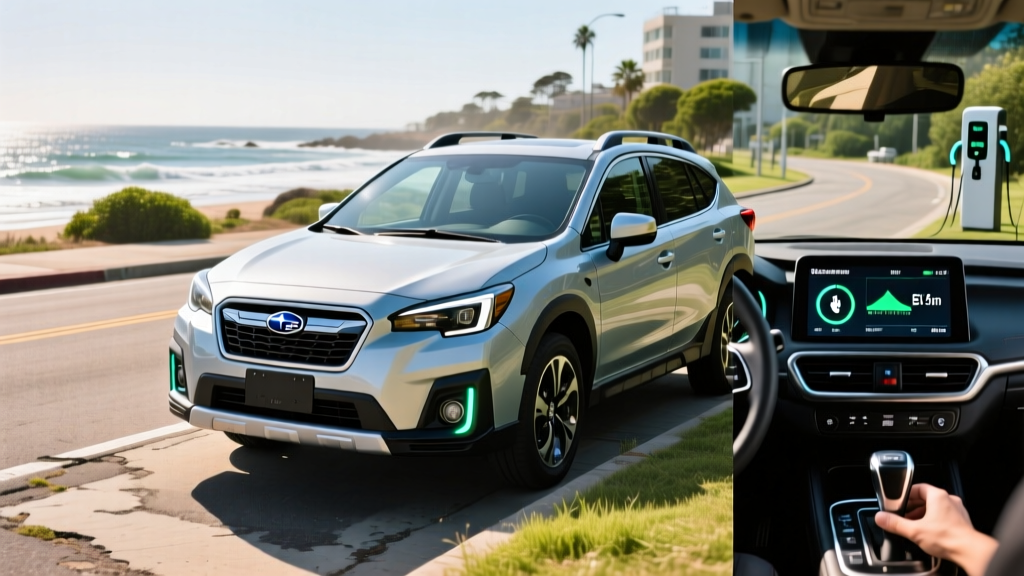
The Subaru Crosstrek has long been the default compact crossover for outdoor-minded drivers who need standard all-wheel drive without sacrificing daily practicality. But as fuel prices fluctuate and electrification options multiply, buyers are asking a pointed question: what kind of Subaru Crosstrek Hybrid MPG can you actually expect, and does a hybrid version even exist for the 2026 model year?
The answer requires some unpacking. Subaru's hybrid strategy for the Crosstrek has shifted over the past several years, and the current lineup demands that buyers understand the difference between a conventional hybrid (HEV) and a plug-in hybrid (PHEV) before heading to the dealership. This guide breaks down every relevant number — EPA estimates, real-world efficiency, powertrain output, battery warranty, and total cost of ownership — so you can decide whether a hybrid Crosstrek fits your driving life or whether a full EV or gas model makes more sense.
HEV vs. PHEV: Which Crosstrek Hybrid Are We Talking About?
Before quoting any MPG figure, it's essential to understand what Subaru actually offers. The distinction between a conventional hybrid and a plug-in hybrid is the single most common source of buyer confusion in this segment.
Conventional Hybrid (HEV)
- Self-charging via regenerative braking and the gasoline engine
- No plug, no charging cable, no home charger needed
- Small battery (typically under 2 kWh)
- Electric motor assists the gas engine; cannot drive on electric power alone for meaningful distances
- Primary benefit: improved MPG, especially in stop-and-go city driving
Plug-In Hybrid (PHEV)
- Larger battery (typically 8–20 kWh) that can be charged via a plug
- Offers a meaningful electric-only driving range (usually 17–40 miles)
- Once the battery is depleted, operates as a conventional hybrid
- Can qualify for federal or state incentives depending on battery size and sourcing
- Primary benefit: electric commuting with gas-engine backup for longer trips
Subaru previously offered the Crosstrek Hybrid as a PHEV (the 2019–2023 model years, which paired a 2.0-liter Boxer engine with a Toyota-sourced plug-in hybrid system and an 8.8 kWh battery). However, that model was discontinued. For the current generation, Subaru's hybrid offerings have focused on other models in the lineup. If you're shopping for a new 2026 Crosstrek, the standard gasoline model is what's currently available at dealerships, and any hybrid variant would need to be confirmed against Subaru's latest official Crosstrek page.
For buyers specifically seeking Subaru Crosstrek Hybrid MPG figures, the most relevant data comes from the last PHEV generation and from the broader Subaru hybrid powertrain strategy that may extend to future Crosstrek trims. We'll cover both the historical PHEV data and the current gas baseline below.
Subaru Crosstrek Hybrid MPG: EPA Estimates and Real-World Numbers
Here's how the numbers break down across the Crosstrek lineup most relevant to hybrid shoppers:
| Model / Powertrain | City MPG | Highway MPG | Combined MPG | Electric-Only Range (mi) | MPGe (Combined) |
|---|---|---|---|---|---|
| 2026 Crosstrek 2.5L Gas (AWD) | 27 | 34 | 29 | N/A | N/A |
| Crosstrek Hybrid PHEV (prior gen, AWD) | 35 (hybrid mode) | 34 (hybrid mode) | 35 (hybrid mode) | 17 | 90 MPGe |
| 2026 Crosstrek 2.0L Gas (AWD) | 28 | 35 | 30 | N/A | N/A |
Sources: fueleconomy.gov (EPA estimates). The PHEV figures reflect the last-generation Crosstrek Hybrid. Current 2026 gas-engine figures reflect the latest EPA data available.
Real-World MPG vs. EPA Sticker
The EPA combined rating of 35 MPG for the prior-generation Crosstrek Hybrid PHEV (operating in hybrid mode after battery depletion) is a solid baseline, but real-world results vary significantly based on driving conditions:
- City driving (hybrid mode): Expect 36–38 MPG. Hybrids excel in stop-and-go traffic where regenerative braking recaptures energy frequently. Many owners report exceeding the EPA city estimate by 1–3 MPG on urban commutes.
- Highway driving (hybrid mode): Expect 32–34 MPG. At sustained highway speeds, the electric motor provides less benefit and the gasoline engine does most of the work. The Crosstrek's boxy shape and AWD drivetrain create aerodynamic and mechanical drag that limits highway efficiency.
- Cold weather: Expect a 10–15% reduction in both hybrid MPG and electric-only range. The engine runs more often to provide cabin heat, and battery chemistry is less efficient below freezing. A 17-mile electric range may shrink to 12–14 miles in sub-30°F conditions.
- PHEV electric-only mode: The 17-mile EPA electric range is modest by today's standards. Real-world testing typically yields 14–18 miles depending on temperature, terrain, and speed. Drivers with short commutes (under 15 miles each way) can operate almost entirely on electricity with nightly charging.
Powertrain Specs: What's Under the Hood
| Specification | 2026 Crosstrek 2.5L Gas | Crosstrek Hybrid PHEV (Prior Gen) |
|---|---|---|
| Engine | 2.5L 4-cyl Boxer | 2.0L 4-cyl Boxer + electric motors |
| Combined Horsepower | 182 hp | 148 hp (net system) |
| Combined Torque | 176 lb-ft | 149 lb-ft (engine) + electric motor torque |
| Drivetrain | Symmetrical AWD | Symmetrical AWD (electronic rear) |
| Transmission | CVT (Lineartronic) | CVT (Lineartronic) |
| Battery Capacity | N/A | 8.8 kWh (lithium-ion) |
| 0–60 mph | ~8.3 sec | ~9.5 sec |
| Towing Capacity | 1,500 lbs | 1,000 lbs |
The prior-generation PHEV used Toyota's hybrid synergy drive technology (a result of the Toyota-Subaru partnership), pairing a smaller 2.0-liter engine with two electric motor-generators. The combined output of 148 hp was adequate for commuting but noticeably less punchy than the 182-hp 2.5-liter gas model. The tradeoff was clear: better fuel economy and 17 miles of electric driving in exchange for slower acceleration and reduced towing capacity.
Charging the Crosstrek Hybrid PHEV: Times and Limitations
If you're considering a used or remaining-stock Crosstrek Hybrid PHEV, understanding its charging profile is critical. This was never a fast-charging vehicle, and that limitation shaped its ownership experience.
| Charging Level | Power (kW) | Time to Full Charge | Miles of Electric Range Added per Hour |
|---|---|---|---|
| Level 1 (120V household outlet) | ~1.2 kW | ~9 hours | ~2 miles/hr |
| Level 2 (240V home/public) | ~3.3 kW | ~2.5 hours | ~7 miles/hr |
| DC Fast Charging | Not supported | N/A | N/A |
The Crosstrek Hybrid PHEV cannot DC fast charge. Its onboard charger tops out at 3.3 kW, meaning even a 240V Level 2 connection requires about two and a half hours for a full battery. For most PHEV owners, this wasn't a dealbreaker — you plug in at home overnight and wake up to a full 17 miles of electric range. But it meant that public DC fast chargers along highways were useless for this vehicle.
The 8.8 kWh battery pack was sized for short commutes rather than extended electric driving. By 2026 standards, where PHEVs like the Toyota RAV4 Prime offer 42 miles of electric range from a much larger battery, the Crosstrek Hybrid's 17 miles feels dated. That said, for drivers with round-trip commutes under 30 miles and reliable home charging access, it covered a meaningful portion of daily driving on electricity alone.
Pricing, Tax Credits, and the Incentive Question
The prior-generation Crosstrek Hybrid PHEV carried an MSRP starting around $36,500 before incentives — roughly $7,000–$8,000 more than the equivalent gas-only Crosstrek Premium trim. That premium bought the plug-in powertrain, a slightly higher feature content, and the promise of reduced fuel costs.
Under current IRS §30D rules for the federal clean vehicle credit, PHEVs can qualify for up to $7,500 if they meet all of the following requirements:
- MSRP cap: The vehicle's MSRP must not exceed $80,000 for SUVs, vans, and pickup trucks, or $55,000 for sedans. The Crosstrek Hybrid cleared this easily.
- Buyer income limits: Adjusted gross income must not exceed $150,000 (single), $225,000 (head of household), or $300,000 (married filing jointly).
- Battery sourcing requirements: Critical minerals and battery components must meet phased-in percentages of US/FTA-country sourcing. These requirements tighten annually, and a discontinued model may no longer appear on the IRS's eligible vehicle list.
- Final assembly: The vehicle must undergo final assembly in North America. The Crosstrek Hybrid was assembled in Gunma, Japan, which disqualified it from the §30D credit under current rules.
- Point-of-sale transfer: Eligible buyers can transfer the credit to the dealer at purchase for an immediate price reduction, but only if the vehicle itself qualifies.
Key Takeaway on Tax Credits
Because the Crosstrek Hybrid PHEV was assembled in Japan, it did not qualify for the $7,500 federal §30D tax credit under the post-2022 Inflation Reduction Act rules. This was a significant competitive disadvantage against US-assembled PHEVs like the Jeep Wrangler 4xe or the Ford Escape PHEV. Some state-level incentives (such as those in California, Colorado, or New York) may have offered partial rebates, but these vary by jurisdiction and change frequently. Always verify current eligibility with your state's energy office and consult a tax professional before relying on any credit.
For the 2026 Crosstrek gas models, no federal EV or PHEV credit applies since they are conventional gasoline vehicles without a plug. Subaru's future hybrid plans for the Crosstrek remain unannounced as of this writing, and any new PHEV variant would need to address the assembly-location issue to compete on price after incentives.
Battery Warranty, Reliability, and Replacement Costs
Hybrid battery longevity is consistently a top concern for buyers considering their first electrified vehicle. Here's what the data shows for the Crosstrek Hybrid:
| Component | Warranty Coverage |
|---|---|
| Hybrid Battery (PHEV) | 8 years / 100,000 miles (10 years / 150,000 miles in CARB states) |
| Hybrid System Components | 8 years / 100,000 miles |
| Powertrain (Gas Engine + Transmission) | 5 years / 60,000 miles |
| Bumper-to-Bumper | 3 years / 36,000 miles |
Subaru's hybrid battery warranty aligns with the industry standard for electrified vehicles. In states that follow California Air Resources Board (CARB) regulations — including California, New York, Massachusetts, Oregon, Washington, and several others — the hybrid battery warranty extends to 10 years or 150,000 miles, providing substantial long-term coverage.
On reliability, Subaru's hybrid system (derived from Toyota's proven hybrid synergy drive in the PHEV generation) benefits from one of the most extensively tested hybrid architectures in the world. Toyota has produced tens of millions of hybrid vehicles using this fundamental technology, and catastrophic battery failures within the warranty period are uncommon. Gradual capacity degradation is normal: expect the 8.8 kWh battery to retain approximately 70–80% of its original capacity after 8–10 years, which would reduce electric-only range from 17 miles to roughly 12–14 miles.
If a hybrid battery does need replacement out of warranty, expect costs between $3,000 and $5,500 for the battery pack alone, plus labor. Third-party refurbished batteries may be available for less as the vehicle ages. However, given the relatively small battery in the Crosstrek Hybrid PHEV and the robust warranty coverage, most owners will never face an out-of-pocket battery replacement.
Hybrid vs. PHEV vs. Full EV: Which Fits Your Driving Life?
The decision between a hybrid, a plug-in hybrid, and a fully electric vehicle depends on your specific driving patterns, charging access, and budget. Here's a practical framework:
Choose a Conventional Hybrid (HEV) If:
- You want better fuel economy without changing any habits — no plugging in, no charging apps, no route planning
- You don't have access to home or workplace charging
- Your daily driving is a mix of city and highway with no predictable short-commute pattern
- You want AWD and a rugged compact crossover in a proven package
Choose a Plug-In Hybrid (PHEV) If:
- Your daily round-trip commute is under 20–30 miles and you can charge at home every night
- You regularly take longer road trips where a full EV's range would require inconvenient charging stops
- You want electric driving for daily errands but the security of a gas engine for weekend adventures
- You live in an area with limited public charging infrastructure
Choose a Full Battery EV If:
- You have reliable Level 2 home charging (garage or driveway with a 240V outlet)
- Your daily driving is under 200 miles and you're comfortable planning road-trip charging
- You want the lowest per-mile fuel cost, minimal maintenance, and zero tailpipe emissions
- You want access to the full $7,500 federal tax credit (available on qualifying BEVs like the Hyundai Ioniq 5, Tesla Model Y, or Ford Mustang Mach-E)
For many Crosstrek shoppers, the vehicle's appeal lies in its standard AWD, 8.7 inches of ground clearance, and outdoor lifestyle positioning. If Subaru reintroduces a Crosstrek Hybrid or PHEV in future model years, it would need to address the modest electric range and Japan-assembly tax-credit disqualification that limited the prior generation's competitiveness. Until then, buyers prioritizing fuel economy should compare the current gas Crosstrek against hybrid competitors like the Toyota RAV4 Hybrid (39 MPG combined), Honda CR-V Hybrid (40 MPG combined), or the Kia Sportage Hybrid (38 MPG combined) — all of which offer substantially higher MPG than the gas-only Crosstrek's 29 MPG combined.
Pros and Cons at a Glance
Pros
- Standard Symmetrical AWD across all trims — a segment differentiator
- 8.7 inches of ground clearance suitable for light off-road and snow
- Toyota-derived hybrid system (PHEV) with proven long-term reliability
- Hybrid battery warranty up to 10 years / 150,000 miles in CARB states
- PHEV version offered 17 miles of zero-emission commuting
- Hybrid mode MPG exceeded EPA city estimates in real-world stop-and-go driving
Cons
- No current hybrid or PHEV variant in the 2026 Crosstrek lineup
- Prior PHEV's 17-mile electric range is short by 2026 standards
- PHEV assembled in Japan — disqualified from $7,500 federal tax credit under §30D
- PHEV's 148 hp combined output feels sluggish vs. the 182-hp gas model
- No DC fast charging on the PHEV — Level 2 only, ~2.5 hours to full
- Gas-only Crosstrek MPG (29 combined) trails hybrid competitors by 10+ MPG
Frequently Asked Questions
How many MPG does the Subaru Crosstrek Hybrid get?
The prior-generation Crosstrek Hybrid PHEV achieved an EPA-estimated 35 MPG combined (35 city / 34 highway) when operating in hybrid mode after the battery was depleted. Real-world city driving often yielded 36–38 MPG thanks to regenerative braking, while highway driving typically returned 32–34 MPG. The current 2026 gas-only Crosstrek 2.5L achieves 29 MPG combined (27 city / 34 highway).
How far can the Crosstrek Hybrid go on electric power alone?
The prior-generation PHEV had an EPA-rated electric-only range of 17 miles. In real-world conditions, most drivers saw 14–18 miles depending on temperature, terrain, and speed. Cold weather (below 30°F) reduced this to approximately 12–14 miles. This range covered short commutes and local errands but was insufficient for longer daily drives.
Does the Subaru Crosstrek Hybrid qualify for a tax credit?
Under current IRS §30D rules, the prior-generation Crosstrek Hybrid PHEV did not qualify for the $7,500 federal clean vehicle credit because its final assembly took place in Japan, not North America. Some state-level incentives may have applied depending on jurisdiction. The 2026 gas-only Crosstrek does not qualify for any EV/PHEV tax credit. Always verify current rules at IRS.gov and consult a tax professional.
Is the Subaru Crosstrek Hybrid reliable, and what does battery replacement cost?
The Crosstrek Hybrid PHEV's Toyota-derived hybrid system has a strong reliability track record. The hybrid battery is covered by an 8-year/100,000-mile warranty (10 years/150,000 miles in CARB states). Out-of-warranty battery replacement costs are estimated at $3,000–$5,500, though gradual degradation (not total failure) is the more common scenario after 8–10 years. Subaru's overall brand reliability ratings from sources like Consumer Reports and J.D. Power have been competitive in the compact SUV segment.
Should I buy a Crosstrek Hybrid, a competing hybrid, or a full EV?
If you need the Crosstrek's specific combination of standard AWD, high ground clearance, and Subaru's safety reputation, the current gas-only model is your option — but accept that its 29 MPG combined trails hybrid competitors by a wide margin. If fuel economy is the priority, the Toyota RAV4 Hybrid (39 MPG combined, available AWD) or Honda CR-V Hybrid (40 MPG combined) deliver significantly better efficiency. If you can charge at home and want the lowest operating cost, a full EV like the Hyundai Ioniq 5 (303 miles EPA range, AWD available) or Tesla Model Y (308+ miles, AWD) eliminates gasoline entirely and may qualify for the full $7,500 federal credit.
Will Subaru release a new Crosstrek Hybrid or PHEV?
As of early 2026, Subaru has not officially announced a hybrid or PHEV variant for the current-generation Crosstrek. Subaru has committed to expanding its electrified lineup, including hybrid versions of several models, but specific timing and specifications for a next-generation Crosstrek Hybrid remain unconfirmed. Any future PHEV would likely feature a larger battery (targeting 25+ miles of electric range) and potentially US assembly to qualify for federal incentives.
Note: This article references the most current EPA data and IRS rules available as of 2026. Tax credit eligibility, model availability, and specifications are subject to change. Always confirm details with fueleconomy.gov, Subaru's official site, and a qualified tax professional before making a purchase decision.